


How Many Stages of Cancer Are There? A Clear Guide
July 9, 2026
How Many Stages of Cancer Are There? A Clear Guide

Cancer staging is the process of classifying how far cancer has developed in the body, using a standard scale of five stages numbered 0 through 4. Understanding how many stages of cancer there are gives patients and families a clearer picture of what a diagnosis actually means. The cancer staging system applies to most solid tumors and directly shapes treatment decisions, from surgery to systemic therapy. Stage 0 marks the earliest possible finding, while Stage 4 means cancer has spread to distant organs. Knowing where a cancer falls on this scale is the first step toward making informed, confident choices about care.
What does each cancer stage from 0 to 4 mean?

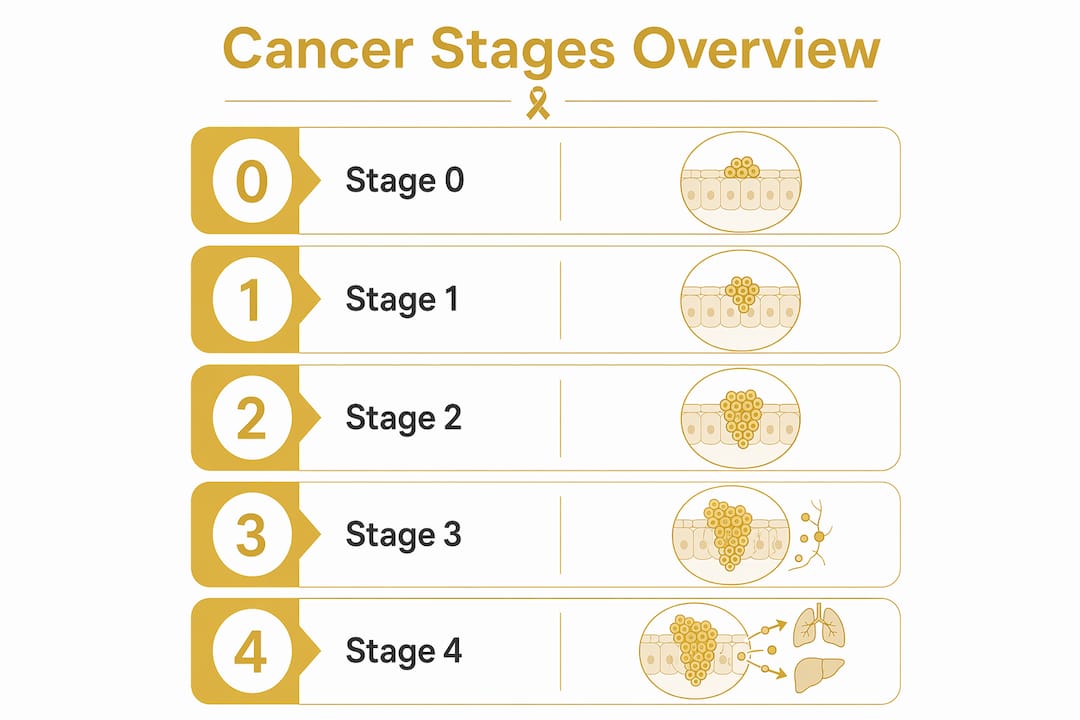
Most solid tumors are classified into five stages, 0 through 4, each describing how far the cancer has grown or spread. These stages are not arbitrary numbers. They reflect measurable changes in tumor size, local spread, and distant involvement, giving doctors and patients a shared language for understanding cancer progression.
Here is what each stage means in plain terms:
-
Stage 0 (Carcinoma in situ): Abnormal cells are present but confined to their original site without invading nearby tissue. This is the earliest possible classification. Treatment at this stage is often less aggressive and highly effective.
-
Stage 1: The tumor is small and localized. Cancer has not spread to lymph nodes or distant organs. Stage 1 cancers are generally curable with surgery or targeted local therapy.
-
Stage 2: The tumor is larger than in Stage 1, or there is limited involvement of nearby lymph nodes. The cancer remains in the region of origin. Treatment typically involves surgery combined with radiation or chemotherapy.
-
Stage 3: Cancer has spread more extensively to regional lymph nodes or nearby tissues. This is considered locally advanced disease. Treatment is more intensive and often combines multiple approaches.
-
Stage 4: Cancer has spread to distant organs, such as the lungs, liver, or bones. This is metastatic cancer. Modern therapies can control Stage 4 disease for many years in some patients.
Pro Tip: Ask your oncologist for the specific substage, such as Stage 2A versus 2B, since these subdivisions carry real differences in treatment planning and expected outcomes.
How does the TNM system complement the 0–4 staging scale?
The TNM system is the standard classification framework used by oncologists worldwide to describe cancer in precise detail before assigning an overall stage. TNM stands for three components:
- T (Tumor): Describes the size and extent of the primary tumor, rated T0 through T4.
- N (Nodes): Indicates whether cancer has reached regional lymph nodes, rated N0 through N3.
- M (Metastasis): Records whether cancer has spread to distant organs, rated M0 (no spread) or M1 (spread present).
The combined TNM result maps directly onto the 0–4 overall stage. A tumor classified as T1, N0, M0 typically corresponds to Stage 1. A classification of T4, N2, M1 places the cancer at Stage 4.
| TNM Example | What It Means | Overall Stage |
|---|---|---|
| T1, N0, M0 | Small tumor, no node or distant spread | Stage 1 |
| T2, N1, M0 | Larger tumor, limited node involvement | Stage 2 |
| T3, N2, M0 | Larger tumor, extensive node spread | Stage 3 |
| Any T, Any N, M1 | Distant metastasis present | Stage 4 |
One detail many patients miss: there are two types of staging. Clinical staging happens before surgery, using imaging and biopsy results. Pathologic staging happens after surgery, when the removed tissue is examined directly. Pathologic staging is more accurate because doctors can see the actual tumor and surrounding tissue. The two types often differ, and both provide useful information.
Pro Tip: If you have had surgery, ask specifically for your pathologic stage. It is the more precise number and may influence decisions about follow-up treatment.
Do all cancers follow the same staging system?
The 0–4 staging scale applies to most solid tumors, but not every cancer follows this framework. Blood cancers and brain tumors use entirely different classification systems, and even within the 0–4 system, some cancers incorporate additional biological markers.
Key exceptions and nuances include:
- Leukemia: Does not form solid tumors, so it cannot be staged by size or spread. Leukemia uses systems based on blood cell counts and bone marrow involvement.
- Lymphoma: Uses the Lugano classification (formerly Ann Arbor staging), which describes how much lymph node regions are affected and whether disease is above or below the diaphragm.
- Brain tumors: Graded rather than staged, using a system based on how abnormal the cells look under a microscope and how fast they grow.
- Breast cancer: Uses the standard 0–4 system but also incorporates hormone receptor status (ER, PR) and HER2 status. These biomarkers can shift a patient’s overall stage grouping even without a change in tumor size.
- Prostate cancer: Incorporates the Gleason score, a measure of how abnormal the cancer cells appear, alongside TNM classification.
The practical takeaway is clear. Patients should ask their care team which specific staging system applies to their cancer type. Assuming all cancers use the same 0–4 scale leads to confusion and misplaced comparisons between diagnoses.
How does cancer stage affect treatment and prognosis?
Cancer stage is the primary driver of treatment planning. Doctors use it to decide which therapies are appropriate, what the goals of treatment are, and whether clinical trials may be relevant.
“Staging guides decisions on surgery, therapy, and clinical trials, but it cannot dictate an individual’s exact outcome. Two patients at the same stage may respond very differently based on their tumor’s molecular features.”
Dr. Abu Rous, Henry Ford Health
Early-stage cancers, particularly Stages 0 and 1, are most often treated with surgery or localized radiation. The goal is cure, and outcomes are frequently excellent. Stage 2 and Stage 3 cancers typically require a combination of surgery, chemotherapy, and radiation. The goal shifts toward eliminating remaining cancer cells after the primary tumor is removed.
Stage 4 cancers are managed with systemic treatments, including chemotherapy, immunotherapy, and targeted therapy. The goal at this stage is often long-term control rather than cure, though some patients achieve complete remission. Some patients with Stage 4 cancer respond remarkably well to targeted therapies or immunotherapy, experiencing years of quality life.
Staging is a roadmap, not a verdict. Cancer staging guides treatment but does not predict an individual’s exact prognosis. Survival rates represent population averages. Individual outcomes depend on tumor biology, genetic factors, overall health, and response to therapy. Two patients at Stage 3 can have very different experiences based on factors that no staging number captures.
Key Takeaways
Cancer staging is a five-level classification system, from Stage 0 to Stage 4, that guides treatment decisions while leaving room for individual variation in outcomes.
| Point | Details |
|---|---|
| Five stages exist | Most solid tumors are classified from Stage 0 (non-invasive) to Stage 4 (metastatic). |
| TNM adds precision | The TNM system describes tumor size, node involvement, and metastasis before assigning an overall stage. |
| Not all cancers use 0–4 | Blood cancers and brain tumors use separate classification frameworks entirely. |
| Stage guides treatment | Early stages favor surgery; higher stages require systemic therapies like immunotherapy or chemotherapy. |
| Stage is not destiny | Individual outcomes vary widely based on tumor biology, genetics, and response to modern therapies. |
What staging numbers cannot tell you
We have sat with families who received a Stage 4 diagnosis and felt the number close around them like a door. We understand that feeling deeply. But here is what years of supporting cancer research at the Robert H. Lurie Comprehensive Cancer Center of Northwestern University has taught us: the stage is the beginning of the conversation, not the end of it.
Staging is an essential map. Without it, oncologists cannot plan a route. But maps do not tell you about the weather, the road conditions, or the strength of the person walking the path. Two patients with the same stage can have widely different prognoses because of molecular and genetic features that no stage number captures.
Personalized medicine is rewriting what Stage 4 means in real time. Targeted therapies and immunotherapy are producing responses that would have seemed impossible a decade ago. The science is moving fast, and that is exactly why we believe in funding research that goes beyond the conventional. We urge every patient and family member to ask their oncologist not just “what stage is it?” but “what does this specific tumor’s biology tell us?” That question opens doors.
— HCRF
Hcrfwingstocure is here for you and your family
Cancer staging raises questions that deserve real answers, and no family should face those questions alone.

Hcrfwingstocure, the Hippocratic Cancer Research Foundation, is a 501©(3) nonprofit that funds bold, unconventional cancer research at the Robert H. Lurie Comprehensive Cancer Center of Northwestern University. We believe that understanding cancer, from its earliest stage to its most advanced, is an act of hope. Our mission is to make sure that hope is backed by science. Visit Hcrfwingstocure to learn about our research programs, access patient education resources, and find out how you can be part of the mission. THEY NEED OUR SUPPORT. We need you.
FAQ
How many stages of cancer are there?
Most solid tumors have five stages, numbered 0 through 4. Stage 0 is the earliest, and Stage 4 means cancer has spread to distant organs.
What is the difference between Stage 3 and Stage 4 cancer?
Stage 3 cancer is locally advanced, meaning it has spread to nearby lymph nodes or tissues but not to distant organs. Stage 4 means the cancer has spread to distant sites such as the lungs, liver, or bones.
Do blood cancers use the same staging system?
No. Leukemia and lymphoma use different classification frameworks based on blood cell counts, bone marrow involvement, and lymph node regions rather than the standard 0–4 scale.
Can a Stage 4 cancer patient still respond to treatment?
Yes. Some Stage 4 patients respond well to targeted therapies or immunotherapy and experience long-term quality of life. Stage 4 does not automatically mean poor immediate prognosis.
What is the TNM staging system?
The TNM system classifies cancer by tumor size (T), lymph node involvement (N), and distant metastasis (M). These three values are combined into an overall stage from 0 to 4.
Recommended


We are excited to share that room blocks for our 2025 Wings to Cure Gala are now open for booking!
Read More →