


Immunotherapy Clinical Trials for Prostate Cancer: 2026 Guide
July 18, 2026
Immunotherapy Clinical Trials for Prostate Cancer: 2026 Guide

Immunotherapy clinical trials for prostate cancer are defined as structured research studies that test whether treatments harnessing the body’s own immune system can slow, stop, or reverse prostate cancer growth. The FDA approved sipuleucel-T years ago, proving the concept works. Now, 2026 trials are pushing far beyond that first step. Studies like the CHAMP trial show a 74% six-month progression-free survival rate in aggressive metastatic disease, compared to 55% with chemotherapy alone. For patients and families weighing every option, understanding what these trials offer, who qualifies, and what to expect is not just reassuring. It is the first step toward doing something about it.
What immunotherapy approaches are being tested in prostate cancer clinical trials?
Prostate cancer immunotherapy trials test several distinct strategies, and each works differently. Knowing the difference helps you ask the right questions when you talk to your oncologist.
Chemoimmunotherapy
The CHAMP trial combines cabazitaxel and carboplatin with the checkpoint inhibitors nivolumab and ipilimumab. This approach targets neuroendocrine and aggressive variant metastatic prostate cancer, a subtype that responds poorly to standard hormone therapy. The trial reported a median progression-free survival of 12 months and a 23% survival rate at 2 years. Those numbers matter because this subtype historically carries a very poor prognosis.
DNA vaccines targeting the androgen receptor
A separate trial tested androgen receptor-targeted DNA vaccination before androgen deprivation therapy in high-risk localized prostate cancer. Patients who received the vaccine showed an 89% PSA progression-free survival rate at one year, compared to 33% in the control group. That gap is striking and suggests vaccines may be most powerful when applied earlier in the disease course.
Personalized dendritic cell vaccines
A phase I trial is testing an autologous neoantigen-pulsed dendritic cell vaccine in metastatic castration-resistant prostate cancer. Patients receive four injections subcutaneously over 8 weeks, with dose escalation up to 1.5×10⁷ cells per injection. Early results confirm safety and immune activation, which is the critical first hurdle for any new therapy.
Checkpoint inhibitors alone
PD-1 blockers like nivolumab show selective effectiveness depending on tumor biology. Interestingly, adding nivolumab to the DNA vaccine in the high-risk localized trial did not improve outcomes and may have suppressed the immune response through regulatory CD4+ T cell activation. This finding shows that combining immunotherapies is not always additive and requires careful study.
Pro Tip: Ask your oncologist whether your tumor has been tested for biomarkers like PD-L1 expression or mismatch repair deficiency. These markers can predict whether checkpoint inhibitors are likely to help you.
Who is eligible to participate in prostate cancer immunotherapy trials?
Eligibility criteria vary by trial, but several common requirements appear across most studies. Understanding these upfront saves time and reduces uncertainty.
-
Confirmed diagnosis. Most trials require a biopsy-confirmed diagnosis of either high-risk localized prostate cancer or metastatic castration-resistant prostate cancer (mCRPC). The specific subtype matters because different trials target different disease stages.
-
Performance status. The CHAMP trial requires a Karnofsky Performance Status of ≥70, meaning patients must be able to perform most normal activities. ECOG 0-1 is a similar standard used in other trials. These thresholds exist because intensive regimens require a baseline level of physical resilience.
-
Prior treatment history. Some trials enroll patients who have already received multiple prior therapies. Others, like the DNA vaccine trial, enroll patients in a neoadjuvant setting before surgery or radiation. Your treatment history directly shapes which trials are open to you.
-
Molecular profiling. Tumor biomarker testing is increasingly required. Aggressive variants with RB1 loss or lineage-plasticity mutations may respond differently to immunotherapy. Genetic testing resources like those offered through clinical trial support services can help clarify which trials fit your tumor’s profile.
-
Leukapheresis readiness. Dendritic cell vaccine trials require leukapheresis, a procedure that collects your blood cells over several hours for personalized vaccine manufacturing. Patients need to be medically stable enough to undergo this step.
Pro Tip: ClinicalTrials.gov lists every registered trial with its full eligibility criteria. Search by your diagnosis and location to build a shortlist before your next oncology appointment.
What are the benefits and risks of joining an immunotherapy trial?
Joining a trial is a deeply personal decision. The potential benefits are real, and so are the risks. Both deserve honest attention.
Potential benefits
- Improved progression-free survival. The CHAMP trial’s 74% six-month PFS rate exceeds the 55% chemotherapy benchmark. That 19-percentage-point difference represents real time without disease progression.
- Access to treatments not yet available. Experimental therapies in trials are not accessible outside of the study. For patients who have exhausted standard options, a trial may be the only path to a new treatment.
- Close medical monitoring. Trial participants receive frequent assessments, labs, and imaging. That level of attention can catch complications early.
- Contributing to science. Every patient who participates helps researchers understand what works, for whom, and why. That knowledge saves future lives.
Risks and side effects
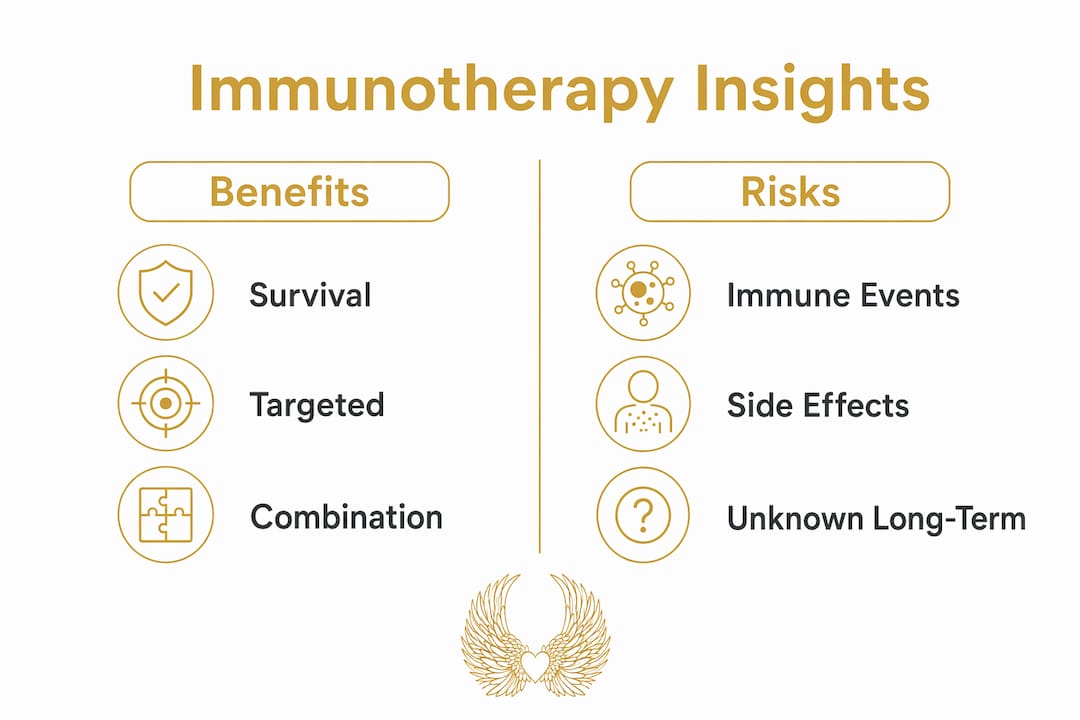
Checkpoint inhibitors carry the highest risk of immune-related adverse events. In the DNA vaccine trial, adverse events occurred primarily in the arm that added nivolumab, with most being grade 1–2 but some reaching grade 3. Grade 3 events can include severe colitis, hepatitis, or pneumonitis and require prompt medical management. Chemoimmunotherapy regimens also carry risks of anemia, fatigue, and gastrointestinal effects from the chemotherapy component. Monitoring protocols are built into every trial specifically to catch and manage these effects before they become dangerous.
Experts emphasize that randomized controlled trials are still needed to fully define long-term toxicity profiles and quality-of-life impact. That means some questions about long-term safety remain open. Patients deserve to know that before enrolling.
How do immunotherapy trials fit into the broader prostate cancer treatment picture?
Immunotherapy does not replace standard care. It works alongside it, and the timing of when you receive it matters enormously.
| Treatment setting | Immunotherapy role | Example approach |
|---|---|---|
| Neoadjuvant (before surgery) | Prime immune response before tumor removal | DNA vaccine before androgen deprivation therapy |
| Locally advanced | Enhance response to radiation or hormone therapy | Checkpoint inhibitor combinations under study |
| Metastatic castration-resistant | Experimental option after standard therapies | Chemoimmunotherapy (CHAMP), dendritic cell vaccines |
| Aggressive variant mCRPC | Primary experimental strategy | Cabazitaxel-carboplatin plus nivolumab and ipilimumab |
The evidence increasingly points to earlier application as more effective. The DNA vaccine trial showed that earlier immune priming before androgen deprivation produced dramatically better PSA control. This makes biological sense. A tumor that has not yet developed resistance mechanisms is more vulnerable to immune attack.
Multimodal approaches combining chemotherapy, vaccines, and checkpoint inhibitors are under active investigation. Researchers are working to understand the optimal sequence. Future immunotherapy protocols aim to enhance anti-tumor T cell activity while reducing the toxicities that have historically limited immunotherapy’s reach. The field is moving fast, and the trials enrolling now will define the standard of care for the next decade.
Pro Tip: Ask your care team specifically about neoadjuvant trial options if you have high-risk localized disease. Many patients assume trials are only for advanced cancer, but some of the most promising results are coming from earlier-stage applications.
Key Takeaways
Immunotherapy clinical trials for prostate cancer offer measurable survival benefits over chemotherapy alone, with the strongest evidence emerging from chemoimmunotherapy and DNA vaccine approaches in 2026 studies.
| Point | Details |
|---|---|
| Chemoimmunotherapy leads in aggressive disease | The CHAMP trial showed 74% six-month PFS versus 55% with chemotherapy alone. |
| DNA vaccines show dramatic PSA control | Androgen receptor-targeted vaccination produced 89% PSA progression-free survival at one year. |
| Eligibility depends on stage and biomarkers | Performance status, tumor subtype, and molecular profiling all shape which trials you qualify for. |
| Earlier application may improve outcomes | Neoadjuvant vaccine trials show the immune system responds better before resistance develops. |
| Checkpoint inhibitors require careful selection | Adding PD-1 blockers does not always help and may suppress immune response in some settings. |
Our perspective on what patients and families should know
We have watched the prostate cancer immunotherapy field evolve for years, and 2026 feels like a genuine turning point. The CHAMP results and the DNA vaccine data are not incremental improvements. They represent a real shift in what is possible for patients who once had very few options.
What we have learned from working alongside researchers and patients is this: the gap between a promising trial result and a patient actually enrolling is often not medical. It is logistical and emotional. Patients do not know which trials are open. Families do not know what questions to ask. Oncologists are busy, and trial coordinators are often understaffed.
The most important thing you can do right now is bring a specific trial name to your next appointment. Not a general question about immunotherapy, but a specific protocol. Ask whether you meet the eligibility criteria. Ask what the monitoring schedule looks like. Ask what happens if you experience a grade 3 adverse event. Those concrete questions move the conversation forward.
We also want to be honest with you. Not every trial will produce a benefit for every patient. Some highly aggressive tumors with RB1 loss or other lineage-plasticity mutations respond less durably to immunotherapy. The science is still catching up to the biology. But the direction is clear, and the pace of progress is real. Hope grounded in evidence is the most powerful kind.
Nonprofits and clinical research foundations play a direct role in closing the access gap. They fund the studies that pharmaceutical companies will not prioritize. They connect patients to trials they would never find on their own. That work matters, and it is why we do what we do.
— HCRF
How HCRF supports prostate cancer immunotherapy research
The Hippocratic Cancer Research Foundation (HCRF) is a 501©(3) nonprofit that funds “out of the box” cancer research at the Robert H. Lurie Comprehensive Cancer Center of Northwestern University. We exist because the most promising ideas in cancer research often go unfunded by traditional sources.

HCRF directly supports immunotherapy research that gives patients access to trials they would not otherwise reach. If you or someone you love is navigating a prostate cancer diagnosis, we want to help you find the path forward. Visit the Hippocratic Cancer Research Foundation to learn about current research initiatives, patient support resources, and how your community can fuel the science that saves lives. You can also explore clinical trial support services to understand what participation in an immunotherapy trial actually involves. We are in this together, and every step forward counts.
FAQ
What is the most promising immunotherapy approach for prostate cancer in 2026?
Chemoimmunotherapy combining cabazitaxel, carboplatin, nivolumab, and ipilimumab shows the strongest recent results, with a 74% six-month progression-free survival rate in aggressive metastatic disease from the CHAMP trial.
How effective is immunotherapy for prostate cancer compared to chemotherapy?
In the CHAMP trial, chemoimmunotherapy exceeded the 55% chemotherapy benchmark by reaching 74% progression-free survival at six months, with a median immune-modified PFS of 12 months.
Who qualifies for immunotherapy clinical trials for prostate cancer?
Eligibility typically requires a confirmed diagnosis of high-risk localized or metastatic castration-resistant prostate cancer, a Karnofsky Performance Status of ≥70, and in some trials, specific tumor biomarker profiles.
What side effects should patients expect from prostate cancer immunotherapy trials?
Checkpoint inhibitor trials carry the highest risk of immune-related adverse events, mostly grade 1–2, but some grade 3 events like colitis or hepatitis can occur and require prompt medical management.
Where can patients find open immunotherapy clinical trials for prostate cancer?
ClinicalTrials.gov lists all registered trials with full eligibility criteria. Patients should search by diagnosis and location, then bring specific trial names to their oncologist for a direct eligibility discussion.
Recommended

Discover the types of tumors in the human body. Learn crucial differences between benign, malignant, and precancerous tumors for better health.
Read More →
Three compliance first paths for companies to partner with a cancer nonprofit, plus vetting, contracts, and impact measurement.
Read More →