


Cancer Research Funding: A 2026 Donor's Guide
July 10, 2026
Cancer Research Funding: A 2026 Donor’s Guide

Cancer research funding is defined as the financial support that drives scientific investigation into cancer prevention, detection, and treatment across federal agencies, private philanthropies, and global collaborative programs. The National Cancer Institute received $7.352 billion in FY2026, a $128 million increase over 2025. That number reflects the strongest federal commitment to cancer science in recent memory. For donors, advocates, and stakeholders, understanding where this money comes from and how it moves is the first step toward making your support count.
What are the main sources of cancer research funding?
Federal appropriations form the backbone of cancer funding in America. The National Institutes of Health and its subsidiary, the National Cancer Institute, together receive tens of billions of dollars each year from Congress. Total NIH funding for FY2026 reached $47.2 billion, $415 million more than FY2025. That scale funds everything from basic laboratory science to large clinical trials.
Private philanthropy fills critical gaps that federal budgets cannot always reach. Foundations, individual donors, and disease-specific nonprofits direct money toward underfunded cancer types and early-stage researchers who struggle to compete for government grants. The American Association for Cancer Research, known as the AACR, and the Mark Foundation for Cancer Research both run structured grant programs that channel private dollars into high-potential science.

Global collaborative programs represent a third and growing stream. Cancer Grand Challenges, a joint initiative between the National Cancer Institute and Cancer Research UK, pools resources from multiple countries to fund interdisciplinary teams. These programs target problems too complex for any single institution to solve alone.
The major funding streams in cancer research today include:
- Federal appropriations through NIH and NCI, covering basic research, clinical trials, and infrastructure
- Private philanthropic foundations such as the Mark Foundation, which has awarded over $300 million since 2017
- Disease-specific nonprofit grants targeting underfunded cancer subtypes with focused, low-overhead awards
- International collaborative programs like Cancer Grand Challenges, which unite global scientific teams
- Institutional grants from universities and cancer centers that support early-career investigators
Each stream serves a distinct purpose. Federal funding provides scale and stability. Private philanthropy provides speed and flexibility. Global collaborations provide the kind of cross-disciplinary thinking that produces genuinely new ideas.
How is cancer research funding allocated and prioritized?
Allocation decisions at the federal level reflect a mix of scientific priority, political will, and historical momentum. The NCI distributes its budget across cancer types, research stages, and investigator career levels. Early-career and mid-career researchers receive dedicated support through mechanisms designed to build the next generation of cancer scientists.
A significant problem exists in how funding aligns with actual cancer burden. Research published in JAMA Network Open in april 2026 found a clear misalignment between federal funding allocations and cancer mortality burden. That means some of the deadliest cancers receive proportionally less funding than their death toll would suggest. Philanthropic donors who understand this gap can direct their support where it matters most.
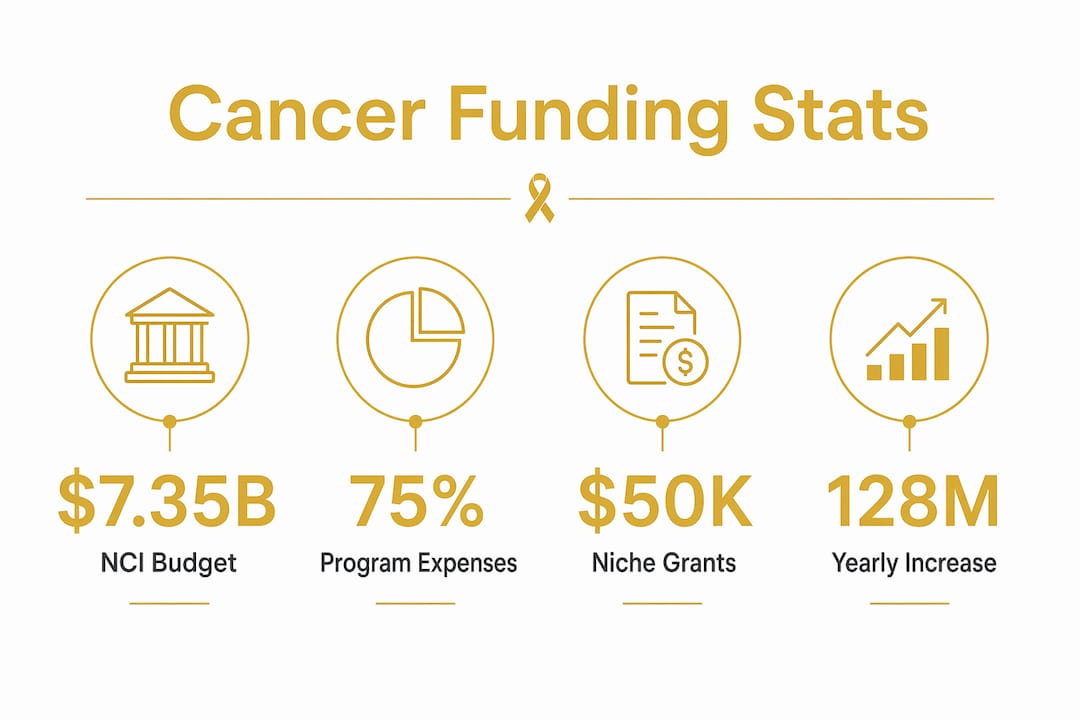
Niche grants address this problem directly. The AACR-Lobular Breast Cancer Alliance grant awards $50,000 with indirect costs capped at 5% or less. That structure means nearly every dollar reaches the lab bench rather than administrative overhead.
| Funding type | Typical scale | Indirect cost cap | Best suited for |
|---|---|---|---|
| NCI R01 federal grant | $250,000+ per year | 26–60% | Established investigators |
| AACR Trailblazer Grant | $1 million over 3 years | Moderate | Early to mid-career researchers |
| Niche disease-specific grant | $50,000 | 5% or less | Targeted, underfunded cancer types |
| Cancer Grand Challenges award | Up to $25 million over 5 years | Varies | Interdisciplinary global teams |
Donor advocacy also shapes allocation. When advocates push Congress to increase NCI appropriations or protect specific programs, they directly influence which research gets funded. The American Cancer Society Cancer Action Network has documented how bipartisan congressional support stabilizes funding cycles and accelerates drug discovery timelines.
Pro Tip: When evaluating a grant program or nonprofit to support, ask what percentage of funds go directly to research versus overhead. A cap of 5% or less on indirect costs signals that your donation reaches the science, not the administration.
What recent major funding initiatives are shaping cancer research in 2026?
2026 has brought several landmark investments that are reshaping the funding landscape. These are not incremental increases. They represent a genuine shift in how the scientific community approaches the hardest problems in cancer.
The headline numbers are significant:
- The NCI received $7.352 billion in FY2026, its largest appropriation to date
- Cancer Grand Challenges awarded $125 million in march 2026 to five interdisciplinary global teams, each receiving up to $25 million over five years
- The AACR committed a total of $15 million in 2026 through its Trailblazer Cancer Research Grants for early to mid-career investigators
- HHS doubled funding for the Childhood Cancer Data Initiative at the NCI, a move that accelerates pediatric cancer research at a critical moment
- The Mark Foundation increased its Emerging Leader Award to $1 million over four years, reflecting a commitment to sustained investigator development
Cancer Grand Challenges has now invested over $624 million since 2016. That cumulative investment funds teams that cross national borders, scientific disciplines, and institutional boundaries. The model works because cancer does not respect those boundaries either.
“The most complex problems in cancer science require scientists from multiple disciplines and countries working together under a shared mission. No single institution, no matter how well funded, can crack these problems alone. That is the promise of collaborative global funding.”
The doubling of childhood cancer research funding deserves special attention. Pediatric cancers have historically received a fraction of the funding directed at adult cancers, despite the profound human cost. This correction signals that Congress recognizes the gap and is willing to act on it.
How can individuals and donors effectively support cancer research funding?
Donors who want to maximize their impact need to understand how funding cycles work and where private dollars create the most leverage. Federal grants are competitive and slow. Private donations can move faster and reach places federal money cannot.
Here is a practical framework for donors and advocates:
- Identify the funding gap. Use publicly available data from JAMA Network Open and NCI budget reports to find cancer types where mortality burden exceeds research investment. Your dollars carry more weight in underfunded areas.
- Choose the right vehicle. Direct donations to nonprofits with low overhead ratios. Niche grants with indirect costs capped at 5% or less deliver more science per dollar than broad institutional gifts.
- Support early-career investigators. Programs like the AACR Trailblazer Grants fund researchers who lack the track record to win federal grants but carry the most transformative ideas. These investigators need private support most.
- Back interdisciplinary programs. Collaborative models like Cancer Grand Challenges produce the kind of cross-disciplinary breakthroughs that single-lab grants rarely achieve. Donors who fund these programs invest in systemic change, not incremental progress.
- Advocate for sustained federal appropriations. Write to your congressional representatives. Bipartisan support for NIH and NCI funding is not guaranteed. Donor voices, organized through networks like the American Cancer Society Cancer Action Network, have measurable influence on appropriations outcomes.
Pro Tip: Ask any nonprofit you consider supporting to share its most recent Form 990. This public document shows exactly how the organization allocates funds between programs, administration, and fundraising. A program expense ratio above 75% is a strong signal of donor-focused stewardship.
Giving through a 501©(3) nonprofit also provides a tax deduction, which means your effective cost of giving is lower than the face value of your donation. That structure rewards sustained, recurring support over one-time gifts.
Key Takeaways
Effective cancer research funding requires a combination of federal appropriations, targeted private philanthropy, and globally collaborative grant models that together address gaps no single source can fill.
| Point | Details |
|---|---|
| Federal funding sets the floor | NCI received $7.352 billion in FY2026, the largest appropriation in its history. |
| Philanthropy fills critical gaps | A JAMA Network Open study confirmed misalignment between funding and cancer mortality burden. |
| Low-overhead grants maximize impact | Niche grants cap indirect costs at 5%, sending more dollars directly to research. |
| Global collaboration accelerates breakthroughs | Cancer Grand Challenges has invested over $624 million since 2016 across interdisciplinary teams. |
| Donor advocacy shapes policy | Bipartisan congressional support for NIH funding directly affects the pace of cancer drug discovery. |
Our perspective on where cancer research funding is heading
We have watched the funding landscape shift in ways that give us genuine hope. The FY2026 NCI appropriation is not just a budget line. It is a signal that Congress, across party lines, understands what is at stake. We have seen bipartisan support hold even in contentious budget cycles, and that stability matters more than any single year’s number.
What moves us most is the rise of collaborative global models. Cancer Grand Challenges proves that when you remove institutional walls and national borders from the equation, scientists find answers they could not find alone. We believe this model is the future of high-impact cancer science, and we believe donors who fund it are investing in something genuinely transformative.
The funding gap between cancer mortality and research dollars is real and documented. That gap is also an opportunity. Every donor who directs support toward an underfunded cancer type, every advocate who calls their senator before an appropriations vote, and every foundation that backs an early-career investigator is doing something that federal budgets cannot do on their own. We are all part of this mission. And we need you in it.
— HCRF
Hcrfwingstocure: putting your donation where it matters
Hcrfwingstocure, the Hippocratic Cancer Research Foundation, is a 501©(3) nonprofit that funds “out of the box” cancer research at the Robert H. Lurie Comprehensive Cancer Center of Northwestern University. Every dollar we raise goes toward research that challenges conventional thinking and opens new doors for patients who need answers now.
We believe that the most important breakthroughs come from the ideas that don’t fit neatly into standard grant categories. That is exactly the kind of science we fund. If you are ready to put your support behind research that could change everything, visit Hcrfwingstocure and learn how your gift becomes part of something much larger than any one of us. THEY NEED OUR SUPPORT. We need you.
FAQ
Who funds cancer research in the United States?
Cancer research in America is funded primarily by the National Institutes of Health and the National Cancer Institute, supplemented by private philanthropic foundations, disease-specific nonprofits, and international collaborative programs like Cancer Grand Challenges.
What is the NCI’s budget for FY2026?
The National Cancer Institute received $7.352 billion in FY2026, a $128 million increase over FY2025, representing the largest federal cancer research appropriation to date.
How do I know if a cancer research nonprofit uses donations well?
Review the organization’s Form 990 and look for a program expense ratio above 75%. Grants with indirect costs capped at 5% or less, such as the AACR-Lobular Breast Cancer Alliance award, signal that the majority of funds reach direct research activities.
What is Cancer Grand Challenges?
Cancer Grand Challenges is a joint initiative between the National Cancer Institute and Cancer Research UK that funds interdisciplinary global teams. It has invested over $624 million since 2016 and awarded $125 million to five new teams in march 2026.
Why does the funding gap between cancer mortality and research dollars matter to donors?
Research published in JAMA Network Open in 2026 confirmed that some of the deadliest cancers receive proportionally less federal funding than their mortality burden warrants. Donors who understand this gap can direct private support toward underfunded cancers where their dollars create the greatest scientific impact.
Recommended


Three clinic ready questions to bring to your oncology appointment, with scripts, NCT lookup, written cost breakdowns, and U.S. resources.
Read More →