


Charitable Donation Receipts: IRS Rules and Templates
August 5, 2026
Charitable Donation Receipts: IRS Rules and Templates

A valid U.S. charitable donation receipt, formally called a contemporaneous written acknowledgment, must include five core elements: the organization’s name, the date of the contribution, the amount of cash given (or a description of noncash property), a statement about whether any goods or services were provided in exchange, and a good-faith estimate of the value of those goods or services when applicable. These are not suggestions. The IRS written-acknowledgment rules make them mandatory for any single gift of $250 or more, and missing even one element can cost a donor their entire deduction.
Here is the quick checklist every receipt must cover:
- Organization’s legal name (as registered with the IRS)
- Date of the contribution
- Amount of cash OR a description (not the fair market value) of noncash property
- Statement that no goods or services were provided in exchange, OR a description and good-faith estimate of value when they were
- Intangible religious benefit statement, when applicable
- Donor’s name (best practice, though not always explicitly required by the IRS for the acknowledgment itself)
For gifts under $250, donors still need written records, but a formal acknowledgment is not legally required. Ready-to-use templates for every common scenario appear in the templates section below. The Hippocratic Cancer Research Foundation (HCRF) uses these same elements in every donor acknowledgment it issues, and we share our own sample language later in this guide.
Table of Contents
- What must appear on a charitable donation receipt?
- When is a written acknowledgment actually required?
- How do noncash gifts, vehicles, and quid pro quo situations change the receipt?
- What records should donors keep for gifts under $250?
- How to create a compliant receipt, step by step, with ready-to-use templates
- How HCRF acknowledges donors: a real-world stewardship example
- Delivery, timing, and recordkeeping best practices for nonprofits
- Common mistakes that put deductions and nonprofits at risk
- Key Takeaways
- Why clear receipts are the foundation of donor trust
- HCRF donor resources: templates, guidance, and support
- Official sources and further reading
What must appear on a charitable donation receipt?
The IRS does not leave this to interpretation. Publication 1771 lays out the required elements of a contemporaneous written acknowledgment with precision, and every nonprofit issuing receipts for charitable contributions should treat it as the operating manual.

| Required Element | Where It Appears | Sample Phrasing |
|---|---|---|
| Organization’s name | Header or first line | “Hippocratic Cancer Research Foundation” |
| Date of contribution | Body of receipt | “Received on March 14, 2026” |
| Amount of cash | Body of receipt | “Cash contribution: $500.00” |
| Description of noncash property | Body of receipt | “One oil painting, approximately 24” x 36"" |
| Goods/services statement | Disclosure line | “No goods or services were provided in exchange for this contribution.” |
| Good-faith estimate of value | Disclosure line | “Goods/services provided: dinner valued at $75.00” |
| Intangible religious benefit | Disclosure line | “Only intangible religious benefits were provided.” |
A few of these deserve extra attention.
The noncash description rule. The charity describes the property; it does not value it. Assigning a dollar amount to donated stock, artwork, or equipment on the receipt is the charity’s job to avoid. Valuing noncash property is the donor’s responsibility, typically with a qualified appraisal.
The goods-or-services statement. Every acknowledgment must address this, even when the answer is “none.” Silence on this point is not the same as a clean disclosure. The IRS expects an explicit statement either way.
Annual summaries vs. per-gift receipts. Publication 1771 permits one contemporaneous acknowledgment to cover several contributions made during a year, provided it identifies each gift separately. Many nonprofits send a January summary letter covering all gifts from the prior year. That works, but only if the donor receives it before filing their return.
“A separate contemporaneous written acknowledgment may be provided for each single contribution of $250 or more, or one contemporaneous written acknowledgment, such as an annual summary, may be used to substantiate several single contributions of $250 or more made by a donor during a year.”
— IRS Publication 1771
When is a written acknowledgment actually required?
The $250 threshold is the most widely cited rule in charitable giving, and it is also the most misunderstood. Here is what it actually means.
A contemporaneous written acknowledgment is required for any single contribution of $250 or more. The rule applies per gift, not per year. A donor who gives $100 every week to the same organization never triggers the $250 rule on any individual gift, even though their annual total far exceeds $250. Those smaller gifts are not aggregated for this purpose.
Timing is everything. “Contemporaneous” has a specific legal meaning here. The donor must have the acknowledgment in hand by the earlier of:
- The date they file their original federal income tax return for the year of the contribution, OR
- The due date (including extensions) for filing that return
Miss that window and the deduction is gone, regardless of how legitimate the gift was.
Triggers that require a written acknowledgment:
- A single cash gift of $250 or more
- A single noncash gift valued at $250 or more
- Payroll deductions of $250 or more per pay period
- Any contribution where the donor intends to claim a deduction and the gift meets the threshold
$250 Rule: Any single contribution of $250 or more requires a contemporaneous written acknowledgment from the charity before the donor can claim a deduction on their federal return.
For gifts under $250, donors still need written records, such as bank statements, canceled checks, or credit card receipts, but a formal acknowledgment from the charity is not legally required. That said, issuing one anyway is simply good stewardship.

How do noncash gifts, vehicles, and quid pro quo situations change the receipt?
Noncash gifts introduce a layer of complexity that trips up even experienced nonprofit staff. The core principle stays the same: describe the property, never value it.
Stock and securities. The receipt should note the number of shares, the name of the company, and the date of transfer. No dollar amount. The donor determines fair market value using the average of the high and low trading prices on the date of the gift.
Vehicles. Donated cars, boats, and aircraft follow special rules under IRS Publications 4302 and 4303. If the charity sells the vehicle, the donor’s deduction is generally limited to the gross proceeds from the sale, and the charity must provide a Form 1098-C (or equivalent written acknowledgment) within 30 days of the sale. If the charity uses the vehicle directly in its mission, the donor may deduct fair market value, but the receipt must state that use explicitly.
Cryptocurrency. The IRS treats crypto as property. The receipt describes the type and amount of cryptocurrency transferred (e.g., “2.5 Bitcoin”) and the date. The donor handles valuation and, for gifts over $500, files Form 8283.
Form 8283 thresholds:
- Noncash gifts over $500: donor files Form 8283, Section A
- Noncash gifts over $5,000: donor must obtain a qualified appraisal and attach it via Form 8283, Section B
- Gifts of publicly traded securities over $500: Section A, but no appraisal required
Quid pro quo contributions and the $75 threshold. A quid pro quo contribution is any payment made partly as a gift and partly in exchange for goods or services. A classic example: a donor pays $150 for a gala ticket where the dinner is worth $60. The deductible portion is $90. Under 26 U.S.C. §6115, when the total payment exceeds $75, the organization must provide a written disclosure that includes a good-faith estimate of the value of the goods or services provided.
Sample quid pro quo disclosure language:
Pro Tip: Auction purchases are not always charitable contributions. When a donor pays fair market value or more for an item at a charity auction, there is no deductible gift. The receipt should reflect the actual fair market value of the item and the amount paid, so the donor can calculate any deductible excess.
What records should donors keep for gifts under $250?
Even when a formal acknowledgment is not required, the IRS expects donors to maintain written records for every monetary gift they intend to deduct. 26 CFR § 1.170A-13 spells out what qualifies.
Acceptable records for cash and monetary gifts:
- Bank records (statements showing the payee, date, and amount)
- Canceled checks
- Credit card statements
- Electronic fund transfer receipts
- A written communication from the charity showing its name, the date, and the amount
For noncash gifts under $250:
- A receipt from the charity describing the donated property
- A written record the donor prepares showing the charity’s name, date, location, and a description of the property
- Photos of the donated items (strongly recommended as supplemental documentation)
Two scenarios illustrate how this plays out in practice.
Weekly church offerings. A donor gives $50 each Sunday throughout the year. No single gift hits $250, so no contemporaneous written acknowledgment is required. The donor should keep bank records or a written statement from the church confirming the total given. Many churches provide an annual giving statement in January, which serves this purpose well.
A single larger gift. A donor writes one check for $300 to a local food bank. That single gift crosses the $250 threshold, so a formal contemporaneous written acknowledgment from the food bank is required before the donor files their return. A bank statement alone is not enough.
How to create a compliant receipt, step by step, with ready-to-use templates
Building a compliant acknowledgment is straightforward once you know what fields to collect at the point of gift. Here is the process, followed by four copy-and-paste templates.
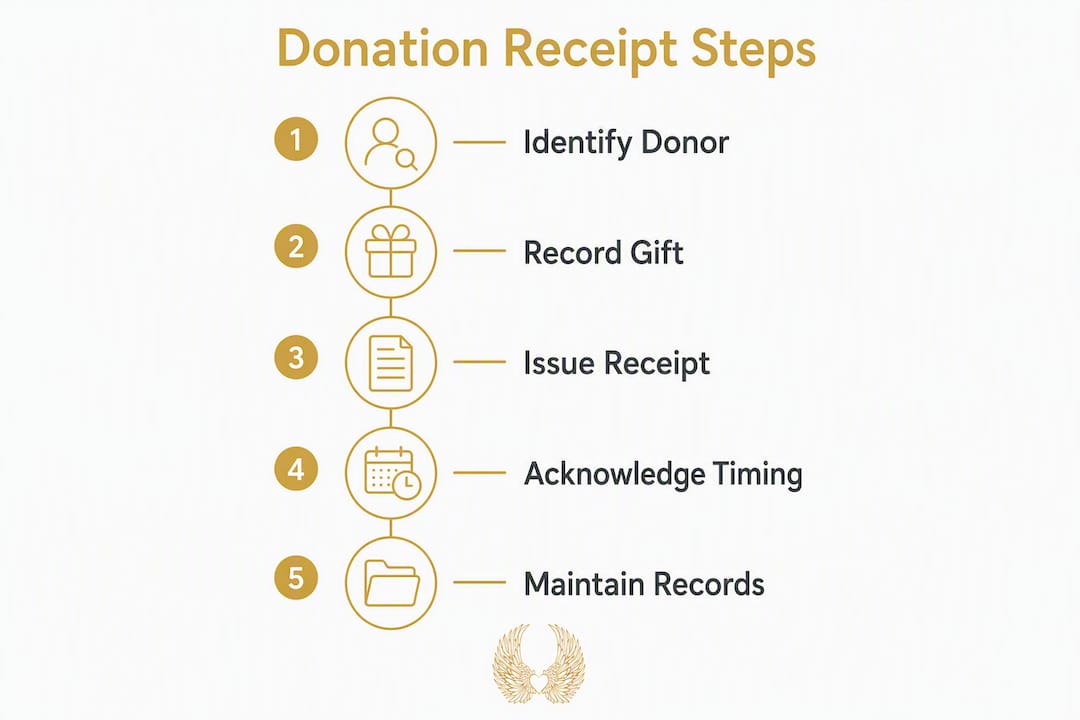
Step-by-step process:
- Collect the donor’s legal name, mailing address, and email at the time of the gift.
- Record the gift date, amount (or property description), and donation type (cash, check, credit card, stock, noncash).
- Determine whether any goods or services were provided in exchange.
- If yes, calculate a good-faith estimate of their fair market value.
- Draft the acknowledgment using the required elements (see the table in Section 2).
- Send or deliver the acknowledgment promptly, ideally the same day or within 48 hours.
- Retain a copy in your records, organized by tax year and gift type.
Template 1: Simple cash receipt under $250
[Organization Name]
[Organization Address]
[Date]

Dear [Donor Name],

Thank you for your generous contribution of $[Amount] on [Date of Gift].
No goods or services were provided in exchange for this contribution.

[Organization Name] is a 501(c)(3) nonprofit organization.
Tax ID: [EIN]

With gratitude,
[Authorized Signature]
[Title]
Template 2: Contemporaneous written acknowledgment for gifts of $250 or more
[Organization Name]
[Organization Address]
[Date]

Dear [Donor Name],

This letter serves as your official written acknowledgment of a contribution
of $[Amount] received on [Date of Gift].

No goods or services were provided in exchange for this contribution.

Please retain this letter for your tax records.
[Organization Name] is a 501(c)(3) organization. Tax ID: [EIN]

With gratitude,
[Authorized Signature]
[Title]
Template 3: Quid pro quo disclosure for events or auctions
[Organization Name]
[Organization Address]
[Date]

Dear [Donor Name],

Thank you for your payment of $[Total Amount] in connection with [Event Name]
on [Date of Event].

In exchange for your payment, [Organization Name] provided [description of
goods/services, e.g., "dinner and entertainment"] with an estimated fair
market value of $[FMV Amount].

The deductible portion of your contribution, to the extent permitted by law,
is $[Total Amount minus FMV Amount].

[Organization Name] is a 501(c)(3) organization. Tax ID: [EIN]

With gratitude,
[Authorized Signature]
[Title]
Template 4: Noncash or stock gift receipt
[Organization Name]
[Organization Address]
[Date]

Dear [Donor Name],

This letter acknowledges receipt of the following noncash contribution
on [Date of Gift]:

Description of property: [e.g., "100 shares of XYZ Corporation common stock"
OR "One upright piano, make/model unknown, approximate age 20 years"]

Note: [Organization Name] has not provided a valuation of this property.
Determining the fair market value is the donor's responsibility.
For noncash contributions exceeding $500, please refer to IRS Form 8283.

No goods or services were provided in exchange for this contribution.

[Organization Name] is a 501(c)(3) organization. Tax ID: [EIN]

With gratitude,
[Authorized Signature]
[Title]
CRM automation fields to configure:
- Donor legal name and email
- Gift date and amount (or property description)
- Donation type (cash, check, ACH, stock, noncash)
- Quid pro quo indicator (yes/no) and benefit value if yes
- Acknowledgment sent date and delivery method
Pro Tip: Set your CRM to trigger an automated acknowledgment email the moment a gift is recorded. Donors who receive a receipt within minutes of giving report higher confidence in the organization, and you eliminate the risk of missing the contemporaneous timing requirement.
How HCRF acknowledges donors: a real-world stewardship example
At the Hippocratic Cancer Research Foundation, every gift acknowledgment does two things at once: it meets the IRS requirements for a contemporaneous written acknowledgment, and it carries a genuine note of gratitude that reflects what the gift actually means to cancer research at the Robert H. Lurie Comprehensive Cancer Center of Northwestern University.
Here is HCRF’s sample acknowledgment paragraph:
Notice the structure: the IRS-required elements come first (organization name, amount, date, goods-or-services statement), and the stewardship language follows. That separation matters. A letter that buries the substantiation language inside a paragraph of warm prose can leave donors uncertain about which sentence is the official acknowledgment.
The thank-you letter is not the tax receipt. These are two different documents serving two different purposes, and conflating them creates ambiguity. HCRF sends a formal acknowledgment immediately upon receipt of a gift, then follows up with a separate stewardship note, a progress report on funded research, or an invitation to an upcoming event. Donors deserve both, but they need the formal acknowledgment first.
CRM integration note. HCRF stores every acknowledgment as a PDF attached to the donor’s record, tagged by tax year and gift type. Year-end summary letters are generated from the same CRM fields, cross-checked against gift records, and sent in early January. That process means donors receive their annual summary well before the April filing deadline, and the foundation maintains a clean audit trail.
Pro Tip: Keep your stewardship language and your IRS-required language in clearly labeled sections of the same document, or in separate documents entirely. Donors who can instantly identify the “official acknowledgment” section are less likely to call your office in March asking whether their letter “counts” for taxes.
Delivery, timing, and recordkeeping best practices for nonprofits
Compliance does not end when the receipt is written. How and when you deliver it, and how long you keep it, determines whether it holds up under scrutiny.
Delivery best practices:
- Send an automated email acknowledgment immediately upon gift processing, with a downloadable PDF attached.
- For paper checks, mail the acknowledgment within 48 hours of deposit.
- For electronic acknowledgments, use a delivery method that is “likely to reach” the donor, such as a confirmed email address on file, not a general contact form.
- For year-end annual summaries, send by January 31 to give donors ample time before the April 15 filing deadline.
Retention guidance:
- Keep donor acknowledgment records for a minimum of seven years, consistent with general IRS audit statute-of-limitations guidance.
- Organize records by tax year and gift type (cash, noncash, quid pro quo).
- Store digital copies in a cloud-based system with access controls and regular backups.
- For noncash gifts requiring Form 8283, retain the charity’s copy of the signed form indefinitely.
Pro Tip: Run a monthly “unacknowledged gifts” report in your CRM. Any gift over $250 that has not generated an acknowledgment within 30 days is a compliance risk. Catching it early means you can still issue a timely receipt before the donor files.
Common mistakes that put deductions and nonprofits at risk
These errors appear in audits far more often than they should, and most are entirely preventable.
Putting a value on noncash property. The charity’s receipt must describe donated property, not appraise it. Writing “$500 worth of clothing” on a receipt is an error that can invalidate the donor’s deduction and expose the charity to scrutiny. The correct language: “Assorted clothing items, approximately two garbage bags.”
Missing the quid pro quo disclosure. When a payment exceeds $75 and the donor received something in return, the disclosure is mandatory. Skipping it triggers a penalty under Publication 1771.
“A penalty of $10 per contribution, not to exceed $5,000 per fundraising event or mailing, may apply for failure to meet the written disclosure requirements for quid pro quo contributions.”
— IRS Publication 1771
Failing to issue a contemporaneous acknowledgment at all. A donor who gives $500 and never receives a written acknowledgment cannot deduct the gift, even with a bank statement. The bank record proves the payment; only the charity’s acknowledgment proves the charitable nature of the gift.
Issuing a corrected acknowledgment after the donor files. If a donor files their return before receiving the acknowledgment, the deduction is disallowed. A corrected letter issued afterward does not fix the problem retroactively.
Remediation steps when errors occur:
- Issue a corrected acknowledgment as soon as the error is discovered, clearly labeled “Corrected Acknowledgment.”
- For missing quid pro quo disclosures, provide the disclosure statement immediately and document the good-faith estimate.
- For noncash receipts that incorrectly included a value, issue a corrected receipt with the description only and a note that valuation is the donor’s responsibility.
- Document all corrections in your CRM with timestamps.
Reasonable-cause defenses exist for charities that can show they made a good-faith effort to comply. But the strongest defense is a clean process that prevents errors in the first place. For nonprofits that want to understand how donation practices connect to donor trust and long-term giving, the principles are the same whether you are a small community organization or a major research foundation.
Key Takeaways
IRS-compliant charitable donation receipts require five core elements, a contemporaneous delivery timeline, and separate handling for noncash gifts, quid pro quo situations, and electronic delivery.
| Point | Details |
|---|---|
| The $250 written-acknowledgment rule | Any single gift of $250 or more requires a formal written acknowledgment before the donor can claim a deduction. |
| Noncash gifts: describe, never value | Charities must describe donated property on the receipt; assigning a dollar value is the donor’s responsibility, not the charity’s. |
| Quid pro quo threshold | Payments exceeding $75 where goods or services were provided require a written disclosure with a good-faith estimate of value. |
| Electronic receipts are valid | Email acknowledgments are IRS-acceptable when sent in a manner likely to reach the donor; retain delivery confirmation. |
| HCRF as a model | The Hippocratic Cancer Research Foundation separates IRS-required language from stewardship language in every acknowledgment it issues. |
Why clear receipts are the foundation of donor trust
We have seen it firsthand at HCRF. When a donor receives a clear, compliant acknowledgment within hours of making a gift, something shifts. The transaction becomes a relationship. They know their contribution has been received, recorded, and honored. That confidence is not incidental to our mission of funding cancer research at Northwestern University. It is part of it.
A receipt that is confusing, delayed, or incomplete does not just create a tax problem. It creates doubt. And doubt is the one thing we cannot afford when we are asking people to invest their hope and their resources in research that could change everything for a cancer patient.
We encourage every nonprofit, large or small, to treat the acknowledgment process as a stewardship moment, not a compliance checkbox. The IRS requirements are the floor. What you build above that floor is where donor relationships are made.
For more on how HCRF approaches donor engagement and the impact of every contribution, visit our donor resources page.
HCRF donor resources: templates, guidance, and support
Every gift to the Hippocratic Cancer Research Foundation directly funds “out of the box” cancer research at the Robert H. Lurie Comprehensive Cancer Center of Northwestern University. We know that navigating donation receipt requirements can feel like one more thing on a long list, and we want to make it as simple as possible for both donors and the nonprofits that serve them.

HCRF offers downloadable receipt templates, a donor FAQ covering common substantiation questions, and direct support for donors who need help understanding their acknowledgment. Whether you are a first-time donor or a nonprofit staff member building your receipting process from scratch, we are here with you.
Visit the Hippocratic Cancer Research Foundation to access donor resources, make a contribution, or reach out with receipting questions. Your generosity carries hope. We want to make sure it is fully recognized, by the IRS and by us.
For community-based giving models and electronic acknowledgment examples, the guidance at Divergent Church offers a practical look at how smaller organizations handle donor communication with clarity and care.
Official sources and further reading
These are the primary IRS publications and legal references used throughout this guide. Each one is freely available and worth bookmarking if you manage charitable giving or nonprofit receipting.
- IRS Written Acknowledgments page — The definitive source for required elements of a contemporaneous written acknowledgment, including the goods-or-services statement and noncash description rules.
- Publication 526: Charitable Contributions — Explains how individual donors claim deductions, what organizations qualify, and what records to keep.
- IRS Substantiating Charitable Contributions — Covers substantiation requirements for both donors and organizations, including the quid pro quo $75 threshold.
- 26 U.S.C. §6115: Disclosure related to quid pro quo contributions — The statutory basis for the written disclosure requirement on quid pro quo contributions.
- 26 CFR § 1.170A-13 — The federal regulation governing recordkeeping and return requirements for charitable contribution deductions, including acceptable donor records for gifts under $250.
- IRS Charitable Organizations: Substantiation and Disclosure Requirements — A summary page linking to all major substantiation and disclosure guidance for charitable organizations.
For noncash gifts over $5,000, a qualified appraisal is required and must be attached to the donor’s return via Form 8283, Section B. The IRS does not accept the charity’s description as a substitute for an independent appraisal at this threshold.
Recommended
- Hippocratic Cancer Research Foundation: Innovative Therapies | How to Donate to Cancer Research and Drive Real Impact
- Hippocratic Cancer Research Foundation: Innovative Therapies | Cancer Research Funding: A 2026 Donor’s Guide
- Hippocratic Cancer Research Foundation: Innovative Therapies | Breast Cancer Research Funding: A Researcher’s Guide
- Hippocratic Cancer Research Foundation: Innovative Therapies | Cancer Awareness Month Calendar: 2026 Complete Guide

Learn how to evaluate a charity in just 15 minutes using three free tools. Ensure your donation goes to a reputable organization.
Read More →
Discover how clinical trial costs vary by phase, revealing what they mean for sponsors and participants. Gain insights into funding and budgeting.
Read More →