


Breast Cancer Research Funding: A Researcher's Guide
July 30, 2026
Breast Cancer Research Funding: A Researcher’s Guide

Most competitive U.S. breast cancer research funding flows from three source categories: federal agencies (NCI/NIH and DoD/CDMRP), large private funders like the Breast Cancer Research Foundation and Susan G. Komen, and targeted society and foundation awards. Your immediate next step is to map those opportunities to your career stage and set a concrete LOI and application calendar before the next funding cycle opens.
TLDR for PIs and grants officers:
- Prioritize by career stage: Early-career investigators should target CDMRP Breakthrough Awards (Levels 1–2), AACR career development grants, and Komen’s career catalyst mechanisms before competing for large NCI R01s. Mid-career and senior investigators are the primary audience for BCRF invited proposals and NCI program project grants.
- Set your LOI calendar now: CDMRP publishes FY cycle deadlines months in advance; BCRF operates on an invitation model with awards announced in October. Mark internal deadlines 3–4 weeks before each funder’s due date.
- First 30-day actions: Identify two or three target mechanisms, contact program officers at each funder, draft your specific aims page, and write a lay summary in parallel. Register on grants.gov and set up NIH Guide email alerts if you have not already.
BCRF currently supports numerous researchers worldwide, channeling donor funds directly to academic medical institutions rather than providing patient services.
Table of Contents
- Where can you find current breast cancer research funding?
- Snapshot: typical award sizes, eligibility, and cadence by funder
- How does the application and review process actually work?
- How do you write a competitive breast cancer research proposal?
- What do timelines and budgets look like in practice?
- How to build a system for tracking funding opportunities
- What happens after you receive an award?
- How the Hippocratic Cancer Research Foundation supports breast cancer research
- Key Takeaways
- What we’ve learned from watching proposals succeed and fail
- HCRF is here to help you move your research forward
- Authoritative sources and further reading
Where can you find current breast cancer research funding?
The U.S. breast cancer research funding ecosystem is wide, but navigable once you know which funders to watch and which discovery tools to use every week.
Federal funders anchor the landscape. The National Cancer Institute, the largest component of NIH, coordinates the national cancer research program and funds basic science, prevention, detection, treatment, and health disparities work through mechanisms ranging from R01 investigator-initiated grants to program project (P01) and SPORE (Specialized Programs of Research Excellence) awards. The NCI Budget Fact Book publishes annual research funding allocations by cancer site, giving you a clear picture of how breast cancer competes within the NCI portfolio. The Congressionally Directed Medical Research Programs Breast Cancer Research Program (CDMRP BCRP), administered by the Department of Defense, is a distinct and substantial federal source. It funds high-impact research with scientists and consumers through multiple Breakthrough Award mechanisms, Breakthrough Award Levels 1–4, Transformative Impact Awards, and Consortium Awards, each with its own eligibility and budget parameters.
Large private funders operate differently. The Breast Cancer Research Foundation issues invited proposals through its Scientific Advisory Board, directing donor funds to academic medical centers. Susan G. Komen publishes open grant opportunities with defined award caps, PI eligibility criteria, and review timelines, making it one of the most accessible private funders for investigators without an existing BCRF relationship. The American Association for Cancer Research (AACR) offers career development grants and research fellowships with open application cycles. The Breast Cancer Alliance funds focused, often early-stage projects at academic institutions. Philanthropic foundations, including the Hippocratic Cancer Research Foundation (HCRF), provide seed funding for innovative, high-risk work that federal mechanisms may not yet support.
Centralized discovery resources are non-negotiable tools:
- grants.gov — the official federal registry for all federal funding opportunities; set keyword alerts for “breast cancer” and “cancer” under NIH and DoD agencies.
- NIH Guide to Funding Opportunities — the authoritative source for NCI and NIH program announcements, RFAs, and NOT notices; subscribe to weekly email digests.
- NIH RePORTER — search funded NIH projects by keyword, PI, institution, or cancer site to identify active mechanisms, typical award sizes, and potential collaborators.
- CDMRP funding pages — updated annually with FY cycle release dates and pre-application deadlines for all BCRP mechanisms.
- Foundation program pages — BCRF, Komen, AACR, and Breast Cancer Alliance each publish program priorities and, where applicable, open solicitations.
When prioritizing, match the mechanism to your project type. Basic and mechanistic studies fit NCI R01s and AACR research grants. Translational and early-phase clinical work aligns with CDMRP Breakthrough Awards and Komen’s research grants. Health disparities and community-based research has dedicated NCI funding lines and CDMRP priority areas. Exploratory, high-risk ideas with limited preliminary data are where private funders like BCRF and HCRF often step in.
Snapshot: typical award sizes, eligibility, and cadence by funder
The figures below are representative of recent program cycles. Award amounts and deadlines change annually; always confirm on the funder’s current program announcement before building a budget.
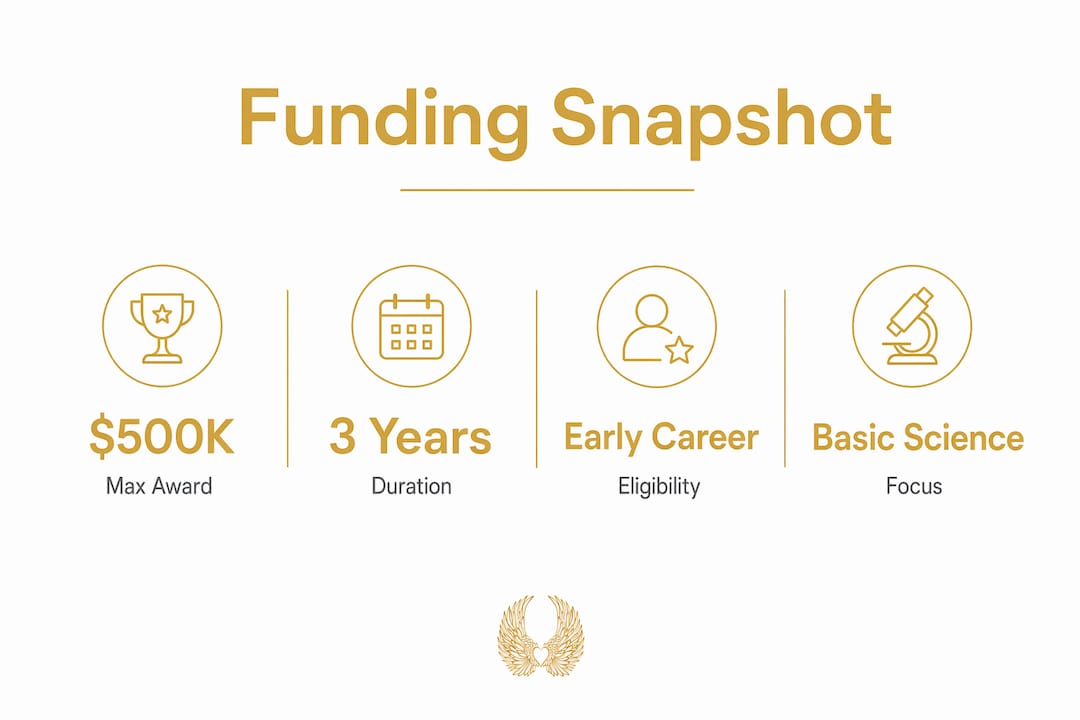
| Funder | Typical Award Size & Duration | Eligible Applicants | Focus / Scientific Priorities | LOI or Invitation Required | Typical Review Timeline |
|---|---|---|---|---|---|
| NCI/NIH (R01) | — | All career stages; U.S. institutions | Full spectrum: basic, translational, clinical, disparities | No LOI for most; some RFAs require letter of intent | Study section review ~6 months post-submission; awards ~9–12 months |
| CDMRP BCRP | Varies by mechanism; Breakthrough Award mechanisms have distinct budget parameters with substantial awards at higher levels | Early-career to senior; U.S. and some international | High-impact, consumer-relevant; mechanistic, translational, clinical trials | Pre-application (LOI equivalent) required for most mechanisms | Pre-application review ~6–8 weeks; full application review ~4–5 months |
| BCRF | Up to $250,000 with indirect costs capped at 20%; typically for one year | Invited investigators at academic medical centers | Translational, clinical, high-risk/high-reward; SAB-driven priorities | Invitation only via Scientific Advisory Board | Invited proposals in late spring; review in summer; awards announced in October |
| Susan G. Komen | Varies by mechanism; research grants have defined award caps | Early-career to senior; U.S. institutions | Basic, translational, clinical, health disparities, health equity | LOI required for most mechanisms | LOI review ~6–8 weeks; invited full application review ~3–4 months |
| AACR | Career development grants typically $50,000–$150,000/year; 1–3 years | Early- to mid-career; postdoctoral to junior faculty | Basic and translational; career development focus | Full application; no LOI for most mechanisms | Review ~3–4 months; awards announced annually |
| Breast Cancer Alliance | Typically $50,000–$100,000; 1 year | Early-career investigators; U.S. academic institutions | Innovative, early-stage; seed funding emphasis | Application per posted RFA | Review ~2–3 months post-deadline |
| HCRF | Seed funding for innovative projects; amounts vary by cycle | Investigators at affiliated academic cancer centers | High-risk, out-of-the-box cancer research; Northwestern/Lurie Center focus | Contact program staff; application per posted guidelines | Varies by cycle |

Indirect cost (F&A) policies vary: BCRF caps indirect costs at 20%; federal awards follow the institution’s negotiated rate. See Section 6 for budgeting detail.
How does the application and review process actually work?
Understanding the workflow from announcement to award notice lets you allocate your time where it matters most and avoid the administrative surprises that derail otherwise strong proposals.
The typical sequence runs like this:
- Program announcement or RFA published — the funder releases the solicitation, eligibility criteria, scientific priorities, and deadline schedule. For CDMRP, this includes a program synopsis with FY cycle dates for pre-applications and full applications.
- LOI or pre-application submitted — most CDMRP mechanisms and many private funders require a brief pre-application (typically 2–3 pages) before extending an invitation to submit a full proposal. This is the funder’s first filter; treat it as seriously as the full application.
- Invitation to submit a full proposal — for invitation-only funders like BCRF, the Scientific Advisory Board reviews the pre-application or directly identifies investigators whose work aligns with current priorities. Building a relationship with program staff before the cycle opens meaningfully improves your chances of receiving an invitation.
- Full application submitted — the complete package: specific aims, research strategy, biosketches, budget and justification, letters of support, human subjects or IRB documentation, data-sharing plan, and, critically, a lay summary.
- Peer review — a scientific review panel evaluates the proposal on significance, innovation, approach, and investigator qualifications. At CDMRP, consumer advocates participate directly in review panels alongside scientists, which shapes scoring toward patient-centered outcomes and quality-of-life measures. Their presence is not ceremonial; proposals that fail to articulate clear clinical relevance and patient impact routinely score lower.
- Programmatic review and funding decision — after peer review, program staff conduct a programmatic review to align funded projects with portfolio balance and strategic priorities. A strong peer-review score does not guarantee funding if the project duplicates existing awards.
- Award notice and negotiation — the funder issues a notice of award, and the institution’s sponsored-projects office negotiates start dates, budget adjustments, and compliance requirements.
BCRF timing example: Invited proposals are typically requested in late spring, reviewed by the Scientific Advisory Board over the summer, and awards are announced in October, with payments made in two installments.
For CDMRP, FY cycle deadlines are published well in advance. Pre-application and full application windows are strict; late submissions are not accepted. Mark both dates on your institutional calendar the day the program synopsis is released.
How do you write a competitive breast cancer research proposal?
Reviewers at both federal and private funders read dozens of proposals in a single cycle. What separates funded applications is not just scientific quality; it is how clearly the proposal communicates novelty, clinical relevance, and feasibility within the page limits.
Core checklist for every application:
- Specific aims page: One page, no exceptions. Open with the central question and why it matters now, not with background. State 2–3 logically connected, independently testable aims. End with a brief statement of expected outcomes and long-term impact.
- Innovation and high-risk framing: Private funders like BCRF and HCRF explicitly favor high-risk/high-reward proposals that traditional federal channels may not fund. Name the paradigm your work challenges and explain why the field is ready for it.
- Preliminary data vs. rationale: For exploratory seed grants, a strong scientific rationale and clear mechanistic hypothesis can substitute for extensive preliminary data. For NCI R01s and CDMRP Breakthrough Level 3–4 awards, preliminary data is expected to be substantial.
- Lay summary: Write it in parallel with the technical narrative, not as an afterthought. Consumer advocates and non-specialist reviewers evaluate this section at CDMRP and several private funders. Use plain language, name the patient population, and state the clinical impact in one or two sentences.
- Biosketches: Use the current NIH biosketch format for federal applications. Private funders often accept a CV but specify format and page limits; confirm before submitting.
- Letters of support: Obtain letters from collaborators, clinical sites, and core facilities early. A letter that describes a specific contribution (e.g., access to a biobank, a co-investigator’s analytical role) carries far more weight than a generic endorsement.
- IRB and human subjects readiness: Applications involving human subjects must include IRB approval or a pending protocol number. Reviewers flag proposals where human subjects protections are vague or incomplete.
- Data-sharing plan: NIH requires a data management and sharing plan for most applications. Private funders increasingly expect one as well; confirm the requirement in the program announcement.
- Budget justification: Every line item needs a sentence of justification tied to a specific aim. Reviewers notice when personnel effort does not match the proposed workload or when equipment costs appear without explanation.
Pro Tip: Frame your aims around a testable central hypothesis, not a list of experiments. Reviewers fund ideas, not task lists. If your aims page reads like a methods section, rewrite it around the scientific question.
Common reviewer pitfalls to avoid: aims that are too broad to complete in the award period; a lay summary that simply restates the technical abstract; milestones with no measurable endpoints; and a budget that does not reflect the actual cost of the proposed work.

What do timelines and budgets look like in practice?
Getting the calendar and the numbers right is where many otherwise strong proposals stumble. Here is what to plan for.
Typical timeline from announcement to award:
- LOI/pre-application deadline: often 6–10 weeks after program announcement release.
- Invitation to submit full application: typically 4–6 weeks after LOI review.
- Full application deadline: usually 8–12 weeks after invitation.
- Peer review: 3–6 months after full application deadline, depending on funder.
- Award start date: for BCRF, October; for CDMRP, varies by FY cycle; for NCI, typically 6–12 months post-submission.
Budget considerations:
- Direct costs vs. F&A: Direct costs cover personnel, supplies, equipment, and other project-specific expenses. Facilities and Administrative (F&A) costs, also called indirect costs, are added on top at the institution’s federally negotiated rate. Private funders often cap F&A; BCRF caps indirect costs at 20% of direct costs. Federal awards use the full negotiated rate unless the RFA specifies otherwise.
- Salary support: NIH caps the amount of an investigator’s salary that can be charged to a federal grant (the NIH salary cap, updated annually). Private funders vary; confirm allowable salary support in the program announcement.
- Multi-year budgets: For multi-year awards, budget each year separately and account for inflation on supplies and personnel. Renewal rules differ: some funders require a competitive renewal application; others allow no-cost extensions.
| Funder | F&A / Indirect Cost Policy | Typical Max Annual Direct Cost | Clinical Trial Costs Allowed |
|---|---|---|---|
| NCI/NIH (R01) | Full negotiated institutional rate | Varies; modular budget ≤ $250,000/year direct | Yes, with appropriate human subjects protections |
| CDMRP BCRP | Varies by mechanism; check program synopsis | Varies by Breakthrough Level | Yes, for clinical trial mechanisms |
| BCRF | Capped at 20% of direct costs | Up to $250,000; typically for one year | Limited; primarily research grants |
| Susan G. Komen | Varies; confirm in RFA | Varies by mechanism | Yes, for clinical research mechanisms |
| HCRF | Confirm with program staff | Seed funding; varies by cycle | Confirm with program staff |
Institutional requirements: Your sponsored-projects office must sign off on the budget and certify compliance before submission. For multi-institution proposals, subaward agreements and flow-down compliance requirements add lead time; build in at least two additional weeks for each subaward institution.
How to build a system for tracking funding opportunities
Discovering a perfect mechanism the day after its LOI deadline is one of the most avoidable setbacks in academic research administration. A repeatable tracking system prevents it.
- Register on grants.gov and set keyword alerts for “breast cancer,” “mammary,” and relevant disease terms under NIH, DoD, and HHS agencies. New opportunities post weekly.
- Subscribe to the NIH Guide to Funding Opportunities weekly email digest. Every NCI program announcement, RFA, and NOT notice appears here first.
- Bookmark and check the CDMRP BCRP funding page monthly. FY cycle synopses and pre-application deadlines are posted well before the release date; early awareness gives you time to contact program officers and refine your pre-application.
- Use NIH RePORTER to search funded grants by keyword and mechanism. Reviewing recently funded projects in your area tells you what the portfolio already contains, which helps you position your proposal as complementary rather than duplicative.
- Subscribe to AACR and society listservs. AACR, the American Society of Clinical Oncology (ASCO), and breast cancer-focused research networks send funding alerts and RFA announcements to members.
- Follow foundation program pages directly. BCRF, Komen, Breast Cancer Alliance, and HCRF post program updates and priority shifts on their websites; follow their research or grants pages and set browser bookmarks.
- Maintain a shared opportunity tracker with your grants office. Key columns: funder, mechanism name, LOI due date, full application due date, PI, administrative lead, required approvals, and budget cap. Set internal LOI deadlines 3–4 weeks before the funder’s due date to allow time for institutional sign-off.
What happens after you receive an award?
The award notice is the beginning of a new set of obligations, not the finish line. Funders expect timely compliance, transparent reporting, and active engagement with grantee resources.
Mandatory post-award tasks:
- Onboarding: Complete all required certifications, set up the award account with your sponsored-projects office, and confirm the award start date and payment schedule. For BCRF, payments arrive in two installments; plan your spending accordingly.
- Financial reporting: Track allowable costs from day one. Unallowable costs charged to an award create audit risk and can affect renewal eligibility.
- Annual progress reports: Most funders require a written progress report at each anniversary of the award. Reports typically cover scientific milestones achieved, publications, personnel changes, and budget expenditures. Transparent, donor-specific reporting strengthens long-term foundation relationships and supports renewal or follow-on award consideration.
- Final reports: A final scientific report and a final financial report are required at award close. Late or incomplete final reports can disqualify you from future funding with that funder.
- Data sharing: NIH-funded projects must comply with the NIH Data Management and Sharing Policy. Private funders increasingly require data-sharing plans and may specify repositories.
Funder-provided grantee resources:
- Grantee portals for document submission and communication (CDMRP uses the Electronic Biomedical Research Application Portal, eBRAP).
- Technical assistance webinars and orientation calls for new grantees.
- Networking and collaboration opportunities, including annual grantee meetings where investigators present progress and connect with program staff.
- For clinical trial awards, funders may provide clinical operations guidance, patient-recruitment support, and data-monitoring committee frameworks.
How the Hippocratic Cancer Research Foundation supports breast cancer research
The Hippocratic Cancer Research Foundation (HCRF) is a 501©(3) nonprofit that funds innovative, out-of-the-box cancer research at the Robert H. Lurie Comprehensive Cancer Center of Northwestern University. HCRF operates on a donor-driven model, channeling philanthropic contributions directly to investigators pursuing ideas that are too early-stage or too unconventional for standard federal mechanisms. That is exactly the gap where transformative science often begins.
How HCRF supports investigators:
- Seed funding for high-risk, high-reward research projects at the Lurie Comprehensive Cancer Center.
- Donor-driven campaigns that allow supporters to direct funds toward specific research priorities, including breast cancer.
- Educational resources, newsletters, and progress reports that keep donors and the research community informed about funded work.
- Access to clinical trial information and patient support resources connected to Northwestern’s research infrastructure.
Pro Tip: If your project is too exploratory for an NCI R01 or lacks the preliminary data for a CDMRP Breakthrough Level 3 award, a seed grant from a foundation like HCRF can generate the proof-of-concept data that makes your next federal application competitive. Think of philanthropic funding as the runway, not the destination.
For investigators interested in HCRF funding, the first step is to visit the HCRF website to review current priorities and contact program staff directly. Understanding how philanthropic donations are used at foundations like HCRF also helps investigators frame their proposals in terms that resonate with donor-driven review processes.
Key Takeaways
Competitive breast cancer research funding in the U.S. requires matching your project’s stage and scientific question to the right federal or private mechanism, then executing a disciplined application and tracking calendar.
| Point | Details |
|---|---|
| Map funders to career stage | Early-career investigators should target CDMRP Breakthrough Levels 1–2, AACR grants, and Komen mechanisms before competing for large NCI R01s. |
| BCRF is invitation-only | BCRF supports more than 260 researchers worldwide as of 2024; awards up to $250,000 with indirect costs capped at 20%; access requires SAB invitation. |
| Consumer advocates shape CDMRP review | CDMRP panels include consumer advocates; proposals must include a strong lay summary and explicit patient-impact statement to score competitively. |
| Build a tracking system early | Use grants.gov alerts, NIH Guide digests, and a shared opportunity tracker with internal LOI deadlines set 3–4 weeks before funder due dates. |
| HCRF funds exploratory research | The Hippocratic Cancer Research Foundation provides seed funding for innovative projects at the Lurie Comprehensive Cancer Center, bridging the gap before federal funding is achievable. |
What we’ve learned from watching proposals succeed and fail
The single most common reason a strong proposal does not get funded is not weak science. It is a mismatch between what the investigator thinks the funder wants and what the review panel actually prioritizes.
At CDMRP, consumer advocates on review panels are not passive observers. They vote, and they push back on proposals that speak only to scientists. We have seen technically brilliant applications score poorly because the lay summary was a compressed version of the abstract, full of jargon, with no sentence that a patient or family member could hold onto. The fix is simple but requires discipline: write the lay summary first, before the technical narrative, and use it as your north star for clarity throughout the application.
At private funders like BCRF, the invitation model means that the proposal you submit is almost never the first conversation. Investigators who receive invitations have usually had at least one substantive exchange with program staff or a member of the Scientific Advisory Board. Waiting for an RFA to appear and then submitting cold is not how this ecosystem works. Relationship-building is not networking for its own sake; it is how you learn whether your project fits the current portfolio before you invest weeks in writing.
The other pattern we see repeatedly: overly broad specific aims. An aims page that tries to address three distinct biological questions, each of which could anchor its own proposal, signals to reviewers that the investigator has not made hard choices. Funded proposals tend to be ruthlessly focused. One central question. Two or three aims that are genuinely connected. A clear statement of what you will know at the end that you do not know now.
Finally, do not underestimate the budget justification. Reviewers notice when the personnel effort does not match the workload, when a postdoc is listed at 10% effort on a project that requires daily cell culture, or when equipment appears without explanation. A budget that tells a coherent story about how the work will actually get done builds reviewer confidence in ways that are hard to quantify but easy to feel.
HCRF is here to help you move your research forward
Every great discovery starts with an idea that needs a chance. At HCRF, we believe the most promising breast cancer research often lives at the edges of what traditional funding will support. That is why we exist.
HCRF funds innovative, out-of-the-box cancer research at the Robert H. Lurie Comprehensive Cancer Center of Northwestern University, with a focus on projects that are too early-stage or too unconventional for standard federal mechanisms. If you are an investigator with a bold idea and limited preliminary data, or an institutional research administrator looking for a philanthropic partner to complement your federal portfolio, we want to hear from you.
Visit hcrfwingstocure.org to learn about current funding priorities, review application guidance, and connect with our program staff. Together, we carry hope forward. THEY NEED OUR SUPPORT — and with your science and our mission, we can make it happen.
Authoritative sources and further reading
These primary sources belong in your browser bookmarks. Each is updated on its own cycle; check them regularly rather than relying on secondary summaries.
- BCRF Grant Guidelines — the definitive source for BCRF’s invitation model, award amounts, indirect cost caps, reporting requirements, and lay summary guidance.
- BCRF FAQs — confirms BCRF’s researcher count, donor-driven model, and institutional eligibility.
- Susan G. Komen Research Grant Opportunities — lists current open mechanisms, award caps, PI eligibility, and review timelines.
- CDMRP Breast Cancer Research Program — program mission, consumer advocate role, and overview of all BCRP mechanisms.
- CDMRP BCRP Funding Opportunities — FY cycle release dates, pre-application and full application deadlines for all Breakthrough Award levels.
- NCI Research Funding Data — annual NCI Budget Fact Book with research funding allocations by cancer site.
- NCI Cancer Research Donation — explains the NCI Gift Fund, the Breast Cancer Research Stamp, and how public donations are applied to NCI’s mission.
- Non-BCRP Support for Breast Cancer Research, NCBI Bookshelf — a peer-reviewed review of the full federal and private funding landscape for breast cancer research, including historical agency-level allocations and program structures.
- grants.gov — the official federal registry for all federal funding opportunities; use keyword alerts for real-time discovery.
- NIH RePORTER — search funded NIH projects by keyword, PI, institution, or cancer site to map the existing portfolio before you apply.
Recommended
- Hippocratic Cancer Research Foundation: Innovative Therapies | Cancer Research Funding: A 2026 Donor’s Guide
- Hippocratic Cancer Research Foundation: Innovative Therapies | How to Donate to Cancer Research and Drive Real Impact
- Hippocratic Cancer Research Foundation
- Hippocratic Cancer Research Foundation: Innovative Therapies | Why Are Some Cancers More Common Than Others?


What to ask before joining a cancer trial with placebo: 1% tumor response, FDA unblinding rules, nocebo risks, and a consent checklist.
Read More →