


Noncash Charitable Contributions: A Cancer Donor's Guide
August 2, 2026
Noncash Charitable Contributions: A Cancer Donor’s Guide

Yes, noncash charitable contributions are deductible for U.S. taxpayers — and they can be among the most powerful gifts you ever make. Three things matter most, right now, before you do anything else:
- Verify 501©(3) status. The Hippocratic Cancer Research Foundation (HCRF) is a confirmed 501©(3) supporting breakthrough cancer research at the Robert H. Lurie Comprehensive Cancer Center of Northwestern University. Any charity you give to must hold this status for your gift to be deductible.
- Get a contemporaneous written acknowledgment (CWA). The IRS requires this document on or before the date you file the return claiming the deduction.
- Collect the right IRS forms. File Form 8283 when your noncash deduction exceeds $500. If you’re donating a vehicle that the charity sells, you’ll also need Form 1098-C.
Table of Contents
- What counts as a noncash charitable contribution?
- U.S. tax rules every donor must understand
- Documentation and IRS forms every donor must gather
- Special rules for securities, vehicles, real estate, and cryptocurrency
- How to verify a charity and protect your gift from fees and fraud
- How to make a noncash gift to HCRF: step-by-step
- Recordkeeping checklist and what to expect after you give
- When should you consult a tax advisor or appraiser?
- Key Takeaways
- Ready to give? Here’s how to reach HCRF Donor Services
- Authoritative sources and further reading
What counts as a noncash charitable contribution?
The IRS defines noncash contributions as any donated property that isn’t cash, a check, or a credit card payment. The range is broader than most donors realize:
- Publicly traded securities (stocks, mutual fund shares, ETFs)
- Privately held stock or business interests
- Real estate (land, residential or commercial property)
- Vehicles (cars, boats, airplanes) — subject to special rules
- Artwork, antiques, and collectibles
- Household goods and clothing (must be in good used condition or better)
- Cryptocurrency (treated as property, not currency, by the IRS)
- Inventory and business property
The distinction between appreciated property and ordinary-income property matters enormously for your deduction. Long-term capital gain property — stock you’ve held more than a year, for example — is generally deductible at its full fair market value (FMV). Ordinary-income property, like inventory or short-term holdings, is limited to cost basis minus any gain you’d have recognized on a sale. One more thing to watch: groups of similar items (a coin collection, a set of rare books) are aggregated when the IRS determines whether reporting thresholds apply, so plan accordingly.
U.S. tax rules every donor must understand
Deductions are allowed, but the IRS sets firm limits tied to your adjusted gross income (AGI). Publication 526 lays out the framework: caps commonly fall at 60%, 50%, 30%, or 20% of AGI depending on the type of property and the receiving organization. Public charities like HCRF generally allow the most favorable limits.
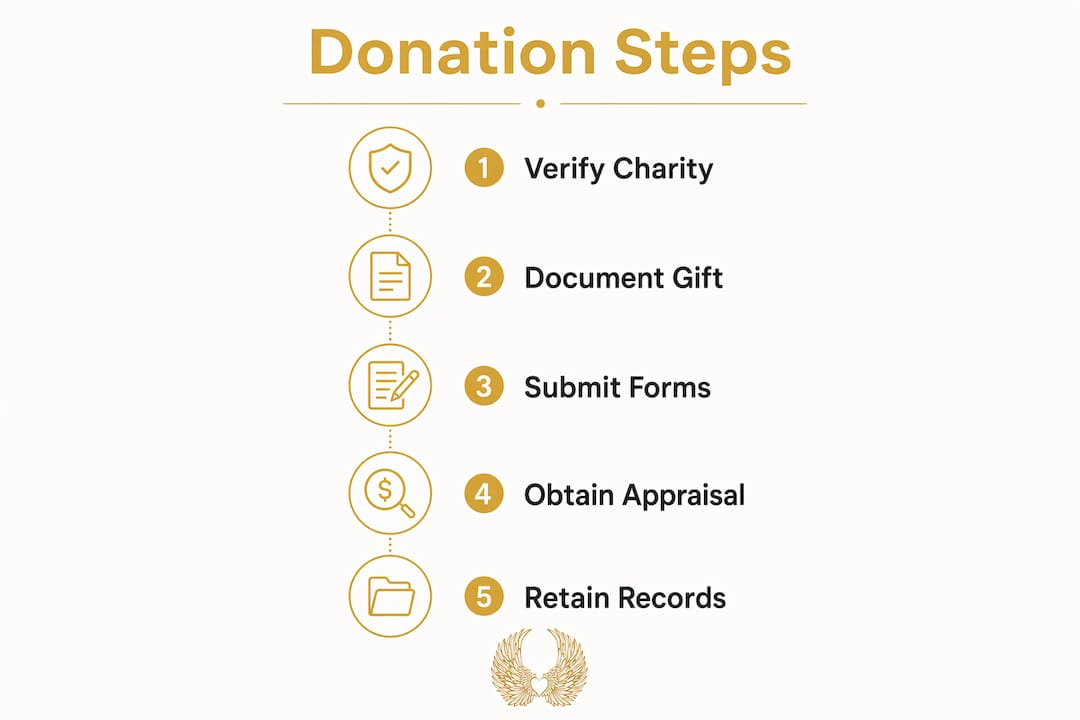
The real tax advantage of donating appreciated stock is one most donors overlook. When you give long-term appreciated securities directly to a qualified charity, you typically deduct the full FMV and pay zero capital gains tax on the appreciation. Sell the stock first and donate the cash, and you owe capital gains tax on the gain before the donation ever happens. For donors holding appreciated positions, gifting shares directly is almost always the smarter move.

Pro Tip: If you’re considering donating appreciated stock to HCRF, instruct your broker to transfer shares directly to HCRF’s brokerage account. Never sell first. The tax savings on a long-held, highly appreciated position can be substantial — and the full value goes to cancer research, not to taxes.
Documentation and IRS forms every donor must gather
Collect your records before you file — not after. The IRS requires Form 8283 whenever your noncash deduction exceeds $500, and the rules escalate with value.
| Deduction Amount | Form 8283 Section | Qualified Appraisal Required? | CWA Required? |
|---|---|---|---|
| $501–$5,000 | Section A | No | Yes |
| Over $5,000 | Section B | Yes | Yes |
| Form 8283 filing is required for noncash charitable contributions with deductions over $500. File Section A for deductions between $501 and $5,000; file Section B and attach a qualified appraisal for items over $5,000. |
A critical point many donors miss: Form 8283 is an appraisal summary, not the appraisal itself. For gifts over $5,000, you must retain the full qualified appraisal report separately. The IRS requires a separate Section B form for each donee organization and each item (or group of similar items) above that threshold.
Documents to gather before filing:
- CWA from the charity (must describe the property, not its FMV, and state whether goods or services were exchanged)
- Completed Form 8283 (Section A or B as applicable)
- Qualified appraisal report (retained, not filed, for gifts over $5,000)
- Broker transfer confirmations for securities
- Any correspondence with the charity about the gift’s use or sale
Pro Tip: Ask the charity to confirm in writing that no goods or services were provided in exchange for your gift. That single sentence in the CWA protects your deduction if the IRS ever asks.
Special rules for securities, vehicles, real estate, and cryptocurrency
Each asset class has its own IRS rules. Follow the transfer and substantiation steps for the type of property you’re giving.
-
Publicly traded securities. Transfer shares directly from your brokerage to the charity’s account — never sell first. Because market quotations are publicly available, a qualified appraisal is generally not required, and these gifts report in Section A of Form 8283 regardless of value.
-
Vehicles (cars, boats, airplanes). When donating vehicles to charity, your deduction is usually limited to the gross proceeds from the charity’s sale of the vehicle. The exception: if the charity makes significant intervening use of the vehicle or materially improves it before selling, you may claim FMV. You must receive Form 1098-C or a CWA stating the sale amount.
-
Real estate. Higher documentation burdens apply. Expect to provide environmental disclosures, title work, and a qualified appraisal. The process takes longer, but the gift can be transformative for a research foundation.
-
Cryptocurrency. The IRS treats crypto as property. Your deduction equals FMV on the date of the gift. Keep records of the transfer from your exchange wallet, the date, and the FMV at that moment. Most major exchanges can generate a transaction report.
-
Household goods and clothing. Must be in good used condition or better. A single item in poor condition claimed above $500 requires Section B of Form 8283 and a qualified appraisal.
How to verify a charity and protect your gift from fees and fraud
Always verify the donee is a qualified 501©(3) before transferring anything. The IRS Tax Exempt Organization Search tool lets you confirm status by EIN in seconds. HCRF’s status is publicly verifiable.
Your trust checklist:
- Confirm 501©(3) status via the IRS search tool
- Review the charity’s official donation process on its own website — Give.org recommends donating directly through the charity’s own channels to avoid high administrative fees
- Request written procedures for how donated property is handled and sold
- Ask what percentage of sale proceeds supports the charitable program
Third-party vehicle donation programs and billboard solicitations often leave far less for the mission than donors expect. When you give directly to HCRF, you know exactly where your gift lands.
How to make a noncash gift to HCRF: step-by-step
Here are the steps to make a noncash gift to HCRF and direct it toward cancer research at the Robert H. Lurie Comprehensive Cancer Center. We are here to make this as simple as possible for you.
- Contact HCRF Donor Services. Reach out by phone or email to describe the asset you’d like to give. We’ll confirm our ability to accept it and walk you through next steps.
- Receive transfer instructions. For securities, we’ll provide our brokerage account details. For vehicles or real estate, we’ll outline the transfer and title process.
- Complete the transfer. Coordinate with your broker, title company, or exchange to move the asset directly to HCRF.
- Receive your CWA. HCRF will issue a contemporaneous written acknowledgment describing the property and confirming no goods or services were exchanged.
- Complete Form 8283. Fill out the appropriate section based on your deduction amount and attach it to your tax return.
Checklist for your gift file:
- HCRF’s written transfer instructions
- Broker or title transfer confirmation
- CWA from HCRF
- Form 8283 (completed and signed)
- Qualified appraisal (if your gift exceeds $5,000)
Every gift, whether shares of stock or a vehicle, is converted into funding for the translational cancer research that the Robert H. Lurie Comprehensive Cancer Center is known for. Learn more about how to donate to cancer research and the impact your gift creates.
Pro Tip: Ask HCRF Donor Services how your specific asset will be used or sold. Knowing the disposition plan helps you complete Form 8283 accurately and confirms your gift is handled with care.
Recordkeeping checklist and what to expect after you give
Keep these records and expect these timeframes. Missing a document at tax time is the most common reason a valid deduction gets disallowed.
| Timing | Action / Document |
|---|---|
| Date of gift | Initiate transfer; note FMV on that date |
| Within days of gift | Receive CWA from HCRF |
| Before filing your return | Complete Form 8283; attach to Form 1040 |
| After vehicle sale | Receive Form 1098-C from HCRF with sale proceeds |
| Ongoing (3+ years) | Retain all records in case of IRS inquiry |
Documents to keep in your file:
- CWA from HCRF (required on or before your filing date)
- Form 8283 (your copy, signed and attached to your return)
- Qualified appraisal report (if deduction exceeds $5,000)
- Broker transfer confirmation or vehicle title transfer records
- Form 1098-C (for vehicle gifts, issued after the charity sells)
- Any written correspondence with HCRF about the gift
When should you consult a tax advisor or appraiser?
- Gift value exceeds $5,000. Hire a qualified appraiser before filing. The appraiser must be independent, credentialed, and must sign Form 8283 Section B. Ask them specifically about the elements required under Publication 561.
- Gift involves real estate or business interests. These carry environmental, title, and valuation complexities that require both an attorney and an appraiser.
- Your deduction affects AMT or triggers large AGI carryovers. A tax professional can model the multi-year impact and help you time the gift for maximum benefit.
- You’re donating cryptocurrency. Recordkeeping and FMV documentation for crypto gifts are still evolving; a tax advisor familiar with digital assets will save you headaches.
- State tax credits are involved. Some states offer additional credits for certain noncash gifts. A local tax professional will know what applies in your state.
Key Takeaways
Noncash charitable contributions to a verified 501©(3) like HCRF are deductible when properly substantiated, with Form 8283 required for deductions over $500 and a qualified appraisal required over $5,000.
| Point | Details |
|---|---|
| Verify 501©(3) status first | Confirm the charity’s status via the IRS search tool before transferring any asset. |
| CWA is non-negotiable | Obtain a contemporaneous written acknowledgment from HCRF on or before your filing date. |
| Form 8283 thresholds | File Section A for deductions between $501 and $5,000; Section B plus a qualified appraisal for items over $5,000. |
| Appreciated stock advantage | Donating long-term appreciated securities directly avoids capital gains tax and maximizes the gift’s value. |
| HCRF as your giving pathway | Contact HCRF Donor Services to give securities, vehicles, or real estate directly to cancer research at Robert H. Lurie. |
Why noncash gifts carry so much hope for cancer research
We at HCRF believe that a share of stock, a car, or a piece of real estate can carry as much hope as any check. When you give a noncash asset directly to us, you’re not just making a financial decision — you’re choosing to put something you’ve built into the hands of researchers who are fighting for lives every single day at the Robert H. Lurie Comprehensive Cancer Center. These gifts fund the “out of the box” cancer prevention science that standard grant cycles often won’t touch. That matters. YOU matter. We invite you to reach out to HCRF Donor Services for a confidential, no-pressure conversation about your gift. We’ll walk beside you every step of the way.
Ready to give? Here’s how to reach HCRF Donor Services
Your noncash gift to HCRF is a direct investment in the cancer breakthroughs that patients and families are counting on. Whether you’re transferring appreciated stock, donating a vehicle, or exploring a real estate gift, we make the process clear and supported.

What to have ready when you contact us:
- A description of the asset (type, approximate value, how long you’ve held it)
- Your broker’s contact information (for securities) or the vehicle title (for cars)
- Any questions about the CWA, Form 8283, or how HCRF will use the gift
HCRF will provide written transfer instructions, issue your CWA promptly, and keep you informed about how your gift advances research. For securities, we’ll share our brokerage account details. For vehicles, we’ll coordinate the title transfer and send Form 1098-C after the sale.
Contact HCRF Donor Services today and take the first step toward turning your assets into hope.
Authoritative sources and further reading
These primary sources will help you verify tax rules and find the forms you need:
- IRS Form 8283 Instructions (December 2025) — Complete guidance on who must file, Section A vs. Section B thresholds, similar items aggregation, and appraisal requirements.
- IRS Publication 526, Charitable Contributions — Covers deductibility rules, AGI limits, appreciated property, and special categories.
- IRS Publication 561 (December 2024) — Defines fair market value, explains CWA requirements, and describes when qualified appraisals are needed.
- IRS Guidance on Vehicle Donations — Explains the gross-proceeds rule, Form 1098-C, and exceptions for significant intervening use.
- About Form 8283 | IRS — Overview page with links to the current form and instructions.
- New York Attorney General: Tips for Donating Your Vehicle to Charity — Practical cautions about paid fundraisers and how to verify a charity’s legitimacy.
- Give.org: Guide to Car Donations for Charities — Better Business Bureau Wise Giving Alliance guidance on maximizing mission impact through direct donation channels.
Keep these sources handy when preparing your tax filing. Rules can update annually, and the IRS publications above reflect the most current guidance available.
This article provides general information about U.S. tax rules for charitable giving and is not professional tax or legal advice. Confirm current rules with the IRS or a qualified tax professional for your specific situation.
Recommended
- Hippocratic Cancer Research Foundation: Innovative Therapies | How to Donate to Cancer Research and Drive Real Impact
- Hippocratic Cancer Research Foundation: Innovative Therapies | Cancer Research Funding: A 2026 Donor’s Guide
- Hippocratic Cancer Research Foundation
- Hippocratic Cancer Research Foundation: Innovative Therapies | Cancer Awareness Month Calendar: 2026 Complete Guide

The Hippocratic Cancer Research Foundation held its 8th annual 'Wings to Cure Gala 'at Navy Pier on Nov. 11. The event raised $1.1 million to support cutting-edge research at the Robert H. Lurie Comprehensive Cancer Center of Northwestern University.
Read More →
Discover the key sign of appendix cancer: persistent pain in the lower right abdomen. Learn how to identify symptoms for early diagnosis.
Read More →