


7 Steps to Request Compassionate Use for Cancer: FDA Approves 99%
September 17, 2026
7 Steps to Request Compassionate Use for Cancer: FDA Approves 99%

Compassionate use, formally called FDA Expanded Access, lets patients with serious or life-threatening cancer request an investigational treatment when every approved option has run out. Two U.S. pathways exist: Expanded Access and Right to Try. The single most important next step is a direct conversation with your treating oncologist about whether either one fits your situation.
TL;DR:
- Most expanded access requests are approved by the FDA if properly filed, but the limiting factor remains the manufacturer’s willingness to supply the drug.
- Eligibility requires that no standard treatments are suitable or available, and enrollment in a clinical trial is impossible, with physicians and sponsors certifying these conditions.
- Emergency requests for compassionate use can often be processed within days, while standard requests generally take several weeks depending on manufacturer responsiveness.
- Right to Try allows patients to access investigational drugs without FDA review, but it offers less oversight and relies solely on manufacturer approval.
- Costs are typically unpaid by insurance, with drug supply either free or charged only at cost, and approval does not guarantee the drug’s effectiveness or safety for the individual patient.
Table of Contents
- What Compassionate Use in Cancer Care Actually Means
- Who Qualifies for Expanded Access
- How to Request Expanded Access, Step by Step
- Right to Try vs. Expanded Access: What’s the Real Difference
- Why Manufacturers or the FDA Might Say No
- What Compassionate Use Costs and How Long It Takes
- Questions to Bring to Your Oncologist
- How HCRF Helps You Navigate These Decisions
- If Your Request Is Approved: What Happens Next
- Ethics and Your Rights as a Patient
- Weighing the Risks and Benefits for Cancer Patients
- Does Compassionate Use Affect Clinical Trials?
- Other Paths Worth Exploring First
- Legal Protections You Should Understand
- Real Examples of Compassionate Use in Oncology
- A Note From HCRF
- Support the Research Behind Tomorrow’s Options
- Sources
- FAQ
What Compassionate Use in Cancer Care Actually Means
Compassionate use cancer requests fall under what the FDA calls Expanded Access. The National Cancer Institute describes it plainly: a way for patients to receive a promising but not yet fully studied or approved therapy when nothing else is left to try. The goal is treatment, not research, which separates this from a clinical trial even when the drug involved is still being studied in one.
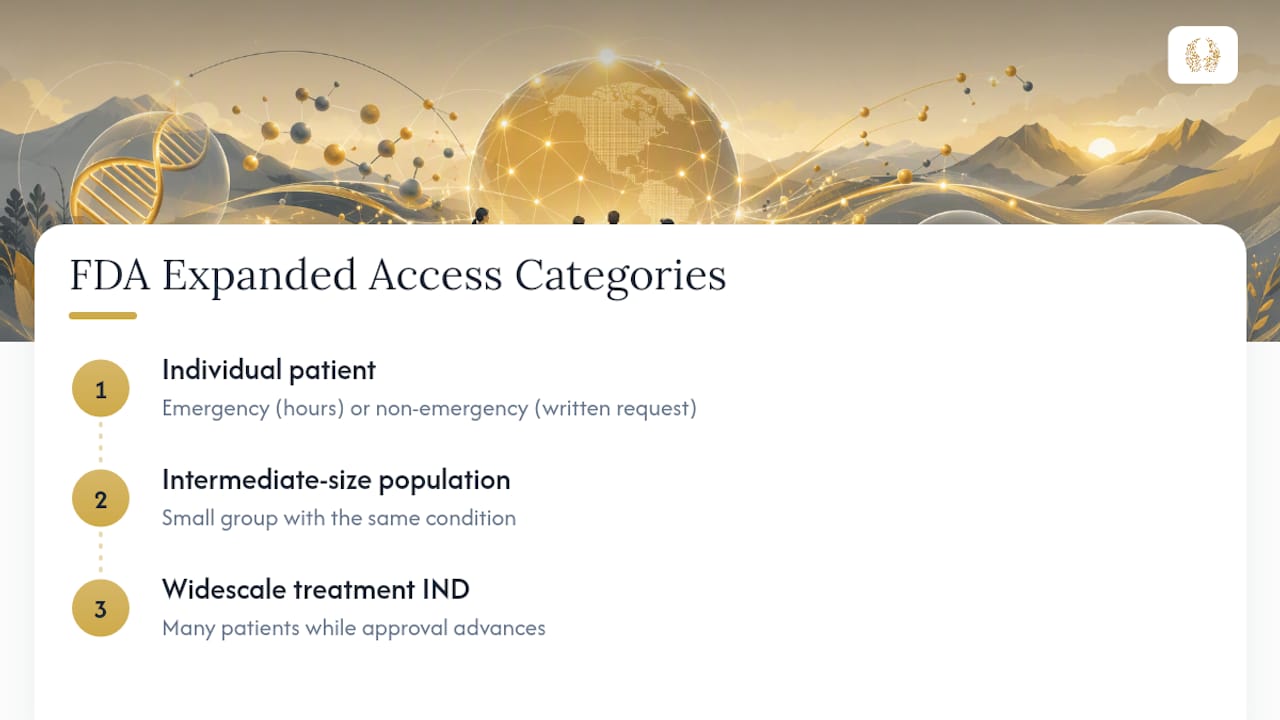
The FDA recognizes three categories. Individual patient expanded access covers one person, and it splits further into emergency use (hours matter) and non-emergency use (there’s time for a full written request). Intermediate-size population access covers a small group with the same condition. Widescale treatment IND or treatment protocol access applies when a drug shows enough promise that many patients might benefit while it moves toward approval.
Every category still carries reporting duties. Physicians must track and report adverse events to the sponsor and the FDA, and expanded access never replaces the clinical trial system. It exists specifically for patients who cannot join one.
Who Qualifies for Expanded Access
Eligibility isn’t a formality. The FDA and the treating physician have to certify several things before a request moves forward, and missing even one can stall the process.
- The patient has a serious or immediately life-threatening condition, which most advanced or metastatic cancers meet.
- No comparable or satisfactory FDA-approved therapy remains, meaning standard treatment options have been exhausted or aren’t appropriate.
- Enrolling in a clinical trial for the drug in question isn’t possible, whether because of geography, trial closure, or the patient not meeting protocol criteria.
- The potential benefit justifies the risk, and using the drug won’t interfere with clinical trials studying it for that same use.
A physician has to sign off on all of this, and the drug’s sponsor, usually the pharmaceutical company, has to agree to provide it. Both pieces have to align before an FDA request even goes in.
How to Request Expanded Access, Step by Step
The treating physician runs point on this process, not the patient or family, though your involvement in gathering records and asking questions matters at every stage.
- Start with your oncologist. Discuss whether an investigational drug fits your case and whether trial enrollment is genuinely impossible.
- Contact the manufacturer or sponsor. Your doctor reaches out to ask about the company’s compassionate use policy; many large sponsors post one on their website, but plenty of smaller biotech firms handle requests case by case.
- Secure sponsor agreement. Nothing moves forward until the company that owns the drug agrees to supply it.
- Submit to the FDA. For individual requests, physicians file Form 3926, a streamlined single-patient application.
- Get IRB review. A local Institutional Review Board typically reviews and signs off on the plan, sometimes on an expedited basis for emergencies.
- Use Project Facilitate for oncology cases. This FDA Oncology Center of Excellence service gives physicians one phone line and email address, ONCProjectFacilitate@fda.hhs.gov, for help navigating the paperwork.
- Prepare informed consent and a monitoring plan. The patient or a legal representative signs off, and the physician sets up a schedule for tracking response and side effects.
Emergency requests can happen by phone with paperwork following within days. Standard requests take longer but still move faster than most people expect.
Pro Tip: Ask your oncologist to draft a one-page medical summary early, covering prior treatments, the biological rationale for the requested drug, past toxicities, and current organ-function labs. Sponsors and FDA reviewers move faster when this is ready on day one instead of assembled piecemeal.
Right to Try vs. Expanded Access: What’s the Real Difference
Right to Try, passed into federal law in 2018, offers a second pathway. It lets eligible patients request an investigational drug directly from the manufacturer without FDA or IRB review of that individual request. Eligibility requires a life-threatening diagnosis, exhausted approved options, ineligibility for a relevant clinical trial, and a drug that has completed at least Phase 1 testing and remains in active development toward approval.
The trade-offs cut both ways:
- Speed and autonomy: skipping FDA and IRB review can shave time off the process.
- Fewer independent checks: no federal safety review of the specific request means less outside oversight of that decision.
- Manufacturer control stays the same: companies are never obligated to participate under either pathway.
- Reporting requirements are lighter, which is part of why many manufacturers still prefer routing requests through Expanded Access instead.
A 2005 through 2014 analysis of nearly 9,000 requests found the FDA approved 99% of Expanded Access applications when the proper procedure was followed. That number reflects FDA approval of the request, not manufacturer willingness to supply the drug or a guarantee that it will work. Right to Try requests bypass that FDA step entirely, so no comparable federal approval statistic exists for them.
Why Manufacturers or the FDA Might Say No
The FDA cannot force a company to hand over its drug. That single fact explains most of the friction patients run into.
- Manufacturers decide supply. A company can decline for limited manufacturing capacity, patent-stage inventory constraints, or business reasons it never has to disclose.
- Trial interference is a real concern. Sponsors worry that widespread expanded access could complicate enrollment or muddy safety data in an active trial.
- Insufficient safety data on a very early-stage compound can lead a sponsor to hold back until more is known.
- Project Facilitate helps, but it doesn’t override sponsor discretion. The FDA oncology contact point speeds up paperwork and reduces the burden on physicians, but the manufacturer still makes the final call on supply.
Expanded access has existed since the HIV treatment era, and the FDA has steadily simplified the paperwork since. The bottleneck today is rarely the federal government. It’s almost always the company that owns the drug.
What Compassionate Use Costs and How Long It Takes
Insurance generally will not cover an investigational drug or the related medical costs tied to receiving it, according to the American Cancer Society. Manufacturers sometimes provide the drug free of charge; others charge for direct costs like manufacturing and shipping, which federal rules permit but cap at cost recovery rather than profit.
By the numbers: the 1996–2014 FDA review found a 99% approval rate for expanded access requests that followed proper procedure. That statistic covers regulatory approval, not clinical outcome. Investigational drugs remain unproven for your specific cancer, and benefit is never guaranteed. Emergency requests can clear in a day; standard non-emergency requests often take one to several weeks depending on sponsor responsiveness.
Questions to Bring to Your Oncologist
Walking into that conversation with the right questions saves time and clarifies whether this path makes sense for your specific diagnosis.
- What evidence exists for this drug in my specific cancer subtype, and what side effects have shown up in other patients?
- Who supplies the drug, the manufacturer or another source, and what costs might land on me?
- How will my response and safety be monitored, and how often?
- How does this treatment interact with anything else I’m currently receiving?
- Is there a clinical trial I could join instead that would offer similar access with more structured oversight?
Pro Tip: Bring a written list to the appointment and ask your oncologist to note answers in your chart. If a request moves forward, that same documentation often becomes part of what the sponsor and FDA review.
How HCRF Helps You Navigate These Decisions
Hcrfwingstocure doesn’t supply investigational drugs. What the foundation offers is guidance for figuring out whether a clinical trial might be a better fit before compassionate use is even necessary.
- Navigator support complements your oncologist’s role in certifying eligibility and coordinating with the sponsor.
- Resources on understanding trial phases can clarify why a drug does or doesn’t qualify for Right to Try.
If Your Request Is Approved: What Happens Next
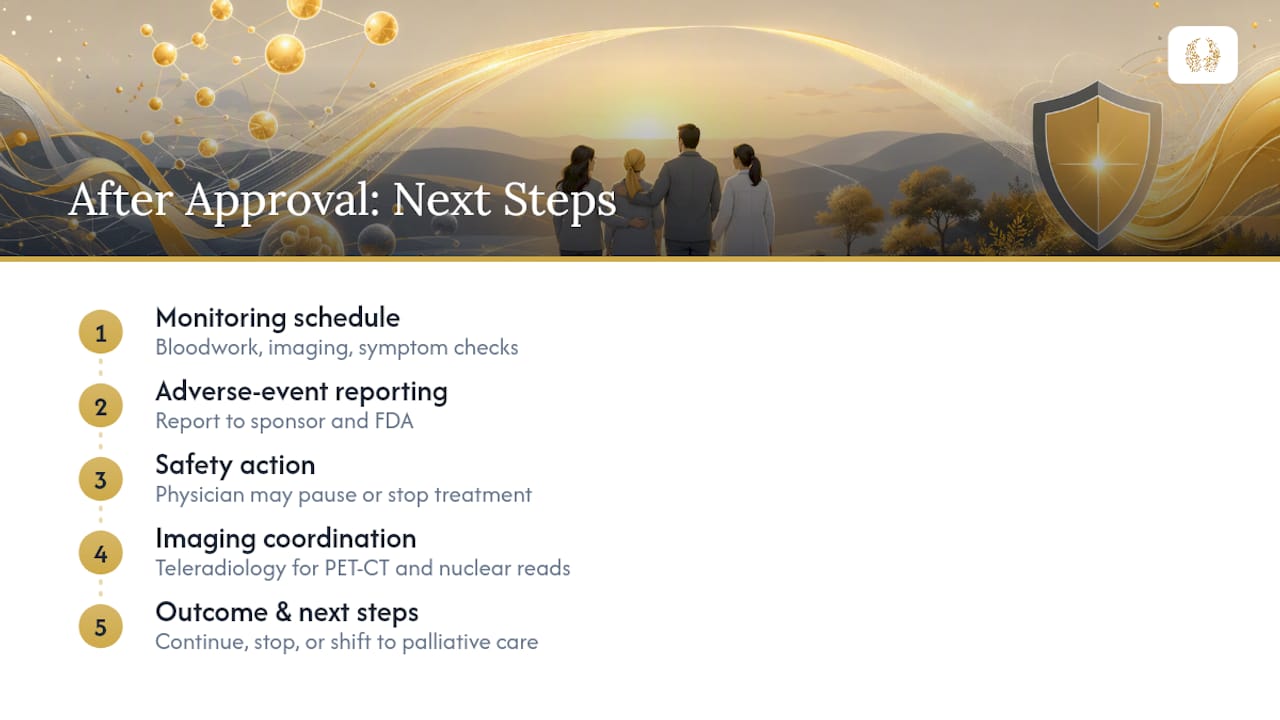
Approval is the beginning of a structured process, not the end of. Your physician sets up a monitoring schedule built around the specific drug and your baseline health, often including regular bloodwork, imaging, and symptom check-ins on a tighter cadence than standard cancer care.
Every adverse event, expected or not, gets reported to the sponsor and to the FDA under the same pharmacovigilance rules that apply to approved drugs in the marketplace. This reporting duty exists because your case adds real data to what’s known about the drug, even outside a formal trial structure. If serious side effects emerge, your physician can pause or stop treatment, and the sponsor may need to report that outcome as part of ongoing safety tracking.
Outcomes vary widely, and no one, not the sponsor, not the FDA, not your oncologist, can predict how your cancer will respond. Some patients see meaningful benefit. Others see no change, and some experience the same toxicities that come with any active cancer treatment. Investigational status means the risk and benefit profile is still being defined, which is exactly why close monitoring matters so much here.
Imaging is often part of that monitoring plan, and coordinating scans through a service familiar with oncology protocols, such as teleradiology partners handling PET-CT and nuclear medicine reads, can help keep results moving quickly back to your care team.
Your physician will also discuss what happens if the drug does or doesn’t work. Some compassionate use arrangements continue for months if a patient stabilizes. Others end quickly if there’s no response, at which point your oncologist pivots back to whatever options remain, including palliative care focused on comfort and quality of life if further active treatment isn’t appropriate.
Ethics and Your Rights as a Patient
Compassionate use sits at a genuine ethical crossroads. On one side is a dying patient’s right to try anything that might help. On the other is the need to protect people from false hope, financial harm, and treatments that haven’t been proven safe or effective.
Informed consent is the backbone of your protection here. Before treatment starts, you or your legal representative must receive a clear explanation of what’s known and unknown about the drug, realistic odds of benefit, possible risks, and your right to stop treatment at any point without it affecting your other care. Signing that consent form isn’t a formality. It’s a documented acknowledgment that you understand you’re receiving something still under study.
You also retain the right to ask questions at every step, request a second opinion, and decline participation even after initially agreeing. No physician or sponsor can pressure you into continuing a treatment that isn’t working or that you no longer want.
An ethical tension specific to cancer care deserves mention: patients facing a terminal prognosis sometimes feel pressure, spoken or unspoken, to try anything rather than “give up.” Your oncologist and care team should present compassionate use as one option among several, including hospice and palliative care, not as the only remaining path forward. A good care team will support whichever choice aligns with your values and goals, not just the one that keeps treatment options open the longest.
Weighing the Risks and Benefits for Cancer Patients
The potential upside is real: access to a drug that isn’t yet approved but has shown enough promise in early trials to justify use outside that structure. For some patients, this has meant meaningful extension of life or symptom control when nothing approved was left to try.
The risks are just as real and often understated. Investigational drugs haven’t completed the full testing that approved medications go through, so unknown side effects are possible, including ones that show up only after the drug reaches a broader population. Dosing may not be fully optimized for your specific case. And because the drug is still under study, the clinical benefit you’re hoping for might simply not materialize, even when the biological rationale sounds compelling.
There’s also a psychological dimension unique to cancer patients pursuing this route. Compassionate use can create a sense of momentum or hope that’s valuable in itself, but it can also delay honest conversations about prognosis if a patient or family treats it as a guaranteed lifeline rather than a genuine long-shot option. Your oncologist should help frame expectations honestly from the start, including the real possibility that the drug does nothing measurable.
Weigh the specific mechanism of the drug against your cancer subtype, your current functional status, and how much monitoring and travel the treatment will require. A drug requiring weekly infusions at a distant academic center carries a burden that matters just as much as the drug’s theoretical promise.
Does Compassionate Use Affect Clinical Trials?
Sponsors watch expanded access closely because it can genuinely complicate the trials studying the same drug. If too many patients access a drug outside a trial, recruitment for the actual study can slow, since patients who might have enrolled instead pursue compassionate use directly.
Safety data from expanded access use also gets folded into the broader safety picture the FDA reviews, which can be useful or complicating depending on how clean that data is. A patient receiving expanded access typically has more advanced disease and more comorbidities than a typical trial participant, since trial protocols usually exclude the sickest patients. That means adverse events reported through expanded access don’t always reflect what a healthier trial population would experience, and sponsors have to account for that context when reporting to the FDA.
This is one reason sponsors sometimes decline expanded access requests even when they’re sympathetic to the patient’s situation. Protecting the integrity of an ongoing trial protects the path toward getting the drug approved for everyone who might benefit later. It’s a real tension: helping one patient today versus protecting the data that could get the drug to thousands of patients tomorrow.
Other Paths Worth Exploring First
Compassionate use isn’t the only door, and for many patients, it isn’t the first one worth trying.
Clinical trials remain the gold standard route to investigational treatment, with structured oversight, typically no direct drug cost to the patient, and rigorous safety monitoring built in. Understanding how trial results translate to real-world risk can help you evaluate whether a specific trial is a better fit than pursuing expanded access.
Off-label use of an already-approved drug is another option your oncologist might raise, since a medication approved for one cancer type sometimes shows activity in another based on shared biological mechanisms, and this route sidesteps the entire expanded access process.
Palliative care deserves serious consideration alongside any active treatment discussion, not as a last resort but as a parallel track focused on comfort, symptom control, and quality of life regardless of what else is happening. Some patients pursue both compassionate use and palliative support simultaneously.
Medical cannabis comes up frequently in cancer symptom management conversations, primarily for nausea, appetite, and pain rather than as a cancer treatment itself. State laws vary widely on access, and it’s not a substitute for investigational therapy, but it’s worth discussing with your care team as a complement to whatever primary treatment path you choose.
Legal Protections You Should Understand
Federal law under both Expanded Access and Right to Try includes liability provisions, but they don’t work identically. Right to Try includes language limiting manufacturer and prescriber liability specifically tied to outcomes from that pathway, provided they acted in good faith and followed the law’s requirements. Expanded Access relies on the FDA’s existing regulatory framework and informed consent process for similar protection.
Physicians who follow proper procedure, obtain valid informed consent, and report adverse events as required are generally protected under the same standards that apply to any medical treatment provided in good faith. That protection isn’t unlimited. A physician who skips required documentation or fails to report a serious adverse event faces the same liability exposure as they would in any other area of practice.
As a patient, your legal protection centers on the informed consent document itself. It should specify what’s known and unknown, your right to withdraw at any time, and what reporting will occur if something goes wrong. Keep a copy. If a dispute ever arises about what you were told, that document is your primary record. Consulting a patient advocate or attorney before signing is reasonable, especially for a widescale treatment protocol involving longer-term commitments.
Real Examples of Compassionate Use in Oncology
Expanded access played a defining role during the earliest years of targeted cancer therapy, when drugs like imatinib moved through compassionate use requests for chronic myeloid leukemia patients before full approval, giving physicians real-world evidence of activity that supported the eventual approval process. That pattern, a promising early compound reaching desperately ill patients ahead of formal approval, has repeated across multiple cancer types since.
Immunotherapy drugs targeting rare tumor mutations have followed similar paths more recently, where a small subset of patients accessed a checkpoint inhibitor or targeted agent through individual patient expanded access before the drug had cleared trials for their specific cancer subtype. Project Facilitate has made a measurable difference in these cases by giving oncologists a direct line to FDA staff instead of navigating the process alone, according to the review documenting the program’s role in reducing administrative delay.
Not every case ends with a dramatic recovery, and that’s worth saying plainly. Some patients who received expanded access drugs saw no measurable benefit, and some experienced significant toxicity. The value of these programs isn’t a guarantee of success. It’s the option itself, offered transparently and with real oversight, for patients who have run out of approved paths and want to try something that might help.
A Note From HCRF
Our mission is funding the research that creates tomorrow’s treatment options, so fewer patients ever reach the point of needing compassionate use. Talk with your care team about what fits your case, and lean on our patient navigator resources if you need help finding the way forward.
— HCRF
Support the Research Behind Tomorrow’s Options
The foundation funds overlooked, high-risk cancer research that traditional grant committees sometimes pass over, supporting research that can turn compassionate use requests into future approved standards of care at a leading cancer center.

We don’t supply investigational drugs, and we’re not a substitute for your oncology team’s guidance on expanded access or Right to Try. What we do offer is a way to stand behind the science that creates more approved options and fewer families facing this decision at all. Join us at Cocktails for a Cure for an evening built around donor engagement and direct support for Lurie Cancer Center research. Or reserve your seat at HCRF’s 13th Annual Wings To Cure Gala, our flagship fundraising event bringing our community together to fund the out-of-the-box projects that rarely find backing anywhere else. Every dollar raised moves research one step closer to giving patients real approved options instead of last-resort ones.
Sources
- Expanded Access: Information for physicians | FDA
- Wheeler et al., analysis of expanded access requests (PMC5135086)
FAQ
What is the 62-day rule for cancer treatment?
This isn’t a recognized FDA or NCI rule tied to compassionate use or expanded access; it may refer to a specific insurance or hospice policy, so confirm the exact context with your care team or insurer rather than assuming it applies to your case.
How many times can you have chemotherapy in a lifetime?
There’s no fixed lifetime limit on chemotherapy; the number of cycles or treatment courses depends on the specific drugs used, cumulative toxicity to organs like the heart, and how your cancer responds, all decided case by case with your oncologist.
How does positive thinking affect cancer outcomes?
No reliable evidence shows that positive thinking alone changes tumor growth or survival, though maintaining quality of life and mental well-being can help patients tolerate treatment and stay engaged in decisions like pursuing compassionate use.
Does compassionate use require FDA approval?
Yes, for Expanded Access, physicians must file a request with the FDA, which approves roughly 99% of properly filed requests; Right to Try bypasses this FDA step but still requires manufacturer agreement.
Can Hcrfwingstocure help me get an investigational drug?
No, Hcrfwingstocure doesn’t supply or arrange investigational treatments; the foundation funds cancer research and offers patient navigator resources to help you find trials and prepare for these conversations with your own care team.
Recommended

Step by step actions to support cancer research: give, join studies, or volunteer. Also a concise charity vetting checklist and HCRF paths.
Read More →
Pick experience-first charity auction items, set start bids at 40–50% of fair market value, and follow HCRF-backed receipt and stewardship steps to secure...
Read More →