


Find Free Cancer Patient Navigator Services and Trial Access
September 9, 2026
Find Free Cancer Patient Navigator Services and Trial Access

Patient navigator services provide individualized help so patients can move through screening, diagnosis, and treatment without getting lost in a system built for specialists, not patients. The National Cancer Institute defines a navigator as someone who guides a patient through care and connects them to financial, legal, and social support, also called a patient advocate. Programs at the CDC and American Cancer Society show these services reliably improve access and satisfaction, especially for patients facing transportation, language, or financial barriers.
TL;DR:
- Most navigation programs are funded through hospital budgets, grants, or insurance reimbursements, but coverage and billing practices vary widely.
- Nonclinical navigators excel at logistical support such as scheduling, referrals, insurance, and translation, while clinical navigators provide medical guidance based on credentials.
- Navigation has been shown to improve patient satisfaction, treatment adherence, and reduce delays, especially for disadvantaged groups facing barriers like transportation and language.
- Long-term benefits, such as survival rates, are less conclusive, as most studies focus on process improvements like time-to-diagnosis and initiation of treatment.
- Patients should ask healthcare providers about navigator availability, clarify their role and tasks, and bring relevant records to initial meetings for effective support.
Table of Contents
- What Does a Patient Navigator Do? Tasks Across the Care Continuum
- Who Becomes a Patient Navigator: Clinical vs. Nonclinical Roles
- Does Patient Navigation Actually Improve Outcomes?
- Where Can You Find Patient Navigator Services?
- What to Bring to Your First Navigator Meeting
- How Are Navigation Programs Funded?
- Why HCRF Highlights Navigation in the Fight Against Cancer
- HCRF’s Perspective on Why Navigation Matters
- Where to Verify These Facts
- Sources
What Does a Patient Navigator Do? Tasks Across the Care Continuum
A patient navigator’s job is less about medicine and more about momentum. Their work keeps a diagnosis from stalling into months of missed calls, denied claims, and appointments nobody remembered to schedule.
The role stretches across the entire arc of cancer care, from the moment a suspicious scan comes back to the last day of chemotherapy and beyond. Here’s what that actually looks like in practice:
- Scheduling and logistics: booking appointments, sending reminders, and arranging transportation or lodging for patients traveling for treatment.
- Insurance and financial navigation: helping with prior authorizations, copay assistance programs, grant applications, and hospital financial-aid paperwork.
- Referrals and care coordination: connecting patients to specialists, home health services, palliative care, or community resources like food assistance and support groups.
- Clinical trial assistance: helping patients locate trials they may qualify for, understand consent paperwork, and manage the logistics of enrollment. If you’re weighing whether a trial fits your diagnosis, a navigator can walk you through cancer clinical trial eligibility requirements alongside your care team.
- Caregiver support: giving family members a single point of contact so they aren’t juggling five different departments trying to get one answer.
One limit matters here: most navigators do not give medical advice. A nonclinical navigator can tell you where the infusion center is and how to appeal a denied claim, but they generally won’t interpret your lab results or adjust your medications. That distinction shapes almost everything else about how these programs are staffed.
Who Becomes a Patient Navigator: Clinical vs. Nonclinical Roles
There’s no single license or degree required to call yourself a patient navigator, and that surprises a lot of people the first time they meet one. The role splits into two broad categories, and knowing which one you’re dealing with changes what you can reasonably ask for.
Clinical navigators are typically oncology nurses or oncology social workers. Because they carry clinical credentials, they can answer questions about side effects, explain treatment plans in more depth, and flag symptoms that need a doctor’s attention right away. Hospital-based cancer centers lean on this model most often for complex treatment phases.
Nonclinical navigators include community health workers, trained volunteers, and lay navigators without a medical background. They excel at the logistical and financial side: paperwork, referrals, transportation, translation services, and connecting patients to community organizations. Research on navigator roles confirms there’s no universal rule requiring a nurse or clinical credential for the job, which is exactly why the field varies so much from one hospital to the next.
Because there’s no single licensure model, the field has leaned on standards instead. The American Cancer Society’s Oncology Navigation Standards and its National Navigation Roundtable push toward consistent training and competencies, even though adoption still varies by institution.
A few things help you gauge who you’re working with before you rely on their guidance:
- Ask directly whether they’re a nurse, social worker, or nonclinical navigator.
- Ask what training or certification their program requires.
- Ask what tasks they’re authorized to handle versus what gets routed to a clinician.
Pro Tip: If a navigator hesitates or gives a vague answer about their clinical background, that’s your cue to ask your oncologist’s office directly who on the care team can answer medical questions versus logistical ones.
Does Patient Navigation Actually Improve Outcomes?
The evidence is genuinely encouraging, though it comes with real caveats worth understanding before you set expectations too high.
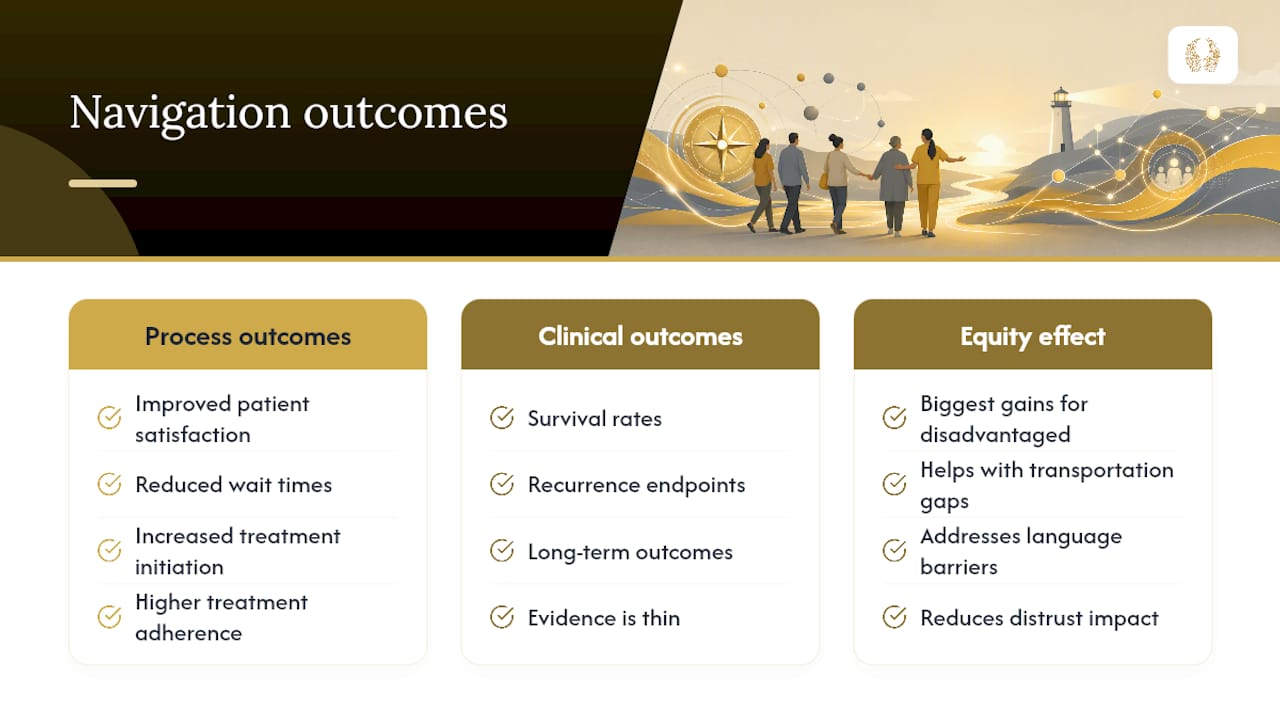
A systematic review of patient navigation programs in cancer treatment found that A majority of included studies reported improved patient satisfaction and positive effects on quality indicators like reduced wait times and increased treatment adherence.
That same body of research found many studies showing improved treatment initiation and adherence, with the biggest gains concentrated among disadvantaged and vulnerable patient populations, the people most likely to face transportation gaps, language barriers, or distrust of the medical system. Navigation doesn’t erase those barriers, but it consistently softens their impact on whether someone actually starts and stays on treatment.
Where the evidence gets thinner is long-term clinical outcomes: survival rates, recurrence, and other endpoints that take years to measure. Most studies focus on process outcomes instead, things like time-to-diagnosis, adherence rates, and satisfaction scores, because those are easier to track over a shorter window. That’s not a flaw in navigation itself; it’s a gap in how long researchers have been able to follow patients through these programs. Health-equity researchers point out that navigators are often most effective precisely because they target the transportation, language, and trust barriers that disproportionately burden marginalized communities, which is where the sharpest measurable gains tend to show up.
Where Can You Find Patient Navigator Services?
Most patients don’t know navigation exists until someone mentions it, and by then weeks of confusion have often already passed. Here’s where to start looking, in the order that tends to work fastest.
- Ask your oncologist or care team directly. Many hospital cancer centers have a navigation program built into intake, but it isn’t always advertised. A direct question, “Do you have a patient navigator?”, often gets a same-day answer.
- Contact hospital patient services or social work departments. Even centers without a formal “navigator” title usually have oncology social workers who perform the same functions informally.
- Reach out to the American Cancer Society. Its navigation programs and support line can connect patients to local resources even outside a specific hospital’s network.
- Look for community-based organizations. Local nonprofits, faith-based groups, and volunteer navigator programs frequently fill gaps for patients without access to a large academic medical center.
- Ask about case management if navigation isn’t offered by name. Hospital case managers often handle the same insurance and referral tasks navigators do, even under a different job title.
If your treatment center genuinely has no formal program, the practical workaround is asking your oncology social worker or clinic nurse to take on navigation tasks informally. It’s not ideal, but it usually works, since most of what a navigator does overlaps heavily with existing case-management roles. Major centers like Mayo Clinic build navigation into standard cancer support at no direct charge to their patients, which is a useful benchmark for what to expect elsewhere.
What to Bring to Your First Navigator Meeting
The first meeting sets the tone for everything after it, so a little preparation goes a long way toward getting real help instead of a generic overview.
Bring the basics: your insurance card, a current medication list, recent test results or pathology reports, and a contact list of every provider currently involved in your care. Having this ready saves the navigator from chasing down records before they can actually start solving problems.
Once you’re sitting down, a short set of questions cuts through a lot of ambiguity:
- Are you a clinical or nonclinical navigator?
- What specifically can you help me arrange, insurance, transportation, referrals, financial aid?
- Who will you be contacting on my behalf, and will I be copied on those communications?
- How is my information kept confidential between you and my care team?
Pro Tip: Ask for a rough timeline on your first request, whether it’s a prior authorization or a ride to your next infusion. Navigators handle dozens of cases at once, and a stated deadline keeps your issue from quietly slipping down the list.
Close the meeting by agreeing on a follow-up plan: a phone call, an email, or a set date to check progress. That single step turns navigation from a one-time conversation into an actual working relationship.
How Are Navigation Programs Funded?
Navigation services are usually free to the patient, but the money behind them comes from several different places, and that mix affects how stable and widespread a program is.
Hospital operating budgets fund some navigator positions outright, treating navigation as part of standard cancer care. Grants and philanthropic gifts fund a large share of community-based and nonprofit navigation programs, which is why funding can fluctuate year to year for smaller organizations. Some payer-funded programs also exist, built directly into insurance plans for members with a cancer diagnosis.
A more recent shift matters here: CMS now reimburses certain cancer navigation services under specific billing codes, which gives hospitals a financial incentive to build and sustain these programs rather than relying solely on grants. That’s a meaningful policy change, but billing practices still differ across systems. Before you assume a service is free, ask the program directly whether navigation is billed to your insurance or covered by grant funding.
Why HCRF Highlights Navigation in the Fight Against Cancer
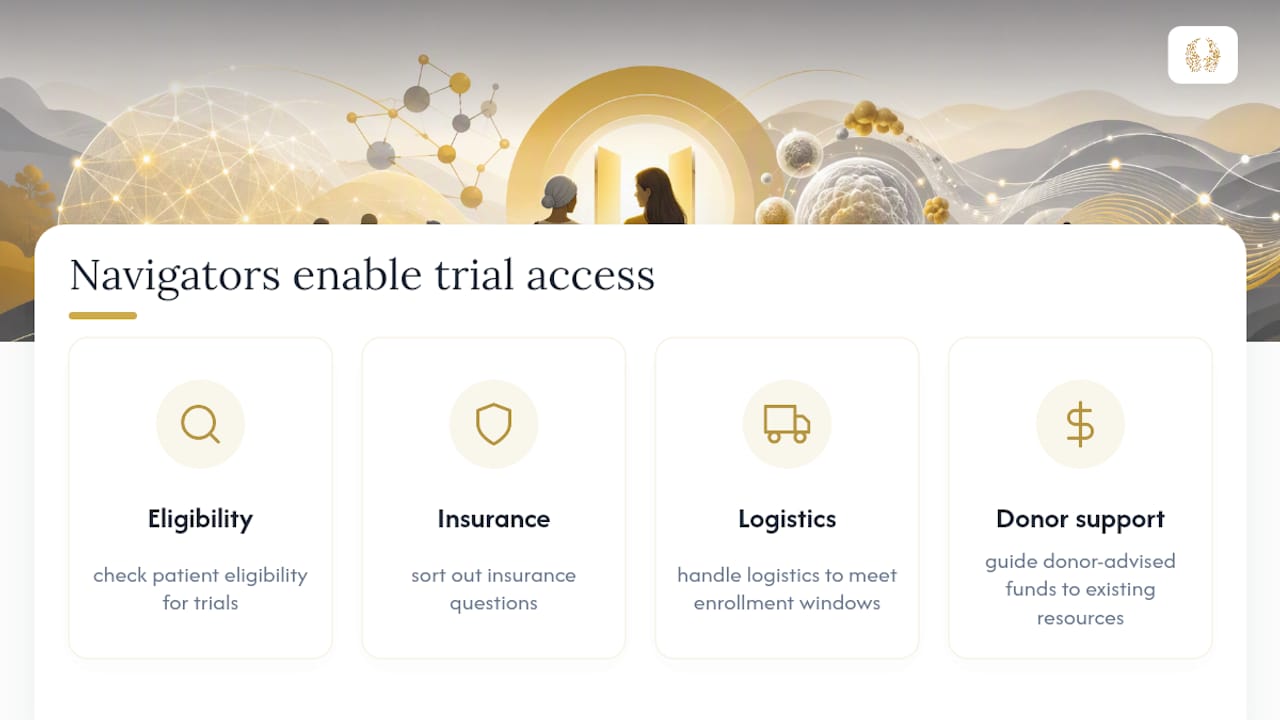
The Hippocratic Cancer Research Foundation is a 501©(3) nonprofit supporting “out of the box” cancer research at the Robert H. Lurie Comprehensive Cancer Center of Northwestern University, and navigation sits close to the mission for a simple reason: groundbreaking research means nothing to a patient who can’t get into the trial testing it. Navigators help check eligibility, sort out insurance questions, and handle the logistics that keep patients from missing enrollment windows. If you’re exploring whether a donor-advised fund could support this kind of patient-facing work, HCRF’s team can point you toward the resources already in motion.
HCRF’s Perspective on Why Navigation Matters
We’ve watched too many families discover navigation services only after weeks of confusion, missed appointments, and paperwork nobody explained clearly. That gap is exactly what breaks trust between patients and the research meant to help them. Navigation is not a luxury add-on to cancer care; it’s the connective work that lets a diagnosis turn into a treatment plan instead of a stalled file on someone’s desk. If you or someone you love is facing that gap right now, reach out to your care team, or to HCRF, and let us help point you toward the support that’s already there for you.
— HCRF
Where to Verify These Facts
- CDC: Patient Navigation — official guidance on setting up and supporting navigation programs.
- NCI Dictionary: Patient Navigator — the standard definition used across cancer care.
- Systematic Review, PMC11063100 — peer-reviewed evidence on outcomes and reimbursement trends.
- Mayo Clinic: Patient Navigators — an example of navigation built into standard cancer care.
This article is general information, not a substitute for advice from a qualified doctor. Consult a qualified healthcare professional about your own circumstances before acting on anything here.
Sources
- Patient Navigation in Cancer Treatment: A Systematic Review
- Patient navigator roles and background (PMC9205656)
- Patient Navigation | Cancer — CDC
- NCI Dictionary: patient navigator
- Mayo Clinic patient navigators page
Recommended

Learn what informed consent means in clinical trials, your rights as a participant, and how it protects you throughout the process.
Read More →
Maximize your savings with charitable donation tax deductions in 2026. Learn how to claim up to $2,000 and qualify for benefits.
Read More →