


Clinical Trial Insurance Coverage: What Patients and Sponsors Must Verify
August 17, 2026
Clinical Trial Insurance Coverage: What Patients and Sponsors Must Verify

Health insurance usually pays for your routine patient care during a clinical trial (the doctor visits, scans, and standard treatments you would need anyway), while the study sponsor covers research-only costs and the experimental drug or device itself. That split sounds tidy. In practice, it depends on your plan type, your state, and whether federal protections apply to your situation, so nothing should be assumed until you make two calls.
Before you sign a consent form, check these three things:
- The Affordable Care Act’s clinical trial provision (42 U.S.C. §300gg‑8), which bars most group health plans from denying routine coverage to qualified trial participants.
- Medicare and Medicaid rules, since both programs have specific (and sometimes state-varied) obligations to cover routine trial care.
- TRICARE eligibility, if you or a family member has military health coverage and the trial is federally sponsored.
Then do the unglamorous part: ask the study coordinator exactly which services will be billed to your insurer, and call your insurance company to confirm they know how to process trial-related claims. That one phone call resolves more billing disputes than anything else in this article.
Key Takeaways
Insurance typically covers routine patient care in a clinical trial while the sponsor covers research-only costs and the investigational product, but confirming this in writing before enrollment prevents most billing disputes.
| Point | Details |
|---|---|
| Know the payer split | Insurance covers routine care; sponsors cover research costs and the investigational product itself. |
| Cite the federal statute | §300gg‑8 requires group health plans to cover routine costs for qualified trial participants. |
| Confirm your plan type | Medicare Advantage and self-funded employer plans often process trial claims differently than standard commercial plans. |
| Get it in writing first | Call your insurer and study coordinator before enrolling, and save every confirmation email. |
| Know sponsor-side norms | Domestic trial liability policies can reach limits up to $20 million, reflecting standard industry risk practice. |
Table of Contents
- Clinical Trial Insurance Coverage: Key Terms to Know First
- U.S. Statutes and Federal Programs That Shape Coverage
- Who Pays for What: A Payer-by-Payer Breakdown
- How Sponsors Manage Risk: Insurance, Indemnity, and Cost Reality
- Verify Your Coverage Before You Enroll: A Step-by-Step Checklist
- Special Cases That Trip Up Even Careful Patients
- What to Do If You’re Billed Incorrectly or Denied Coverage
- How HCRF Supports Patients and Researchers Facing Coverage Questions
- Editorial Take: What Actually Matters When It Comes to Trial Coverage
- Frequently Asked Questions
- Sources
Clinical Trial Insurance Coverage: Key Terms to Know First
Coverage disputes almost always trace back to a vocabulary problem. Insurers, sponsors, and patients use the same words to mean different things, and that mismatch is where bills go sideways.
Routine patient care refers to any service you would receive regardless of whether you joined the trial. Think bloodwork, imaging, hospital stays, and standard-of-care chemotherapy. Research-related costs, by contrast, are the extra tests, visits, and procedures that exist purely to answer the study’s scientific question. A CT scan you’d get anyway for monitoring is routine care. An extra biopsy done only to measure a drug’s effect on tumor tissue is a research cost.
The investigational product (the drug, device, or biologic being tested) sits in its own category. Insurers exclude it from routine coverage almost universally, because it has not been approved for the condition being studied and its cost is expected to come from the sponsor. That’s also why sponsors, not insurers, typically absorb the price of the experimental therapy itself.
Liability insurance and indemnification describe how sponsors and institutions financially protect participants who are injured during a trial. Liability insurance is a policy purchased from a commercial insurer that pays claims up to a set limit. Indemnification is a contractual promise, sometimes backed by insurance and sometimes backed by government funds, to compensate for harm without requiring the participant to prove negligence in court.
| Term | Plain-Language Meaning | Who Usually Pays |
|---|---|---|
| Routine patient care | Standard treatment you’d need with or without the trial | Health insurer (subject to copays/deductibles) |
| Research-related cost | Extra tests or visits done only for study data | Study sponsor |
| Investigational product | The experimental drug, device, or biologic | Study sponsor |
| Liability insurance | Commercial policy covering injury claims | Sponsor or institution (purchased) |
| Indemnification | Contractual or government promise to cover harm | Sponsor, institution, or federal program |
U.S. Statutes and Federal Programs That Shape Coverage
The single most important legal fact in this entire topic is that group health plans covering an individual are legally required to pay routine patient costs for qualified participants in approved clinical trials, under 42 U.S.C. §300gg‑8. This provision, part of the Affordable Care Act, also prohibits insurers from dropping or discriminating against someone simply for enrolling in a trial.
That statutory language is your strongest leverage point if an insurer tries to deny a routine claim tied to trial participation. But it applies specifically to “qualified individuals” in “approved clinical trials,” so the exact wording of your diagnosis, trial phase, and plan type all matter when you’re asking a claims representative to apply it.
Federal programs layer additional protections on top of that statute, though each behaves a little differently:
- Medicare (Original Medicare Part A/B) generally covers routine costs in qualifying trials, but Medicare Advantage plans handle billing order differently and sometimes route claims back through Original Medicare, which can confuse both patients and billing offices.
- Medicaid programs are required to cover routine patient care costs for participants in qualifying clinical trials, though implementation and eligibility details vary by state, so check your state’s Medicaid office directly.
- TRICARE and VA benefits typically extend to routine costs for enrollees in NCI-sponsored trials, a detail worth confirming if you or a family member has military health coverage.
- The PREP Act shows how government indemnification works in emergency-use research: instead of relying on commercial liability insurance, the federal government provides legal protection and, in some cases, compensation pathways for injuries tied to pandemic or emergency countermeasures.
Plan type changes everything here. A fully insured employer plan behaves differently than a self-funded employer plan, and Medicare Advantage often requires extra prior authorization steps that Original Medicare does not. Confirm your exact plan type before assuming any of these protections apply automatically.
Who Pays for What: A Payer-by-Payer Breakdown
Cost responsibility in a trial splits four ways: the participant’s insurer, the sponsor, the site or institution, and occasionally a government program. NCI guidance is blunt about this: sponsors typically cover research costs, insurance typically covers routine patient care, and out-of-pocket costs can still show up for either category depending on your plan.
| Cost Category | Typical Payer | Notes |
|---|---|---|
| Routine patient care | Health insurer | Subject to normal copays, deductibles, coinsurance |
| Investigational product | Sponsor | Rarely billed to insurance or patient |
| Trial-only tests/visits | Sponsor | Extra scans or labs done solely for study data |
| Travel, lodging, meals | Sponsor or nonprofit assistance | Varies widely; ask the coordinator directly |
| Follow-up care post-trial | Insurer (if standard of care) | Sponsor only if trial protocol requires it |
Three quick scenarios show how this plays out. In a Phase II oncology trial, a patient’s insurer typically pays for the CT scans and lab work that would happen regardless of the study, while the sponsor covers the experimental agent and any extra biopsies required purely for research purposes. In a device implant study, the surgery itself might be billed to insurance as standard care, but the device is often supplied by the sponsor at no charge, with the sponsor also covering follow-up imaging that exists only to track device performance. In an emergency-use research context, like vaccine trials operating under expedited authorization, government indemnification (through mechanisms tied to the PREP Act) can replace traditional sponsor liability coverage entirely.
None of this erases your normal cost-sharing. Even when a service is billed correctly to your insurer as routine care, you still owe your usual copay, deductible, or coinsurance. Many Americans on employer plans carry deductibles that can make “covered” scans generate surprising out-of-pocket costs if plan details are not checked in advance. So, a “covered” scan can still generate a bill that surprises you if you haven’t checked your plan’s specifics.
How Sponsors Manage Risk: Insurance, Indemnity, and Cost Reality
No federal law forces a trial sponsor to carry insurance, but skipping it isn’t realistic in practice. Institutional review boards and host institutions routinely require proof of coverage before they’ll activate a protocol, which makes clinical trial insurance a de facto industry standard even without a legal mandate.
Sponsors typically choose between a master policy, which covers multiple trials under one umbrella, and a trial-specific policy, purchased for a single study. Coverage usually spans several lines: general liability, medical expense coverage for participant injuries, and professional liability for the research staff. According to insurance carriers active in this space, domestic trial policy limits can reach up to $20 million per trial, reflecting how costly a serious adverse event claim can become once legal defense and long-term medical care are factored in.

Sponsors also choose between two liability models. No-fault compensation pays for injury-related care without requiring the participant to prove negligence, which speeds up access to treatment and avoids drawn-out litigation. Tort-based indemnity requires a legal finding of fault before compensation is paid, a slower and more adversarial route that’s more common in commercial trials outside emergency contexts. A National Library of Medicine review of trial risk management notes that commercial insurance can get expensive fast in emergency-response research, which is part of why governments sometimes step in with indemnification instead. That same review cites a 2015 PREVAIL I cost estimate of roughly $65,000 to $100,000 plus about $14.16 per participant for certain coverage arrangements, a useful real-world anchor for how granular these budgets get.
Pro Tip: If your organization runs trial sites internationally, don’t assume your U.S. master policy travels with you. Many countries require a locally admitted policy before a site can even activate, and skipping that step can stall or kill a protocol’s approval at the ethics-committee stage.
Institutions negotiating these policies should push for clear certificates of insurance, explicit territory clauses, and confirmation of how local admitted-policy requirements interact with the master policy, particularly for any international arm of a domestic study.
Verify Your Coverage Before You Enroll: A Step-by-Step Checklist
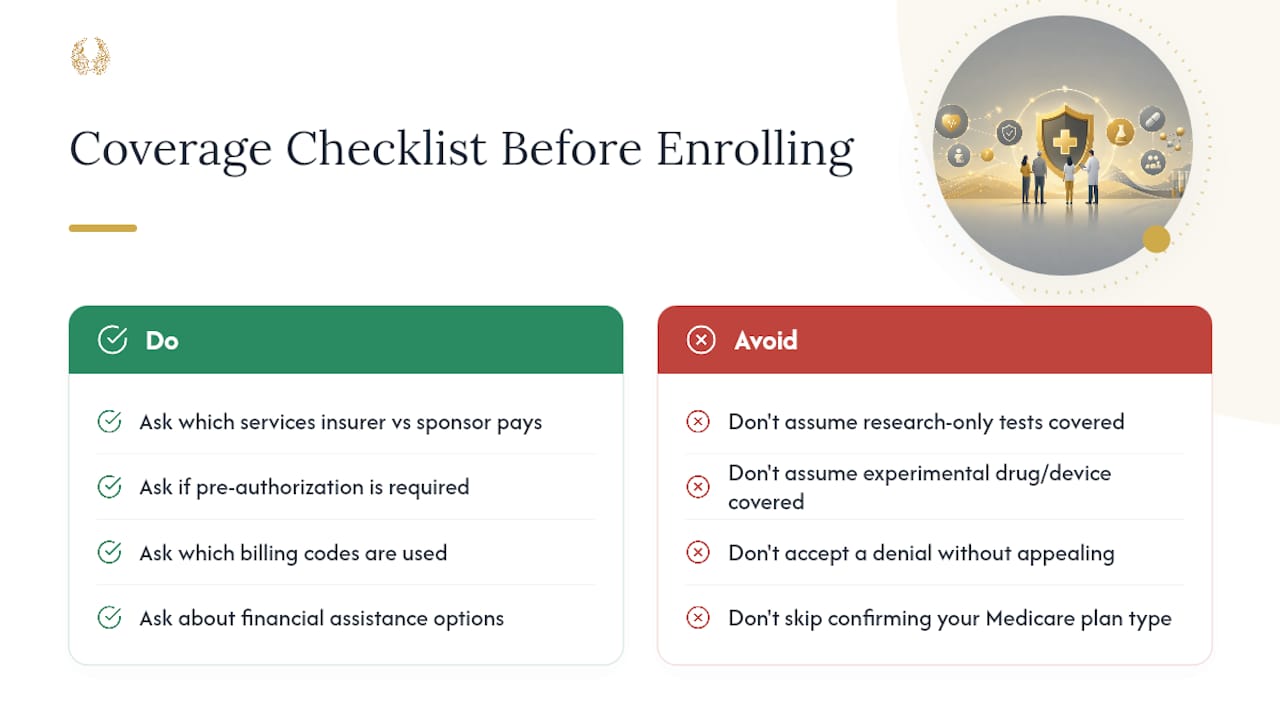
Call your insurer before you sign anything, and get whatever they tell you in writing. That single habit prevents the majority of post-enrollment billing disputes.
Specifically, confirm the following with both your insurer and the study team:
- Whether pre-authorization is required for any routine services tied to the trial.
- Which providers count as “in-network” for trial-related visits, since some trial sites operate outside a patient’s normal network.
- The billing codes the study will use, so your insurer’s claims system recognizes them correctly.
- Who bills first when both insurance and the sponsor might cover a given service.
- Whether your plan is fully insured, self-funded, or a Medicare Advantage plan, since each has different rules for trial billing order.
Keep copies of everything: the informed consent language describing what the sponsor covers, any written confirmation from your insurer, and billing authorization forms from the study site. A short, polite email to your insurer’s member services line, referencing your plan number and asking them to confirm routine-cost coverage under the trial provision, creates a paper trail that becomes invaluable if a claim gets denied later.
If you get coverage through an employer, especially a large self-funded employer plan, your benefits manager can often intervene directly with the plan administrator when a claim gets stuck. That step gets skipped constantly, and it shouldn’t be.
Special Cases That Trip Up Even Careful Patients
Medicare Advantage plans and self-funded employer plans are the two most common sources of unexpected denials, mostly because they operate under different rules than Original Medicare or fully insured commercial plans. Ask specifically whether your plan is self-funded and whether it follows Medicare Advantage billing order, since a “yes” to either question means you should get every coverage confirmation in writing before your first study visit.
A few other situations deserve extra attention:
- Uninsured or underinsured participants sometimes qualify for sponsor-funded financial assistance or site-level charity funds; ask the study coordinator directly whether such a program exists for the specific trial.
- Out-of-network billing for trial-related care can sometimes be resolved through a formal exception request to your insurer, particularly when the trial site is the only location offering the specific protocol.
- Pediatric trials often involve additional consent and billing layers, since a parent’s insurance plan, not the child’s, is usually the one being billed.
- Emergency or crisis-context research, like trials launched during a public health emergency, may rely on indemnification frameworks tied to the PREP Act rather than standard commercial billing.
If a state-level question comes up, your state insurance regulator and Medicaid office are the right first stop, and resources like Fred Hutch’s patient financial guidance walk through common scenarios in plain language.
What to Do If You’re Billed Incorrectly or Denied Coverage
Start by confirming the bill is actually correct. Study billing offices occasionally submit charges to insurance that should have gone to the sponsor, and that mistake accounts for a meaningful share of trial-related billing disputes.
Work through this sequence in order:
- Contact the study’s billing office and ask them to review whether the charge should have gone to the sponsor instead of your insurer.
- If the charge was correctly submitted to insurance but denied, request the specific denial reason from your insurer in writing.
- Bring that denial reason to the study coordinator, who may be able to provide documentation showing the service qualifies as routine patient care under 42 U.S.C. §300gg‑8.
- File a formal appeal with your insurer, attaching the coordinator’s documentation and a copy of your informed consent form.
- If the appeal is denied or delayed unreasonably, contact your state’s insurance regulator or a patient advocacy organization for help escalating the case.
Key contacts worth saving early: the study’s billing manager, your insurer’s medical director (not just the general claims line), and your state insurance department’s consumer complaint division. For complex denials involving large medical expenses, legal aid organizations and dedicated patient advocacy groups can help interpret appeal rights you might not know you have. Keep every document dated and organized. Appeals move faster when you can show a clear timeline from consent, to billing, to denial, to appeal, and institutions with a compliance office can often intervene when a straightforward appeal stalls.
How HCRF Supports Patients and Researchers Facing Coverage Questions
The Hippocratic Cancer Research Foundation is a 501©(3) nonprofit partner to the Robert H. Lurie Comprehensive Cancer Center of Northwestern University, funding “out of the box” cancer research and producing patient-facing resources that make trial participation less intimidating.
HCRF’s role isn’t to process insurance claims. It’s to fund the research that creates trial opportunities in the first place, and to make sure patients have clear, honest information about what those trials actually involve. That includes:
- Direct funding support for innovative clinical research at Lurie Comprehensive Cancer Center.
- Patient-facing guides covering specific trial types, including immunotherapy trials for lung cancer, pancreatic cancer immunotherapy trials, and immunotherapy trials for prostate cancer.
- Educational content addressing practical patient questions, including safety topics like supplements to avoid during immunotherapy.
When insurance questions become a genuine barrier to enrolling in a trial, that’s exactly the kind of obstacle HCRF exists to help patients navigate, whether through resource referrals or pointing families toward the right financial-assistance pathway. If your organization moves patient samples or trial materials across sites, coordination resources like this clinical trial logistics guide can also clarify how operational timing affects billing and site readiness.
If you want to see how donor support translates into real trial access for patients, the foundation’s full mission and resource hub is the place to start, and every gift, whether it comes through a workplace giving program or a direct donation, moves that work forward.
Editorial Take: What Actually Matters When It Comes to Trial Coverage
Most guidance on this topic buries the one thing that matters most: the phone call. Patients read pages of statutory language about §300gg‑8 and walk away without picking up the phone to confirm their own plan will actually apply it correctly. The law is real and it is strong, but it doesn’t enforce itself at the claims-processing level. Someone has to invoke it, in writing, before a denial happens rather than after.
The conventional advice tends to focus heavily on what sponsors are supposed to cover, as if that answers the practical question. It doesn’t. The gap that trips up real patients isn’t sponsor obligation, it’s insurer behavior, particularly among Medicare Advantage plans and self-funded employer plans that don’t process trial claims the way fully insured commercial plans do. That’s where the confusion concentrates, and it’s the part almost nobody checks in advance.
If there’s one thing worth prioritizing above everything else in this article, it’s this: get your plan type confirmed and your coverage documented in writing before you enroll, not after your first bill arrives. Sponsors carrying $20 million in liability coverage and government indemnification frameworks like the PREP Act matter enormously, but they exist to protect you from catastrophic scenarios. The everyday scenario, an ordinary routine-care claim getting mishandled by an insurer unfamiliar with trial billing, is solved by five minutes on the phone and a saved email, not by a federal statute you’ll never need to cite.
Frequently Asked Questions
Does insurance cover clinical trials in the United States? Health insurance generally covers routine patient care within an approved trial, meaning the standard treatments and monitoring you’d receive regardless of study participation. It typically does not cover research-only tests or the experimental drug or device, which the sponsor usually pays for directly.
What does clinical trial insurance actually cover for sponsors? Sponsor-purchased clinical trial insurance typically includes general liability, medical expense coverage for participant injuries, and professional liability for research staff, with domestic policy limits sometimes reaching $20 million per trial.
What should I ask the study coordinator about coverage for trial participants before enrolling? Ask which specific services will be billed to your insurer versus the sponsor, whether pre-authorization is required, what billing codes will be used, and whether financial assistance exists for uninsured or underinsured participants.
What happens if my insurer denies a clinical trial claim? Confirm the bill was submitted correctly, request the denial reason in writing, gather documentation from the study coordinator showing the service qualifies as routine patient care, and file a formal appeal citing 42 U.S.C. §300gg‑8 if applicable.
Does Medicare cover clinical trial insurance costs? Original Medicare generally covers routine patient care costs in qualifying trials, but Medicare Advantage plans handle billing order differently, so confirm your specific plan type with Medicare directly before enrolling.
This article provides general information about clinical trial insurance coverage and is not a substitute for professional legal, financial, or insurance advice. Confirm current rules directly with your insurer, your state insurance department, or a qualified professional before making enrollment decisions.
Sources
For verification, appeals, or deeper research into your specific situation, these primary sources carry the most weight:
- Who pays for clinical trials? - NCI
- 42 U.S. Code § 300gg-8 - Coverage for individuals participating in approved clinical trials
- Health Insurance and Clinical Trials - Fred Hutch
- Book: Clinical research risk management and insurance (NCBI)
- Medicaid
Save every insurer letter, denial notice, and consent form you receive. They’re the paper trail that makes an appeal succeed.
Recommended
- Hippocratic Cancer Research Foundation: Innovative Therapies | Immunotherapy Clinical Trials for Lung Cancer: Your Guide
- Hippocratic Cancer Research Foundation: Innovative Therapies | Immunotherapy Clinical Trials for Prostate Cancer: 2026 Guide
- Hippocratic Cancer Research Foundation: Innovative Therapies | Supplements to Avoid During Immunotherapy: A Patient Guide
- Hippocratic Cancer Research Foundation: Innovative Therapies | Pancreatic Cancer Clinical Trials: Immunotherapy Guide

Three compliance first paths for companies to partner with a cancer nonprofit, plus vetting, contracts, and impact measurement.
Read More →