


Workplace Giving Programs for Cancer Research Donors
August 1, 2026
Workplace Giving Programs for Cancer Research Donors

Workplace giving programs let employees donate through payroll deduction, request employer matches, or trigger volunteer grants — and you can use them right now to direct funds to cancer research organizations like the Hippocratic Cancer Research Foundation (HCRF). The fastest action you can take today: log into your employer’s giving portal, search for HCRF by EIN, and submit a payroll deduction or match request.
The most common program elements you’ll encounter:
- Payroll deduction — a set amount comes out of each paycheck pre-tax and goes directly to your chosen nonprofit
- Employer matching gifts — your company matches your donation, often dollar-for-dollar, up to an annual cap
- Employee-choice platforms — tools like Benevity that let you search, designate, and track gifts in one place
- Donor-advised funds (DAFs) — workplace-integrated accounts where you contribute funds and recommend grants to specific nonprofits
- Volunteer grants — employer funds triggered by your verified volunteer hours
TL;DR: Check your employer’s giving portal today. Provide HCRF’s EIN and registered name when designating. Submit a match request immediately after donating — don’t wait until year-end.
Table of Contents
- How workplace giving programs channel your donation to a nonprofit
- Practical ways to give through your workplace and support cancer research
- How to make sure your workplace gift actually reaches HCRF
- U.S. tax basics and timing you should plan around
- What to ask HR or your CSR team before you give
- How to build year-round workplace giving that funds multi-year research
- Direct your workplace gift to HCRF — here’s exactly how
- Key Takeaways
- Why workplace giving is personal to us at HCRF
- Sources and where to learn more
How workplace giving programs channel your donation to a nonprofit
Workplace giving raises a substantial amount for U.S. charities annually, and payroll deduction drives the highest participation rates of any giving method. Understanding how money actually moves helps you catch delays and ensure your gift lands where you intend.

The basic flow: you authorize a deduction or platform gift → your employer or platform processor batches contributions → funds are forwarded to the nonprofit, sometimes through an intermediary → the nonprofit receives and reconciles the deposit. Matching gifts follow a parallel track: you submit documentation after donating → your employer’s CSR team or platform verifies eligibility → the match payment is issued separately, often weeks or months later.
Three program features matter most to donors who want to support cancer research specifically. First, designation: can you name a specific nonprofit, or does the platform distribute funds to a general pool? Always confirm you can designate by EIN. Second, matching eligibility rules: some employers restrict matches to certain nonprofit categories or cap annual amounts. Third, platform fees: some processors deduct a small administrative fee before forwarding funds, which may reduce the amount your chosen nonprofit receives.
Predictable, recurring workplace gifts are among the most valuable contributions a research nonprofit can receive. A steady monthly stream of payroll deductions lets scientists plan multi-year projects with confidence — something one-time donations, however generous, cannot replicate.
Pro Tip: Ask your platform administrator whether fees are deducted from your donation or covered separately by your employer. Choosing “cover the fee” at checkout, when that option exists, sends 100% of your intended gift to the nonprofit.
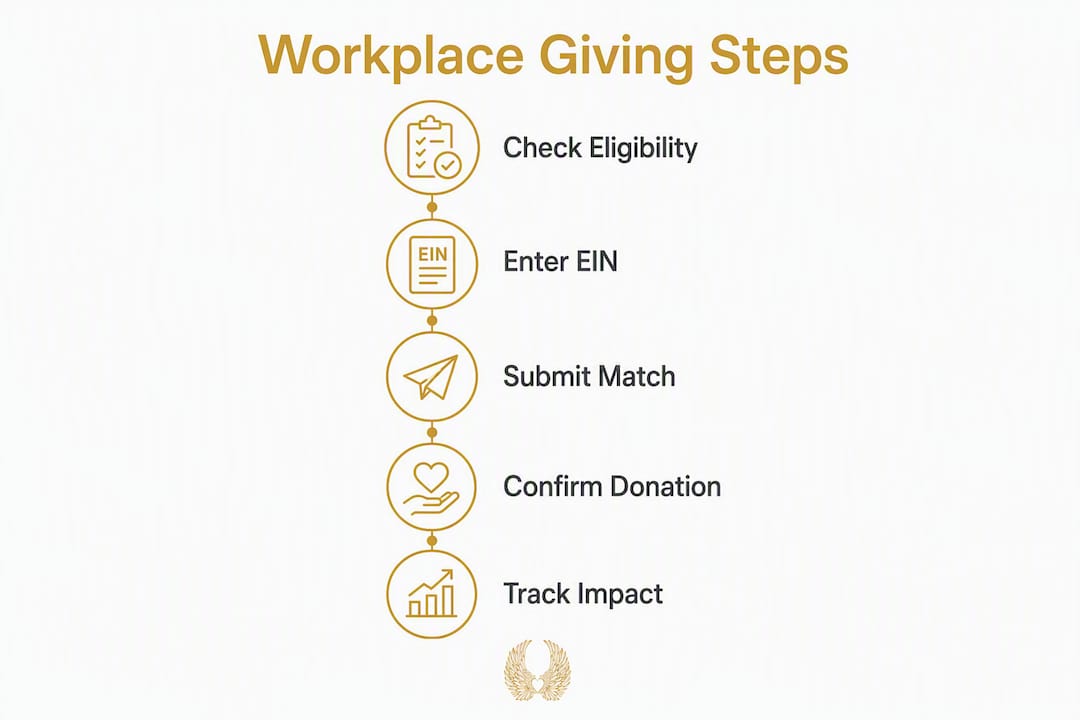
Practical ways to give through your workplace and support cancer research
Giving through your employer takes a few deliberate steps, but the impact multiplies quickly once the systems are in place.
- Enroll in payroll deduction. Log into your HR or benefits portal and search for a charitable giving option. Select a recurring amount, designate HCRF by EIN, and confirm the start date. Even a small monthly amount compounds over a full year.
- Request an employer match. After donating, locate your company’s match request form (usually in the same portal or through HR). Submit your donation receipt, HCRF’s EIN, and the donation amount. Match processing can take 4–12 weeks, so submit promptly.
- Use an employee-choice platform. If your employer uses a platform like Benevity, search for HCRF directly. These platforms often display verified 501©(3) status and allow you to track both your gift and the match in one dashboard.
- Trigger volunteer grants. Volunteer grants and peer-directed matching are increasingly common in modern programs. Log your volunteer hours with HCRF through your employer’s system. Once verified, your employer releases a grant to HCRF based on those hours — no additional out-of-pocket cost to you.
- Route a DAF gift through your workplace program. Some employers integrate with DAF providers like Fidelity Charitable. If yours does, you can recommend a grant from your DAF balance directly to HCRF, combining the tax efficiency of a DAF with the convenience of your workplace platform.
Workplace giving is shifting from seasonal campaigns to continuous, year-round engagement — which means you don’t have to wait for a company-wide drive to act. Advocate for a standing payroll option and share HCRF’s research milestones with your HR team to keep the program active.
Pro Tip: Seed a small initial gift through your platform to confirm HCRF is listed and the designation routes correctly before setting up a larger recurring deduction.
How to make sure your workplace gift actually reaches HCRF
The difference between a designated and an undesignated gift is significant. An undesignated gift goes into a general fund the platform or employer distributes at its discretion. A designated gift is earmarked for a specific nonprofit — in this case, HCRF — and that’s what you want.
Checklist: what to have ready before you submit a workplace gift or match request
- Nonprofit legal name: Hippocratic Cancer Research Foundation
- EIN: Confirm directly at hcrfwingstocure.org or via the IRS Tax Exempt Organization Search
- Preferred fund or program name: Ask HCRF donor services if you want to direct funds to a specific research initiative at the Robert H. Lurie Comprehensive Cancer Center
- Platform designation field: Enter the EIN in the “designate to specific nonprofit” field — do not leave it blank
- Contact at HCRF: Reach out through the foundation’s website for reconciliation support
If HCRF isn’t listed on your employer’s platform, don’t give up. You have three options: provide the EIN and request a manual addition, ask HR to submit a nonprofit enrollment request to the platform vendor, or request a direct match check payable to HCRF outside the platform. Most platforms add nonprofits within a few business days once the 501©(3) status is confirmed.
| Giving method | Designation possible? | Key data required |
|---|---|---|
| Payroll deduction | Yes, by EIN | EIN, nonprofit legal name |
| Employer match | Yes, tied to original gift | Donation receipt, EIN, donation amount |
| Employee platform (e.g., Benevity) | Yes, searchable | EIN or nonprofit name |
| Volunteer grant | Yes, by EIN | Volunteer hours log, EIN |
| DAF grant recommendation | Yes, by EIN | EIN, fund name |
For practical guidance on directing gifts effectively, HCRF’s donor resources walk through each step.
U.S. tax basics and timing you should plan around
Employee payroll deductions to a 501©(3) are generally tax-deductible, subject to standard IRS rules on charitable contributions. Employer matching gifts are treated as corporate charitable donations and are not taxable income to employees participating in workplace giving programs. If you give through a DAF, your deduction occurs when you contribute to the DAF, not when the grant reaches HCRF.
Timing varies by method. Payroll deductions are typically forwarded to nonprofits monthly or quarterly, depending on your employer’s payroll cycle and platform batching schedule. Match payments often take longer — anywhere from 4 to 12 weeks after you submit your request — because they require manual verification. DAF grants can be processed within days once you submit the recommendation.
Consolidated year-end tax receipts are often provided by the platform or employer after the tax year closes. Don’t rely on these alone.
Recordkeeping actions to take now:
- Save each payroll slip showing the deduction amount and nonprofit name
- Download your match confirmation email immediately after approval
- Request a written donation acknowledgment from HCRF for any gift over $250
- Keep the consolidated year-end statement from your platform for your tax return
| Giving method | Tax deduction timing | Typical fund arrival at nonprofit |
|---|---|---|
| Payroll deduction | Tax year of deduction | Monthly or quarterly batching |
| Employer match | Not tax-deductible for employee (corporate deduction) | 4–12 weeks after match approval |
| DAF grant | When contributed to DAF | Days after grant recommendation |
| Direct gift | Tax year of gift | Immediate or within days |
What to ask HR or your CSR team before you give
Getting a clear answer from HR upfront saves weeks of confusion later. Here are the exact questions worth asking — and a short email snippet you can copy.
- Is the Hippocratic Cancer Research Foundation (EIN: [confirm at hcrfwingstocure.org]) listed in our giving platform?
- If not, what is the process to add a new nonprofit, and how long does it take?
- Does our company offer matching gifts? What is the match ratio and annual cap?
- How do I submit a match request, and what documentation is required?
- Does the platform charge an administrative fee, and is it deducted from my donation?
- What records will I receive, and when will I get my year-end giving statement?
- How is my personal and donation data handled? Is employee consent required before volunteer hours are shared with the platform?
Sample email to HR/CSR:
Pro Tip: CC your CSR coordinator on the email, not just HR — CSR teams often have faster access to platform vendor contacts and can expedite nonprofit additions.
How to build year-round workplace giving that funds multi-year research
One-time campaigns raise awareness. Year-round programs fund science. Modern workplace giving models are evolving toward continuous engagement precisely because predictable monthly contributions let nonprofits like HCRF plan research timelines that span years, not quarters.
Nonprofits that provide regular, high-quality progress reports empower employer communications and drive higher participation rates — giving employers the stories they need to keep employees engaged and giving all year long.
Here’s what you can do as a donor to sustain that momentum:
- Share impact updates. Forward HCRF’s research milestone reports to your HR or CSR team. A concrete story about a clinical trial advance at the Robert H. Lurie Comprehensive Cancer Center is far more compelling than a generic charity description.
- Volunteer as a giving ambassador. Many employers support peer-led campaigns. Step up, share your story, and invite colleagues to join your payroll deduction.
- Request quarterly impact reports. Ask HCRF to send updates you can circulate internally — this keeps the program visible and participation high.
- Seed a small grant. Leadership participation and seeding funds accelerate adoption. A modest initial gift from you or a colleague signals commitment and encourages others to follow.
Fidelity Charitable research shows that workplace giving programs are associated with higher employee satisfaction and stronger alignment with company values — which gives you a compelling business case to bring to leadership, not just a personal one. For donors who want to understand how steady funding sources accelerate discovery, HCRF’s cancer research funding guide explains the connection directly.
Direct your workplace gift to HCRF — here’s exactly how
The Hippocratic Cancer Research Foundation is a registered 501©(3) that funds “out of the box” cancer research at the Robert H. Lurie Comprehensive Cancer Center of Northwestern University. That means it is fully eligible to receive designated workplace gifts, employer matches, volunteer grants, and DAF distributions through any U.S. workplace giving program.
To direct your workplace gift to HCRF, you need three things: the foundation’s legal name (Hippocratic Cancer Research Foundation), its EIN (available at hcrfwingstocure.org), and a designated gift field in your employer’s platform. If your platform doesn’t list HCRF yet, provide the EIN and request a manual addition — HCRF’s donor services team can supply any additional documentation your employer needs to complete the enrollment. Impact reports, match reconciliation letters, and research milestone updates are all available to help your employer keep the program active.
We need your support — and so do the researchers working every day to find answers that change lives. Visit hcrfwingstocure.org to confirm HCRF’s EIN, access donation resources, and connect with donor services for matching gift and payroll designation support.
Key Takeaways
Workplace giving programs are most effective for cancer research donors when gifts are designated by EIN, matched by employers, and sustained year-round rather than limited to seasonal campaigns.
| Point | Details |
|---|---|
| Designate by EIN | Always enter HCRF’s EIN in the platform’s designation field to prevent undesignated distribution. |
| Request matches promptly | Submit match documentation immediately after donating — processing takes 4–12 weeks. |
| Save all receipts | Keep payroll slips, match confirmations, and year-end statements for tax recordkeeping. |
| Advocate for year-round giving | Share HCRF impact reports with HR to sustain continuous programs beyond seasonal campaigns. |
| Give to HCRF | The Hippocratic Cancer Research Foundation accepts designated workplace gifts, matches, and volunteer grants at hcrfwingstocure.org. |
Why workplace giving is personal to us at HCRF
Most donors don’t realize that the gap between a promising research lead and a funded clinical trial is often just a matter of predictable, sustained funding. At the Hippocratic Cancer Research Foundation, we see it directly: the researchers at the Robert H. Lurie Comprehensive Cancer Center who need multi-year commitments to pursue the unconventional ideas that could change everything. Workplace giving, done right, is one of the most powerful tools a donor has — not because of any single gift, but because of what a steady stream of committed support makes possible over time.
We are grateful for every donor who takes the time to navigate a platform, submit a match request, and advocate for HCRF within their organization. That effort carries hope forward in ways that matter deeply to us and to every patient waiting for a breakthrough.
If you have questions about designating a workplace gift, need HCRF’s EIN or match documentation, or want to share an impact report with your employer, please reach out through hcrfwingstocure.org. We are here, and we are honored to walk this mission alongside you.
Sources and where to learn more
These are the primary resources donors should consult to verify EINs, understand program mechanics, and connect with HCRF:
- America’s Charities — Employee Workplace Giving: Explains payroll deduction mechanics, EIN verification, and consolidated receipt practices for U.S. donors.
- Benevity — Ultimate Guide to Workplace and Employee Giving: Covers volunteer grants, peer matching, and the shift to year-round engagement models.
- Fidelity Charitable — Giving in the Workplace: Research on employee satisfaction, values alignment, and program design best practices.
- RallyUp — Corporate Giving Programs Guide: Practitioner guidance on impact reporting, seeding, and leadership participation.
- IRS Tax Exempt Organization Search: The authoritative tool for verifying a nonprofit’s 501©(3) status and EIN before submitting a workplace gift or match request.
- Hippocratic Cancer Research Foundation: Donation resources, EIN confirmation, donor services, and impact reports for workplace giving designation.
Verifying an EIN: Go to the IRS Tax Exempt Organization Search, enter the nonprofit’s legal name or EIN, and confirm active 501©(3) status. Save a screenshot with the date — some employer platforms require this documentation alongside a match request. Always keep your year-end consolidated giving statement; it is the single document that reconciles every payroll deduction and match payment for your tax return.
This article provides general information about U.S. workplace giving programs and is not tax or legal advice. Confirm current IRS rules and your employer’s specific policies with a qualified tax professional or your HR team before making giving decisions.
Recommended
- Hippocratic Cancer Research Foundation: Innovative Therapies | How to Donate to Cancer Research and Drive Real Impact
- Hippocratic Cancer Research Foundation: Innovative Therapies | Cancer Research Funding: A 2026 Donor’s Guide
- Hippocratic Cancer Research Foundation
- Hippocratic Cancer Research Foundation: Innovative Therapies | Cancer Awareness Month Calendar: 2026 Complete Guide

A clinician-forward explainer of three proven AI applications in cancer imaging, the evidence that matters, operational risks, and the validation funders...
Read More →
How donors can verify patient-focused real-world evidence in oncology: which metrics to ask for and how HCRF reports verifiable patient impact.
Read More →