


Turn $50K into 10x: Early-Stage Research Funding for Donors & Lurie
September 2, 2026
Turn $50K into 10x: Early-Stage Research Funding for Donors & Lurie

Early-stage research funding, also called seed or pilot funding, gives cancer researchers focused, short-term support, usually capped at two years, sized to answer one question: can this idea actually work? Its job is not to prove a treatment effective; it is to generate the preliminary data that makes a larger grant possible. The Hippocratic Cancer Research Foundation (HCRF) funds exactly this kind of work at the Robert H. Lurie Comprehensive Cancer Center, and both donors and research teams can act on that today.
TL;DR:
- Pilot funding ranges from around $50,000 to $1.5 million, with most projects expected to conclude within two years and focused on feasibility.
- Reviewers assess scientific rigor, feasibility, innovation, and potential for preliminary data, emphasizing concrete, measurable endpoints.
- Funding success often depends on clear follow-on plans, with pilot data serving as the foundation for larger federal grants like R01 or SBIR Phase II.
- Donors can enhance impact through multi-year pledges, milestone funding, and transparent reporting, increasing leverage for subsequent federal and foundation support.
- Applications are more likely to succeed if they target high-risk, early-stage ideas and explicitly demonstrate the project’s feasibility and potential for future funding.
Table of Contents
- What Pilot and Seed Funding Actually Does
- Award Sizes, Timelines, and What the Money Covers
- How Reviewers Judge a Pilot Proposal
- Structuring a Gift for Maximum Leverage
- Building a Competitive Application, and How HCRF Helps
- Who Can Apply, and What Projects Qualify
- Why Pilot Applications Get Rejected
- What Happens After the Award: Reporting and Accountability
- Real Outcomes From Small Grants
- Why HCRF Backs Pilot Funding So Directly
- Fund the Idea No One Else Will Fund Yet
- Where to Go Deeper
- Sources
What Pilot and Seed Funding Actually Does
Pilot funding answers “can I do this?” It does not answer “does it work?” That distinction sounds small, but it decides whether reviewers approve or reject a proposal. A pilot grant tests recruitment logistics, workflow feasibility, assay reproducibility, or a translational idea that has never been tried in humans. It is not the vehicle for testing whether a drug reduces tumor size across a population.
The NCCIH’s guidance on pilot studies is blunt about this: pilot and proof-of-concept projects are discrete, well-defined efforts completable in a one to two year window, built to gather feasibility data rather than test broad hypotheses. Investigators at Lurie who try to squeeze an efficacy trial into a pilot budget almost always run out of runway.
Three scenarios typically call for pilot funding: testing whether a rare-population recruitment plan will actually enroll patients, confirming a new assay works reliably on human tissue before scaling it, or validating a translational approach no federal reviewer has seen before. If the answer to “can I do this” is already obvious, skip pilot funding and go straight to a larger mechanism.
Award Sizes, Timelines, and What the Money Covers
Numbers vary by program, and that range matters when donors plan a gift. Local institutional pilots often start around $50,000. Specialized ventures, including some translational programs, can climb toward $1.5 million, according to NCCIH. Federal seed pathways add another layer: NCI’s SBIR/STTR Phase I awards typically fund proof-of-concept work up to roughly $400,000, with Phase II support reaching around $2 million for teams that clear the first hurdle.
Almost every pilot award assumes the project finishes within two years. That constraint shapes the budget. Common line items include:
- Limited personnel time, often a research coordinator or part-time postdoc rather than a full team
- Assays, reagents, and lab supplies, where a research reagent supplier becomes a real budget line rather than an estimate
- Pilot recruitment costs, including patient incentives and screening
- Small equipment, biostatistics support, and regulatory or IRB fees
Donors funding a gift in this range should expect a tight, itemized budget, not a broad institutional ask. Read HCRF’s own breakdown of what cancer research really costs for a fuller picture of where dollars go.
How Reviewers Judge a Pilot Proposal
Reviewers scoring pilot applications look for a specific mix, and it differs from what they expect in an efficacy trial. According to pilot award review criteria published by the University of Wisconsin School of Medicine, four elements consistently carry the most weight:
- Scientific rigor — Is the design sound even at small scale?
- Feasibility — Can this specific team complete this specific project in the funded window?
- Innovation — Does the idea go beyond an incremental add-on to already-funded work?
- Preliminary data potential — Will the results actually support a larger grant application?
The most common mistake investigators make is writing feasibility outcomes vaguely. A proposal that says “we will assess recruitment” gives reviewers nothing to score. A proposal that says “we will enroll 20 patients within 12 months, with an 80% retention target” gives them a concrete benchmark, and pre-specified thresholds like this let reviewers judge success objectively rather than guessing at intent.
Pro Tip: Define your feasibility endpoints before you write the aims page. Recruitment rate, protocol adherence, and assay reproducibility are the three metrics reviewers most often look for, and stating a specific number for each turn an ambiguous pilot into a reviewable one.
Avoid overstating efficacy goals. If your abstract implies you are testing whether a treatment works, but your budget and timeline only support feasibility testing, reviewers will flag the mismatch immediately.
Structuring a Gift for Maximum Leverage
Donors have more control over impact than most realize, and the vehicle matters as much as the amount. A one-time restricted gift is simple and fast, but it offers less flexibility if a project’s timeline shifts. A multi-year pledge spreads risk and signals sustained commitment, which researchers can point to when applying for follow-on federal support. Donor-advised funds let philanthropists recommend specific research priorities while retaining tax advantages, a route HCRF outlines in detail for donors weighing this option. Endowed seed funds, meanwhile, generate recurring pilot money year after year rather than a single infusion.
Beyond the vehicle, the terms attached to a gift shape its leverage:
- Milestone-based funding, where a second tranche releases only after feasibility benchmarks are met
- Matching or multiplier challenges, which signal donor confidence and often help teams attract additional funders
- Clear reporting requirements built in from the start, rather than negotiated after the award
- Explicit support for follow-on grant development, including biostatistics help for the next application
Coordinating with the foundation’s development office early avoids friction later. HCRF’s donor’s guide to funding mechanics walks through the administrative side, including how restricted gifts get tracked against specific projects.
Building a Competitive Application, and How HCRF Helps
A strong pilot application checklist is shorter than most investigators expect. Reviewers want succinct aims, feasibility metrics stated as numbers rather than adjectives, a realistic one to two year timeline, a line-item budget that matches the scope, letters of support from collaborators, and a stated plan for what larger grant the pilot data will feed into.
That last item gets skipped constantly, and it shouldn’t. A pilot proposal that names its target follow-on mechanism, whether an NIH R03, an R01, or an SBIR Phase II, reads as more serious to reviewers than one that treats the pilot as an endpoint in itself.
HCRF supports Lurie teams through the full arc: funding decisions, administrative and liaison support so investigators spend less time on paperwork, structured donor reporting that keeps philanthropic supporters engaged, and matchmaking between promising projects and donors looking for a specific research focus. The recommended internal timeline runs pre-proposal review, then IRB and institutional approvals, then a funding decision, then project start-up. Teams who engage HCRF during the pre-proposal stage, rather than after drafting a full application, tend to move through that sequence faster.
Who Can Apply, and What Projects Qualify
Eligibility for pilot and seed funding hinges on both the applicant’s status and the project’s design, not just institutional affiliation. Most programs, including HCRF’s, expect applicants to hold a faculty or equivalent research appointment at Lurie, though some mechanisms extend to postdoctoral fellows with a named faculty mentor and sponsor letter.
Project eligibility depends heavily on scope. A proposal built around a genuinely novel, high-risk idea fits the pilot model well. A proposal that adds a small experiment onto an already well-funded, ongoing project usually does not, since funders at institutions like the University of Wisconsin explicitly favor ideas that could not otherwise access conventional funding streams over incremental extensions.
Study design also determines eligibility for specific mechanisms. Not every pilot idea belongs under every program. Some federal funding opportunity announcements, including NHLBI’s R34 mechanism, explicitly exclude first-in-human or Phase I safety studies, reserving that funding instead for projects that refine the design of a future full-scale trial. Investigators need to match their study type to the right mechanism before applying, not after a rejection.
For donor-funded pilots through HCRF, eligibility tends to be more flexible than federal mechanisms, since the foundation can tailor criteria to a project’s translational relevance and its fit with Lurie’s research priorities. That flexibility is one of the practical advantages of philanthropic seed funding over federal alternatives: fewer categorical exclusions, faster decision timelines, and room for ideas too early-stage for a federal reviewer to fund yet.
Why Pilot Applications Get Rejected
Most rejected pilot applications share a handful of avoidable problems, and almost none of them involve the underlying science being weak.
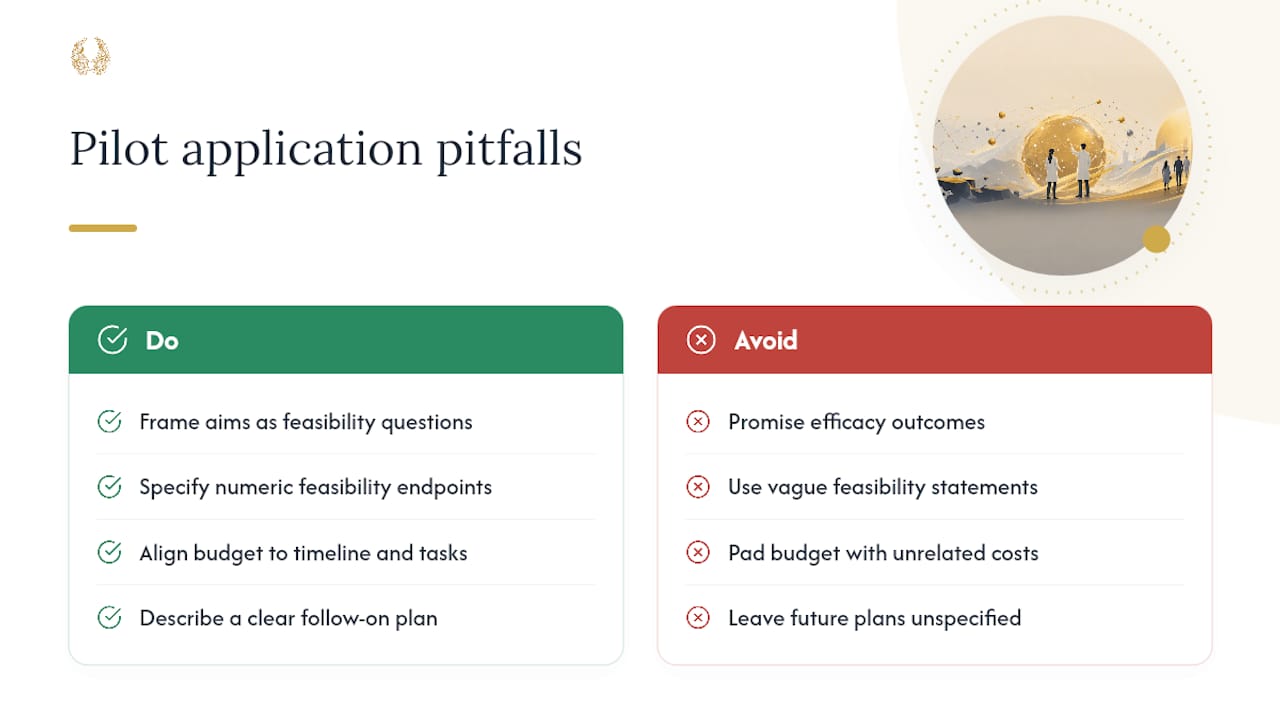
The most frequent issue is scope mismatch: an application that reads like an efficacy trial squeezed into a feasibility budget. Reviewers notice immediately when aims promise to determine whether an intervention works, rather than whether a study of it can be run. That framing error alone sinks otherwise strong proposals, and it is precisely the mistake methodological guidance on pilot study design warns against most directly.
A second common problem is vague feasibility endpoints. “We will evaluate whether recruitment is feasible” tells a reviewer nothing measurable. Applications that survive review specify a number: enrollment targets, retention percentages, assay success rates.
Budget mismatches cause rejections too. A line-item budget padded with unrelated personnel costs, or one that clearly cannot cover the proposed timeline, signals to reviewers that the team hasn’t planned realistically.
Finally, weak follow-on planning hurts otherwise solid proposals. Reviewers increasingly ask what happens after the pilot ends. An application silent on that question reads as a one-off experiment rather than a stepping stone, and stepping stones are what pilot funding exists to build.
What Happens After the Award: Reporting and Accountability
Winning a pilot award is the beginning of an accountability relationship, not the end of the application process. Most funders, HCRF included, require progress reports at defined intervals, typically at the midpoint and conclusion of the funded period, covering recruitment numbers against the stated benchmarks, any protocol deviations, and preliminary findings.
Financial accountability runs alongside scientific reporting. Budgets get tracked against actual spending, and significant deviations, such as reallocating funds from reagents to personnel, generally require prior approval rather than after-the-fact disclosure. This matters as much to donors as to federal program officers: a donor funding a restricted gift expects to see exactly how the money moved, which is why HCRF builds structured reporting into every donor-funded pilot from the start.
Beyond compliance, reporting serves a strategic purpose. A well-documented final report, one that clearly states whether feasibility thresholds were met and why, becomes the backbone of the next grant application. Teams that treat reporting as a formality miss this opportunity. Teams that treat it as evidence-building set up their next proposal months before they write it.
Real Outcomes From Small Grants
The clearest argument for pilot funding isn’t theoretical, it’s in the leverage numbers. A case study on cancer-focused seed grant programs found that recipients leveraged approximately $10.10 in follow-on funding for every dollar of seed money received. That ratio holds because pilot data does something a concept paper cannot: it gives a federal reviewer or a larger foundation actual evidence the idea works at small scale.
The path tends to follow a pattern. A pilot grant funds a small recruitment or assay-feasibility study. That study produces the preliminary data an NIH R03 application requires. The R03’s results then support a full R01 or an SBIR Phase II submission, where translational technologies move from proof-of-concept toward actual development funding, sometimes reaching the $2 million range NCI’s SBIR/STTR program offers at that stage.
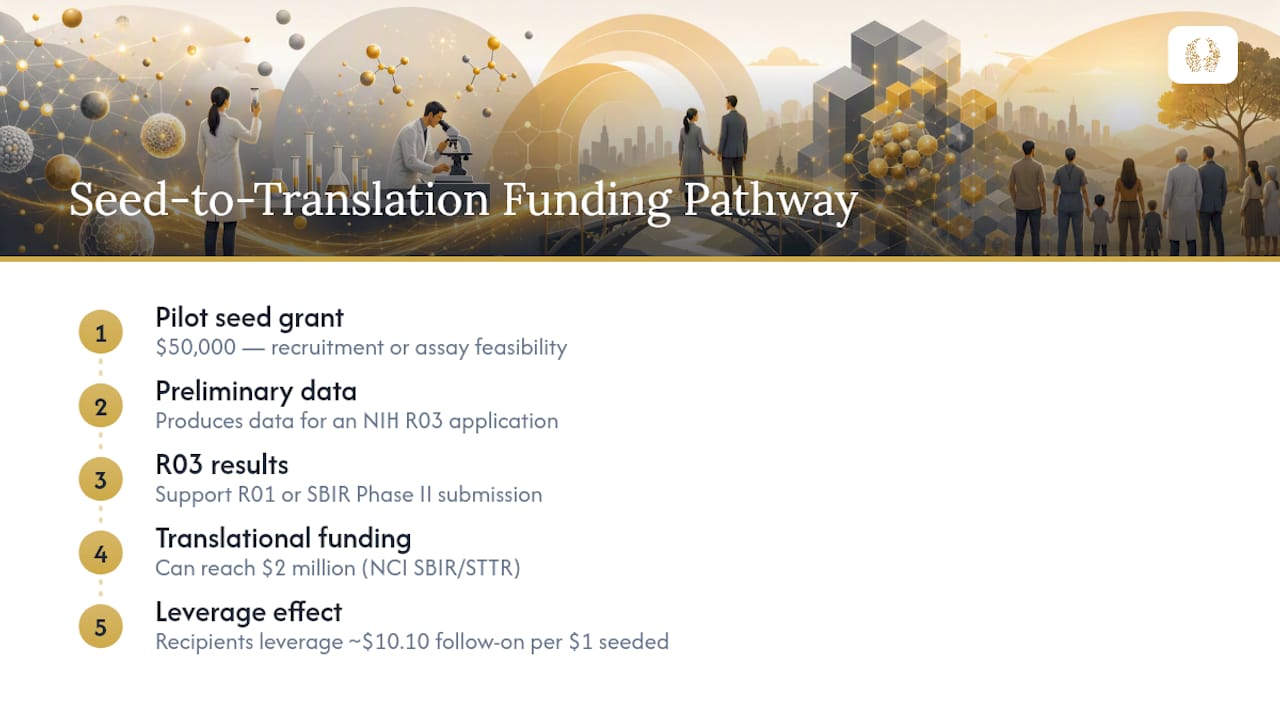
This staged progression is exactly why seed funding at Lurie matters beyond the dollar amount of any single award. A $50,000 pilot that confirms a novel biomarker assay is reproducible can become the preliminary data section of a grant application worth many multiples of that initial investment. Donors funding that first, smallest check are often funding the piece of evidence that unlocks everything after it.
Why HCRF Backs Pilot Funding So Directly
Pilot funding is where philanthropy does its most efficient work. A single restricted gift, sized correctly and reported on transparently, de-risks the uncertainty that keeps promising ideas from ever reaching a federal reviewer’s desk. HCRF has watched this pattern hold at Lurie: seed support answers the feasibility question first, and that answer becomes the preliminary data section of the next, much larger, application.
The leverage math backs this up. Roughly ten dollars in follow-on funding for every seed dollar is not a fluke; it reflects how reviewers weight demonstrated feasibility. Donors who structure gifts with milestone reporting and a clear follow-on plan see that leverage most reliably, and HCRF reports back on exactly those milestones throughout the funded period.
— HCRF
Fund the Idea No One Else Will Fund Yet
Conventional funders wait for proof. HCRF exists to fund the step that creates that proof, the pilot work that’s too early-stage, too unconventional, or too high-risk for a federal reviewer to touch yet, but exactly the kind of “out of the box” cancer research Lurie investigators need backed today.
For research teams, that means a faster route from idea to funded pilot, with administrative support and donor matchmaking built in rather than negotiated after the fact. For donors, it means a restricted gift, a donor-advised fund contribution, or a multi-year pledge that goes directly toward feasibility data with a stated follow-on plan attached, not a general operating fund. Visit the Hippocratic Cancer Research Foundation to review current pilot funding priorities, request a pre-proposal conversation if you’re a Lurie investigator, or schedule a donor briefing if you’re considering a gift. Every seed dollar is tracked against the specific project it funds, and every donor receives progress reporting tied to the milestones that project set out to hit.
Where to Go Deeper
Investigators drafting a proposal, and donors wanting to verify funding mechanics independently, should start with primary sources rather than secondhand summaries. The NCCIH’s guidance on pilot study uses and misuses remains the clearest public explanation of what feasibility funding is built to do. Teams considering a federal follow-on mechanism should read the NIH R03 notice of funding opportunity directly rather than relying on institutional summaries, since eligibility language changes between reissues. For translational and technology-focused projects, the NCI SBIR/STTR overview published in the Journal of Clinical Investigation explains award tiers and the “valley of death” bridge funding that Phase IIB awards address. Finally, the methodological case for rigorous feasibility design, including how to set stop or go criteria, is laid out in the BMC Medical Research Methodology tutorial on pilot studies, a resource worth citing in any proposal’s design section.
This article is general information, not a substitute for advice from a qualified doctor. Consult a qualified healthcare professional about your own circumstances before acting on anything here.
Sources
Recommended

Step by step actions to support cancer research: give, join studies, or volunteer. Also a concise charity vetting checklist and HCRF paths.
Read More →
Discover crucial supplements to avoid during immunotherapy. Protect your health and treatment with this essential patient guide.
Read More →