


What Does Cancer Research Really Cost? A Donor's Guide
August 11, 2026
What Does Cancer Research Really Cost? A Donor’s Guide

The cost of cancer research spans a breathtaking range: a single pilot grant may run tens to hundreds of thousands of dollars, a pivotal clinical trial can reach $17.7M to $79.4M depending on design, and bringing one drug from lab to approval carries a median R&D spend of roughly $648 million. Variability is the rule, not the exception. Trial design, patient population, endpoint type, and institutional overhead all shift the final number dramatically.
Here is a practical gift-sizing frame donors use when opening conversations with development staff:
- $25,000–$250,000: Pilot projects, feasibility studies, and early-stage investigator support
- $500,000–$5 million: Clinical trial seed funding, single-site Phase 1 or Phase 2 launch, or center infrastructure
- $50 million+: Sustained multi-site programs, endowed research centers, or long-horizon drug development
The NCI’s FY2026 Congressional Justification shows federal cancer research investment at a scale that dwarfs any single philanthropic gift, which is exactly why strategic donor dollars matter so much at the margins where federal funding stops.
Key Takeaways
Cancer research expenses span a wide range, but donors who understand the cost structure, give flexibly, and fund early-stage work consistently achieve the greatest scientific impact per dollar.
| Point | Details |
|---|---|
| Cost ranges vary enormously | Pilot grants start at $25,000; pivotal trials range from $17.7M to $79.4M depending on design. |
| Personnel drives the largest share | Salaries for PIs, CRCs, and technicians typically consume 40–60% of a direct trial budget. |
| Phase averages anchor gift sizing | Phase 1, Phase 2, and Phase 3 clinical trials have average per-study costs that increase substantially from early to late phases, varying by therapeutic area. |
| Unrestricted gifts move science faster | Flexible funds cover protocol amendments, indirect-cost gaps, and bridging periods that restricted gifts cannot. |
| HCRF funds the frontier | The Hippocratic Cancer Research Foundation directs gifts to early-stage investigators at the Lurie Cancer Center, where donor impact is highest. |
Table of Contents
- What do your dollars actually pay for in a cancer research budget?
- How do research costs vary by phase and trial type?
- Who funds cancer research in the U.S., and how is the money structured?
- How are donor gifts typically used, and what can each gift size accomplish?
- What strategies help you get more impact from every dollar you give?
- How should you evaluate a grant proposal before committing?
- How were the numbers in this guide derived?
- HCRF’s perspective on where donor dollars matter most
- Support HCRF and put your gift where it matters most
- Sources
What do your dollars actually pay for in a cancer research budget?
Every cancer research budget breaks into direct costs and indirect costs. Direct costs are the line items researchers request for the science itself. Indirect costs, also called facilities and administration (F&A) charges, cover the institutional infrastructure that makes the science possible: building maintenance, compliance offices, shared equipment, and utilities.
Direct cost categories donors will see in proposals:
- Personnel: Principal investigator (PI) salary, clinical research coordinators (CRCs), biostatisticians, and lab technicians typically consume 40–60% of a trial budget
- Clinical procedures: Imaging scans, biopsies, infusions, and protocol-required visits
- Central lab costs: Biomarker assays, genomic sequencing, and correlative science panels
- Drug supply and acquisition: Especially high for targeted therapies and biologics, where manufacturing complexity drives costs well above conventional chemotherapy
- Data management and EDC: Electronic data capture systems, database builds, and query resolution
- Monitoring and site visits: Clinical research associate (CRA) travel and oversight, now increasingly risk-based
- Participant reimbursements: Travel, lodging, and time compensation for trial participants
A CASRAI budgeting guide notes that oncology trials carry higher per-patient costs than most other therapeutic areas because they require specialized biomarker testing, small and hard-to-find patient populations, and long-term follow-up that intensifies personnel oversight.
A Premier Research analysis of more than 170 site budgets found that per-patient investigator grant costs rose sharply from 2015 to 2025, with Phase I per-patient site costs more than doubling in many cases. Personnel, start-up fees, IRB charges, pharmacy handling, and institutional overhead drove most of that increase.
Pro Tip: Unrestricted gifts matter most for indirect-cost shortfalls, rapid protocol amendments, and bridging funds between grant cycles. Restricted gifts fund specific line items but cannot flex when a protocol changes mid-study.
How do research costs vary by phase and trial type?
The ASPE/HHS analysis using Medidata cost modeling provides cross-therapeutic-area phase averages that give donors a useful anchor:
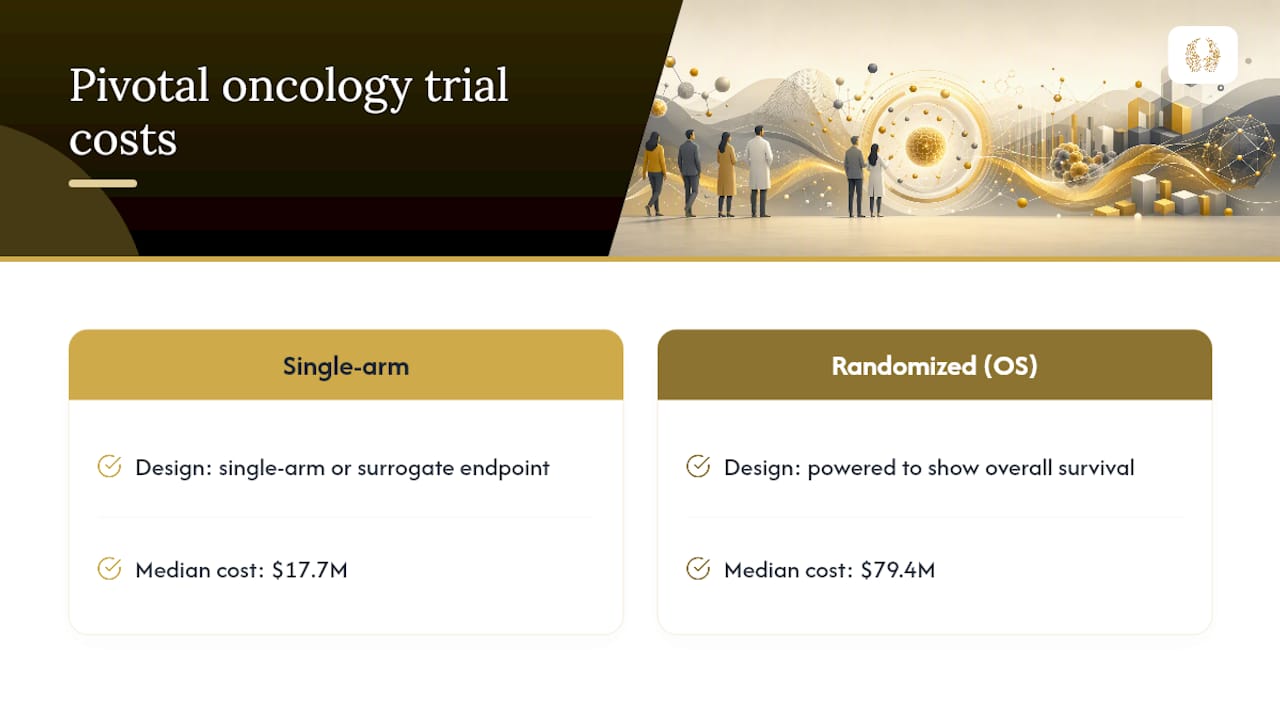
Pivotal oncology trials show even wider swings. A peer-reviewed analysis of FDA-approved cancer drugs from 2015–2017 estimated a median pivotal trial cost of roughly $17.7 million for single-arm or surrogate-endpoint designs, rising to a median of $79.4 million for trials powered to show overall survival benefit. Randomization and hard endpoints are expensive.
Basic and translational research sits at a different cost level entirely. A well-funded bench lab running preclinical oncology studies might operate on $300,000–$1.5 million per year. The leap to an Investigational New Drug (IND)-enabling package and first-in-human trial is where budgets climb steeply and where philanthropic seed funding is most catalytic.
Modern immune and targeted therapies push budgets higher still. Drug-acquisition and biologic assay costs for precision-medicine trials substantially exceed those of conventional chemotherapy regimens, which is why a Phase 2 immunotherapy study can cost twice what a comparable cytotoxic trial would.
Who funds cancer research in the U.S., and how is the money structured?
Federal investment dominates the landscape. The NCI distributes funds through four primary mechanisms: Research Project Grants (RPGs, including R01s), Research Centers (P30/P50 grants), R&D contracts, and intramural programs at NIH campuses. The NCI Fact Book shows extramural obligations spanning all four mechanisms, with RPGs representing the largest share of investigator-initiated science.
Pharmaceutical and biotech industry funding is the other major pillar, typically covering late-stage trials where commercial return is visible. Early-stage and higher-risk work, the kind that generates tomorrow’s breakthroughs, relies far more on federal grants and philanthropy.
Philanthropic dollars occupy a specific and powerful niche:
- Gap funding: Covering the period between a grant’s end and the next award cycle
- Indirect-cost supplements: Helping institutions accept smaller restricted awards by covering F&A shortfalls
- Pilot and feasibility grants: Generating the preliminary data that makes a competitive federal application possible
- Infrastructure: Funding shared equipment, biorepositories, and data platforms that federal grants rarely cover fully
The FY2026 NCI Congressional Justification also highlights how policy changes, such as proposals to cap indirect cost rates, can materially reduce the net funding that reaches investigators and centers. When federal indirect-cost policy tightens, philanthropic support for institutional infrastructure becomes even more consequential.
How are donor gifts typically used, and what can each gift size accomplish?
Translating a gift into a tangible outcome is what separates a meaningful donor conversation from a generic ask. Here is how gift sizes typically map to research milestones:
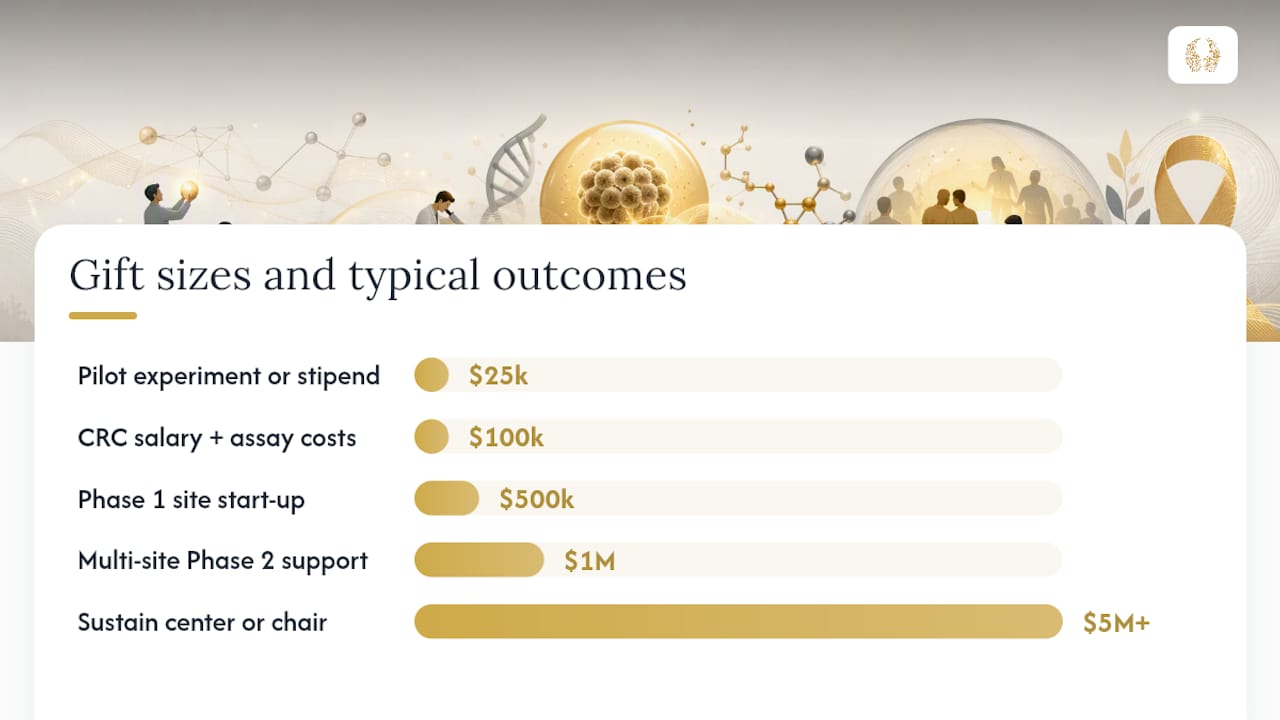
- $25,000: Funds a pilot experiment, a graduate student stipend for one year, or a key assay panel that generates preliminary data
- $100,000: Covers a CRC’s salary for a year plus biomarker assay costs for a small cohort study
- $500,000: Seeds a Phase 1 site opening, covering start-up fees, IRB costs, pharmacy setup, and initial patient enrollment
- $1 million: Supports multi-site Phase 2 coordination, including monitoring, data management, and investigator meetings
- $5 million+: Sustains a research center, funds an endowed investigator position, or underwrites a multi-year translational program
Costs are not incurred evenly across a project’s life. Preclinical and IND-enabling work front-loads laboratory and regulatory expenses. Trial start-up, which includes IRB review, site contracting, and staff training, arrives next and can take 12–18 months before a single patient enrolls. Enrollment and treatment phases drive the highest monthly burn rates. Analysis and publication costs come last but are frequently underfunded.
Philanthropy’s highest-leverage role is at the earliest stages, where federal and industry funders rarely go. Unrestricted gifts that allow rapid re-budgeting prevent study delays when protocol amendments arrive unexpectedly, which they almost always do.
What strategies help you get more impact from every dollar you give?
Giving mechanics that multiply your impact:
- Multi-year commitments give researchers the planning horizon to hire staff and open sites without worrying about annual renewal gaps
- Challenge grants and matching funds motivate additional donors and can double the effective value of a single gift
- Unrestricted gifts let institutions direct funds to the highest-priority need, including indirect-cost shortfalls and bridging awards
- Funding early-stage investigators carries the highest scientific risk but also the highest potential return, since junior faculty often pursue the most original questions
- Infrastructure support (shared equipment, biorepositories, data platforms) benefits every researcher at an institution, multiplying the reach of a single gift
Cost-reduction levers are equally worth funding. The ASPE/HHS modeling shows that moving appropriate activities to lower-cost settings, including in-home testing, mobile technology for data capture, and centralized laboratories, materially reduces per-trial costs across all phases. Donors who fund pilot programs testing these approaches create savings that compound across future studies.
Supply-chain efficiency matters too. Thoughtful peptide and reagent procurement strategies can reduce lab costs meaningfully, particularly for biomarker-heavy precision-medicine trials.
Both protect your investment without constraining the science.*
How should you evaluate a grant proposal before committing?
A credible proposal is specific, justified, and honest about risk. Use this checklist when reviewing any request:
- Line-item realism: Are personnel costs tied to named roles with FTE percentages? Are procedure costs based on actual site rates?
- Indirect cost clarity: Is the F&A rate stated, and is it the institution’s federally negotiated rate?
- Monitoring plan: Does the budget include CRA costs or a risk-based monitoring strategy?
- Data management: Is there a line item for EDC, database build, and query resolution?
- Patient recruitment strategy: Are enrollment projections based on site-specific historical data, not optimistic assumptions?
- Contingency and amendments: Is there a protocol amendment reserve, or at least a re-budgeting provision?
- Measurable milestones: Are go/no-go decision points defined with specific scientific criteria?
Red flags to watch for:
- No indirect cost allowance (signals the institution may not be able to execute)
- Absent or vague monitoring plan
- Enrollment targets that exceed the site’s documented patient volume
- Missing IRB approval or timeline for approval
- PI with no track record in the proposed therapeutic area
- Budget that does not account for start-up fees, pharmacy handling, or central lab costs
Trust signals worth weighting: NCI/NIH-style milestone structures, IRB approvals already on file, experienced PIs with funded grant histories, and concrete per-patient site budgets backed by actual site-cost data.
How were the numbers in this guide derived?
The ranges and benchmarks here draw from four source types: peer-reviewed cost analyses, NCI budget documents, industry cost models, and site-budget trend reports.
Primary sources and their roles:
- NCI Congressional Justification (FY2026): Federal mechanism-level budget totals and indirect-cost policy context
- ASPE/HHS Medidata-based analysis: Phase-average per-study cost estimates and component shares across therapeutic areas
- PMC peer-reviewed drug-development analysis: SEC-based median R&D cost estimate for single cancer drugs
- CASRAI clinical trial budgeting guide: Line-item logic and oncology-specific cost drivers
- Premier Research site-budget analysis: Per-patient investigator grant trends from 2015–2025
- SAGE/peer-reviewed pivotal trial cost study: Median pivotal trial costs by endpoint and design (2015–2017 FDA approvals)
Limitations are real. Costs vary by trial design, therapeutic area, geography, institutional overhead rate, and sponsor type. The figures here are benchmarks for donor orientation, not precise budget forecasts. Any specific proposal should be evaluated against its own detailed justification.
HCRF’s perspective on where donor dollars matter most
At the Hippocratic Cancer Research Foundation, we have watched the funding landscape long enough to hold a strong opinion: the most consequential donor dollars are the ones that go where no one else will.
Federal grants reward preliminary data. Industry funds de-risked late-stage trials. That leaves a persistent gap at the frontier, where a brilliant early-career investigator has a genuinely original hypothesis but no pilot data to compete for an R01. That is where we focus. That is where your gift can change the trajectory of a scientific career and, through it, the trajectory of a disease.
We also believe that unrestricted gifts are undervalued by most donors. The instinct to fund something specific and named is understandable. But the researchers we support at the Robert H. Lurie Comprehensive Cancer Center tell us, consistently, that flexible funds are the ones that actually move science forward. They cover the unexpected assay, the protocol amendment, the bridge between grants. They keep momentum alive when bureaucratic timelines would otherwise stall a study.
If you want to fund a named project, we will find you one worth naming. If you want to give us the flexibility to deploy your gift where the need is greatest, we will honor that trust with full transparency and annual reporting.
Support HCRF and put your gift where it matters most
Every dollar given to the Hippocratic Cancer Research Foundation goes directly toward funding the kind of bold, early-stage cancer research that federal agencies and industry sponsors routinely pass over. We support investigators at the Robert H. Lurie Comprehensive Cancer Center of Northwestern University who are pursuing the questions that could change everything.

Your giving options are straightforward. An online gift can be directed to our general research fund or to a specific investigator or project. A named fund or multi-year pledge gives researchers the planning horizon they need to hire staff and open trials. Corporate sponsors can structure event sponsorships or matching gift programs that engage employees while funding science that matters.
Whatever your giving level, we will connect you with the researchers your dollars support and report back on what your investment made possible. Visit HCRF to make your gift or discuss philanthropic partnership with our team today.
Sources
These primary sources underpin the figures and frameworks in this guide. Each is worth bookmarking for your own due diligence.
- NCI Congressional Justification FY 2026
- Examination of clinical trial costs and barriers for drug development — ASPE (HHS)
- Research and development spending to bring a single cancer drug to market and revenues after approval — PMC/peer-reviewed analysis
- Cost of Running a Clinical Trial: Budgeting — CASRAI
- Escalating site burden and cost: What’s driving the surge in oncology investigator grants over the past decade — Premier/Conference supplement
This article is general information, not a substitute for advice from a qualified financial advisor. Consult a qualified financial professional about your own circumstances before acting on anything here.
Recommended
- Hippocratic Cancer Research Foundation: Innovative Therapies | Cancer Research Funding: A 2026 Donor’s Guide
- Hippocratic Cancer Research Foundation: Innovative Therapies | How to Donate to Cancer Research and Drive Real Impact
- Hippocratic Cancer Research Foundation: Innovative Therapies | Breast Cancer Research Funding: A Researcher’s Guide
- Hippocratic Cancer Research Foundation: Innovative Therapies | Workplace Giving Programs for Cancer Research Donors

On Monday, January 8th, 2024 The Hippocratic Cancer Research Foundation proudly presented the gala proceeds check to Dr. Platanias and the Lurie's Cancer Center.
Read More →
Discover the 2026 cancer awareness month calendar. Plan impactful events and campaigns with key dates for every major cancer type. Join the fight!
Read More →