


Using a Donor-Advised Fund to Support Cancer Research
August 27, 2026
Using a Donor-Advised Fund to Support Cancer Research

Yes, you can recommend a grant from your donor-advised fund to support cancer research, and for most donors it’s one of the most efficient ways to give. But the mechanics matter. Your tax deduction happened the moment you funded the DAF, not when you recommend a grant to a cancer charity. Grants must go to IRS-qualified public charities, and they can’t hand you or your family more than an incidental personal benefit, like a seat at a gala dinner. If your employer offers matching gifts, don’t assume your DAF grant qualifies. Here’s what changes your outcome:
- Confirm the nonprofit’s legal name and EIN before you submit anything.
- Understand that your deduction is locked in already. A DAF grant doesn’t generate a new one.
- Check with your employer directly. Most matching programs require a direct gift, not a DAF recommendation.
- Use your sponsor’s portal or a DAFPay widget to send the grant and specify how you want it attributed.
Key Takeaways
Donor-advised fund grants can fund cancer research effectively when donors confirm nonprofit eligibility, respect IRS restrictions, and favor unrestricted, recurring gifts over scattered one-time grants.
| Point | Details |
|---|---|
| Deduction happens at funding | You claim your tax deduction when you contribute to the DAF, not when you recommend a grant. |
| No personal benefit allowed | Grants can’t cover event tickets or anything else that benefits you personally. |
| Matching gifts often don’t apply | Check your employer’s policy directly since most matching programs require a direct gift. |
| Unrestricted gifts fund risk | Early-stage, unconventional research often depends on flexible, unrestricted DAF support. |
| International grants take longer | Foreign organizations typically require equivalency determination, adding weeks to processing. |
This article is general information, not a substitute for advice from a qualified financial advisor. Consult a qualified financial professional about your own circumstances before acting on anything here.
Table of Contents
- How Donor-Advised Fund Cancer Giving Actually Works
- What Can a Cancer-Focused DAF Grant Actually Fund?
- How Do You Recommend a Grant to a Cancer Nonprofit?
- Why Doesn’t My Employer Match My DAF Grant?
- What Fees and Timelines Should You Expect?
- How Can You Recommend a DAF Grant to HCRF?
- Who Qualifies for Cancer-Related DAF Grants?
- Does DAF Money Actually Move Cancer Research Forward?
- Can You Fund International Cancer Research Through a DAF?
- Do DAF Grants Help Patients Directly, or Only Research?
- How Do You Stay Engaged With a Cancer Nonprofit Beyond One Grant?
- A Straight-Talk Take on DAF Giving for Cancer Research
- Sources
How Donor-Advised Fund Cancer Giving Actually Works
A donor-advised fund is a charitable account you fund through a sponsoring organization, which takes legal ownership of the assets while you retain “advisory privileges” over how they’re granted. You get your federal tax deduction the moment you contribute to the fund, whether that gift lands with a cancer research charity next week or three years from now. Every grant you recommend afterward is exactly that: a recommendation. The sponsor has to approve it, and it produces no additional deduction.
Sponsors matter more than most donors realize. Fidelity Charitable, Schwab Charitable, Vanguard Charitable, and the National Philanthropic Trust each run their own approval process, though all four generally accept grants to IRS-qualified public charities. If your DAF is advisor-managed, meaning a financial advisor oversees the account, that advisor often plays a role in shaping grant timing and asset allocation alongside you.
Two practical notes for 2026 planning:
- Deduction rules and floors for charitable giving shift periodically at the federal level, so timing large contributions matters.
- A tax advisor can tell you whether bunching several years of giving into one DAF contribution this year makes sense for your bracket.
What Can a Cancer-Focused DAF Grant Actually Fund?
Grants can go to any IRS-qualified 501©(3) public charity doing cancer research, patient support, or treatment access work. That’s the easy part. The restrictions are where donors trip up.
- No private benefit. If a grant buys you a table at a gala, tickets to an event, or any goods and services in return, the sponsor will likely reject it or require you to pay the “fair market value” portion out of pocket first. DAF grants cannot confer more than an incidental personal benefit.
- No private foundations or individuals. Grants have to go to public charities, not private non-operating foundations, and never directly to a patient or family, however sympathetic the case.
- No pledge fulfillment. If you already made a legally binding pledge to a cancer charity, using DAF funds to satisfy that exact pledge can violate IRS rules. The safer language, and what most sponsors recommend, is to tell the nonprofit you “intend to recommend a grant” rather than promising a fixed amount.
- No political activity. Cancer advocacy campaigns tied to legislation or candidates are off-limits for DAF dollars.
Violating these rules can trigger excise taxes on the sponsor and, in some cases, on the donor. If you’re unsure whether a planned gift, especially one tied to an event, crosses a line, call your sponsor’s grant compliance team before you submit the recommendation.
Pro Tip: If you want to support a gala or fundraising walk for a cancer nonprofit, recommend the grant as general event support rather than ticket purchase, and buy any tickets or table seats separately with personal funds.
How Do You Recommend a Grant to a Cancer Nonprofit?
Getting a grant approved quickly comes down to preparation. Here’s the order that works:
- Get the nonprofit’s exact legal name and EIN. A slightly wrong name (a program name instead of the parent organization) is the most common cause of processing delays.
- Log into your sponsor’s portal, whether that’s Fidelity Charitable, Schwab Charitable, Vanguard Charitable, or NPT, or use the nonprofit’s DAFPay widget if it offers one for direct grant initiation.
- Fill in the memo field with specifics: which fund, program, or campaign you’re supporting, and any event name if relevant.
- Decide whether the grant is restricted to a specific research area or unrestricted. Many research organizations actually prefer unrestricted gifts because they can move that money toward early-stage, high-risk projects that don’t yet have dedicated funding.
- Request anonymity in the portal if you want it. The sponsor and nonprofit are both equipped to honor that.
- Follow up two to three weeks later if you haven’t received acknowledgment.
A few things to keep on hand for your records:
- A copy of the grant confirmation from your sponsor
- The nonprofit’s acknowledgment letter (for your files, since the deduction was already taken)
- Notes on whether the gift was restricted or unrestricted, useful if you’re tracking your giving across multiple years
Why Doesn’t My Employer Match My DAF Grant?
This catches donors off guard constantly. You recommend a generous grant through your DAF, expect your employer to double it, and then find out it doesn’t qualify. Many corporate matching gift programs require a direct gift from the employee to the nonprofit, not a grant recommended through a donor-advised fund, because the DAF sponsor, not you personally, is technically the donor of record.
Before you route a large gift through your DAF expecting a match, check your employer’s matching gift policy directly. Some companies have started updating policies to accommodate DAF grants, but they remain the exception rather than the rule.
Noncash assets are where DAFs genuinely shine. Contributing appreciated securities directly into your DAF, rather than selling them and donating cash, lets you avoid capital gains tax while still claiming a deduction on the full fair market value. The tradeoff is processing time: noncash contributions require your sponsor to liquidate or value the asset, which takes longer than a cash grant.
International giving or complex assets add another layer. Grants to organizations outside the U.S. or to private operating foundations may require equivalency determination or expenditure responsibility, both of which add fees and processing weeks to your timeline.
What Fees and Timelines Should You Expect?
Most DAF sponsors charge an annual administrative fee (often a percentage of assets) plus underlying investment management fees while your contribution sits in the fund. These fees apply whether or not you’re actively granting, so an inactive DAF still costs you something every year.
Grant processing speed depends on the method. Portal-initiated grants to established nonprofits often move in days. Grants requiring a physical check can take one to three weeks. If you’re supporting an event with a giving deadline, submit your recommendation at least three weeks ahead.
- Use the memo field to attribute your gift to a specific campaign, research fund, or event name
- Confirm your sponsor’s typical turnaround time before promising a nonprofit a gift by a deadline
- Ask the nonprofit directly how they prefer gifts to be labeled for internal tracking
Pro Tip: If you’re supporting a time-sensitive fundraiser, like a gala or a Giving Tuesday campaign, submit your DAF grant recommendation the same week you decide, not the week of the event.
How Can You Recommend a DAF Grant to HCRF?
The Hippocratic Cancer Research Foundation is a 501©(3) nonprofit that funds “out of the box” cancer research at the Robert H. Lurie Comprehensive Cancer Center of Northwestern University, which gives your DAF grant a direct line to a named academic research institution rather than an undefined general fund.
If you’re weighing restricted versus unrestricted support, our guide on restricted vs. unrestricted funds walks through what each means for research flexibility. Donors giving noncash assets should read our noncash contributions guide, and anyone who wants their name kept out of public materials should check our anonymous giving guide before submitting a request through their sponsor.
To recommend a grant to HCRF:
- Use our legal name and EIN, available on our donor landing page
- Note in the memo field whether you want the gift applied to a specific research initiative or kept unrestricted
- Reach out through our site if you don’t receive acknowledgment within three weeks
For a broader look at where cancer research funding is headed, our 2026 donor’s guide explains why unrestricted gifts matter so much for early-stage science.
Who Qualifies for Cancer-Related DAF Grants?
The eligibility bar for cancer-related DAF grants isn’t about the cause. It’s about the recipient’s tax status. Your sponsor will approve a grant to any organization holding current 501©(3) public charity status, whether that’s a major research hospital, a patient assistance nonprofit, or a smaller regional cancer support group. What sponsors check, every time, is the organization’s standing in IRS records, not the emotional weight of its mission.
That means a wildly compelling GoFundMe for a specific cancer patient, however deserving, cannot receive a DAF grant. Neither can a private family foundation set up informally to help one household. The nonprofit has to be independently recognized, have its own EIN, and file its own Form 990.
Size doesn’t disqualify a nonprofit either way. A small, laboratory-specific research fund tied to a major cancer center can be just as eligible as a national organization, provided it operates under a qualified public charity’s umbrella. This is actually good news for donors who want their dollars to reach a specific lab or research program rather than a general operating budget, since many cancer centers structure designated funds precisely for this kind of targeted giving.
One eligibility wrinkle worth knowing: donor-advised fund sponsors sometimes maintain internal lists of “approved” or “pre-vetted” charities to speed up processing. If a smaller cancer nonprofit isn’t already in a sponsor’s system, expect an extra verification step, not a rejection, just a delay of a few extra days while the sponsor confirms 501©(3) status.
Does DAF Money Actually Move Cancer Research Forward?
Unrestricted DAF gifts tend to do the most good for cancer research precisely because they aren’t tied to a single grant cycle or predetermined project. Early-stage, high-risk research, the kind that hasn’t yet produced enough preliminary data to win a federal grant, depends heavily on this kind of flexible philanthropic funding. Federal research dollars, largely distributed through the National Institutes of Health, tend to favor projects with an established track record, which leaves a funding gap for genuinely novel ideas.
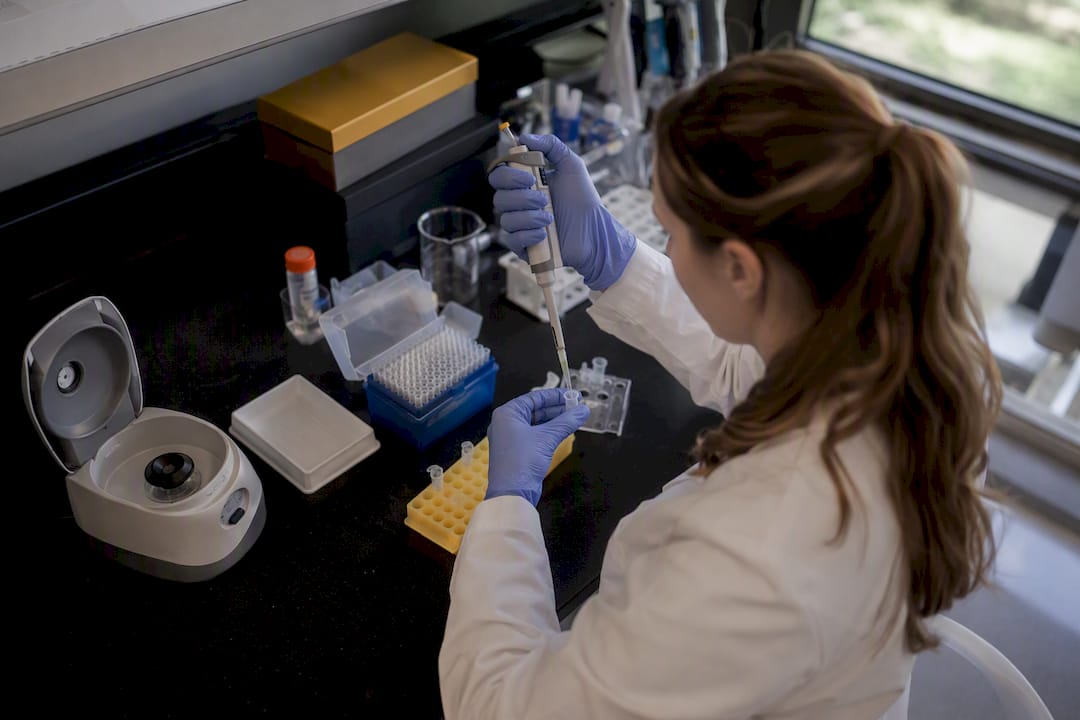
That gap is where DAF-supported unrestricted gifts do disproportionate work. A research team pursuing an unconventional approach, testing a repurposed drug against a rare cancer subtype, for instance, often relies on exactly this kind of bridge funding to generate the pilot data needed to eventually qualify for larger federal or institutional grants.
The pattern shows up across the cancer research funding sector broadly: philanthropic capital, DAF-sourced or otherwise, frequently funds the risky first step that unlocks larger, more conservative funding sources later. Donors who recommend recurring or multi-year DAF grants to a single research program, rather than one-off gifts spread across many causes, give that program’s leadership something federal grant cycles rarely offer: predictable, flexible funding they can commit to long-term hires or multi-year experiments.
Can You Fund International Cancer Research Through a DAF?
You can, but expect extra steps. Domestic grants to U.S.-based 501©(3) organizations move quickly because sponsors can verify status through IRS records almost instantly. International cancer research organizations don’t have that same clean verification path.
Grants to foreign organizations typically require either equivalency determination or expenditure responsibility, two distinct due-diligence processes sponsors use to confirm the foreign entity operates comparably to a U.S. public charity, or to track exactly how the funds get spent once they arrive. Both processes add real time, often several weeks, and sometimes additional fees charged directly to your DAF account.
The practical workaround many donors use: if you want to support cancer research happening internationally, look for a U.S.-based “friends of” organization that channels funds to the foreign institution while maintaining its own domestic 501©(3) status. These intermediary organizations already have the equivalency paperwork in place, which means your grant processes at roughly the same speed as any other domestic recommendation.
If you’re set on funding a specific overseas lab or hospital directly, call your sponsor before you submit anything. Ask whether they’ve previously done due diligence on that organization. Some sponsors maintain records of prior determinations that can save you weeks of waiting.
Do DAF Grants Help Patients Directly, or Only Research?
DAF grants can fund either research or direct patient services, but not the same way for both. A grant recommended to a cancer research institution generally supports lab work, clinical trials, or program operations. A grant to a patient assistance charity, the kind that helps cover transportation to treatment, temporary housing near a hospital, or copay support, works exactly the same procedurally. Both are qualified 501©(3) recipients.
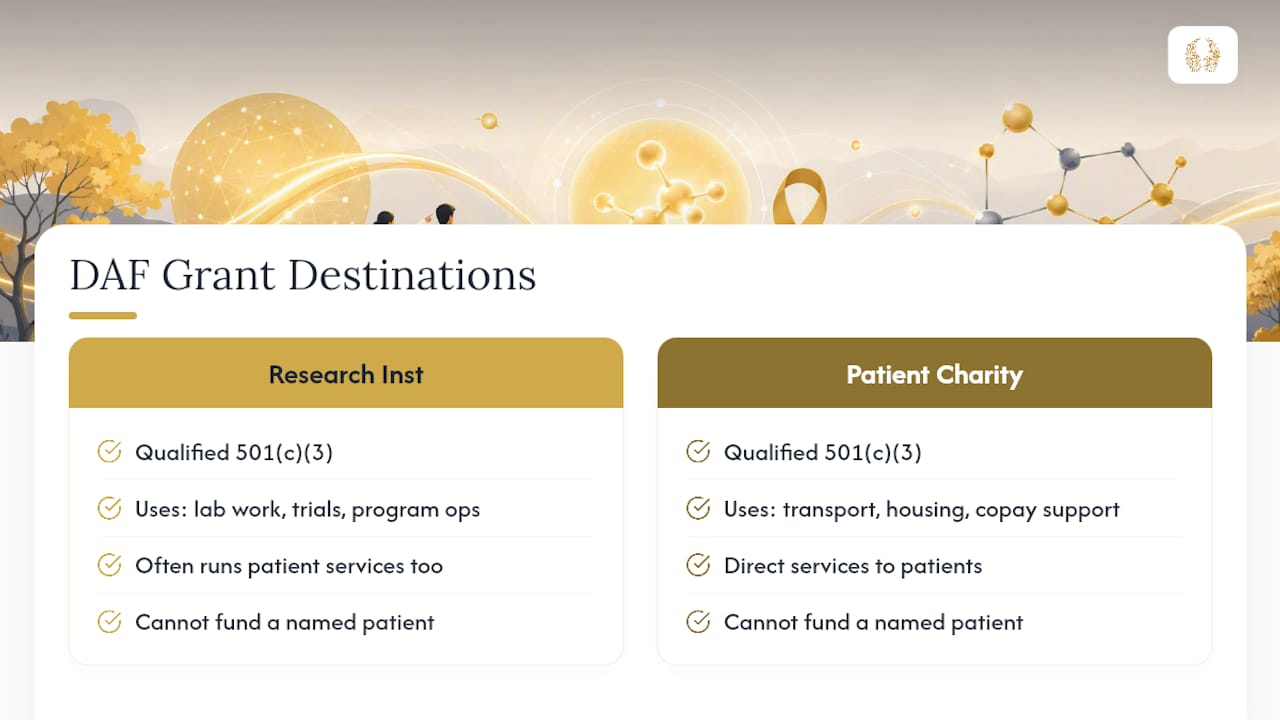
What you cannot do is direct a DAF grant to a specific named patient, no matter how compelling their story. This trips up well-meaning donors constantly, especially when a patient assistance charity’s marketing highlights one family’s situation. The grant has to go to the organization’s general fund or a named program, never earmarked for one individual by name.
Many cancer research centers, including academic centers like the Robert H. Lurie Comprehensive Cancer Center, run both research programs and patient support services under one umbrella, which means a single DAF grant to that institution, if unrestricted, can end up supporting both. If you want your gift split deliberately between research and patient services, say so explicitly in your grant memo. Most sponsors and nonprofits will honor a donor’s stated intent even when the grant itself is technically unrestricted at the organizational level.
How Do You Stay Engaged With a Cancer Nonprofit Beyond One Grant?
A single DAF grant is a transaction. Ongoing engagement is a relationship, and it tends to produce more meaningful outcomes for both the donor and the research program.
Setting up a recurring grant recommendation, many sponsor portals allow this, turns your DAF into a predictable annual funding source for a cancer research program rather than a one-time gesture. Research leadership can plan around predictable philanthropic revenue the same way they plan around grant cycles, which matters enormously for multi-year projects.
Beyond recurring grants, ask the nonprofit whether they publish progress reports on funded research. Organizations that track outcomes, published papers, clinical trial milestones, patient enrollment numbers, give DAF donors something federal grant reports rarely offer: a direct line of sight into what their specific dollars accomplished. If you’re recommending grants specifically to support event-based fundraising, like galas or awareness walks, consider recommending a grant timed to coincide with the event itself rather than months later, since many nonprofits use event momentum to unlock matching challenge gifts from major donors.
Finally, consider naming your DAF fund itself after a cause you care about internally, even though sponsors don’t publicize this. It’s a small but real way to keep your own giving intentional year over year, rather than defaulting to whatever cause is most visible each December.
A Straight-Talk Take on DAF Giving for Cancer Research
The conventional advice on donor-advised funds treats them like a tax hack first and a philanthropic tool second. That gets the priority backward for cancer donors. The real value of a DAF isn’t the deduction timing, it’s the flexibility to fund unrestricted, early-stage research that federal grant cycles routinely pass over.
Most donor guides spend too much time on IRS mechanics and too little on where the money should actually go. Restricted gifts feel more controlled, but unrestricted gifts to a research center with a track record, the kind Robert H. Lurie Comprehensive Cancer Center has built over decades, often do more good precisely because researchers can move that money toward the riskiest, most promising ideas without waiting on a grant committee.
If you take one thing from this article, prioritize the relationship over the transaction. Recurring, unrestricted DAF grants to a research program you trust will outperform scattered one-time gifts chasing whatever cause trends this year. The rules matter, but they’re not the point. The point is getting flexible money to the researchers willing to try something nobody’s funded yet.
— HCRF
Sources
- Donor Advised Fund | American Cancer Society
- Donor-Advised Fund FAQ: Questions Donors and Fundraisers Ask
Recommended
- Hippocratic Cancer Research Foundation: Innovative Therapies | Cancer Research Funding: A 2026 Donor’s Guide
- Hippocratic Cancer Research Foundation: Innovative Therapies | How to Donate to Cancer Research and Drive Real Impact
- Hippocratic Cancer Research Foundation: Innovative Therapies | What Does Cancer Research Really Cost? A Donor’s Guide

Discover how many stages of cancer are there and what each stage means. Understand your diagnosis better for informed treatment choices.
Read More →
2026 clinician update: sevabertinib 75% ORR, daraxonrasib survival gain, and why degraders, KRAS inhibitors, and AI-designed neoantigen trials are...
Read More →