


Anonymous Charitable Donations: Give Privately and Stay IRS-Compliant
August 11, 2026
Anonymous Charitable Donations: Give Privately and Stay IRS-Compliant

Yes — you can make anonymous charitable donations in the United States, and donor-advised funds (DAFs) are the clearest, most flexible route when you need both privacy and a tax deduction. A DAF sponsor like Fidelity Charitable, Vanguard Charitable, Schwab Charitable, or the American Endowment Foundation issues the grant to the charity in its own name, so the recipient never sees yours. Other viable options include intermediary platforms such as Silent Donor, giving through legal counsel or a trust, and cash for very small gifts. One immediate caveat: always confirm your intermediary’s anonymity policy in writing before you give. Intention alone does not guarantee privacy.
- Donor-advised funds (DAFs): Best for anonymity plus deductibility; grant goes out under the sponsor’s name.
- Intermediary platforms: Useful for mid-size gifts; vet policies carefully.
- Trusts or LLCs: Strongest structural privacy; higher cost and complexity.
- Cash: Anonymous at delivery but leaves no paper trail for deductions over $250.
Key Takeaways
Donor-advised funds are the most reliable method for combining anonymous charitable donations with full IRS deductibility in the United States, but every method requires written confirmation of anonymity terms before the gift is made.
| Point | Details |
|---|---|
| DAFs are the clearest route | DAF sponsors like Fidelity Charitable issue grants under their own name, keeping your identity from the recipient. |
| Always get written confirmation | Verbal assurances are not enough; confirm anonymity terms in writing with your intermediary before giving. |
| Anonymous grants are a small share | Anonymous grants represented a small share of DAF grants in 2020; most supported human services rather than policy groups. |
| Cash loses deductibility above $250 | Without a contemporaneous written acknowledgment, cash gifts over $250 cannot be deducted. |
| HCRF accepts anonymous gifts | The Hippocratic Cancer Research Foundation will honor your privacy and provide IRS-compliant acknowledgments. |
Table of Contents
- How can you give anonymously? The main methods explained
- What IRS and tax rules apply to anonymous gifts?
- Why do donors choose anonymity, and what does the sector think?
- What risks and legal limits should you watch for?
- A step-by-step checklist for giving anonymously and keeping your deduction
- Comparing the main methods at a glance
- How common are anonymous gifts, and who receives them?
- HCRF’s perspective on anonymous giving and donor privacy
- Support the Hippocratic Cancer Research Foundation anonymously
- Sources
How can you give anonymously? The main methods explained
Each method preserves donor privacy differently, and the right choice depends on gift size, how much control you want to keep, and whether a tax deduction matters.
Donor-advised funds are the workhorse of private charitable giving. You contribute assets to a sponsoring organization — Fidelity Charitable, Vanguard Charitable, Schwab Charitable, or the American Endowment Foundation, among others — take your deduction in the year of contribution, and then recommend grants over time. When you request an anonymous grant, the sponsor sends the check under its own name. The recipient charity sees “Fidelity Charitable” or “American Endowment Foundation,” not you. Financial advisers consistently describe DAFs as the most straightforward vehicle for combining anonymity with deductibility, and the institutional infrastructure is already built for it. Minimums vary: Fidelity Charitable opens at $5,000; Vanguard Charitable at $25,000.
Intermediary platforms and third-party giving services operate on a similar principle. Silent Donor, for example, runs an affiliated giving fund that acts as the visible donor to the recipient organization. These platforms can work well for donors who want a lighter administrative lift than a full DAF account, but you must vet their policies in writing. Not every platform guarantees the same level of privacy, and some share donor data with recipient charities upon request.
Private foundations, trusts, and LLCs offer the strongest structural anonymity. A donor-directed trust or a single-member LLC can make charitable contributions without revealing the individual behind the entity. The tradeoff is real: legal formation costs, ongoing administration, and the fact that foundation names sometimes appear on public filings. Charitable remainder trusts (CRTs) add tax-planning benefits but are more complex than a DAF. For most donors, this route makes sense only for very large gifts or estate-planning contexts.

Giving through counsel or a fiscal sponsor is a practical middle path. Your attorney or a fiscal sponsor organization makes the gift on your behalf, keeping your name out of the transaction. Non-traditional giving vehicles and fiscal sponsorships can also serve donors who want to support a specific project without establishing a formal fund. Family offices often coordinate this for high-net-worth donors.
Cash and money orders deliver anonymity at the point of delivery, but they create a documentation gap. For gifts under $250, the IRS does not require a written acknowledgment, so cash can work for small, truly private contributions. Above that threshold, you need a contemporaneous written acknowledgment to claim a deduction — and cash gifts rarely generate one that satisfies IRS requirements.
What IRS and tax rules apply to anonymous gifts?
Anonymity and deductibility can coexist, but only if you follow the documentation rules precisely. Here is what matters.
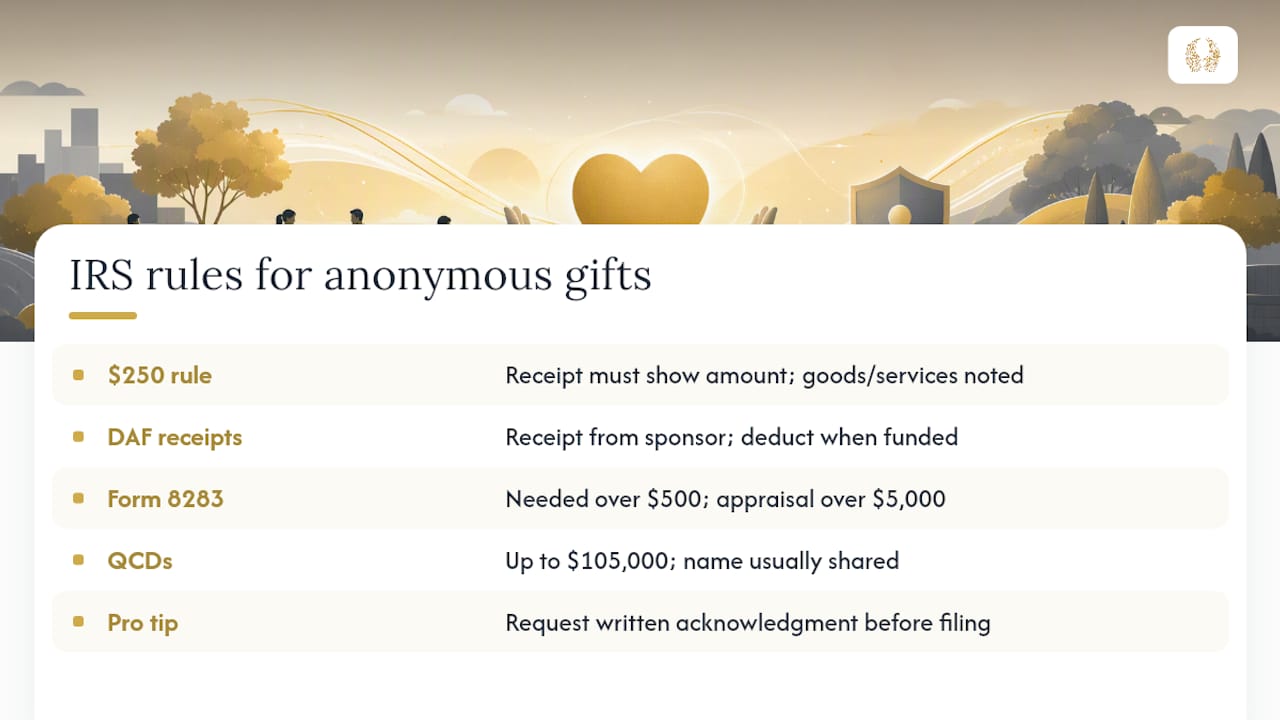
The $250 rule. The IRS requires a contemporaneous written acknowledgment for any single charitable contribution of $250 or more. That acknowledgment must come from the recipient organization and must state the amount (or description of property), whether the charity provided any goods or services in exchange, and a good-faith estimate of their value. IRS guidance on Form 990-EZ governs public inspection requirements and makes clear that individual donor names do not appear on the public copy of Form 990 — only on private IRS filings. That distinction protects your identity from public view even when you give directly.
How intermediary receipts work. When you give through a DAF, the receipt for your deduction comes from the DAF sponsor, not the recipient charity. You claim the deduction in the year you fund the DAF account, regardless of when grants go out. This timing advantage is one reason advisers favor DAFs: you can lock in a deduction in a high-income year and distribute grants over several years. Ask your DAF sponsor for written confirmation of what identifying information, if any, it will include in grant letters to recipient charities.
Noncash gifts and Form 8283. Donations of appreciated stock, real estate, or other property require Form 8283 for gifts over $500. For gifts over $5,000, a qualified appraisal is mandatory. These forms go to the IRS, not to the public, but they do carry your name. A DAF still protects you here: you contribute the asset to the DAF sponsor (filing Form 8283 with your return), and the sponsor then grants cash to charities anonymously.
Qualified charitable distributions (QCDs). Donors aged 70½ or older can direct up to $105,000 per year (as indexed) from an IRA directly to a qualified charity. QCDs are excluded from taxable income, which is a meaningful benefit. However, the distribution goes directly from the IRA custodian to the charity, and the charity typically receives the donor’s name from the custodian. QCDs generally do not preserve anonymity for the recipient.
Pro Tip: Always request a contemporaneous written acknowledgment before you file your return, and ask the intermediary or charity to confirm in writing exactly what identifying information will appear on that acknowledgment. A vague verbal assurance is not enough.
Anonymous giving is lawful and the IRS does not prohibit it, but legal guidance for 501©(3) recipients makes clear that nonprofits still have recordkeeping obligations and compliance duties regardless of whether a donor’s name is disclosed to the public.
Why do donors choose anonymity, and what does the sector think?
The motivations are personal, varied, and deeply human. Some donors give quietly out of religious conviction — many faith traditions teach that giving should be private. Others want to avoid the flood of solicitations that follows a named gift. Safety and privacy concerns are real for high-profile individuals or those in contentious public roles. And some donors simply believe that recognition changes the act of giving in ways they find uncomfortable.
- Modesty and religious principle: Many donors across faith traditions believe public recognition undermines the spirit of the gift.
- Privacy and safety: Public donors can become targets for solicitation, fraud, or unwanted attention.
- Avoiding reputational risk: Donors supporting controversial causes or organizations may face professional or social consequences.
- Preserving relationships: Some donors prefer that the recipient not feel obligated or indebted.
The sector-level debate is sharper. Inside Philanthropy documents a growing tension between donor privacy and calls for transparency, particularly when large anonymous gifts influence public policy, fund advocacy organizations, or shape political discourse. Critics argue that when philanthropy functions as a form of power, the public has a legitimate interest in knowing who is exercising it. Defenders counter that privacy protections encourage more giving overall and protect donors from retaliation.
Research from the Johnson Center notes that anonymous gifts attract outsized scrutiny when they involve large sums with public-policy implications, even though most anonymous giving is entirely noncontroversial. Small anonymous gifts remain broadly accepted across the sector. The debate concentrates almost entirely on large, policy-adjacent donations.
What risks and legal limits should you watch for?
Anonymous giving carries real operational risks that donors often underestimate.
Intermediary mishandling. A DAF sponsor or platform may inadvertently disclose your identity through grant letters, acknowledgment language, or internal database fields visible to charity staff. Confirm in writing which staff at the recipient organization will see donor data, and ask whether the intermediary’s grant management system stores your name in fields the charity can access.
State-level disclosure rules. Some states require disclosure of large donors to certain types of organizations, particularly advocacy groups or political nonprofits. The rules vary significantly by state and by the type of recipient entity. For gifts above six figures, consult legal counsel before assuming your anonymity is protected at the state level.
Reduced stewardship and influence. Anonymous donors often miss out on matching gift programs, named recognition opportunities, and the relationship-building that leads to deeper impact. Nonprofit-sector guidance notes that anonymous DAF grants complicate stewardship, because charities cannot thank, cultivate, or report back to a donor they cannot identify. If you care about how your gift is used, anonymity can reduce your leverage.
AML and OFAC compliance. Charities must screen gifts for anti-money-laundering (AML) and Office of Foreign Assets Control (OFAC) compliance. Anonymity does not exempt a gift from these checks. DAF sponsors and intermediary platforms conduct their own compliance screening on the donor before issuing grants, so the charity receives a vetted gift even without knowing the original donor’s name.
Pro Tip: For gifts above $50,000, use a written gift agreement that defines the anonymity terms, specifies who at the charity may access donor information, and includes a remedy if the charity breaches those terms. A handshake is not a policy.
A step-by-step checklist for giving anonymously and keeping your deduction
Follow these steps in order. Skipping the pre-gift phase is where most donors lose either their anonymity or their deduction.
- Decide your anonymity level. Do you want the recipient to know nothing, or just to keep your name off public communications? The answer shapes which method you need.
- Choose your method. For most donors who need both privacy and a deduction, a DAF is the right starting point. For very large or complex gifts, add legal counsel.
- Verify intermediary policies in writing. Contact your DAF sponsor or platform and ask specifically: “What information will the recipient charity receive about the donor?” Get the answer in writing.
- Consult a tax adviser for large or complex gifts. Noncash contributions, trust structures, and multi-year commitments all have tax implications that a general checklist cannot fully address.
- Fund the account and request the grant. Specify “anonymous” in the grant recommendation. Confirm the sponsor’s grant letter will not include your name.
- Obtain your receipt. Your deduction receipt comes from the DAF sponsor. Confirm it includes the required IRS language (amount, date, no goods or services provided, or a description of any that were).
- Request the exact wording of any public acknowledgment. If the charity plans to list the gift in an annual report or press release, ask to approve the language (“Anonymous donor” or similar) before publication.
- Confirm who at the recipient will be notified. Ask the DAF sponsor whether the charity’s development director, gift processor, or any other staff member will see your name in any system.
- Retain all documentation. Keep the contemporaneous written acknowledgment from the DAF sponsor, the grant confirmation, and any written anonymity agreements. Store them with your tax records.
- Track grant dates for tax timing. Your deduction is in the year you fund the DAF, not the year the grant goes out. Note both dates in your records.
- Update your advisers. Inform your estate attorney and financial planner of the gift, particularly if it involves appreciated assets or affects your estate plan.
Sample questions to ask your intermediary or the recipient charity:
- “What name will appear on the grant letter sent to the charity?”
- “Will any staff member at the recipient organization see my name in your grant management system?”
- “What is your written policy for handling anonymous gifts?”
- “If I request anonymity, will that request be honored if the charity asks for donor information?”
- “What acknowledgment will I receive, and what identifying information will it contain?”
Pro Tip: Test the process with a modest gift — say, $500 through your chosen DAF or platform — before routing a major donation. Confirm the grant letter language and the acknowledgment you receive before scaling up.
Comparing the main methods at a glance
| Method | Anonymity level | Tax deductible | Donor control over grant | Complexity / cost | Best for |
|---|---|---|---|---|---|
| Donor-advised fund (DAF) | High — grant issued under sponsor’s name | Yes | Recommend grants; sponsor has legal control | Low to moderate; account minimums apply | Mid to large gifts needing deductibility |
| Intermediary / platform (e.g., Silent Donor) | High — platform acts as visible donor | Yes (via platform’s fund) | Limited; platform processes grant | Low; fees vary | Smaller to mid-size gifts; lighter setup |
| Private foundation | Moderate — foundation name is public | Yes | Full control | High; legal, filing, and admin costs | Very large gifts; family philanthropy |
| Trust or LLC | High — entity name shields individual | Conditional; depends on structure | High | High; legal formation required | Large gifts; estate planning context |
| Giving through counsel / fiscal sponsor | High — attorney or sponsor is visible | Yes (if properly structured) | Moderate | Moderate; professional fees | One-time large gifts; complex situations |
| Cash / money order | Complete at delivery | Only for gifts under $250 without acknowledgment | None after delivery | None | Very small, truly private gifts |
Each of these methods is covered in detail in the sections above. For most donors who need both privacy and a deduction, the DAF row is the right starting point. For donors who want structural separation and have the resources for legal setup, a trust or LLC offers the strongest long-term shield.
How common are anonymous gifts, and who receives them?
Anonymous giving is a small but meaningful slice of overall philanthropy. Analysis of the five largest DAF sponsors found that anonymous grants represented about 4.3% of all grants in 2020 — roughly 97,866 anonymous grants out of 2,256,033 total. That is a modest share, but at the scale of DAF giving, it represents a substantial dollar amount.
Where do anonymous DAF grants go?
- Human services organizations receive the largest share of anonymous grants.
- Religion, health, and education follow as the next most common recipients.
- Policy-focused or advocacy organizations receive a much smaller proportion of anonymous grants.
This pattern matters for the public debate. Critics who worry about anonymous giving shaping public policy are responding to a real concern, but the data shows that most anonymous DAF grants support noncontroversial service organizations. The controversy concentrates in a small subset of large, policy-adjacent gifts that attract disproportionate media attention.
Anonymous giving remains a small share of total philanthropy, but it carries outsized weight in conversations about donor accountability. That tension is unlikely to resolve soon.
HCRF’s perspective on anonymous giving and donor privacy
At the Hippocratic Cancer Research Foundation, we believe that every act of generosity deserves to be honored — whether it carries a name or not. We accept anonymous donations, and we protect donor privacy with the same care we bring to our research mission. That said, we always welcome a conversation about donor intent, because understanding what you hope to accomplish helps us direct your gift where it can do the most good for cancer patients and the researchers working to save their lives at the Robert H. Lurie Comprehensive Cancer Center of Northwestern University.
Our preference is to discuss your goals before the gift is finalized, not to override your privacy, but to serve you better. When you give anonymously through HCRF, we will provide a written acknowledgment that satisfies IRS requirements without disclosing your identity in any public communication. For donors exploring how their giving can drive real impact, our cancer research donation guide explains how contributions are used and what research they fund. Donors who give through workplace programs can also explore our workplace giving resources for additional routing options.
Support the Hippocratic Cancer Research Foundation anonymously
The Hippocratic Cancer Research Foundation (HCRF) is a 501©(3) nonprofit, and your gift — however it arrives — goes directly toward funding bold, unconventional cancer research that larger institutions often overlook. We are grateful for every dollar, and we are committed to honoring your privacy if that is what you need.
HCRF accepts anonymous gifts through several routes. You can direct an anonymous DAF grant from Fidelity Charitable, Vanguard Charitable, Schwab Charitable, or any other DAF sponsor to HCRF, and we will issue a written acknowledgment to the sponsoring organization. Donors who prefer a trust or LLC structure can route gifts through legal counsel, and we will work with your adviser to confirm anonymity terms in writing. For donors who want to give directly and quietly, contact us before the gift to establish those terms.
To give now or to ask about anonymous giving options, visit the Hippocratic Cancer Research Foundation donation page. Our team will respond promptly, confirm your privacy preferences in writing, and make sure your generosity reaches the researchers and patients who need it most. Hope is worth protecting — and so is your privacy.
Sources
This article is general information, not a substitute for advice from a qualified financial advisor. Consult a qualified financial professional about your own circumstances before acting on anything here.
Recommended
- Hippocratic Cancer Research Foundation: Innovative Therapies | Workplace Giving Programs for Cancer Research Donors
- Hippocratic Cancer Research Foundation: Innovative Therapies | How to Donate to Cancer Research and Drive Real Impact
- Hippocratic Cancer Research Foundation: Innovative Therapies | Cancer Research Funding: A 2026 Donor’s Guide
- Hippocratic Cancer Research Foundation

Discover how clinical trial costs vary by phase, revealing what they mean for sponsors and participants. Gain insights into funding and budgeting.
Read More →
On Monday, January 8th, 2024 The Hippocratic Cancer Research Foundation proudly presented the gala proceeds check to Dr. Platanias and the Lurie's Cancer Center.
Read More →