


Volunteer Grant Programs: A Nonprofit Coordinator's Guide
August 14, 2026
Volunteer Grant Programs: A Nonprofit Coordinator’s Guide

Volunteer grant programs convert your volunteers’ time into real funding for your organization. There are two main types: corporate “Dollars for Doers” grants, where companies pay a set amount per volunteer hour (or at a milestone) to the nonprofit their employee serves, and capacity-building grants like the AmeriCorps Volunteer Generation Fund, which fund the systems and infrastructure behind volunteer engagement rather than individual hours. The single most powerful thing you can do today is add one question to every volunteer intake form: “Where do you work, and may we contact your employer to verify your hours?” That one field unlocks everything else.
Three actions to take this week:
- Add an employer/employee field to your volunteer sign-up and exit forms.
- Start logging volunteer hours consistently, with dates and activity descriptions.
- Designate a verification contact at your organization and share that person’s name and email with every active volunteer.
Quick funding comparison:
- Dollars for Doers (hourly/milestone): Cash paid directly to your nonprofit, typically $8–$15 per volunteer hour, sometimes higher. Fastest path to immediate revenue.
- AmeriCorps VGF (capacity-building): Competitive federal grant funding volunteer recruitment, training, and retention systems. Longer timeline, larger strategic payoff.
Pro Tip: The employer field on intake forms is the highest-ROI change most nonprofits never make. Even a simple dropdown asking “Do you work for a company with a volunteer grant program?” starts the conversation.
Key Takeaways
Corporate volunteer grants and AmeriCorps VGF capacity grants work best together: pursue hourly Dollars for Doers grants for immediate revenue while building toward federal capacity funding for long-term volunteer infrastructure.
| Point | Details |
|---|---|
| Add employer field immediately | One intake form question unlocks Dollars for Doers claims across your entire volunteer base. |
| Per-hour rates vary widely | Most programs pay $8–$15 per hour; Microsoft’s reported rate of $25/hour sits at the high end. |
| VGF deadline is May 4, 2026 | The FY2026 AmeriCorps VGF application closes at 5:00 PM Eastern on May 4, 2026. |
| Designate one verification contact | A single named contact with a 48-hour response commitment eliminates the most common claim delay. |
| Track grants per volunteer | Measure grants claimed, revenue received, and admin time per grant in your first three months. |
Table of Contents
- What are volunteer grant programs and how do they work?
- Where can you find volunteer grant opportunities?
- What eligibility rules do most volunteer grant programs require?
- How do you claim volunteer grants step by step?
- Which companies run notable volunteer grant programs?
- Why do volunteer grant dollars go unclaimed, and how do you fix it?
- What does the AmeriCorps Volunteer Generation Fund offer in FY2026?
- How volunteer grants fit into a blended funding strategy
- Primary sources and recommended tools
- Sources
What are volunteer grant programs and how do they work?
Corporate volunteer grants, widely known as Dollars for Doers programs, follow four main frameworks:
- Per-hour match: The employer donates a fixed dollar amount for every hour the employee volunteers (most common).
- Milestone grants: A lump-sum grant triggers when an employee reaches a set number of volunteer hours (e.g., $750 after 50 hours).
- Credit grants: Volunteer hours accumulate as credits the employee can direct to a nonprofit of their choice.
- Team-based grants: A group of employees volunteers together and the company donates a larger grant to the host organization.
Capacity-building grants work differently. The AmeriCorps Volunteer Generation Fund does not pay per hour. Instead, it funds the infrastructure that makes volunteer programs run: recruitment systems, training curricula, supervision structures, and retention strategies. Think of Dollars for Doers as immediate revenue and VGF as an investment in the engine that generates that revenue.
When to prioritize which: If your organization has active volunteers whose employers offer Dollars for Doers programs, pursue those grants first. They require no competitive application and can generate cash within weeks. Pursue VGF-style capacity grants when you have the organizational capacity to write a competitive federal application and a clear plan to scale volunteer engagement.
Pro Tip: Document which programs accept small community nonprofits and which are limited to 501©(3)s or State Service Commissions. Some corporate programs exclude advocacy organizations or religious entities — knowing this before you invest time in outreach saves real frustration.
Where can you find volunteer grant opportunities?
Discovery starts with the data you already have. Your volunteer intake forms contain employer names. Run those names against a corporate CSR database before you do anything else.
Primary discovery channels, in priority order:
- Corporate CSR pages: Search “[Company name] volunteer grant program” or “[Company name] Dollars for Doers” to find the official program page.
- Double the Donation: Offers an employer search tool and database of corporate volunteer grant programs; embedding their search widget on your volunteer registration page lets volunteers self-identify eligible programs at the moment they sign up.
- GrantWatch: Curates foundation and government grant opportunities for volunteer-driven nonprofits; set keyword alerts for “volunteer grants” and “community service grants.”
- AmeriCorps VGF NOFO pages: Monitor the FY 2026 Volunteer Generation Fund page and subscribe to AmeriCorps funding notices for future cycles.
- State Service Commissions: Many states subgrant VGF funds to local nonprofits. Contact your state commission directly to ask about subgrant opportunities.
Most corporate volunteer grant dollars go unclaimed not because programs are hard to find, but because nonprofits never ask their volunteers where they work. Research from the Center for Social Impact Communication at Georgetown confirms that simply adding an employer field to intake forms and following up with a claim reminder materially increases capture rates.
Pro Tip: Subscribe to GrantWatch alerts and AmeriCorps funding notices simultaneously. Corporate grants and federal capacity grants run on completely different calendars — monitoring both keeps your pipeline full year-round.

What eligibility rules do most volunteer grant programs require?
Before a volunteer submits a claim, confirm they and your organization meet the program’s criteria. Most programs share these eligibility categories:
| Dimension | Typical requirement |
|---|---|
| Organization type | 501©(3) public charity; schools and community foundations sometimes included; political/advocacy orgs typically excluded |
| Employee status | Full-time or part-time employee; some programs require minimum tenure |
| Minimum volunteer hours | a range of hours is typically required for per-hour and milestone grants, varying by program |
| Annual cap | common programs have a limit on the grant amount per employee annually, though exact values vary |
| Geographic restriction | Volunteer activity must occur in the same country as the employer; some programs restrict to specific states |
| Excluded activities | Political campaigning, lobbying, religious instruction, and activities that benefit the employee personally |
| Documentation required | Signed hour log, supervisor or coordinator verification, employer portal confirmation |
| Payment timing | Typically 4–12 weeks after a verified claim is submitted |
Eligibility audit checklist for coordinators:
- Confirm your organization holds active 501©(3) status.
- Verify the volunteer is a current employee (not a contractor or retiree, unless the program explicitly includes them).
- Check whether the volunteer has met the minimum hours threshold for the specific program.
- Confirm the activity type is eligible (direct service, not advocacy or fundraising in most cases).
- Prepare a signed hours log with dates, activity descriptions, and your verification contact’s name and email.
Numbered steps for pre-submission verification:
- Pull the volunteer’s employer from your intake data.
- Look up that employer’s CSR page or use Double the Donation to confirm program details.
- Calculate total eligible hours for the grant period.
- Confirm the activity type is covered.
- Prepare your verification contact information and a signed hours summary.
Most programs pay within 4–12 weeks of a verified submission. Keep a tracking spreadsheet with submission date, employer, volunteer name, expected payment date, and actual receipt date.
How do you claim volunteer grants step by step?
The claim process has six stages. Build a workflow around them and you will capture grants consistently rather than sporadically.
- Intake: Collect employer name and permission to verify hours at sign-up.
- Hour tracking: Log every shift with date, hours, and activity type. Use a volunteer management system (VolunteerHub, Galaxy Digital, or a simple Google Sheet) to maintain a running record.
- Volunteer self-submission: After a volunteer reaches the minimum hours threshold, send them a reminder with a direct link to their employer’s grant portal and your verification contact’s details.
- Nonprofit verification: When the employer contacts you to confirm hours, respond within 48 hours with a signed hours summary on your letterhead.
- Portal submission: Some programs require the nonprofit to submit directly through an employer portal (e.g., Benevity, YourCause, Cybergrants). Register on these platforms proactively.
- Reconciliation: When payment arrives, record it in your accounting system, note any restrictions on use, and send a thank-you to the volunteer.
Sample email you can give volunteers to send to their HR or CSR team:
Points of Light confirms that providing volunteers with pre-written verification language and a ready-to-send email template significantly speeds employer confirmation and payout timelines.
Cross-team coordination is the hidden bottleneck. Volunteer management, finance, and development staff all touch the grant process at different points. Designating a single verification contact and a shared tracking document eliminates the delays that kill claims.
Pro Tip: Register your nonprofit on Benevity, YourCause, and Cybergrants now, before you need them. Many corporate programs require the receiving organization to have an active profile on the platform before a grant can be processed.
Which companies run notable volunteer grant programs?
These are representative examples drawn from publicly reported program details. Confirm current rules on each company’s CSR page or employee portal before communicating specifics to your volunteers.
Most per-hour programs fall in the $8–$15 per volunteer hour range, with Microsoft’s reported $25/hour rate sitting at the higher end of publicly cited examples.
How to use this table strategically:
- Cross-reference your volunteer roster against these employers. A volunteer who works at Microsoft and logs 40 hours could generate $1,000 for your organization.
- Prioritize outreach to volunteers at companies with no minimum hours or a low threshold (Microsoft, ConocoPhillips) — they are the fastest path to a first grant.
- Use these figures to build a revenue projection: multiply your active volunteers at each employer by their reported rate and likely hours.
Program rules change. Always direct volunteers to their employer’s official CSR page or HR portal for current terms before they submit.
Why do volunteer grant dollars go unclaimed, and how do you fix it?
The gap between available funding and claimed funding is staggering. Georgetown’s Center for Social Impact Communication identifies the core problem plainly: most volunteers simply do not know their employer offers a volunteer grant program, and most nonprofits never ask.
Root causes and targeted fixes:
- Volunteers are unaware: Frame volunteer grants as a way to double their impact without spending a dollar. Use this language in orientation, newsletters, and stewardship emails.
- Intake forms miss employer data: Add a required employer field and an opt-in for employer contact to every sign-up form.
- Volunteers don’t know how to claim: Provide a one-page instruction sheet and the sample email template from Section 5 above.
- Verification delays: Designate one staff member as the verification contact and commit to a 48-hour response window.
- High hour thresholds: Focus initial outreach on programs with low minimums (1–10 hours) to generate early wins and build volunteer confidence in the process.
- Administrative friction: Embed an employer search widget (Double the Donation offers one) on your volunteer registration page so volunteers can self-identify eligible programs at sign-up.
Framing is everything. Volunteers respond when you tell them: “Your hours are worth money to us — and it costs you nothing.” That single reframe, used consistently in orientation and follow-up communications, is what separates nonprofits that capture volunteer grants from those that leave the money on the table.
Step-by-step fix sequence:
- Audit your current intake form — add employer name and grant permission fields today.
- Pull your existing volunteer list and send a one-time “Did you know?” email explaining the program.
- Set up an automated post-shift reminder (via your volunteer management system or email platform) that fires 24 hours after a volunteer logs a shift.
- Prepare a one-page “How to claim your volunteer grant” PDF with your verification contact and the sample email template.
- Track responses and claims in a shared spreadsheet; review monthly.
Pro Tip: Embed Double the Donation’s employer search widget directly on your volunteer registration page. Volunteers who can search their employer and see a matching program in real time are far more likely to follow through on a claim.
What does the AmeriCorps Volunteer Generation Fund offer in FY2026?
The AmeriCorps Volunteer Generation Fund is a federal competitive grant program. It does not pay per volunteer hour. It funds the capacity that makes volunteer programs work at scale: recruitment infrastructure, training systems, supervision frameworks, and retention strategies.
Who can apply:
- State Service Commissions (primary applicants)
- Eligible nonprofits, including 501©(3)s, through subgrants from State Service Commissions
- Organizations must demonstrate operational capacity (OFMS completion) and submit through eGrants
FY2026 key dates:
- Application deadline: May 4, 2026 at 5:00 PM Eastern Time
- Notification of award: July 2026 (as reported in the FY2026 NOFO)
What VGF funds (and what it does not):
- Funds: volunteer recruitment campaigns, training and orientation programs, supervision and coordination systems, retention and recognition strategies
- Does not fund: direct service delivery, per-hour cash grants to volunteers, or unrelated organizational overhead
Checklist for a competitive VGF application:
- Complete your Organizational Financial Management Survey (OFMS) well before the deadline.
- Register and prepare your submission in eGrants.
- Draft an evidence-based volunteer engagement plan that includes measurable retention and recruitment goals.
- Include a training and orientation plan with clear milestones.
- Identify your technical assistance contacts at AmeriCorps and your State Service Commission early.
- Review AmeriCorps’ Manage Your Grant page for pre-award requirements and reporting obligations.
Pro Tip: VGF reviewers look for evidence-based engagement strategies and demonstrated operational capacity. If your organization has not yet completed OFMS, start there — it is a prerequisite, not a formality, and it takes longer than most applicants expect.
A statistic worth noting: VGF awards are competitive and limited in number each cycle. Organizations that apply through their State Service Commission’s subgrant process often face less competition than those applying directly, making that pathway worth exploring first.
How volunteer grants fit into a blended funding strategy
Here is what we have learned, and what we believe deeply at HCRF: no single funding stream sustains a mission. Volunteer grant programs are not a replacement for major gifts, events, or federal grants. They are a multiplier.
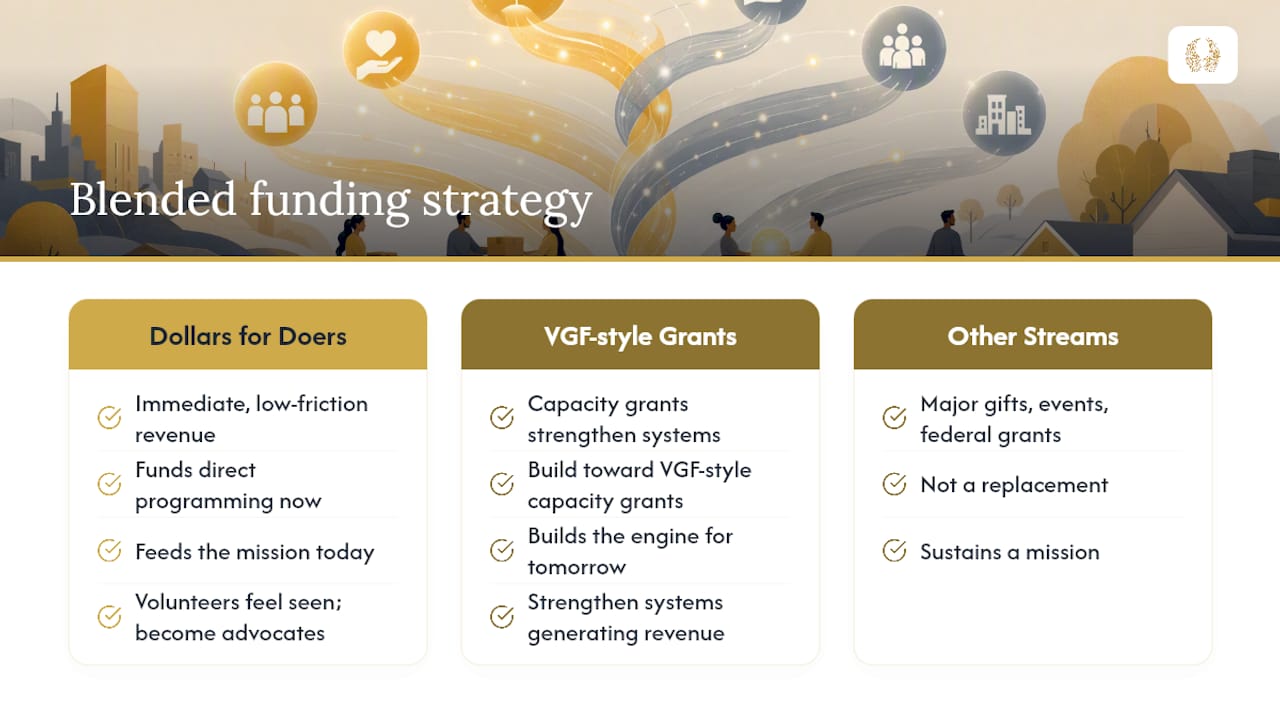
The most effective nonprofits we see treat Dollars for Doers grants as immediate, low-friction revenue that funds direct programming now, while they simultaneously build toward VGF-style capacity grants that strengthen the systems generating that revenue long-term. One feeds the mission today. The other builds the engine for tomorrow.
Measure the ROI honestly. Track administrative time per grant dollar received. If your team spends three hours processing a $50 grant, that is a workflow problem, not a funding problem. Automate employer lookups, use pre-written email templates, and designate a single verification contact. When the math improves, scale the effort.
And never forget the human dimension. Volunteers who learn their hours generated a grant feel seen. They stay longer, recruit friends, and become advocates. That stewardship conversation, “Your 20 hours brought $300 to our mission,” is also a corporate partnership conversation waiting to happen. Use it. Explore how workplace giving programs can deepen those corporate relationships beyond a single grant cycle.
Primary sources and recommended tools
Official program sources:
- FY 2026 Volunteer Generation Fund NOFO | AmeriCorps — official application page, deadline, and priorities
- AmeriCorps Manage Your Grant — pre-award requirements, OFMS, and reporting guidance
- Volunteer Generation Fund overview | AmeriCorps — program purpose and eligibility overview
Employer database and discovery tools:
- Double the Donation — Dollars for Doers program database and employer search widget; embed on your volunteer registration page
- GrantWatch — curated grant alerts for volunteer-driven nonprofits; set keyword alerts for “volunteer grants” and “community service grants”
Practitioner guides:
- Points of Light: Dollars for Doers Guide — templates, verification workflows, and program examples
- Georgetown CSIC: Dollars for Doers — volunteer engagement and intake form recommendations
Always verify current program rules on the company’s official CSR page or employee portal before communicating specific rates or thresholds to your volunteers. Program terms change, and a coordinator who quotes an outdated rate loses credibility with the volunteers they are trying to motivate.
For nonprofits ready to put these strategies to work in service of a mission that matters, the Hippocratic Cancer Research Foundation offers a model of donor-driven, volunteer-supported fundraising that blends community engagement with rigorous scientific purpose. Every grant claimed, every hour logged, every dollar raised carries hope forward.
This article is general information, not a substitute for advice from a qualified financial advisor. Consult a qualified financial professional about your own circumstances before acting on anything here.
Sources
- FY 2026 Volunteer Generation Fund | AmeriCorps
- Volunteer Generation Fund overview | AmeriCorps
- Dollars for Doers- Grants definition | Double the Donation
- Dollars for Doers Programs: A Guide to Employee-Driven Contributions for Nonprofits | Points of Light
- Dollars for Doers- Informing and engaging volunteers for funding - Center for Social Impact Communication
Recommended
- Hippocratic Cancer Research Foundation: Innovative Therapies | Workplace Giving Programs for Cancer Research Donors
- Hippocratic Cancer Research Foundation: Innovative Therapies | Breast Cancer Research Funding: A Researcher’s Guide
- Hippocratic Cancer Research Foundation: Innovative Therapies | Young Investigator Award: Your 2026 Application Guide
- Hippocratic Cancer Research Foundation: Innovative Therapies | Cancer Research Funding: A 2026 Donor’s Guide

A historic homecoming as the Hippocratic Cancer Research Foundation brings its mission to Athens for the first time, uniting global leaders, researchers, and supporters in the fight to end cancer through innovation, compassion, and hope.
Read More →
Wondering if you qualify for a cancer clinical trial? Learn about eligibility criteria that may surprise you and find your options.
Read More →