
Clinician Playbook to Secure Expanded Access for U.S. Cancer Patients
September 18, 2026
Clinician Playbook to Secure Expanded Access for U.S. Cancer Patients

Yes, expanded access can put an investigational cancer drug into a patient’s hands when every clinical trial door has closed, and the FDA authorizes the overwhelming majority of these requests. The catch isn’t the government. It’s the drugmaker, who must agree to supply the medicine before anything else moves forward. Your next step tonight: call your oncologist and ask them to look into Project Facilitate.
TL;DR:
- Most FDA requests for expanded access are approved, but the major hurdle remains manufacturer willingness due to supply limits, safety concerns, or ongoing trials.
- The fastest route involves an individual patient request, often handled by the patient’s oncologist, with eligibility requiring a serious condition and no alternatives.
- Bypassing FDA review with Right to Try does not guarantee access, as manufacturers still control drug supply and may decline requests.
- A well-documented, data-rich request accelerates manufacturer approval, especially when institutional regulatory support and tools like Project Facilitate are utilized.
- Insurance rarely covers investigational drugs through expanded access, and manufacturers may charge for the drug’s direct costs, highlighting the importance of informed consent and cost management.
Table of Contents
- What Expanded Access to Cancer Treatment Actually Means
- The Five-Point Eligibility Checklist Your Care Team Must Meet
- How to Request Expanded Access, Step by Step
- Right to Try vs Expanded Access: Which Path Fits Your Situation
- The Real Barrier Isn’t the FDA. It’s the Manufacturer
- What You Need to Know About Risk, Consent, and Cost
- How HCRF Helps You Navigate These Decisions
- Why Manufacturer Willingness Matters More Than Any Form
- Sources
- FAQ
What Expanded Access to Cancer Treatment Actually Means
Expanded access, often called compassionate use, is a federal pathway that lets a patient outside a clinical trial receive an investigational drug still under FDA review. It exists because trials have strict enrollment rules, and not every patient who could benefit from a promising therapy fits inside them. The National Cancer Institute treats it as a bridge, not a shortcut. Someone gets access despite the drug not yet carrying full FDA approval, because there’s reason to believe it might help and nothing else is left to try.
The FDA recognizes three versions of this pathway, and knowing which one applies to your situation changes how the request gets built:
- Individual patient expanded access covers one person, including emergency situations where there’s no time for the usual paperwork cycle. This is the most common route for cancer patients working one on one with an oncologist.
- Intermediate-size population access serves a defined group of patients, often those sharing a rare cancer diagnosis or a specific mutation, when a sponsor is willing to treat more than one person under a single protocol.
- Treatment IND or treatment protocol access opens the door widest, covering broader populations, usually later in a drug’s development when data already looks strong. Recorded expanded access programs for agents like ulixertinib show how sponsors structure this kind of broader access once a drug is far enough along.
Most cancer patients start at the individual level, because that’s where a single treating physician has the most direct control over the request.
The Five-Point Eligibility Checklist Your Care Team Must Meet
The FDA doesn’t leave eligibility to guesswork. It applies five criteria consistently across expanded access requests, and your oncologist will walk through each one before filing anything:
- The patient has a serious or immediately life threatening condition.
- No comparable or satisfactory alternative therapy exists.
- The patient cannot enroll in a clinical trial for that drug.
- The potential benefit justifies the risk of an unapproved treatment.
- Providing the drug will not interfere with the clinical trials still testing it.
Beyond the patient, the drug itself has to clear its own bar. It generally needs an active investigational new drug application, has to be in a phase of development the FDA considers reasonable for this use, and cannot be discontinued or on clinical hold. Your physician will need to document the diagnosis, prior treatments tried and failed, and the specific clinical rationale for why this particular drug is the right next move. Informed consent follows immediately after, walking through what’s known, what isn’t, and what risks the patient is accepting.
How to Request Expanded Access, Step by Step
Getting from “there’s a drug that might help” to “the patient is receiving it” runs through a fairly predictable sequence, even though every case has its own wrinkles.
- Your oncologist identifies the candidate drug based on your diagnosis, biomarkers, and treatment history, and confirms clinical trials are genuinely off the table.
- The care team compiles the clinical data packet. This includes pathology reports, prior treatment records, imaging, and a written rationale explaining why this drug and why now.
- Someone contacts the manufacturer directly. This is often the single hardest step, and it’s where oncologists describe themselves as the “quarterback” of the process, coordinating everything even when they lean on institutional regulatory staff for the paperwork.
- The physician submits FDA Form 3926 for individual patient requests, or the appropriate IND submission for larger programs, and secures concurrence from an institutional review board (IRB).
- Once authorized, treatment begins, with the IRB and physician tracking outcomes and reporting as required.
For oncology specifically, the FDA’s Project Facilitate gives physicians a single point of contact inside the agency to help navigate this process, cutting through administrative friction that used to slow individual patient requests to a crawl. Ask your oncologist directly whether they’ve used it before.
Pro Tip: Manufacturers respond fastest to organized, data-rich requests. Ask your oncologist whether your treatment center has dedicated regulatory or research staff who assemble these packets full time. A well-documented request with clear objective data and a defined clinical rationale moves faster than a hurried phone call, and it’s often the difference between a quick yes and a drawn-out silence.
If the manufacturer declines, ask why. Some companies will reconsider with more data or after a treatment cycle completes elsewhere. Others may point you toward a different trial site, an alternative investigational agent, or, when the honest answer is that no more disease-directed options exist, a conversation about palliative care that focuses on comfort and quality of remaining time.
Right to Try vs Expanded Access: Which Path Fits Your Situation
The Right to Try Act, signed into federal law in 2018, created a second route for patients facing life-threatening illness who have exhausted approved treatments and can’t enroll in a trial. It removes the FDA authorization step and the IRB review that expanded access requires, which sounds faster on paper.
Here’s the trade-off that matters more than speed:
- Right to Try skips FDA and IRB review, but it does not obligate any manufacturer to hand over their drug. The bottleneck never moves.
- Expanded access keeps FDA and IRB oversight, which many oncologists actually prefer because it builds in safety monitoring and structured data tracking that protects the patient.
- Reporting requirements differ. Expanded access creates a documented trail the FDA can review; Right to Try has lighter federal reporting.
- Manufacturer willingness governs both pathways equally. Bypassing the FDA doesn’t remove the real obstacle, which is why many clinicians still steer families toward expanded access even when Right to Try is technically available.
If your treating physician has a choice, ask them directly which pathway they’d choose for your specific drug and why. The answer usually comes down to how comfortable they are without FDA and IRB oversight in the room.
The Real Barrier Isn’t the FDA. It’s the Manufacturer
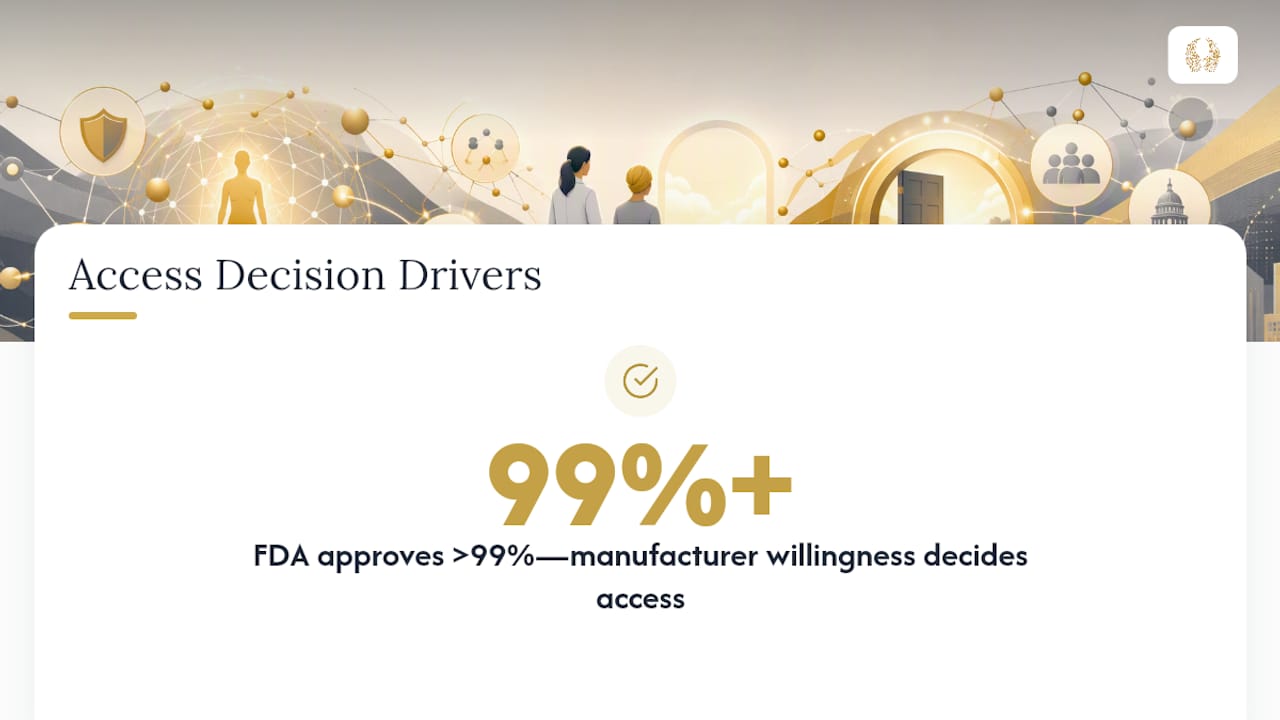
Here’s the number that surprises most families: over the last decade, the FDA has authorized the overwhelming majority of expanded access requests it receives, demonstrating a very high authorization rate, according to the Congressional Research Service. The agency is not the wall standing between your loved one and an investigational drug. The manufacturer is.
Companies decline requests for reasons that have nothing to do with compassion and everything to do with logistics:
- Limited manufacturing supply that can’t stretch beyond active trial participants.
- Genuine uncertainty about safety or efficacy outside a controlled trial setting.
- Concern that an adverse event in an expanded access patient could complicate an ongoing registration trial.
Institutions add their own friction, too. A hospital without dedicated regulatory staff may take weeks longer to assemble the same request another center finishes in days. If your treatment center lacks that infrastructure, ask explicitly whether a patient navigator or research coordinator can be assigned to your case. That single ask can shave real time off the process.
What You Need to Know About Risk, Consent, and Cost
An investigational drug has not been proven safe or effective the way an approved treatment has. The FDA is direct about this, and your care team should be too, walking through what’s actually known from earlier trial data versus what remains genuinely uncertain.
A few realities worth writing down before you sign anything:
- Insurance typically will not cover an investigational drug obtained through expanded access, since it lacks FDA approval for that use.
- Manufacturers may charge for direct costs of the drug itself, but not for profit or development costs. Get any expected charges in writing before treatment starts.
- Participating in expanded access can affect eligibility for future clinical trials, so ask your oncologist how this specific request might change your options down the line.
- Informed consent should cover every known risk in plain language. Our guide to informed consent in clinical trials walks through what a thorough conversation should include.
Document these conversations. If questions arise later about what you knew and when, a written record protects everyone involved.
How HCRF Helps You Navigate These Decisions
You don’t have to build this request packet alone. The Hippocratic Cancer Research Foundation connects patients with patient navigator services designed to help families understand their options and connect with the right resources at the right moment.
A few concrete moves to make this week:
- Gather every pathology report, imaging result, and treatment record in one place, so nothing slows your physician down.
- Appoint one family member as the point of communication with the care team, so information doesn’t get lost between relatives.
- Ask your oncologist directly about Project Facilitate if the diagnosis is cancer.
- Review our page on clinical trial eligibility to confirm a trial truly isn’t an option before pursuing expanded access.
Why Manufacturer Willingness Matters More Than Any Form
Most coverage of this topic fixates on paperwork, as if Form 3926 were the obstacle standing between a patient and hope. It isn’t. The data tells a different story: the FDA said yes to more than 99% of the single-patient requests it received over a decade. The real fight happens in a boardroom at a pharmaceutical company weighing supply constraints against one family’s urgency.
That reframes the whole conversation. If you’re preparing a request, spend your energy where it counts: building a data-rich packet, securing institutional regulatory support, and asking pointed questions when a manufacturer hesitates. Conventional advice tells families to “talk to your doctor,” which is true but incomplete. Talk to your doctor about whether your center has regulatory staff. Ask specifically about Project Facilitate. Push for clarity on manufacturer supply before you get emotionally invested in a single drug.
HCRF exists because research funding gaps leave too many promising drugs stuck earlier in development than they should be, which is part of why manufacturer supply runs thin in the first place. If this article helped you understand the terrain, consider joining us at Cocktails for a Cure, an evening event that directly funds out-of-the-box cancer research. Every dollar raised helps push therapies further along, so fewer families face the exact crossroads this article describes. Learn more about our mission at HCRF.
— HCRF
This article is general information, not a substitute for advice from a qualified doctor. Consult a qualified healthcare professional about your own circumstances before acting on anything here.
Sources
Start with the FDA’s expanded access hub for Form 3926 and program details, then read the Congressional Research Service report comparing Right to Try against expanded access. Oncologists preparing a request packet may also find value in guidance on assembling clinical documentation that supports a data-rich submission.
- Expanded Access — FDA
- Navigating the Expanded Access Pathway to Investigational Drugs as an Academic Oncologist — PMC / NIH
- Expanded Access and Right to Try: Access to Investigational Drugs — Congressional Research Service
FAQ
Can Any Cancer Patient Request Expanded Access?
Not automatically. The patient needs a serious or life threatening condition, no comparable alternative therapy, and an inability to enroll in a clinical trial, among the five FDA criteria.
How Long Does an Expanded Access Request Take?
Timelines vary by case, but FDA review itself moves quickly once submitted. The bigger variable is how fast the manufacturer agrees to supply the drug and how quickly your institution assembles the request packet.
Does Right to Try Guarantee Access to an Investigational Drug?
No. Right to Try removes the FDA and IRB review steps for eligible patients, but it does not require any manufacturer to provide the drug, which remains the real limiting factor either way.
Will Insurance Cover an Investigational Drug Received Through Expanded Access?
Typically not. Manufacturers may charge for direct costs of the drug itself, but not for development or profit, and coverage for an unapproved treatment usually falls outside standard insurance policies.
What Is Project Facilitate and Who Should Use It?
Project Facilitate is an FDA Oncology Center of Excellence service giving oncologists a single point of contact to help submit expanded access requests for individual cancer patients, reducing administrative delays.