


Why Cancer Screening Matters: Your 2026 Guide
July 20, 2026
Why Cancer Screening Matters: Your 2026 Guide

Cancer screening is a medical process used to find cancer before symptoms appear, enabling early intervention that can save lives and reduce treatment burdens. The importance of screening for cancer cannot be overstated: less than 50% of all cancers in the United States are currently detected through screening. That gap represents millions of people whose cancers could be found earlier, treated more effectively, and in some cases prevented entirely. We have the tools. We have the knowledge. What we need is for more people to use them.
Early detection is the single most powerful factor in improving cancer survival. When cancer is found at an early stage, treatment options are broader, less invasive, and far more likely to succeed. The American Cancer Society and the U.S. Preventive Services Task Force (USPSTF) have both built their cancer screening guidelines around this core truth. Understanding what those guidelines say, and why they matter, is the first step toward protecting your health.
What do current cancer screening guidelines recommend?
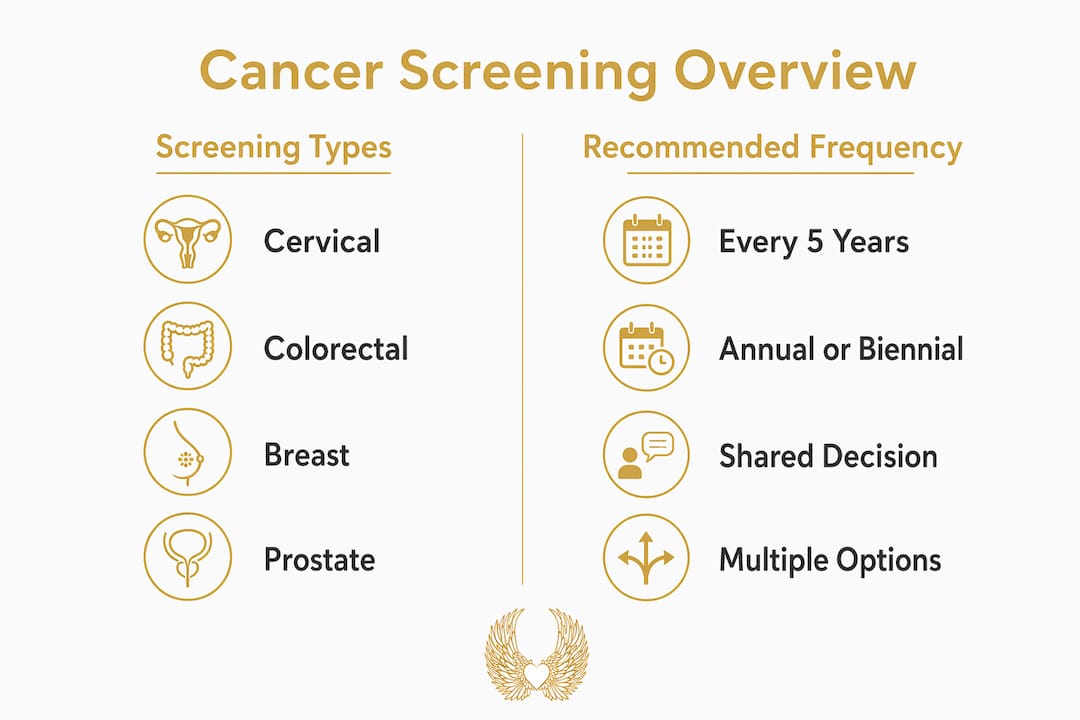
Cancer screening guidelines exist for a reason: they reflect decades of research on which tests save the most lives with the least harm. Here is what the leading guidelines recommend for the four most commonly screened cancers.

Cervical cancer
Cervical cancer screening via high-risk HPV (hrHPV) testing is recommended every 5 years for individuals aged 30–65. This interval reflects the slow progression of HPV-related cervical changes, giving clinicians a meaningful window to catch and treat precancerous cells before they become invasive cancer. For those aged 21–29, a Pap smear alone every 3 years remains the standard.
Colorectal cancer
Colorectal cancer screening offers the most options of any cancer type. Stool-based tests, such as the fecal immunochemical test (FIT), are recommended every year, while a multi-target stool DNA test is recommended every 3 years. A colonoscopy, which is both diagnostic and preventive, is recommended every 10 years for average-risk adults starting at age 45.
Breast cancer
Mammography screening is recommended annually or biennially starting at ages 40–45 for individuals with an expected life expectancy of at least 10 years. Annual screening catches more cancers earlier. Biennial screening reduces the number of false positives. The right interval depends on your personal risk profile and your conversation with your doctor.
Prostate cancer
Prostate-specific antigen (PSA) testing is recommended as a shared decision-making conversation for men aged 55–69. PSA testing is not universally recommended because its benefits and harms are closely balanced. Your doctor will weigh your family history, race, and overall health before advising you.
Pro Tip: Keep a personal health record that lists your last screening date for each cancer type. Bring it to every annual physical so your doctor can flag any gaps.
| Cancer type | Recommended test | Frequency |
|---|---|---|
| Cervical | hrHPV test (ages 30–65) | Every 5 years |
| Colorectal | Colonoscopy (average risk, age 45+) | Every 10 years |
| Colorectal | FIT stool test | Every year |
| Breast | Mammography (ages 40–45+) | Annually or biennially |
| Prostate | PSA test (ages 55–69) | Shared decision with provider |
What are the benefits and risks of cancer screening?
Screening is not a perfect tool. Understanding both sides helps you make a confident, informed decision rather than a fearful one.
The real benefits
Screening prevents cancer in two distinct ways. First, it detects cancer early when it is most treatable. Second, it identifies precancerous lesions, such as polyps in the colon or abnormal cells in the cervix, so they can be removed before cancer ever develops. That second benefit is often underappreciated. Colorectal and cervical screening programs have measurably reduced cancer incidence, not just mortality, precisely because of this preventive power.
- Earlier treatment. Cancers caught at stage I or II respond far better to treatment than those found at stage III or IV.
- Less invasive procedures. Early-stage cancers often require surgery alone rather than surgery combined with chemotherapy and radiation.
- Peace of mind. A normal result gives you real, evidence-based reassurance, not just hope.
- Prevention. Removing precancerous tissue stops cancer from forming in the first place.
The real risks
Screening carries risks that every person deserves to understand before agreeing to a test. Overdiagnosis occurs when screening finds a cancer that would never have caused symptoms or shortened life. Treating that cancer exposes the person to surgery, radiation, or chemotherapy with no benefit. False positives cause anxiety and lead to follow-up procedures that carry their own risks. These are not reasons to avoid screening. They are reasons to screen thoughtfully.
“Abnormal screening results often detect benign or precancerous changes, not cancer itself. Understanding this reduces anxiety and improves adherence to the follow-up care that actually saves lives.”
— Mayo Clinic
A critical and often overlooked point: a positive screening test requires timely follow-up diagnostics, such as a colonoscopy within 6 months, to confirm or rule out a diagnosis. Screening is the first step, not the final answer.
How should age, health, and risk factors shape your screening decisions?
Screening is not one-size-fits-all. The right decision for a 45-year-old in excellent health differs from the right decision for a 78-year-old managing multiple chronic conditions. Personalized screening decisions based on age, health status, and individual risk factors better balance benefits and harms, especially in older adults.
Here is a practical framework for thinking through your own situation:
- Know your baseline risk. Family history of cancer, genetic mutations such as BRCA1 or BRCA2, prior cancer diagnoses, and lifestyle factors all raise or lower your risk. Higher risk often means starting screening earlier or screening more frequently.
- Consider your life expectancy honestly. Screening guidelines emphasize life expectancy and overall health rather than chronological age alone. A frail 75-year-old may not benefit from a colonoscopy if the risks of the procedure outweigh the likelihood of meaningful benefit. A healthy 80-year-old may still benefit from mammography.
- Discuss your current health conditions. Conditions that complicate treatment, such as heart failure or advanced kidney disease, change the calculus. If treating a detected cancer would be too risky, finding it may cause more harm than good.
- Revisit your decisions regularly. Health changes. Guidelines change. A screening plan that made sense at 50 may need revision at 65. Schedule a dedicated conversation with your provider every few years to reassess.
- Ask about race and ethnicity-specific risks. Black men face a higher risk of aggressive prostate cancer and may benefit from earlier PSA discussions. Black women face higher rates of aggressive breast cancer subtypes. These disparities are real and should factor into your plan.
Pro Tip: Before your next appointment, write down your family cancer history going back two generations. This single piece of information can change your entire screening timeline.
Understanding cancer risk factors and how they interact with screening decisions is one of the most empowering things you can do for your long-term health.
What new technologies are shaping the future of cancer screening?
The next generation of cancer screening is moving away from population-wide, age-triggered tests toward precision models that account for individual biology. Emerging technologies like artificial intelligence and liquid biopsy are driving this shift toward more precise, equitable, and effective screening.
Artificial intelligence is already improving mammography interpretation. AI models can flag subtle patterns that radiologists might miss, reducing both false negatives and unnecessary callbacks. In lung cancer screening, AI assists in analyzing low-dose CT scans to prioritize high-risk nodules for follow-up.
Liquid biopsy is perhaps the most exciting development in early detection. A liquid biopsy analyzes a blood sample for fragments of tumor DNA, proteins, or other cancer signals. It has the potential to detect multiple cancer types from a single blood draw, years before a tumor would be visible on imaging. This technology is still maturing, but clinical trials are advancing rapidly.
| Approach | Current status | Key advantage |
|---|---|---|
| AI-assisted imaging | In clinical use for mammography and CT | Reduces missed cancers and false positives |
| Liquid biopsy (multi-cancer) | Clinical trials and limited commercial use | Detects multiple cancers from one blood draw |
| Risk-adapted screening | Emerging guideline integration | Personalizes timing and test type by individual risk |
| Traditional imaging | Standard of care | Proven, widely accessible, well-studied |
The European Cancer Prevention Organization has called for future screening programs to integrate precision medicine concepts, combining AI and liquid biopsy to customize strategies for each person. That future is closer than most people realize. Staying informed about these advances, and discussing them with your provider, keeps you ahead of the curve.
Key Takeaways
Early cancer detection through regular, guideline-based screening remains the most effective strategy for reducing cancer mortality and, in some cases, preventing cancer from developing at all.
| Point | Details |
|---|---|
| Screening gap is real | Less than 50% of U.S. cancers are currently found through screening, leaving enormous room for improvement. |
| Guidelines are specific | Cervical, colorectal, breast, and prostate cancers each have distinct recommended tests, ages, and intervals. |
| Benefits and risks coexist | Overdiagnosis and false positives are real harms; understanding them helps you screen wisely, not fearfully. |
| Personalization matters | Age, health status, and risk factors should shape your screening plan, not age alone. |
| Technology is advancing | AI and liquid biopsy are moving screening toward precision models that promise greater accuracy and equity. |
Our perspective: screening is a conversation, not a checkbox
We at the Hippocratic Cancer Research Foundation have watched too many people treat cancer screening as a bureaucratic obligation, something to check off a list and forget. That mindset misses the point entirely.
Screening is a living conversation between you and your healthcare provider. It should evolve as your health changes, as guidelines are updated, and as new technologies become available. The people who benefit most from screening are not those who simply show up for their annual mammogram. They are the ones who ask questions, share their family history, and push back when a recommendation does not feel right for their situation.
We also want to say something that most articles skip: an abnormal result is not a death sentence. Abnormal findings most often represent precancerous changes or benign conditions. That knowledge should reduce your fear of getting screened, not increase it. The anxiety of not knowing is almost always worse than the clarity of a result, even an unexpected one.
The 2026 cancer awareness calendar is a good reminder that every month brings a new opportunity to act. Do not wait for symptoms. Do not wait for a scare. Schedule the test. Have the conversation. You owe it to yourself and to the people who love you.
— HCRF
How the Hippocratic Cancer Research Foundation supports this mission
The Hippocratic Cancer Research Foundation (HCRF) is a 501©(3) nonprofit that funds “out of the box” cancer research at the Robert H. Lurie Comprehensive Cancer Center of Northwestern University. Our mission is rooted in hope and driven by urgency. We believe that better science leads to better screening, and better screening leads to more lives saved.

Every dollar we raise goes toward research that could redefine how we detect and prevent cancer. From supporting liquid biopsy trials to funding studies on health equity in screening access, HCRF stands at the front lines of this fight. Visit the Hippocratic Cancer Research Foundation to learn more about our work, access educational resources, or make a contribution that carries hope forward. We need you. THEY NEED OUR SUPPORT!
FAQ
What is cancer screening and why does it matter?
Cancer screening is the testing of people who have no symptoms to find cancer or precancerous changes early. Early detection dramatically improves treatment outcomes and, in some cancers, prevents the disease from developing at all.
At what age should I start cancer screening?
Starting ages vary by cancer type: colorectal screening begins at 45 for average-risk adults, breast cancer mammography starts at 40–45, and cervical screening begins at 21. Your personal risk factors may shift these timelines earlier.
Does an abnormal screening result mean I have cancer?
No. Most abnormal results reflect precancerous or benign changes, not cancer. Timely follow-up, such as a diagnostic colonoscopy after a positive stool test, clarifies the finding and guides next steps.
When should older adults stop cancer screening?
Screening decisions in older adults depend on life expectancy and overall health, not age alone. A frail person with limited life expectancy may face more harm than benefit from screening, while a healthy older adult may still gain meaningful protection.
What is a liquid biopsy and how does it relate to cancer screening?
A liquid biopsy analyzes a blood sample for tumor DNA or other cancer signals, with the potential to detect multiple cancer types before symptoms appear. The technology is in active clinical development and represents one of the most promising directions in precision cancer screening.
Recommended
- Hippocratic Cancer Research Foundation: Innovative Therapies | Cancer Research Funding: A 2026 Donor’s Guide
- Hippocratic Cancer Research Foundation: Innovative Therapies | Cancer Awareness Month Calendar: 2026 Complete Guide
- Hippocratic Cancer Research Foundation: Innovative Therapies | What Causes Cancer: Key Factors and Prevention
- Hippocratic Cancer Research Foundation: Innovative Therapies | Teas to Avoid During Chemo: A 2026 Patient Guide

Wondering if you qualify for a cancer clinical trial? Learn about eligibility criteria that may surprise you and find your options.
Read More →
Discover teas to avoid during chemo. This 2026 guide reveals risks, helps protect your treatment, and ensures safe choices for herbal infusions.
Read More →