


IRS Rules for Charity Gala Tax Deductions: $75, $250, $1,000
September 14, 2026
IRS Rules for Charity Gala Tax Deductions: $75, $250, $1,000

Generally, gala ticket payments are quid pro quo transactions: only the amount you paid that exceeds the fair market value of benefits received is tax-deductible. The deductible portion equals your payment minus the FMV of the dinner, entertainment, or other privileges you received. Charities must disclose that FMV in writing for payments over $75, and you need a contemporaneous written acknowledgment for any single gift of $250 or more. You’ll also need to itemize, or fall within non-itemizer limits, to actually claim it.
TL;DR:
- The deductible amount for a gala ticket depends on the payment minus the fair market value of the dinner and entertainment, which charities must disclose if over $75.
- Returning or explicitly waiving participation in benefits in writing can convert a ticket payment into a full donation for tax purposes.
- Accurate documentation, including written FMV estimates and disclosures, is essential to substantiate deductions and must be obtained before or at the time of purchase.
- Auction and raffle purchases follow specific rules, with deductions for winning bids limited by the item’s fair market value, and raffle tickets generally not deductible.
- Non-itemizers can deduct up to $1,000 in cash contributions in 2026, but gala-related deductions typically require itemizing and proper IRS-compliant documentation.
Table of Contents
- Understanding the Charity Gala Tax Deduction: Quid Pro Quo and Fair Market Value
- Getting Your Charity Gala Tax Deduction Paperwork Right
- How Silent Auction and Live Auction Purchases Are Taxed
- Are Raffle Tickets and Game Entries Tax-Deductible?
- Calculating Your Deductible Portion: Three Worked Examples
- Should You Itemize Your Gala Deduction, and What Are the AGI Limits?
- Avoiding the Most Common Charity Gala Deduction Mistakes
- How HCRF Issues IRS-Compliant Gala Receipts
- A Note on Transparency From HCRF
- Attend an HCRF Gala With Your Deduction Already Figured Out
- Where This Guidance Comes From
- Sources
- FAQ
Understanding the Charity Gala Tax Deduction: Quid Pro Quo and Fair Market Value
The IRS calls a gala ticket a “quid pro quo contribution” for a reason that trips up a lot of well-meaning donors. You’re not just giving money. You’re paying for something: a plated dinner, a live band, a program of speakers, maybe a wine pull. The tax code only lets you deduct the sliver of your payment that exceeds what those things are actually worth.
Here’s the mechanics. If a gala ticket costs $500 and the charity states the dinner and entertainment are worth $150, you can deduct $350. That $150 isn’t an arbitrary guess. Charities are supposed to determine fair market value based on what a similar meal or experience would cost from a comparable vendor, not what it cost the charity to produce. Publication 526 walks through this with concrete examples, including cases where an “established charge” for the event matches the benefit value exactly, in which case nothing beyond that charge is deductible unless you can show you paid more than the value of what you got.
There’s a wrinkle worth knowing: what happens if you buy a ticket and then can’t attend, simply skipping the event doesn’t make your payment fully deductible. The IRS bases the deduction on your right to receive the benefit, not whether you showed up and ate the chicken. If you want the full payment treated as a gift, Publication 526 spells out the fix: return the ticket to the organization for resale before the event. Once you’ve formally given up the seat, and the charity accepts that in writing, the quid pro quo problem disappears and the full amount becomes deductible.
A related but distinct scenario is an explicit written waiver. If you tell the charity in advance that you’re declining the dinner, entertainment, or any other privilege attached to your ticket, and the organization accepts that waiver in writing, your payment can be treated as a pure donation. The key word is explicit. A verbal “I probably won’t make it” doesn’t count. You need a paper trail showing the benefit was declined and the charity agreed.

Getting Your Charity Gala Tax Deduction Paperwork Right
Two separate IRS thresholds govern what documentation you need, and they trigger at different dollar amounts for different reasons.
The first is the contemporaneous written acknowledgment rule. For any single contribution at or above a threshold amount, the IRS requires the charity to give you a written statement before you file your return (or before the filing deadline, whichever comes first) that states the amount you paid, whether you received goods or services in exchange, and a good-faith estimate of their value. Without this document in hand, the IRS can disallow the deduction entirely, even if you genuinely gave the money and can prove it with a bank statement.
The second is the quid pro quo disclosure rule under IRC § 6115. For any payment above a certain threshold that is partly a purchase and partly a gift, the charity must disclose in writing that only the excess over fair market value is deductible, along with a good-faith estimate of that value. This disclosure often shows up on the invitation, the ticket itself, or the follow-up receipt. It’s a common misconception that the first $75 of any gift is automatically deductible. It isn’t. The $75 threshold only determines whether the charity has to give you a disclosure statement, not how much of your payment counts as a gift.
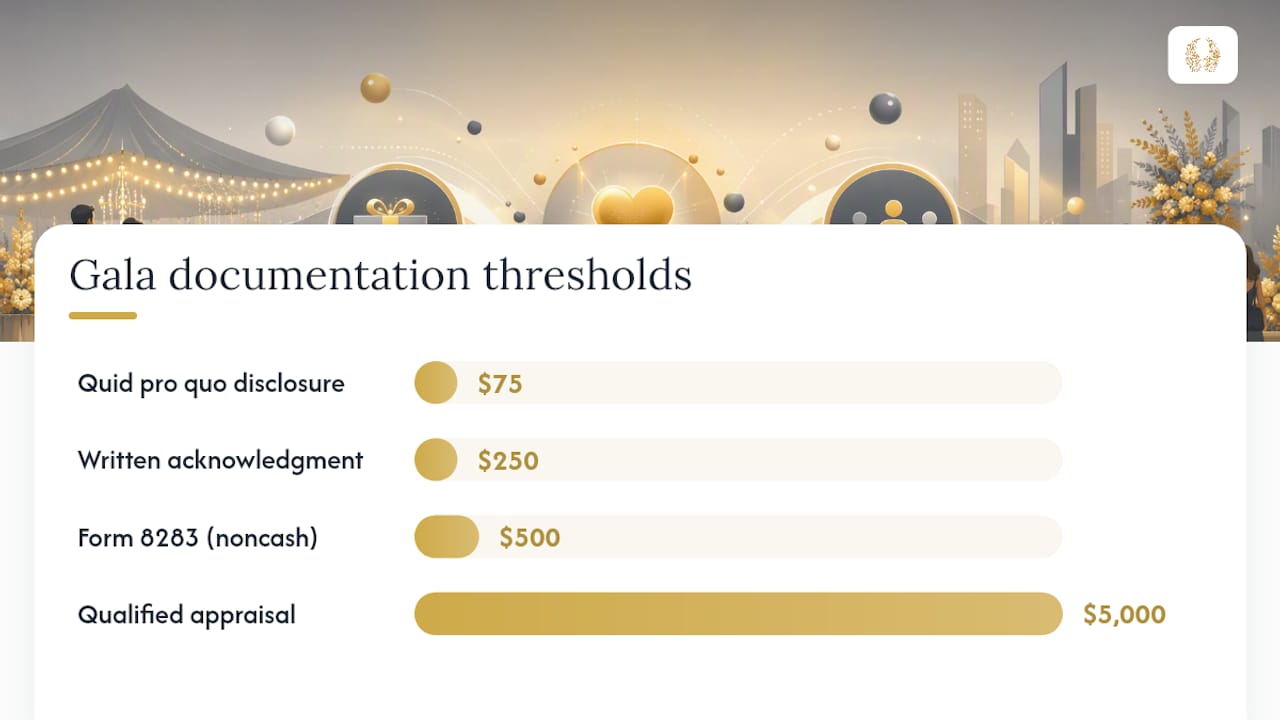
For noncash gifts tied to a gala, such as donating an item for the auction rather than buying one, different rules apply. Noncash donations above $500 typically require Form 8283, and gifts above $5,000 usually require a qualified appraisal.
Before you hand over a credit card at the registration table, take a moment to ask the organizer for the FMV breakdown in writing.
Practical steps to lock in proper documentation:
- Ask for the FMV disclosure at the time of purchase, not months later at tax season.
- Save the invitation or event program if it states the dinner and entertainment value.
- Request a written acknowledgment before you file, especially for gifts of $250 or more.
- If you plan to skip the event, notify the charity in writing and ask them to confirm the waiver.
Pro Tip: If a gala invitation doesn’t list a fair market value estimate, email the organizer and ask for one in writing before the event. That single email becomes your proof if the IRS ever asks how you calculated your deduction.
How Silent Auction and Live Auction Purchases Are Taxed
Auction items work on the same quid pro quo logic as gala tickets, but the valuation gets trickier because there’s no printed ticket price to start from.
- If you’re the winning bidder, your deductible amount is your winning bid minus the item’s fair market value. A vacation package listed in the auction catalog at an estimated $800 that you win for $1,200 gives you a $400 deduction. Keep the catalog or program page showing the published estimate. Without it, you have no way to prove what portion of your bid exceeded value.
- If you donated the item being auctioned, your deduction can be more limited than you’d expect. When a charity sells your donated item, current IRS guidance on charity auctions treats that as an “unrelated use,” which can cap your deduction at your cost basis rather than the item’s full market value. Donate a painting you bought for $2,000 that’s now worth $6,000, and your deduction may be limited to that original $2,000 basis, not the appreciated value.
- For higher-value donated items, Form 8283 applies once noncash gifts exceed $500, and contributions above $5,000 generally require a qualified written appraisal filed with Section B of the form.
Both buyers and donors should hold onto the auction catalog, any printed valuation, and the charity’s acknowledgment letter. These documents form your entire case if the IRS ever questions the number you wrote on Schedule A.
Are Raffle Tickets and Game Entries Tax-Deductible?
No, in almost every case. Raffle tickets, game entries, and similar chances to win a prize are treated as a purchase of a wagering opportunity, not a charitable gift, regardless of the cause behind them. You’re paying for a chance at a prize with defined odds, which the IRS doesn’t recognize as a donation even when the charity keeps most of the proceeds.
A few exceptions and related situations do come up at galas:
- If your raffle ticket bundle includes a separate, clearly itemized donation beyond the ticket price, that separate amount can be deductible.
- If you donate a prize for the raffle rather than buying a ticket, normal noncash donation rules apply, including basis limits if the charity later sells rather than awards the item.
- Cash “paddle raise” pledges made during the event, distinct from any ticket or raffle purchase, are typically fully deductible gifts since no goods or services are exchanged for them.
Don’t lump paddle-raise pledges and raffle tickets together on your return. They’re taxed completely differently, and mixing them up is one of the more common gala-related filing errors.
Calculating Your Deductible Portion: Three Worked Examples
The formula stays constant no matter the scenario: deductible amount = total payment minus fair market value of benefits received. “Benefits received” means anything with real market value that you got in exchange, such as the meal, entertainment, valet parking if separately valued, or a gift bag with listed contents.
| Scenario | Amount paid | Stated FMV of benefits | Deductible portion |
|---|---|---|---|
| Single gala ticket | $500 | $150 | $350 |
| Table of 10 (bulk purchase) | $5,000 | $1,500 ($150 × 10 seats) | $3,500 |
| Auction winning bid on vacation package | $1,200 | $800 | $400 |
A donor who buys a single $500 ticket where the charity discloses $150 in FMV can claim $350 as a charitable contribution on Schedule A. Buy a table of 10 at $5,000, and if the charity confirms the same $150-per-seat FMV, the math scales proportionally to a $3,500 deduction, assuming all 10 seats are used or the unused seats were returned in writing. The auction example follows the same subtraction, just using your winning bid instead of a fixed ticket price.
One dollar figure worth remembering for 2026: non-itemizers can deduct up to $1,000 ($2,000 if married filing jointly) in cash contributions to qualified organizations, even without itemizing. Report the itemized version of your gala deduction on Schedule A, and if you donated a noncash item worth over $500 rather than purchasing one, attach Form 8283.
Should You Itemize Your Gala Deduction, and What Are the AGI Limits?
A charity gala tax deduction only lowers your tax bill if your total itemized deductions, mortgage interest, state and local taxes, medical expenses, and charitable gifts combined, exceed your standard deduction. For a lot of taxpayers, especially since the standard deduction nearly doubled under the Tax Cuts and Jobs Act, that threshold is harder to clear than it used to be. If your itemized total falls short, the $350 or $3,500 you calculated from your gala ticket effectively delivers no tax benefit on its own, unless you’re one of the non-itemizers eligible for the $1,000/$2,000 cash contribution allowance described above.
For those who do itemize, the IRS caps how much of your income you can offset with charitable giving in a single year. Cash contributions to public charities like a 501©(3) research foundation are generally limited to 60% of your adjusted gross income. Donations of appreciated noncash property, like stock or real estate given instead of cash, are typically capped at 30% of AGI. Anything above those ceilings doesn’t disappear. It carries forward for up to five subsequent tax years, subject to the same percentage limits each year.
One more layer worth a brief mention: these rules describe individual taxpayer treatment. Corporate donors face a different framework, generally a flat percentage-of-taxable-income cap set separately from individual AGI rules, so a company sponsoring a table at your gala should route that question to its own tax advisor rather than assume the individual limits apply.
Avoiding the Most Common Charity Gala Deduction Mistakes
Most denied gala deductions come down to a handful of repeatable errors, not aggressive tax positions. Here’s what actually trips donors up:
- Deducting the full ticket price without subtracting the disclosed FMV of the dinner or entertainment.
- Assuming skipping the event automatically makes the payment a full gift, without a written waiver on file.
- Losing or never requesting the $250+ contemporaneous acknowledgment before filing.
- Treating a raffle ticket purchase as a charitable gift.
- Claiming full market value for a donated auction item the charity later sold, instead of the basis-limited amount.
- Filing without Form 8283 for noncash gifts over $500.
Before you write a check for a gala table, ask the organizer six questions: What is the stated FMV per seat? Will I get a written acknowledgment before tax season? Is there a way to decline the meal in writing? How should I document a donated auction item? Do you provide Form 8283 support for noncash gifts? What happens if I can’t attend?
Pro Tip: If a charity can’t answer these questions or won’t put the FMV in writing, ask for it by email anyway and keep the response. A missing disclosure doesn’t mean you can’t deduct anything, but it does mean you’ll need to build your own paper trail to support the number you claim.
How HCRF Issues IRS-Compliant Gala Receipts
The is a registered 501©(3) nonprofit supporting cancer research at the Robert H. Lurie Comprehensive Cancer Center of Northwestern University, and every gala ticket sold carries the documentation the IRS expects a compliant charity to provide.
That means a written statement that spells out four things clearly: the total amount paid, a good-faith estimate of the fair market value of the dinner, entertainment, or other privileges included, an explicit statement confirming what goods or services were provided in exchange, and the date of the contribution. Donors who give $250 or more receive this as a contemporaneous written acknowledgment, delivered in time to support a return filed by the following tax deadline.
For payments over $75 tied to an event ticket, the same materials include the required quid pro quo disclosure so donors know exactly which portion of their payment is deductible before they ever sit down to file. That’s the standard we hold every fundraising event to, not just a courtesy extended to major donors.
A Note on Transparency From HCRF
We hear from donors every year who assumed their entire gala ticket was deductible, only to learn the rules are more specific than that. We’d rather you know the real numbers upfront than get a surprise from your accountant in April. Every receipt we issue spells out the fair market value estimate and the deductible portion in plain language, because a donor who understands the math is a donor who keeps giving. If a receipt from one of our events ever looks unclear, reach out to our development team directly and we’ll get you what you need.
— HCRF
Attend an HCRF Gala With Your Deduction Already Figured Out
HCRF designs its gala receipts so you never have to guess what portion of your ticket qualifies as a charitable gift. Every attendee gets the fair market value estimate and the required written disclosure up front, not buried in fine print after the fact, so the math in this article is already done for you before you file.

Certain galas fund “out of the box” cancer research at the Robert H. Lurie Comprehensive Cancer Center of Northwestern University, and tickets generally come with documentation as described in this guide: the FMV breakdown, the quid pro quo disclosure for payments over $75, and a contemporaneous acknowledgment for gifts of $250 or more. If you’re weighing a gala ticket against another way to give, our charitable donation tax deduction guide covers alternatives like direct online gifts that carry no quid pro quo complications at all. Ready to see what’s coming up? Visit Hcrfwingstocure to check upcoming events and get in touch with our development team about receipt questions before you buy.
Where This Guidance Comes From
This guide draws directly from primary IRS sources so you can verify every rule yourself before filing:
- Topic No. 506, Charitable Contributions
- Publication 526, Charitable Contributions
- Substantiating Charitable Contributions
- Charity Auctions
These four pages remain the authoritative reference for how gala payments, auction items, and disclosure requirements are treated under federal tax law.
This article is general information, not a substitute for advice from a qualified financial advisor. Consult a qualified financial professional about your own circumstances before acting on anything here.
Sources
- Topic No. 506, Charitable contributions
- Charitable contributions: substantiating charitable contributions (IRS)
- Charity auctions (IRS)
- Publication 526, Charitable Contributions (IRS)
FAQ
Are Charity Raffle Tickets Tax-Deductible?
No. Raffle tickets are treated as a wager for a chance to win a prize, not a charitable gift, so the purchase price isn’t deductible even when the charity keeps the proceeds.
How Much Do Charitable Donations Reduce Your Taxes?
The reduction depends on your tax bracket and whether you itemize; a deduction lowers your taxable income by the deductible amount, not your tax bill dollar-for-dollar, and gala tickets only count for the portion exceeding the fair market value of benefits received.
What Is the New $1,000 Charitable Deduction?
For 2026, non-itemizers can deduct up to $1,000 ($2,000 if married filing jointly) in cash contributions to qualified charities without itemizing, a separate benefit from the itemized deduction rules that govern most gala ticket purchases.
Can You Deduct Charitable Contributions in 2026 Without Itemizing?
Yes, up to the $1,000 single or $2,000 joint cash contribution limit described above; larger gifts, or gifts involving benefits like a gala dinner, generally still require itemizing on Schedule A to claim beyond that threshold.
Does the organization provide the documentation needed to claim a gala deduction?
Yes. They issue written acknowledgments for gifts of $250 or more and provide quid pro quo disclosures for gala tickets over $75, stating the fair market value of benefits received so donors know their deductible portion before filing.
Recommended

Four checks patients and caregivers can use to read clinical trial results, find absolute benefit and NNT, spot bias, and know what to ask.
Read More →
Learn about clinical trial phases to understand treatment testing, risks, and what participation truly entails for you or your loved ones.
Read More →