


Charitable Donation Tax Deductions: Your 2026 Guide
August 12, 2026
Charitable Donation Tax Deductions: Your 2026 Guide

Yes, charitable donations are tax deductible — but only when you give to a qualified organization and meet the IRS’s documentation and reporting requirements. For most taxpayers, that means itemizing deductions on Schedule A rather than taking the standard deduction. Starting with the 2026 tax year, however, even non-itemizers can claim a limited deduction: up to $1,000 for single filers or $2,000 for married couples filing jointly on qualified cash gifts, per Topic No. 506.
Three conditions must be in place before any gift reduces your federal tax bill:
- Qualified organization. The recipient must be recognized under Section 170© of the Internal Revenue Code — religious, charitable, educational, scientific, or literary organizations, among others. Gifts to individuals never qualify.
- Proper documentation. Bank records for any cash gift; a contemporaneous written acknowledgment from the charity for gifts of $250 or more.
- Correct reporting. Itemizers use Schedule A (Form 1040). Non-itemizers in 2026 follow IRS guidance in Publication 526 and Topic 506 for the new limited deduction.
Pro Tip: The contemporaneous written acknowledgment must be in hand before you file your return — not just before the deadline. A canceled check alone is not enough for gifts of $250 or more.
Key Takeaways
Charitable donations are tax deductible when made to a qualified organization, properly documented, and reported on the correct IRS forms — with a new 2026 option for non-itemizers to deduct a limited amount for qualified cash gifts.
| Point | Details |
|---|---|
| Qualified organization required | Only gifts to Section 170© organizations are deductible; verify status at the IRS Tax Exempt Organization Search before giving. |
| Documentation thresholds | Written acknowledgment required at $250+; Form 8283 required for noncash gifts over $500; qualified appraisal required above $5,000. |
| AGI-based deduction limits | Cash gifts to public charities are generally limited to 60% of AGI; excess carries forward for up to five years. |
| 2026 non-itemizer deduction | Non-itemizers may now deduct up to $1,000 (single) or $2,000 (MFJ) for qualified cash contributions starting in 2026. |
| HCRF as a giving destination | HCRF is a verified 501©(3) funding cancer research at Northwestern’s Lurie Cancer Center — donations are fully deductible and mission-driven. |
Table of Contents
- What qualifies as a deductible charitable contribution?
- How much can you deduct? AGI limits, special rules, and carryovers
- What records do you need to substantiate your deduction?
- How do you claim the deduction on your federal return?
- Special cases that change the rules
- Your step-by-step checklist for every charitable gift
- Why giving to medical research nonprofits like HCRF matters beyond the tax benefit
- The part most tax guides get wrong about charitable giving
- Support the research that changes everything
- Sources
What qualifies as a deductible charitable contribution?
A charitable contribution, as the IRS defines it, is a voluntary transfer of money or property to a qualified organization with no expectation of receiving something of equal value in return. That last clause matters more than most donors realize.
Qualifying organization types include:
- Churches, synagogues, mosques, and other religious organizations
- Nonprofit educational institutions (schools, colleges, universities)
- Nonprofit hospitals and medical research organizations
- Publicly supported charities (the classic 501©(3))
- Certain veterans’ organizations, fraternal societies, and cemetery companies
- Federal, state, and local governments (when the gift is for a public purpose)
What does NOT qualify: gifts to individuals, political parties or candidates, foreign organizations (with limited treaty exceptions), and social clubs or labor unions. Even a well-meaning cash gift to a neighbor in need earns no deduction.
Before you give, verify status using the IRS Tax Exempt Organization Search. This free tool confirms whether an organization is recognized as tax-exempt and shows any special percentage limits that apply to contributions made to it — a detail that matters when you’re planning a large gift. The IRS charitable contribution deductions page also directs donors to this tool and notes that the search results include deductibility codes indicating whether a 30% or 20% AGI limit applies rather than the standard 60%.
How much can you deduct? AGI limits, special rules, and carryovers
The ceiling on your charitable deduction depends on your adjusted gross income (AGI) and the type of organization you’re giving to. Publication 526 lays out the full framework, but here are the essential tiers:
| Limit | Applies to |
|---|---|
| 60% of AGI | Cash gifts to most public charities and certain private foundations |
| 60% of AGI | Certain capital gain property contributions |
| 30% of AGI | Cash gifts to private foundations; appreciated capital gain property to public charities |
| 20% of AGI | Appreciated capital gain property to private foundations |
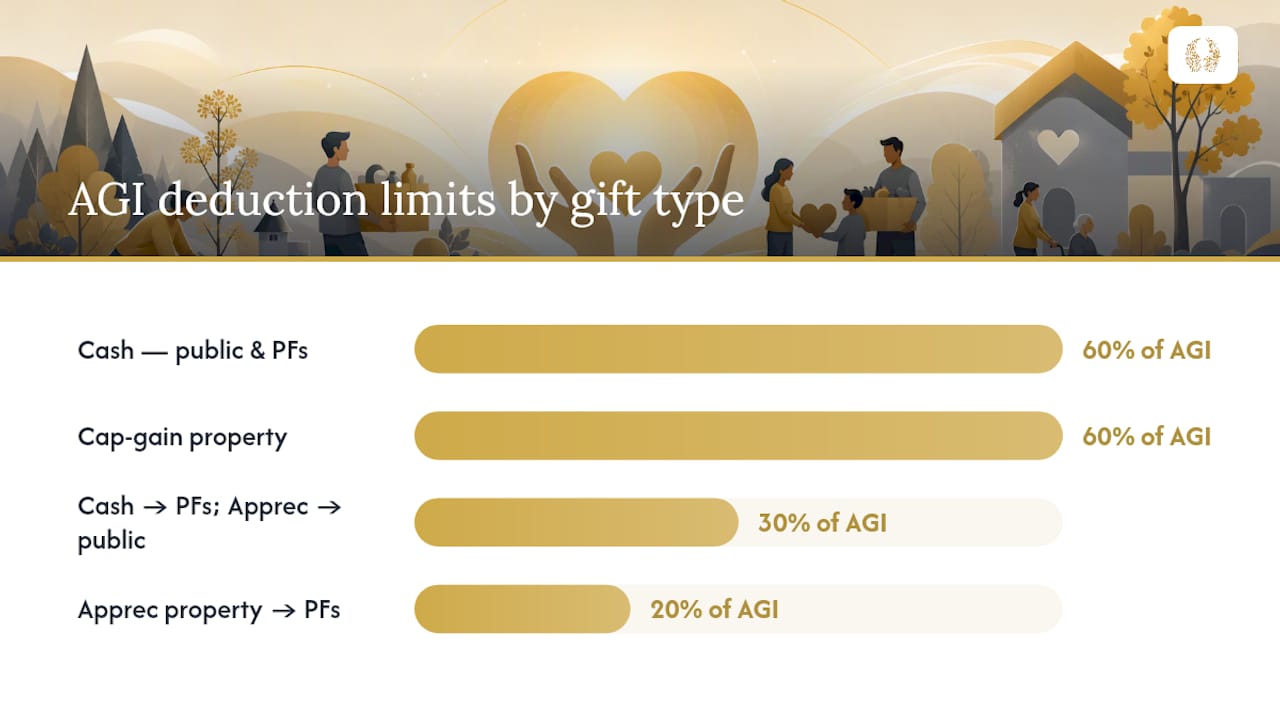
If your total charitable gifts exceed the applicable limit in a given year, the excess doesn’t disappear. You carry it forward and deduct it over the next five tax years, subject to the same percentage limits each year.
A short example: if your AGI is $100,000 and you donate $70,000 in cash to a public charity, you can deduct $60,000 this year and carry the remaining $10,000 forward.
The 2026 non-itemizer rule. For the first time, taxpayers who take the standard deduction can still claim a charitable deduction — up to $1,000 (single) or $2,000 (married filing jointly) for qualified cash contributions made in 2026. This is a meaningful shift for the majority of filers who don’t itemize.
Pro Tip: If you’re close to the itemizing threshold, bunching two or three years of charitable gifts into one tax year can push you over the standard deduction and unlock the full deduction for all your giving.
What records do you need to substantiate your deduction?
The IRS’s documentation rules are tiered by donation size and type. Missing the right record at the right threshold is one of the most common reasons deductions get disallowed on audit.
Cash donations:
- Any amount: bank record, credit card statement, or written communication from the charity showing the date, amount, and organization name
- $250 or more: a contemporaneous written acknowledgment from the charity, stating the amount and whether any goods or services were provided in return
Noncash donations:
- Under $250: receipt from the charity with a description of the property
- $250–$500: contemporaneous written acknowledgment plus a description of the property
- Over $500: complete Form 8283 (Noncash Charitable Contributions) and attach it to your return
- Over $5,000: a qualified appraisal from a certified appraiser, plus Section B of Form 8283 signed by the appraiser and the charity
For donated vehicles, boats, and airplanes, the rules shift further. The charity must provide Form 1098-C within 30 days of the sale or contribution. Your deduction is generally limited to the gross proceeds from the charity’s sale of the vehicle, not the vehicle’s fair market value, unless a specific exception applies (such as the charity using the vehicle directly in its mission).
Valuation of donated property follows fair market value — what a willing buyer would pay a willing seller, neither under compulsion. For clothing and household items, the IRS requires that donated goods be in good used condition or better. IRS Publication 561 provides detailed guidance on determining fair market value for a wide range of property types.
Key threshold: A qualified appraisal is generally required for any noncash item where the claimed deduction exceeds $5,000. Without it, the deduction can be disallowed entirely — not just reduced.
Pro Tip: File the charity’s written acknowledgment with a copy of your tax return for that year. If the IRS questions the deduction two or three years later, you’ll have everything in one place.
How do you claim the deduction on your federal return?
For itemizers: Report charitable contributions on Schedule A (Form 1040), lines 11 through 14, depending on the type of gift. Cash gifts go on line 11; noncash gifts on line 12 (with Form 8283 attached when required); carryover amounts from prior years on line 13.
Additional forms required:
- Form 8283 — attach when total noncash deductions exceed $500; Section B required when any single item exceeds $5,000
- Form 1098-C — attach (or include the information) when donating a motor vehicle, boat, or airplane
For non-itemizers in 2026: Follow the IRS instructions in Topic No. 506 and Publication 526 for reporting the limited deduction. The IRS will specify the exact line on Form 1040 for this new provision.
Filing checklist:
- Confirm the organization’s qualified status via the IRS Tax Exempt Organization Search before filing
- Gather all bank records and credit card statements for cash gifts
- Collect written acknowledgments for every gift of $250 or more
- Complete Form 8283 if noncash gifts exceed $500 in total
- Attach Form 1098-C for any donated vehicle
- Calculate carryover amounts from prior years and include them on Schedule A
- Check your state return — some states have different rules or additional forms
One practical note: your deduction is claimed in the tax year the gift is delivered, not when you pledge it. A check mailed on December 31 counts for that year; a credit card charge on December 31 counts even if the statement closes in January.
Special cases that change the rules
Appreciated securities
Donating stock or mutual fund shares you’ve held for more than one year is one of the most tax-efficient moves available. You deduct the full fair market value on the date of the gift and avoid paying capital gains tax on the appreciation. Short-term holdings (held one year or less) are deductible only at your cost basis, not fair market value.

Donor-advised funds
A donor-advised fund (DAF) lets you take the charitable deduction in the year you contribute to the fund, even if you don’t direct the grants to specific charities until later years. The contribution to the DAF must go to a sponsoring organization that qualifies under Section 170©. Grants from the DAF to individual charities are not separately deductible — the deduction was already claimed at contribution.
Quid-pro-quo contributions
When you buy a gala ticket, bid at a charity auction, or attend a fundraising dinner, you can only deduct the amount you paid above the fair market value of what you received. If a ticket costs $500 and the dinner is worth $150, your deduction is $350. Charities are required to disclose the FMV of benefits in a written statement for payments exceeding $75, per Publication 526.
State tax credit interactions
If your state offers a tax credit for a charitable contribution, that credit can reduce your federal deduction. The general rule: reduce your federal deduction by the amount of the state credit you receive or expect to receive.
IRA Qualified Charitable Distributions (QCDs)
Taxpayers age 70½ or older can transfer up to $105,000 directly from a traditional IRA to a qualified charity as a QCD. The transfer counts toward your required minimum distribution but is excluded from your taxable income entirely. You don’t claim a charitable deduction for a QCD — the tax benefit comes from the income exclusion. This makes QCDs especially powerful for donors who don’t itemize.
AMT interactions
Charitable deductions are generally allowed for Alternative Minimum Tax purposes, so they don’t trigger the AMT the way some other deductions do. Appreciated property donations are one area to watch: the AMT may treat the appreciation differently in certain circumstances, so donors making large noncash gifts should confirm the AMT impact with a tax advisor.
Pro Tip: For workplace giving programs, payroll deductions to a charity are deductible — but your pay stub or employer statement serves as the bank record. Request a pledge card or employer confirmation showing the organization’s name and the amount withheld. Learn more about workplace giving programs that can amplify your impact.
Your step-by-step checklist for every charitable gift
Getting the deduction right starts well before you file. Here’s what to do at each stage.
Before you donate:
- Search the organization on the IRS Tax Exempt Organization Search to confirm 501©(3) status and check for any reduced percentage limits
- Ask whether your state offers a tax credit for contributions to this type of organization — and understand how that credit interacts with your federal deduction
- For large gifts, request the charity’s written acknowledgment procedures in advance so you know what documentation you’ll receive and when
Year-round recordkeeping:
- Save every bank record, credit card statement, and canceled check for cash gifts
- File written acknowledgments from the charity immediately upon receipt — don’t wait until tax season
- For noncash gifts, keep a written description of the property, its condition, and how you determined fair market value
- If you received an appraisal, keep the full appraisal report and the appraiser’s credentials
- Retain Forms 8283 and 1098-C with your tax records for at least three years after filing
At filing time:
- Match each acknowledgment to the correct tax year — the gift date, not the acknowledgment date, determines the year
- Confirm carryover amounts from prior years and include them on Schedule A
Pro Tip: Time large gifts carefully. A wire transfer or brokerage transfer of securities must settle by December 31 to count in that tax year. Don’t assume a transfer initiated on December 30 will clear in time — confirm with your broker or bank.
Why giving to medical research nonprofits like HCRF matters beyond the tax benefit
The Hippocratic Cancer Research Foundation (HCRF) is a 501©(3) nonprofit organization — fully verified under Section 170© — that funds “out of the box” cancer research at the Robert H. Lurie Comprehensive Cancer Center of Northwestern University. Every dollar donated goes toward pilot studies, clinical trial seed funding, and translational research that moves discoveries from the laboratory to patients who need them.

The tax benefit of a charitable donation is real and worth claiming. But for donors to HCRF, the deeper return is measured in something else entirely: research that might not get funded through conventional channels, clinical trials that open doors for patients who’ve run out of options, and a scientific community emboldened to think differently about cancer.
How your gift creates impact at HCRF:
- Pilot study funding that allows researchers to generate the preliminary data needed to compete for larger federal grants
- Seed funding for clinical trials at the Lurie Cancer Center, one of the nation’s leading NCI-designated comprehensive cancer centers
- Support for translational research that connects laboratory findings to patient care
- Donor engagement through progress reports, educational newsletters, and gala events that keep our community connected to the science
For donors considering multi-year commitments, a donor-advised fund or a pledge structure can align giving with HCRF’s research cycles and maximize both impact and tax planning flexibility. Designating gifts to specific research priorities — immunotherapy, early detection, or a particular cancer type — gives your contribution a direct line to the science you care about most.
Learn more about how to donate to cancer research and drive real impact, or visit the HCRF donor guide for 2026 for giving strategies tailored to this moment.
The part most tax guides get wrong about charitable giving
Most articles on charitable donation tax deductions treat the deduction as the point. Get the paperwork right, hit the AGI limit, carry over the excess. That framing is technically correct and practically incomplete.
Here’s what the conventional advice misses: the documentation rules exist because Congress wanted to ensure that tax benefits flow to genuine charitable acts, not to disguised personal transactions. Understanding that intent changes how you approach giving. It means the written acknowledgment isn’t bureaucratic friction — it’s the charity’s confirmation that your gift served a public purpose. It means the appraisal requirement for high-value noncash gifts isn’t punitive — it’s a check on inflated valuations that have historically been abused.
The second gap in standard advice is the overemphasis on maximizing the deduction rather than maximizing the impact. A donor who gives $10,000 to a charity they haven’t researched, purely because it’s a 501©(3), has optimized the wrong variable.
For donors to medical research organizations like HCRF, the calculus is different in the best possible way. The tax benefit is real. But the pilot study that gets funded because of your gift — the one that generates the preliminary data for a federal grant application — that’s the return that doesn’t appear on Schedule A. Treat the deduction as a feature of generosity, not its purpose.
Support the research that changes everything
When you give to the Hippocratic Cancer Research Foundation, you’re not just claiming a charitable donation tax deduction. You’re funding the kind of research that larger institutions won’t take a chance on — the unconventional hypotheses, the early-stage trials, the ideas that need a champion before they need a grant committee.

HCRF is a verified 501©(3) at the Robert H. Lurie Comprehensive Cancer Center of Northwestern University. Your gift is fully deductible under the rules this guide covers, and every dollar goes directly to research that matters. Whether you’re making a one-time contribution, setting up a recurring gift, or directing a grant from a donor-advised fund, HCRF has the infrastructure and the mission to put your generosity to work.
We need you. The patients who will benefit from tomorrow’s breakthroughs need you today.
Make your gift at Hcrfwingstocure and join a community of donors who believe that hope, backed by science, is the most powerful force in medicine.
This article is general information, not a substitute for advice from a qualified financial advisor. Consult a qualified financial professional about your own circumstances before acting on anything here.
Sources
These IRS publications, forms, and tools are the primary references for any question about charitable deductions. Bookmark them before you file.
- 26 USC 170: Charitable, etc., contributions and gifts
- Deducting charitable contributions at a glance
A note on community fundraising: Organizations like Meallmore, which raised £7,000 for cancer research through a community walking event, show what collective giving looks like in action. That same spirit drives every HCRF fundraising campaign, and the tax rules above apply equally to every dollar our donors contribute.
For HCRF-specific giving guidance, visit Hcrfwingstocure or read our guide on how to donate to cancer research.
Recommended
- Hippocratic Cancer Research Foundation: Innovative Therapies | Cancer Research Funding: A 2026 Donor’s Guide
- Hippocratic Cancer Research Foundation: Innovative Therapies | Workplace Giving Programs for Cancer Research Donors
- Hippocratic Cancer Research Foundation: Innovative Therapies | How to Donate to Cancer Research and Drive Real Impact
- Hippocratic Cancer Research Foundation: Innovative Therapies | Why Cancer Screening Matters: Your 2026 Guide


A historic homecoming as the Hippocratic Cancer Research Foundation brings its mission to Athens for the first time, uniting global leaders, researchers, and supporters in the fight to end cancer through innovation, compassion, and hope.
Read More →