


$250 IRS rule: 5 ready tribute donation messages for donors
September 1, 2026
$250 IRS rule: 5 ready tribute donation messages for donors

A tribute donation is a charitable gift made in someone’s honor or memory instead of, or alongside, a traditional gift, following the IRS written-acknowledgment guidance that governs receipts for gifts of $250 or more. To give one right now, pick a nonprofit like HCRF, check the “in memory” or “in honor” box, add a short dedication, and choose whether you want your gift kept private. The rest is details.
TL;DR:
- Gifts of $250 or more require a written acknowledgment from the charity, with specific details on the amount and receipt timing for tax deductions.
- Tribute donations can be made via one-time gifts, recurring donations, tribute pages, or memorial funds, depending on time and involvement.
- Effective tribute messages are short, sincere, and often use pre-made templates to encourage donations and reduce donor hesitation.
- Nonprofits typically notify families without revealing donation amounts, and privacy requests are honored to protect donor confidentiality.
- Successful tribute campaigns rely on consistent promotion, updates, storytelling, and timely thank-yous, while avoiding multiple pages for the same honoree.
Table of Contents
- What Are the Different Ways to Make a Tribute Donation?
- What Should I Write in a Tribute Message or Card?
- How Do Tax Deductions and Receipts Work for Tribute Gifts?
- How Do Nonprofits Handle Tribute Gifts and Donor Requests?
- How Do You Set Up a Tribute Page or Memorial Fund?
- When Is the Right Time to Give a Tribute Donation?
- How Can Communities Encourage More Tribute Giving?
- What Etiquette Should Donors and Families Keep in Mind?
- What Do Successful Tribute Campaigns Look Like?
- What Challenges Come Up With Tribute Donations?
- Why Tribute Gifts Matter to Our Mission
- Make a Tribute Donation to HCRF Today
- Sources
What Are the Different Ways to Make a Tribute Donation?
Most donors give in one of a handful of ways, and the right one usually depends on how much time you have and who else is involved. A one-time online gift is designed to be quick and easy on most nonprofit websites: you enter an amount, select “give in memory of” or “give in honor of,” type a name, and submit. Recurring tribute gifts can repeat monthly or annually, which some families choose to mark a loss on meaningful dates, such as a birthday or an anniversary.
Beyond a single form, you have several other paths:
- Tribute pages and memorial funds. Many nonprofits, including HCRF, host a dedicated page where friends and family can all give toward one goal. The Michael J. Fox Foundation’s tribute page model is a good example of how a single shareable link replaces scattered instructions in an obituary or group text.
- “In lieu of flowers” gifts. Funeral homes often collect tribute envelopes at services, or families ask that checks be mailed to a specific organization instead of flowers being sent.
- Checks by mail. Some donors still prefer paper, especially older relatives; just be sure to write the honoree’s name clearly on the memo line or an accompanying note.
- Donor-advised funds and noncash gifts. Stock transfers, appreciated assets, and DAF grants can all carry a tribute designation, though the paperwork differs from a cash gift. Our guide to noncash charitable contributions walks through valuation and documentation.
Whichever route you pick, most forms ask for the same core details: the honoree’s name, whether to notify a specific person or family, an optional short message, and whether you want to remain anonymous.
What Should I Write in a Tribute Message or Card?
Short and sincere beats long and formal almost every time. Nonprofits that provide ready-made e-card language, similar to what The Jed Foundation recommends, tend to see fewer abandoned donation forms, because grieving donors often freeze up trying to find the “right” words.
Here are a few templates that work in most situations:
- In memory: “In loving memory of [Name], whose warmth touched everyone who knew her. This gift supports research that carries her spirit forward.”
- In memory (brief): “Given in memory of [Name]. Gone but never forgotten.”
- In honor: “In honor of [Name] on this special milestone. May this gift do a fraction of the good you’ve done for others.”
- Obituary phrasing, option one: “In lieu of flowers, the family requests donations be made to [organization] in memory of [Name].”
- Obituary phrasing, option two: “Memorial contributions may be directed to [organization], where they will support [specific cause].”
Keep the message to one or two sentences unless the tribute page invites a longer story. If you’re setting up a tribute page yourself, always include the direct URL in the obituary and any social posts. Guests should never have to hunt for it.
How Do Tax Deductions and Receipts Work for Tribute Gifts?
The IRS treats a tribute donation exactly like any other charitable gift for tax purposes; the “in memory of” or “in honor of” label doesn’t change what you can deduct or what the charity owes you in return.
Here’s what a valid receipt needs to include, and when it’s required:
- Any single gift of $250 or more requires written acknowledgment from the charity, stating the amount, the date, and whether you received anything of value in return.
- IRS Publication 557 covers how different types of charitable organizations must document gifts, including situations where specialized substantiation applies.
- Noncash gifts and donor-advised fund grants follow different rules than cash: DAF grants generally aren’t separately deductible at the time of the tribute gift, since you already took the deduction when you funded the fund. A tax professional, or a resource like Chisholm Law Firm’s overview of deductible contributions, can help sort out edge cases.
Quick fact: the $250 written-acknowledgment threshold applies per contribution, not per year, so a series of smaller recurring gifts may never trigger it individually even if the annual total is well above that mark.
Keep every receipt, and if you gave through a workplace giving campaign or an online fundraiser, save the confirmation email too. And know this: your donation amount is confidential by default at almost every reputable nonprofit unless you specifically agree to share it.
How Do Nonprofits Handle Tribute Gifts and Donor Requests?
Behind the scenes, a well-run tribute program balances two things that can pull against each other: honoring the family’s wishes and protecting the donor’s privacy. Most nonprofits, HCRF included, follow a similar playbook. A card or e-card goes out to the honoree or family notifying them a gift was made, but the dollar amount stays off that notification. The Library of Congress’s tribute gift program follows this exact model, sending notification while keeping amounts confidential unless the donor says otherwise. Cleveland Clinic’s honor and memorial giving program works the same way: public acknowledgments stay amount-free, but donor names and addresses can go to the family privately if requested.
Here’s what families organizing a tribute fund can typically ask for:
- A list of donor names (not amounts) for personal thank-you notes.
- Periodic updates, sometimes weekly, on who has given to a tribute page.
- Printed or digital thank-you materials to send to donors.
- A dedicated tribute page with photos, a short biography, and a running total.
Pro Tip: If privacy matters to you as a donor, just check the anonymous box or say so in your message. Reputable nonprofits will honor that request every time, and the FTC’s guidance on protecting personal information is part of why responsible organizations treat donor data with real caution.
How Do You Set Up a Tribute Page or Memorial Fund?
Setting one up is more straightforward than most first-time organizers expect. Follow this order and you’ll avoid the common stumbles:
- Choose the beneficiary and platform. Decide whether the nonprofit will host the page directly or whether you’ll use a third-party fundraising tool.
- Gather the materials. A few photos, a short biography or dedication, and a suggested donation amount or goal all make the page feel personal rather than transactional.
- Publish and share. Post the link in the obituary, on social media, and in a group email so nobody has to ask “where do I send flowers instead?”
- Track and reconcile. Nonprofit-hosted pages, similar to Macmillan Cancer Support’s tribute funds, let organizers add offline gifts to the running total so the page reflects everything, not just what came in online.
- Send thank-yous. A simple note, even a group email, closes the loop and lets people know their gift mattered.
If someone hands you cash or a check at a service, write down their name and preferred notification option immediately. It’s easy to lose track once a dozen envelopes pile up.
When Is the Right Time to Give a Tribute Donation?
There’s no single “correct” moment for a tribute gift, but a few occasions naturally lend themselves to one. Funerals and memorial services are the most common, especially when a family requests donations “in lieu of flowers.” But tribute giving works just as well for happier milestones: a birthday, a wedding anniversary, a retirement, or the anniversary of someone finishing cancer treatment.
Recurring giving dates work well too. Some donors set up an annual gift on the date of a loved one’s passing, turning what could be a hard anniversary into something that produces good. Others tie a tribute gift to a survivor’s “cancer-free” anniversary, which reframes the date around progress rather than loss.
If you’re choosing an occasion for someone still living, ask yourself what they’d actually want. Some people love the idea of a gift made in their honor; others would rather you save the money for something practical. When in doubt, a quiet note letting them know the gift was made, rather than a public announcement, usually lands better.
There’s also no fixed dollar amount tied to a milestone. As The Jed Foundation notes, many donors simply give what they might otherwise have spent on flowers or a gift, and that’s a perfectly reasonable way to decide.
How Can Communities Encourage More Tribute Giving?
Tribute donations tend to grow through visibility, not pressure. A single shareable tribute page link does more than a dozen scattered instructions in a group text, largely because it gives everyone one place to give, read updates, and see the running total.
A few practices consistently help:
- Put the link everywhere relevant. The obituary, the funeral program, social media posts, and follow-up thank-you emails should all carry the same tribute page URL.
- Update it as gifts come in. A page that shows recent activity and a running total encourages more giving than a static page that looks abandoned.
- Tie it to an event. Galas, memorial walks, and workplace giving drives all give tribute donations a natural moment to be announced, rather than asking people to give “out of the blue.”
- Let people add their own memory or message. This turns a transaction into something communal, which is often what drives the second and third wave of gifts after the initial announcement.
Community fundraising also benefits from a light touch on reminders. One well-timed email update tends to outperform three or four repeated asks, especially in the weeks right after a loss.
What Etiquette Should Donors and Families Keep in Mind?
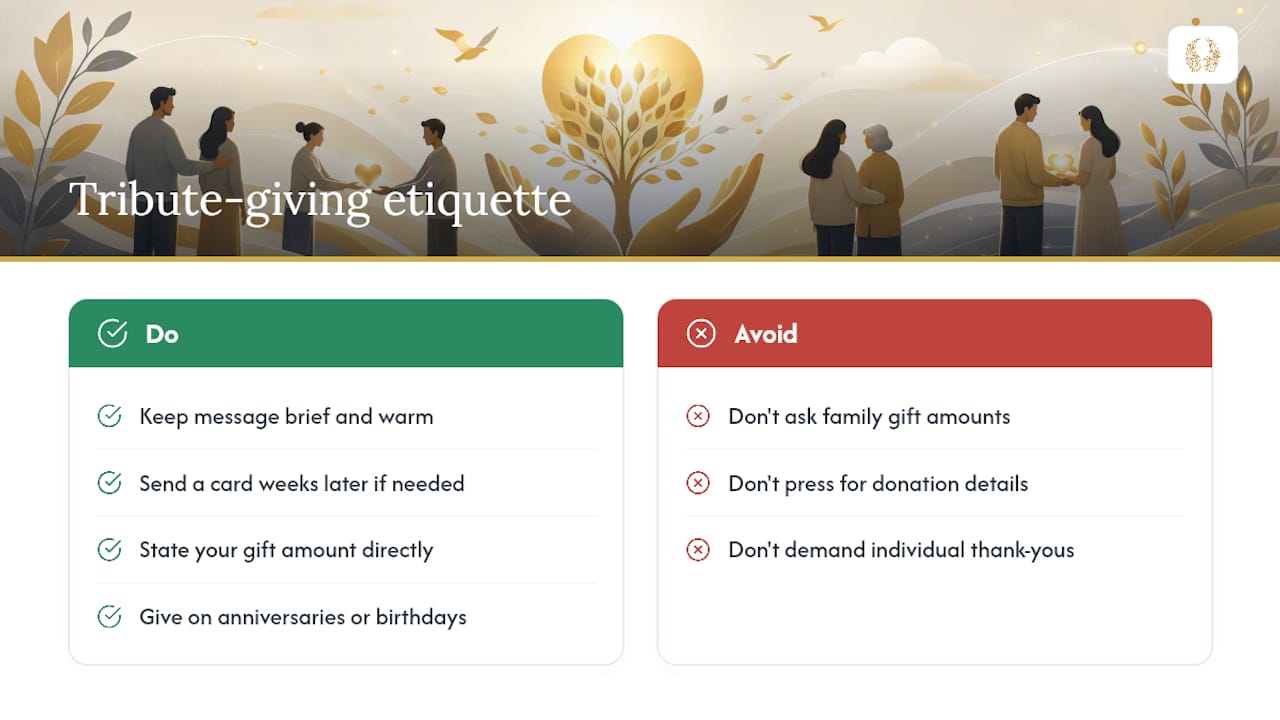
Grief changes how people process even small decisions, so etiquette around tribute giving matters more than it might for an ordinary donation. If you’re the donor, keep your message brief and warm rather than trying to say everything you feel. A card that arrives weeks after a service is still welcome; there’s no expiration window on a tribute gift.
If you’re the grieving family member receiving notification, you’re not obligated to send individual thank-you notes for every gift, though many families choose to send one general acknowledgment once things settle. Nonprofits typically handle the formal receipt, so the personal thank-you can be simple: a card, an email, or even a social media post thanking everyone collectively.
One etiquette point that trips people up: never ask a grieving family how much a particular donor gave. Amounts are private by design, and pressing for that information puts the family in an awkward spot. If you’re the donor and you’d like the family to know your gift’s size for some specific reason, say so directly in your message rather than making them ask.
Finally, timing matters. Giving immediately after a death is common, but so is giving on a later anniversary, a birthday, or during an awareness month tied to the cause. There’s no wrong window, only genuine intent.
What Do Successful Tribute Campaigns Look Like?
The tribute campaigns that raise the most money share a few traits: a clear story, an easy-to-share link, and regular updates that keep momentum going past the first week. Nonprofit-hosted tribute pages, the kind Macmillan Cancer Support and the Michael J. Fox Foundation both run, succeed largely because they let organizers add a photo, a short story, and a goal, then track progress publicly.
A workplace memorial fund is a common pattern: colleagues pool tribute gifts after losing a coworker, often matched by the employer, and the total frequently surprises the family with how many people were touched by that one person. Anniversary campaigns work similarly. A family sets up a recurring tribute gift each year on the date of a loss, and over several years, that single gift can add up to a substantial cumulative contribution toward research or patient support, even though no single year’s gift felt large on its own.
What separates a page that raises a few hundred dollars from one that raises many thousands usually isn’t the cause itself. It’s whether the organizer shared the link consistently, updated it with a photo or story partway through, and sent a genuine thank-you once the campaign wound down.
What Challenges Come Up With Tribute Donations?
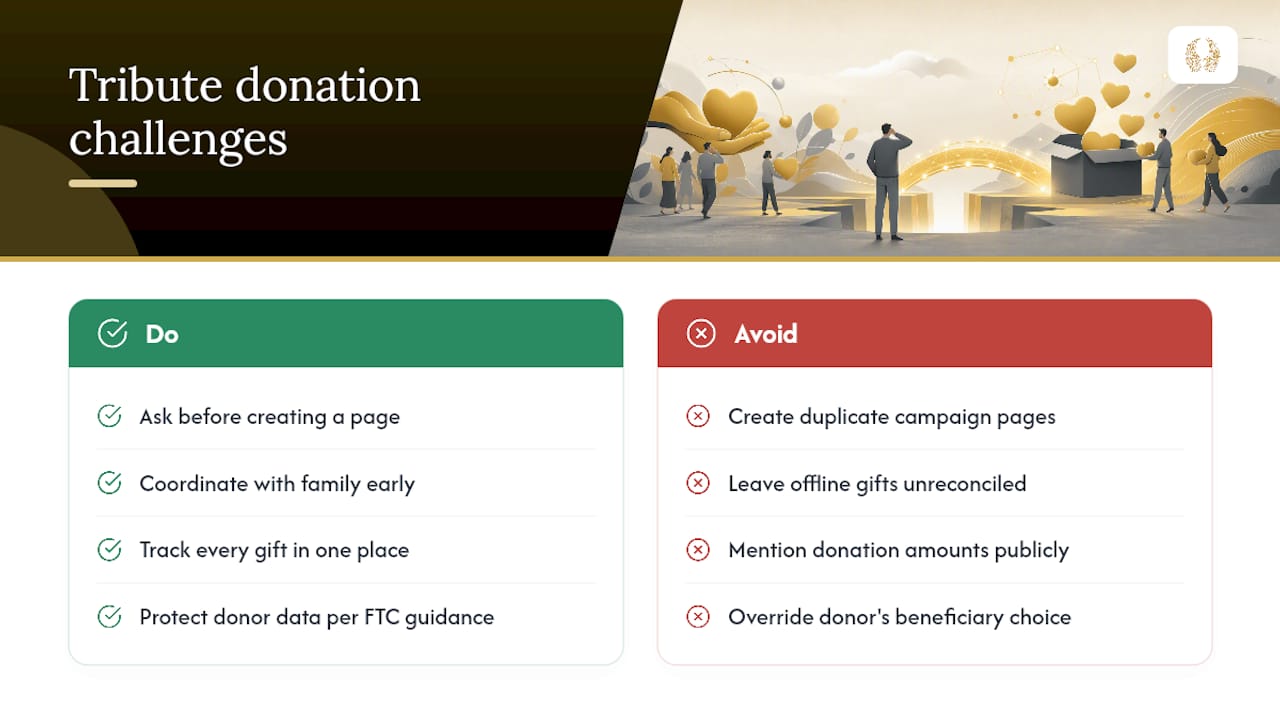
The most common problem donors run into is simple confusion: multiple family members set up separate pages for the same person, splitting what could have been one strong campaign into three weak ones. The fix is coordination early. Whoever hears about the loss first should ask, before setting anything up, whether another family member already started a page.
Nonprofits face a different challenge: reconciling online and offline gifts into one accurate total. A tribute envelope collected at a service doesn’t automatically show up on a digital fundraising page, which can make a campaign look smaller than it actually is until someone manually adds those figures in. Tracking every gift, online or offline, in one place, such as a simple spreadsheet noting donor name, date, method, and amount, solves most of this friction before it becomes a real problem.
Privacy missteps are the other recurring issue. A well-meaning staff member might mention a donation amount in a thank-you call, not realizing the donor wanted it kept confidential. This is exactly why the FTC’s guidance on protecting personal information matters at an organizational level: donor data, including gift amounts, deserves the same care as any other sensitive record. And occasionally, a family member disagrees with the choice of beneficiary itself. There’s no clean fix for that beyond respecting that the donor, not the family, chooses where their own gift goes.
Why Tribute Gifts Matter to Our Mission
Every tribute gift HCRF receives becomes fuel for research that a traditional grant might never fund. As a 501©(3) supporting bold, unconventional cancer research at the Lurie Cancer Center, we’ve watched gifts given “in memory of” a parent or “in honor of” a survivor’s milestone quietly become the difference between a promising idea and a funded study. We handle every receipt properly, keep every amount confidential unless you say otherwise, and our Donor Services team is here for anything a card or tribute page needs.
— HCRF
Make a Tribute Donation to HCRF Today
HCRF exists specifically for donors who want their gift to mean something beyond a transaction. Give a one-time or recurring tribute donation online, mail a check with the honoree’s name in the memo line, or set up a dedicated tribute page for a loved one’s memory or milestone.

We send a tribute card or e-card to the person or family you designate, keep every gift amount private unless you tell us otherwise, and provide a proper written acknowledgment for tax purposes on every qualifying gift. If you’re organizing something bigger, like a memorial fund tied to a specific research goal, our guide to in-memory donations walks through sample wording and setup steps. Reach out to our Donor Services team for help building a tribute page, requesting a donor list for thank-you notes, or figuring out the best way to honor someone through research that could change what comes next for other families.
This article is general information, not a substitute for advice from a qualified financial advisor. Consult a qualified financial professional about your own circumstances before acting on anything here.
Sources
- Charitable contributions: written acknowledgments (IRS)
- Publication 557 (IRS)
- Tribute gifts (Library of Congress)
- Protecting personal information: a guide for business (FTC)
Recommended

See how donations fund research: salaries, reagents, and trials. Learn which gifts and choices most boost patient benefit.
Read More →
Three clinic ready questions to bring to your oncology appointment, with scripts, NCT lookup, written cost breakdowns, and U.S. resources.
Read More →