


Qualified Charitable Distributions: 2026 IRA Owner's Guide
August 3, 2026
Qualified Charitable Distributions: 2026 IRA Owner’s Guide

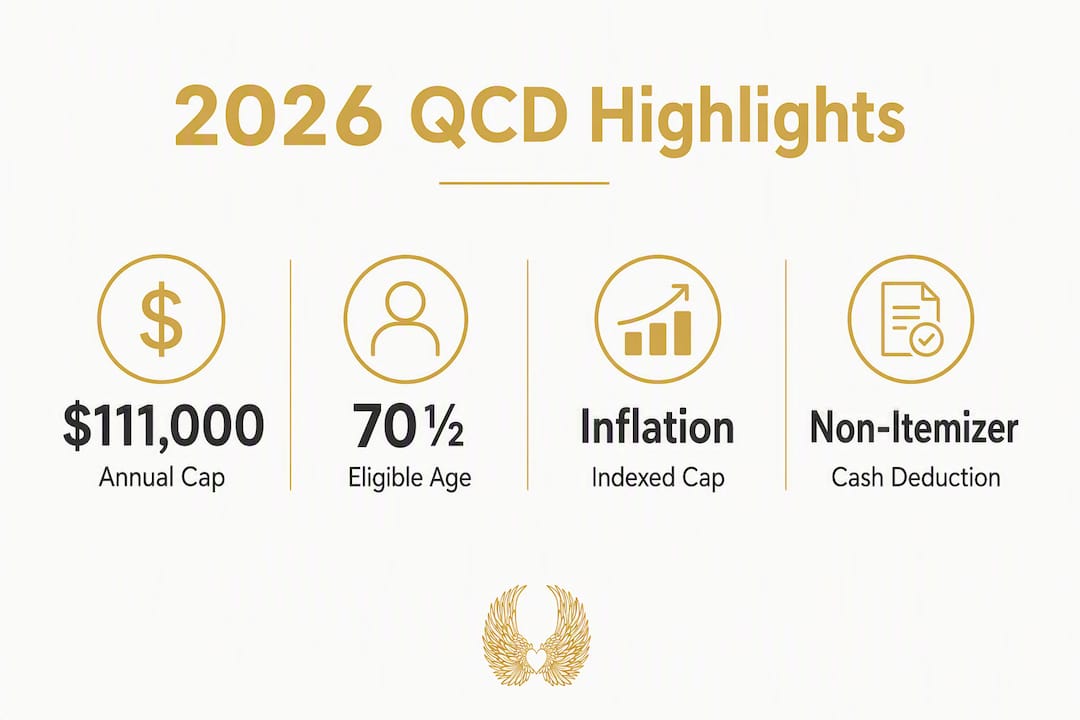
A qualified charitable distribution (QCD) is a direct transfer from an eligible IRA to a qualifying 501©(3) charity that is excluded entirely from your taxable income. If you are age 70½ or older, this is one of the most powerful giving tools available to you. For 2026, the annual per-person QCD cap is $111,000, and a one-time split-interest distribution cap sits at $55,000. The transfer counts toward your Required Minimum Distribution (RMD), and because it never enters your gross income, it lowers your adjusted gross income (AGI) in ways a standard charitable deduction simply cannot match.
Who benefits most from a QCD?
- Retirees who want to satisfy their RMD without adding to taxable income
- IRA owners whose AGI triggers Medicare IRMAA surcharges
- Donors who take the standard deduction and cannot itemize charitable gifts
- Anyone whose higher AGI pushes them into a less favorable tax bracket or phases out other benefits
$111,000 — the 2026 per-person QCD limit, indexed for inflation under SECURE 2.0. A married couple where both spouses own IRAs can transfer up to $222,000 combined this year.
Table of Contents
- What exactly is a QCD and who qualifies?
- How do the 2026 QCD limits and law changes affect your giving?
- Which charities can receive a QCD?
- How do QCDs affect your taxes, AGI, and Medicare costs?
- How do you actually make a QCD? A step-by-step checklist
- What are the common mistakes and disadvantages of QCDs?
- How are QCDs reported on your tax return?
- Two scenarios that show a QCD’s real impact
- Why advisors still favor QCDs after the 2026 law changes
- Key Takeaways
- HCRF’s perspective on receiving QCDs from donors like you
- Direct your QCD to HCRF and fund the research that matters
- Authoritative sources and further reading
What exactly is a QCD and who qualifies?
A QCD, sometimes called an IRA charitable rollover, is not a reimbursement or a two-step gift. The funds must travel directly from your IRA custodian to the charity. You never touch the money. If the check is made payable to you and you then write a check to the charity, the distribution is taxable. The trustee-to-trustee requirement is absolute.
Eligible IRA accounts:
- Traditional IRAs (the most common source)
- Rollover IRAs funded from former employer plans
- Inherited IRAs (subject to the same age rule for the beneficiary)
- Inactive SEP-IRAs and inactive SIMPLE-IRAs (no employer contributions received in the current or prior two years)
Ineligible sources:
- 401(k), 403(b), 457(b), and other workplace retirement plans
- Active SEP-IRAs or SIMPLE-IRAs still receiving employer contributions
- Roth IRAs (technically eligible, but since qualified Roth distributions are already tax-free, the QCD exclusion adds no benefit in most cases)
The age threshold is 70½, not 72 or 73. You can make a QCD the moment you reach 70½, even if your first RMD is not yet due under current law. IRS Publication 590-B is the authoritative federal reference for these eligibility rules, and it is worth reading the relevant section before you act.
Pro Tip: Call your custodian before initiating anything. Fidelity Investments, Charles Schwab, and Vanguard each have their own required forms or Letters of Instruction for QCDs, and some require a notarized signature. Knowing the exact process in advance saves weeks.
How do the 2026 QCD limits and law changes affect your giving?
The numbers matter here, so let’s be precise.
| Limit | 2025 | 2026 |
|---|---|---|
| Annual per-person QCD cap | $111,000 | $111,000 |
| One-time split-interest cap | $55,000 | $55,000 |
The Pension Protection Act of 2006 created QCDs, and SECURE 2.0 later indexed the annual cap to inflation, which is why the limit climbs each year. For 2026, a married couple where both spouses hold their own IRAs can each transfer up to $111,000, for a combined $222,000 in tax-free charitable transfers.
The split-interest cap ($55,000) applies to a one-time election to fund a charitable remainder annuity trust, a charitable remainder unitrust, or a charitable gift annuity directly from an IRA. This is a sophisticated estate-planning move and is separate from the standard annual QCD.
Two rules that trip people up:
- No carryforward. If you transfer $120,000 but the cap is $111,000, the extra $9,000 is taxable. You cannot carry it forward to next year.
- No future RMD reduction. A QCD above your RMD amount does not shrink your RMD obligation in future years.
The One Big Beautiful Bill Act introduced a modest non-itemizer cash charitable deduction for 2026, but its dollar ceiling is far below $111,000. For IRA owners making meaningful gifts, the QCD remains the more powerful tool because it removes income at the source rather than offering a deduction that depends on itemizing or falls under a low cap.
Which charities can receive a QCD?
Not every worthy cause qualifies. The charity must be a public 501©(3) organization eligible to receive tax-deductible contributions. Several common giving vehicles are specifically excluded:
Eligible recipients:
- Public charities with 501©(3) status (hospitals, universities, religious organizations, medical research foundations)
- Most operating foundations
Excluded recipients:
- Donor-advised funds (DAFs) — explicitly prohibited by statute
- Private foundations
- Supporting organizations (even those that support public charities)
- Political organizations or candidates
- Any entity that provides goods or services in exchange for the gift (charity auctions, gala ticket purchases, benefit dinners)
The IRS Exempt Organizations Select Check tool lets you search any organization by name or EIN to confirm its 501©(3) status and public charity classification. Request the charity’s EIN and, if you want extra certainty, ask for a copy of their IRS determination letter.
Red flags that can disqualify a QCD: the charity asks you to route the gift through a donor-advised fund, the acknowledgement letter mentions a benefit you received (dinner, merchandise, event access), or the organization cannot confirm its public charity status in writing.

Pro Tip: Email the charity’s finance office before you initiate the transfer. Ask them to confirm in writing that they accept QCDs, that no goods or services will be provided, and that they will send a written acknowledgement upon receipt. This takes five minutes and protects your tax treatment.
How do QCDs affect your taxes, AGI, and Medicare costs?
This is where the QCD earns its reputation. A standard charitable deduction reduces your taxable income only if you itemize, and only after your income has already been counted. A QCD works differently: the transferred amount is excluded from your gross income entirely. It never appears as income on your return.
The downstream effects of that exclusion can be significant:
- Lower AGI means you may stay in a lower federal tax bracket
- IRMAA surcharges on Medicare Part B and Part D premiums are calculated from your AGI two years prior; a lower AGI today can reduce your Medicare costs in 2028
- Means-tested benefits tied to income thresholds are less likely to be affected
- State income taxes may follow federal treatment, but not always — several states tax IRA distributions regardless of federal QCD treatment, so check your state’s rules separately
Fidelity Charitable’s analysis makes the contrast plain: because QCDs exclude income rather than generate a deduction, they can be more reliable than itemized deductions under the 2026 rules, especially for donors whose gifts exceed the new non-itemizer deduction ceiling.
The flow looks like this: IRA distribution → paid directly to charity as a QCD → amount excluded from gross income → AGI drops → potential reductions in tax bracket exposure, IRMAA surcharges, and income-based phaseouts. Each step compounds the benefit for higher-income retirees.
A note on state taxes: Federal exclusion does not guarantee state exclusion. States like California and Pennsylvania have their own IRA distribution rules. Confirm your state’s treatment with a tax professional before assuming the full federal benefit carries through.
How do you actually make a QCD? A step-by-step checklist
Execution is where most mistakes happen. Follow these steps in order.
- Confirm your age. You must be 70½ or older on the date of the distribution, not just by year-end.
- Choose the IRA and the dollar amount. Decide how much to transfer, keeping the $111,000 cap in mind and coordinating with your RMD amount.
- Verify the charity’s eligibility. Use the IRS Exempt Organizations Select Check and confirm the charity accepts direct QCD payments.
- Contact your custodian. Call Fidelity Investments, Charles Schwab, or whichever institution holds your IRA. Ask for the exact form or Letter of Instruction required for a QCD. Do not assume an online distribution form will work.
- Specify the distribution type. Request a check made payable directly to the charity (not to you), or an electronic transfer to the charity’s account. Provide the charity’s full legal name, mailing address, and EIN.
- Submit the request with QCD designation. Ask the custodian to note the distribution as a QCD on their records. Starting with tax year 2025, custodians are required to use a specific Form 1099-R code for QCDs, so confirm how your institution will report it.
- Notify the charity. Let the charity know the check is coming, the amount, and that it is a QCD. Ask them to send written acknowledgement upon receipt.
Documentation to keep:
- Custodian distribution statement showing the amount and payee
- Copy of your Letter of Instruction or distribution request form
- Written acknowledgement from the charity confirming receipt, the date, and that no goods or services were provided
- Copy of the Form 1099-R you receive in January
Sample instruction wording you can adapt when calling or writing your custodian:
“Please process a Qualified Charitable Distribution from my IRA [account number] in the amount of $[X], payable directly to [Charity Legal Name], EIN [XX-XXXXXXX], at [mailing address]. Please note this as a QCD on my account records and on my Form 1099-R.”
Pro Tip: Start this process in early December, not December 31. Custodians need processing time, and the charity must receive the funds by December 31 for the transfer to count in that tax year. A December 15 initiation date gives you a meaningful buffer.
What are the common mistakes and disadvantages of QCDs?
Knowing what can go wrong is as valuable as knowing the rules themselves.
Structural disadvantages:
- Age 70½ is a hard floor — no exceptions for younger IRA owners
- No carryforward: excess transfers above the $111,000 cap are taxable
- You cannot claim an itemized charitable deduction for the same funds you transferred as a QCD — it is one or the other
- Donor-advised funds and private foundations are categorically excluded
- State income tax treatment varies and may not mirror the federal exclusion
Execution mistakes:
- Asking the custodian to send the check to you rather than directly to the charity — this immediately makes the distribution taxable
- Missing the charity’s written acknowledgement — without it, you have no substantiation if the IRS questions the transfer
- Waiting until December 31 to initiate the process and missing the year-end deadline
- Confusing a Roth IRA distribution with a traditional IRA QCD — the mechanics differ, and the tax benefit is usually absent for Roth accounts
- Assuming your custodian’s standard online distribution form handles QCDs — many do not
Red flags to watch for:
A charity that asks you to route the gift through a donor-advised fund, or that cannot confirm its 501©(3) public charity status, is a sign to pause and verify before proceeding.
How are QCDs reported on your tax return?
The IRS does not create a separate tax form for QCDs. Your custodian will issue a Form 1099-R showing the full IRA distribution amount, including any QCD portion. Starting with tax year 2025, custodians must use a specific reporting code to identify QCDs, but practices vary by institution. Do not assume the 1099-R alone tells the full story.
What to keep and show your tax preparer:
- Form 1099-R from your custodian (shows the gross distribution)
- Custodian distribution statement confirming the payee was the charity
- Written acknowledgement from the charity (date received, amount, no goods or services provided)
- Copy of your original distribution request or Letter of Instruction
On your Form 1040, the gross distribution from the 1099-R is reported on the appropriate line, but the QCD amount is subtracted so it does not appear in your taxable income. Tax software like TurboTax and H&R Block have specific QCD entry fields; your preparer will know where to input the exclusion. IRS Publication 590-B walks through the exact reporting sequence if you are filing independently.
Inherited IRAs: A beneficiary who has reached age 70½ can make QCDs from an inherited IRA, but the reporting follows the same 1099-R process and requires the same charity documentation.
Roth IRAs: Technically eligible, but since qualified Roth distributions are already tax-free, the QCD exclusion typically provides no additional tax benefit. Reporting is the same, but the practical advantage is minimal.
Two scenarios that show a QCD’s real impact
Scenario 1: A QCD covers the full RMD

Margaret is 74, single, and her traditional IRA RMD for 2026 is $14,000. She has been donating $14,000 annually to her local hospital foundation. Without a QCD, that $14,000 RMD adds to her AGI, potentially pushing her into a higher IRMAA bracket. With a QCD, she instructs her custodian to transfer $14,000 directly to the hospital foundation. The $14,000 satisfies her RMD and is excluded from her gross income. Her AGI stays lower, her IRMAA surcharge is reduced, and she still makes her full annual gift. She cannot also claim a $14,000 charitable deduction — the QCD exclusion replaces that deduction, and for most donors in her position, the AGI reduction is worth more.
Scenario 2: A larger QCD above the RMD
Robert is 78, married, and his RMD is $22,000. He wants to give $60,000 to a cancer research foundation this year. He instructs his custodian to transfer $60,000 as a QCD. The first $22,000 satisfies his RMD; the remaining $38,000 is an additional charitable transfer, all excluded from taxable income. His AGI drops by $60,000 compared to taking the full distribution as income. The $60,000 stays well under the $111,000 cap, so no portion is taxable. The excess $38,000 above his RMD does not reduce his RMD obligation in future years, and he cannot carry any unused cap forward. The lesson: plan the QCD amount each year based on current-year giving goals, not as a multi-year strategy.
Why advisors still favor QCDs after the 2026 law changes
The One Big Beautiful Bill Act and the 2026 tax environment have not diminished the QCD’s appeal for most IRA owners. They have actually sharpened the contrast between QCDs and other giving methods.
Legislative indexing under SECURE 2.0 keeps the QCD cap growing with inflation, while the new non-itemizer cash deduction introduced in 2026 carries a ceiling far below what most serious donors give. For IRA owners with meaningful charitable intent, the QCD remains the cleaner tool: it removes income rather than generating a deduction that depends on itemization thresholds or AGI-based caps.
When advisors prioritize a QCD over other giving strategies:
- Your AGI is close to an IRMAA threshold and a lower AGI would reduce your Medicare surcharge
- You take the standard deduction and cannot benefit from itemizing charitable gifts
- Your gift is large enough that the non-itemizer deduction ceiling is irrelevant
- The charity is a public 501©(3) that accepts direct payments and will provide written acknowledgement
- You do not need the flexibility of a carryforward (which QCDs do not offer)
Advisors also caution that QCDs are not the right tool for every situation. If you are coordinating a large gift with a donor-advised fund, funding a private foundation, or managing a complex estate with multiple income streams, a tax professional should review the full picture before you act. The interaction between QCDs, RMDs, estate plans, and state tax rules is nuanced enough that a one-size answer rarely holds.
Key Takeaways
A QCD is the most tax-efficient way for IRA owners age 70½ or older to give to charity in 2026, because it excludes the transferred amount from gross income and counts toward the RMD.
| Point | Details |
|---|---|
| Age and account eligibility | You must be 70½ or older; eligible accounts include traditional, rollover, and inherited IRAs. |
| 2026 annual limit | The per-person QCD cap is $111,000; married couples with separate IRAs can transfer up to $222,000 combined. |
| Counts toward your RMD | A QCD satisfies your RMD obligation dollar-for-dollar, with no tax on the transferred amount. |
| Document everything | Keep your 1099-R, custodian statement, and a written charity acknowledgement — the IRS requires substantiation. |
| Support cancer research through HCRF | The Hippocratic Cancer Research Foundation is a 501©(3) that accepts QCDs and can provide written acknowledgement for your tax records. |
Pro Tip: Call your custodian and the charity in early December. Confirm the custodian’s exact QCD form requirements and the charity’s mailing address or wire instructions. Waiting until the last week of December is the single most common reason QCDs miss the year-end deadline.
HCRF’s perspective on receiving QCDs from donors like you
We have seen, up close, what happens when a donor’s generosity meets the right research at the right moment. At the Hippocratic Cancer Research Foundation, we are a 501©(3) public charity, which means your IRA custodian can transfer a QCD directly to us. We are not a donor-advised fund. We are not a private foundation. We are an operating public charity supporting “out of the box” cancer research at the Robert H. Lurie Comprehensive Cancer Center of Northwestern University, and we can accept your direct IRA transfer.
When you designate a QCD to HCRF, please notify our donor services team so we can prepare your written acknowledgement promptly. That letter will confirm the date we received the funds, the amount, and that no goods or services were provided in exchange. You will need that letter for your tax records, and we want to make sure you have it without delay.
Your gift, however it arrives, carries hope into a laboratory where researchers are working on the cancers that have touched so many of our families. A QCD is one of the most direct ways to channel that hope. To learn more about giving options and donor impact, our team is ready to help you make the transfer as smooth as possible.
Direct your QCD to HCRF and fund the research that matters
If you are ready to use a QCD to support cancer research, the Hippocratic Cancer Research Foundation is here to receive it with gratitude and purpose. Instruct your custodian to make the distribution payable directly to the Hippocratic Cancer Research Foundation, and contact our donor services team to confirm our EIN, mailing address, and wire instructions. We will send your written acknowledgement as soon as the gift is received.

Please confirm the tax treatment of your QCD with your tax preparer before initiating the transfer, especially if you have an inherited IRA or complex estate situation. When you are ready, visit hcrfwingstocure.org to find our donation portal, donor-services contact, and QCD instructions. Every dollar you send goes directly toward the research that is carrying hope forward. We need you. THEY NEED OUR SUPPORT.
Authoritative sources and further reading
These are the primary references behind this guide. Verify current-year limits and consult a tax advisor for complex situations.
- IRS Publication 590-B — Distributions from Individual Retirement Arrangements: The federal reference for QCD eligibility, reporting, and technical rules. Read the QCD section before filing.
- IRS Exempt Organizations Select Check: Search any charity by name or EIN to confirm 501©(3) and public charity status before initiating a transfer.
- Congress.gov / CRS — Qualified Charitable Distributions from IRAs: Legislative history, SECURE 2.0 indexing details, and 2026 limit analysis from the Congressional Research Service.
- Vanguard — How to take a QCD: Practical custodian-level guidance on initiating a QCD, including timing and documentation.
- Fidelity Charitable — QCD guidance: Analysis of QCDs versus itemized deductions under 2026 rules, with planning considerations for donors.
- HCRF — Cancer research funding: a 2026 donor’s guide: How 2026 tax law changes affect charitable giving to medical research, with context for donors considering a QCD to fund cancer research.
This article provides general information about qualified charitable distributions and is not tax or legal advice. Consult a qualified tax professional and verify current IRS rules before making any distribution.
Recommended
- Hippocratic Cancer Research Foundation: Innovative Therapies | Cancer Research Funding: A 2026 Donor’s Guide
- Hippocratic Cancer Research Foundation: Innovative Therapies | Young Investigator Award: Your 2026 Application Guide
- Hippocratic Cancer Research Foundation: Innovative Therapies | Why Cancer Screening Matters: Your 2026 Guide
- Hippocratic Cancer Research Foundation: Innovative Therapies | Teas to Avoid During Chemo: A 2026 Patient Guide

Chrisoula's zest for life, her immense love for her family, and her unwavering commitment to her community were the pillars of her spirit. She will be forever remembered for the warmth, love, and light she shared with all who knew her.
Read More →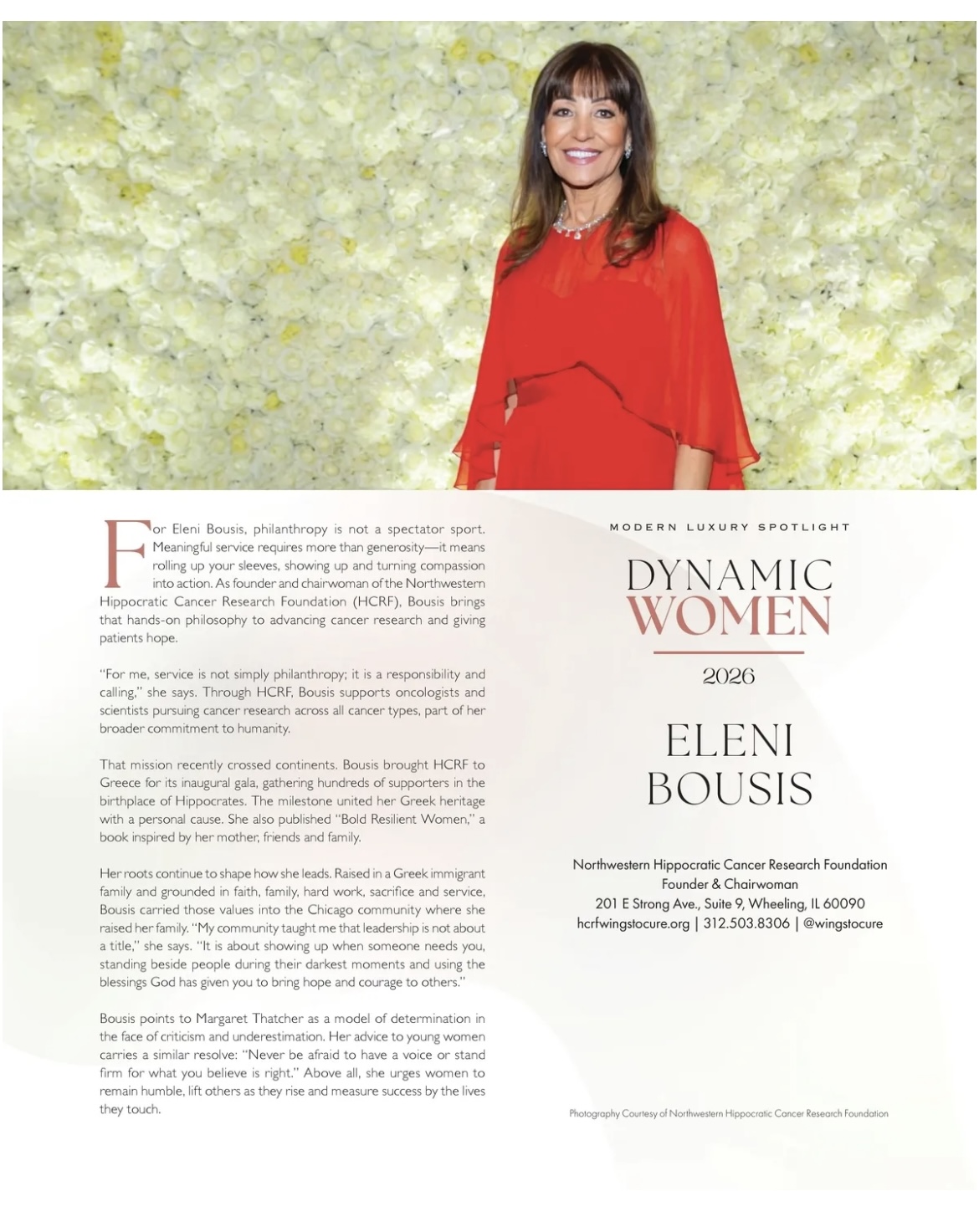
Featured in Modern Luxury’s Dynamic Women 2026 for her philanthropic leadership and dedication to cancer research.
Read More →