


How to Make an In-Memory Donation with Grace and Purpose
August 22, 2026
How to Make an In-Memory Donation with Grace and Purpose

You have three practical paths for an in-memory donation: give directly to a charity in the person’s name, give through a memorial fundraising page, or help the family set up a dedicated memorial fund. Most charities record the gift as “in memory of” your loved one and send an acknowledgment to you and, often, a notice to the family, so include the honoree’s full name wherever the donation form allows it. Keep any request simple: one link, one short reason, and language that makes giving optional, never obligatory.
- Direct gift: Donate on the charity’s website or by mail, noting “in memory of [name].”
- Memorial page: Use a fundraising page that centralizes the story, the link, and a running total.
- Family memorial fund: Partner with a nonprofit or foundation to create something lasting.
Feeding America’s memorial giving data shows most gifts fall between $25 and $100, a useful benchmark if you’re unsure what feels appropriate.
Key Takeaways
Making an in-memory donation well depends on verifying the charity first, using soft and specific wording second, and tracking gifts carefully so every donor gets proper thanks.
| Point | Details |
|---|---|
| Pick one of three paths | Direct gift, memorial page, or family memorial fund each fit different timelines and goals. |
| Verify before promoting | Check 501©(3) status and ratings on Charity Navigator or Give.org before naming a charity publicly. |
| Use soft, positive wording | “The family suggests memorial contributions be sent to…” outperforms directive phrasing like “no flowers.” |
| Track gifts without listing amounts | Assign one point person and send acknowledgments that thank donors without naming dollar figures. |
| HCRF ties gifts to specific research | Memorial gifts to HCRF fund named research at the Lurie Comprehensive Cancer Center with formal receipts. |
This article is general information, not a substitute for advice from a qualified financial advisor. Consult a qualified financial professional about your own circumstances before acting on anything here.
Table of Contents
- Ways to Give an In-Memory Donation Right Now
- How Do You Choose the Right Charity for a Memorial Gift?
- What Should You Write in an Obituary or Memorial Program?
- How Do Families Track Gifts and Send Thank-Yous?
- How Do You Set Up a Lasting Memorial Fund?
- How HCRF Supports Memorial Gifts for Cancer Research
- What This Article Gets Right That Most Advice Misses
- Give an In-Memory Gift That Funds Real Cancer Research
- Sources
Ways to Give an In-Memory Donation Right Now
Each method takes a different amount of time and creates a different experience for the family, so it helps to know exactly how each one works before you pick one.
- Give online. Find the charity’s donation page, look for a field labeled “dedicate this gift” or “in honor/memory of,” and enter the person’s full name. Many organizations, including the Hippocratic Cancer Research Foundation, will send a notification to the family if you provide their mailing address or email.
- Use a memorial page. These pages centralize the honoree’s story, a single donation link, and sometimes a public donor list, though the family controls whether names or amounts show. Funeral notes this centralization is what actually drives higher participation, since guests aren’t hunting for the right charity or the right link.
- Mail or call it in. Write “in memory of [name]” on the check memo line, or say it aloud on the phone, and ask the representative to send a written acknowledgment. This route suits donors who aren’t comfortable giving online, or who want a paper record for their files.
- Give toward funeral costs instead. Some families need help with burial expenses rather than charity, in which case gifts should be labeled clearly as funeral assistance. The Federal Trade Commission’s funeral pricing checklist stresses that clear labeling protects everyone involved, since a “donation” and a personal gift toward expenses carry different tax and disclosure implications.
Pro Tip: Screenshot or save your donation confirmation before you close the browser tab. If the memorial page later gets taken down or archived, that confirmation is your only proof the gift was ever made.
How Do You Choose the Right Charity for a Memorial Gift?
Start with mission fit. A gift that reflects what the person actually cared about (cancer research, a local shelter, a scholarship fund) means more to the family than a generically “reputable” charity that had no connection to their life.
Once you’ve found a candidate, verify it before you give:
- Confirm 501©(3) status through the IRS Tax Exempt Organization Search.
- Check its financial health and accountability rating on Charity Navigator.
- Review complaint histories and standards compliance on Give.
- Read a couple of recent annual reports if the charity publishes them.
There’s a real tradeoff between national and local giving. A national organization offers scale and brand recognition, but a local hospice or community fund often means every dollar touches people the family actually knew. You’ll also want to decide between a designated gift (earmarked for a specific program, like a lab or a scholarship) and an unrestricted gift (used wherever the charity’s board decides is most urgent). Designated gifts feel more personal but come with more paperwork on the charity’s end. Hcrfwingstocure’s own guide on evaluating a charity before you give walks through this decision in more detail.
What Should You Write in an Obituary or Memorial Program?
The wrong phrasing can make a heartfelt request sound like a demand. The Society of American Florists recommends softer, positive framing over directive language, and it works because it invites rather than instructs.
Use phrases like:
- “The family suggests memorial contributions be sent to…”
- “In lieu of flowers, donations in [name]'s memory may be made to…”
- “Gifts to [charity], a cause close to [name]'s heart, would be appreciated.”
Avoid harder language like “no flowers, donations only” or “please do not send flowers.” A one-line reason tied to the honoree, such as “[Name] battled cancer for six years and believed in funding research,” raises participation because it gives donors a personal reason to act, not just an instruction to follow.
Never list suggested dollar amounts. It’s fine to allow both flowers and donations; simply present them as equally acceptable options rather than one being the “correct” choice.

How Do Families Track Gifts and Send Thank-Yous?
Assign one point person early, usually a close family member or a trusted friend, and give them a single job: keep a running log of every gift, the donor’s name and address, and whether the charity notified you directly.
- Record each gift as it’s confirmed, either through charity notifications or a shared spreadsheet.
- Send acknowledgments within two to four weeks, using wording like “Your generous gift in [name]'s memory means so much to our family” without mentioning the amount.
- Set memorial page privacy so donor names show only with permission, and honor anonymous requests without exception.
- Keep the charity’s official receipt for tax purposes; you don’t need to issue your own, since the charity’s letter satisfies IRS documentation requirements.
Pro Tip: If gifts are coming in through multiple channels (mail, a memorial page, and a workplace giving match), check each source weekly rather than waiting until after the service. Gifts get missed when they arrive out of order.
How Do You Set Up a Lasting Memorial Fund?
A one-time collection honors the moment. A structured fund honors the person for years. Before you commit to one, understand the basic paths and what each typically requires.
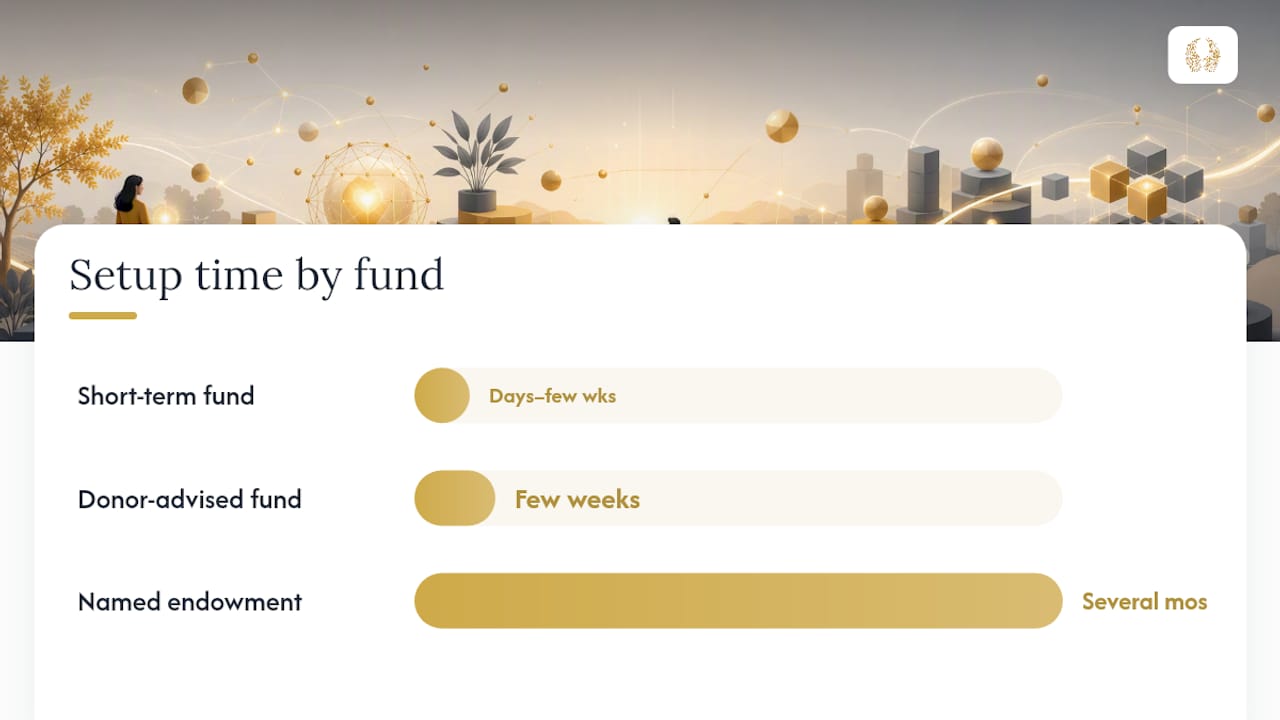
- Short-term memorial fund: Hosted by a charity for a specific campaign, often with no minimum and a defined end date.
- Donor-advised fund: Set up through a community foundation, letting the family recommend grants over time.
- Named endowment or scholarship: Requires a larger commitment and is designed to give indefinitely.
| Fund Type | Typical Setup Time | Who Manages It |
|---|---|---|
| Short-term memorial fund | Days to a few weeks | The host charity |
| Donor-advised fund | A few weeks | Community foundation staff |
| Named endowment or scholarship | Several months | University or foundation board |
Minimums and rules vary widely between hosts, so contact the organization directly before promising anything in an obituary. Before setup, the family needs to decide the fund’s purpose, how distributions get approved, how long it runs, and who has authority to manage it. For anything beyond a short-term collection, loop in an estate attorney or the foundation’s gift officer early. If you’re weighing whether a workplace match could double the impact, Hcrfwingstocure’s guide to workplace giving programs is worth a look before you finalize the structure.
How HCRF Supports Memorial Gifts for Cancer Research
As a 501©(3) nonprofit, HCRF issues a written acknowledgment for every gift, including those made in memory of a loved one, and can notify the family directly when you provide their contact information.
- Read HCRF’s guide to noncash charitable contributions if you’re considering stock, property, or other non-cash gifts.
- Review anonymous giving guidance if the donor wants privacy while remaining IRS-compliant.
- Use the charity evaluation checklist if you’re comparing HCRF against other cancer research organizations.
If you’d like to set up a memorial page tied to cancer research funding at the Robert H. Lurie Comprehensive Cancer Center, reach out through HCRF’s donation page to get started.
| Point | Details |
|---|---|
| Three main giving paths | Direct gift, memorial page, or a family memorial fund each work for different needs and timelines. |
| Say the reason, not the amount | A one-line reason tied to the honoree drives more participation than any dollar figure ever could. |
| Verify before you give | Check 501©(3) status and ratings on Charity Navigator or Give.org before sending a gift. |
| HCRF issues written receipts | Every memorial gift to HCRF gets a formal acknowledgment that satisfies IRS documentation needs. |
What This Article Gets Right That Most Advice Misses
Most guides on memorial giving treat wording and tracking as separate problems from charity vetting, as if etiquette and due diligence live in different worlds. They don’t. A beautifully worded obituary line pointing to an unverified fundraising page does more harm than a plain sentence pointing to a checked, registered 501©(3).
The conventional advice oversells the emotional side and undersells the paperwork. Families get plenty of guidance on what to write in an obituary and almost none on how to keep a clean gift log or what a proper acknowledgment letter should say. That gap causes real friction weeks later, when a grieving family realizes they never confirmed who gave what, or a donor never got the tax documentation they needed.
If you take one thing from this, prioritize verification first, wording second. A well-vetted charity with a plain, honest request outperforms a beautifully worded appeal to an organization nobody checked. Get the foundation right, then make it sound like the person you’re honoring.
Give an In-Memory Gift That Funds Real Cancer Research
If the person you’re honoring was touched by cancer, a memorial gift to HCRF puts that donation directly into research at the Robert H. Lurie Comprehensive Cancer Center of Northwestern University, rather than into general overhead spread across a large national organization. HCRF is small enough that a memorial fund set up in someone’s name can be tied to a specific line of “out of the box” research rather than disappearing into a broad budget.

That specificity matters to families who want their gift to mean something concrete: a lab, a clinical trial, a line of research the honoree cared about. HCRF issues a written acknowledgment for every in-memory gift and can notify the family directly when asked. To start, visit HCRF’s donation page to make a gift in memory of your loved one or to request help setting up a dedicated memorial page connected to cancer research funding.
Sources
- In Lieu of Flowers: Alternatives and Wording | Society of American Florists
- Funeral
- Funeral costs: pricing checklist | Federal Trade Commission
- Charity Navigator profile (example) — helps evaluate nonprofits
Recommended
- Hippocratic Cancer Research Foundation: Innovative Therapies | Anonymous Charitable Donations: Give Privately and Stay IRS-Compliant
- Hippocratic Cancer Research Foundation: Innovative Therapies | How to Donate to Cancer Research and Drive Real Impact
- Hippocratic Cancer Research Foundation: Innovative Therapies | Noncash Charitable Contributions: A Cancer Donor’s Guide
- Hippocratic Cancer Research Foundation: Innovative Therapies | Corporate Matching Gifts: How to Double Your Donation

