


Operationalizing Adaptive Clinical Trials in Cancer for Oncology Teams
September 10, 2026
Operationalizing Adaptive Clinical Trials in Cancer for Oncology Teams

Adaptive clinical trials let investigators change a cancer study’s course, dose levels, arm allocation, or sample size, based on data accumulating in real time, rather than waiting until the trial ends. In oncology, this means faster answers on which drugs work, better matching of patients to the treatments most likely to help them, and, according to a 2025 review of response adaptive randomization, sample sizes that run significantly smaller on average than fixed designs. None of it works, though, unless every adaptation is planned and justified before the trial ever enrolls a patient.
TL;DR:
- Response-adaptive randomization typically reduces sample sizes by about 22 percent, speeding up trial conclusions but often lacks detailed implementation reporting.
- Adaptive trials require comprehensive pre-planning, validated data infrastructure, and simulation runs before patient enrollment to meet regulatory standards.
- Designing adaptive studies usually costs more upfront due to extensive simulations and infrastructure setup but offers faster decision-making and resource efficiency later.
- Successful implementation depends on a dedicated, transparent governance structure, including a biostatistician, data monitoring committee, and clear reporting practices.
- Not all cancer trials benefit from adaptive designs; they are most effective when endpoints are quickly measurable, biomarker assays are validated, and sample sizes are constrained.
Table of Contents
- What Are the Core Methods Behind Adaptive Clinical Trials in Cancer?
- What Statistical and Regulatory Standards Govern Adaptive Cancer Trials?
- How Do You Build the Infrastructure to Run an Adaptive Trial?
- What Are the Real Benefits and Limitations of Adaptive Cancer Trials?
- Which Real Oncology Trials Show Adaptive Designs in Action?
- How Do You Decide If Your Cancer Trial Should Be Adaptive?
- How Can Nonprofit Research Foundations Support Adaptive Trials?
- What Does a Data Monitoring Committee Do in an Adaptive Cancer Trial?
- How Should Adaptive Trials Handle Missing or Delayed Data?
- What Ethical Issues Go Beyond Patient Allocation in Adaptive Oncology Trials?
- What Software Do Biostatisticians Use to Design and Analyze Adaptive Trials?
- HCRF’s View: Innovation Has to Move at the Speed of Patient Need
- Sources
What Are the Core Methods Behind Adaptive Clinical Trials in Cancer?
Every adaptive oncology trial design traces back to a small set of building blocks. Investigators mix and match them depending on the clinical question, the disease biology, and how quickly outcomes can be measured. The PMC review on adaptive clinical trial designs in oncology lays out the taxonomy that most modern platform trials now build on.
Dose-finding designs dominate phase I oncology work, where the old 3+3 escalation scheme is steadily losing ground to model-based alternatives. The continual reassessment method (CRM) and its Bayesian variants use a statistical model of the dose-toxicity relationship, updated after each patient’s outcome, to pick the next dose more efficiently than rule-based escalation. This matters most in oncology because toxicity and efficacy often sit close together on the dose curve, and a poorly chosen phase II dose can sink an otherwise promising drug for good.
Interim analyses and group sequential stopping rules let a data monitoring committee look at accumulating results at pre-set points and decide whether to stop early for efficacy, stop for futility, or continue as planned. The statistical trick is controlling how often you look without inflating the false-positive rate. Group sequential methods, such as the O’Brien-Fleming or Pocock boundaries, spend a fixed “error budget” across the planned looks so the trial’s overall type I error stays at its target, typically 5%, no matter how many interim peeks occur.
Adaptive randomization, and specifically response-adaptive randomization (RAR), shifts the allocation ratio toward arms performing better as data comes in. Bayesian RAR (often shortened to BRAR) computes a posterior probability that each arm is superior and skews future assignment toward the stronger performer. It sounds like an obvious win for patients, and it often is, but the same review found that most published RAR trials gave little detail on how the randomization algorithm was actually implemented, which makes replication and regulatory review harder than it should be. RAR also carries a real statistical cost: if allocation shifts too fast, imbalance across time periods can distort treatment comparisons, an issue biostatisticians call time-trend bias.
Biomarker-guided allocation routes patients to the arm matched to their tumor’s molecular profile, rather than randomizing everyone equally across every arm. Combine that with seamless designs (phase I/II or II/III trials that transition without a stop-and-restart delay) and platform or master-protocol trials (a single infrastructure testing multiple drugs or arms simultaneously, with arms added and dropped over the trial’s life), and you get the structure behind nearly every major precision-oncology platform running today.
Choosing among these methods depends on a few practical questions:
- Is the primary endpoint measurable quickly enough to feed real-time decisions, or does it take years to mature?
- Are validated biomarker assays available at trial start, or will they need development mid-study?
- Does the clinical question involve one drug and one population, or multiple drugs across a shared, evolving infrastructure?
- How much statistical and data-operations capacity does the site or network already have in place?
A single-arm phase I dose-escalation study rarely needs a master protocol. A late-stage precision-oncology program testing five targeted agents against five biomarker subgroups almost always benefits from platform architecture, because rebuilding trial infrastructure for each new drug candidate wastes time cancer patients don’t have.
What Statistical and Regulatory Standards Govern Adaptive Cancer Trials?
The FDA’s guidance on adaptive design clinical trials sets the baseline rule that governs everything else: every adaptation has to be specified prospectively, in the protocol, before the trial starts enrolling. Retrofitting a design change after seeing unblended results isn’t an adaptation. It’s a different kind of problem, and regulators treat it that way.
Beyond prospective specification, the FDA guidance expects sponsors to demonstrate, through simulation, that the proposed adaptive rules preserve the trial’s intended operating characteristics, meaning the probability of a false positive result (type I error) stays controlled and the trial retains adequate power to detect a true effect. This isn’t a formality. Simulation is how a sponsor proves, before a single patient enrolls, that the adaptive machinery will behave the way the protocol claims it will across a range of plausible scenarios.
Bayesian and frequentist approaches solve this problem differently, and understanding the distinction matters for anyone writing a statistical analysis plan:
- Bayesian predictive-probability designs calculate, at each interim look, the probability that a treatment will ultimately prove superior given the data observed so far, and use that probability directly to drive decisions like stopping, continuing, or reallocating patients.
- Frequentist group-sequential methods pre-specify fixed decision boundaries at each planned interim look and compare observed test statistics against those boundaries, spending statistical significance according to a fixed schedule.
- Hybrid approaches use Bayesian decision rules for operational choices, such as adaptive randomization, while still reporting frequentest-calibrated error rates for the primary hypothesis test, a common compromise that satisfies both statistical philosophies and regulatory reviewers.
Neither camp is objectively better. Bayesian methods tend to be more intuitive for clinical teams making mid-trial calls (a 92% probability of superiority is easier to act on than a p-value boundary), while frequentist group-sequential methods have decades of regulatory precedent behind them.
Statistical callout: The infrastructure gap is real and well documented. Among published RAR trials reviewed in the 2025 analysis, 71% lacked clear reporting on how the statistical implementation actually worked in practice, and 88% used a burn-in period of fixed randomization before activating the adaptive rule. Both numbers tell the same story: RAR is powerful, but it’s also easy to under-document and hard to audit without deliberate planning.
The most common pitfall biostatisticians flag is time-trend bias: if patient characteristics, standard-of-care practices, or supportive care improve over the course of a long trial, response-adaptive randomization can mistake a secular trend for a treatment effect, skewing allocation for the wrong reason. Simulation studies that ignore realistic time trends will show clean operating characteristics on paper and then behave unpredictably once real enrollment data starts flowing in.
How Do You Build the Infrastructure to Run an Adaptive Trial?
An adaptive design is only as good as the plumbing underneath it. Unlike a fixed trial, where data gets cleaned and analyzed in batches after the fact, an adaptive trial needs a live, validated pipeline feeding decisions while the study is still enrolling.
Here’s what that infrastructure actually requires, in the order most teams need to build it:
- A validated electronic data capture system with EHR interfacing so that outcome and toxicity data reach the statistical team quickly enough to inform the next allocation or dosing decision, not weeks later.
- Central randomization software that executes the adaptive algorithm consistently across every enrolling site, since a platform trial spanning dozens of institutions can’t rely on local, ad hoc randomization lists.
- A dedicated adaptive statistician or biostatistics team who owns the simulation work before the trial starts and monitors the algorithm’s real-world behavior once it’s running.
- A data monitoring committee (DMC or DSMB) with clear authority and a pre-specified charter for reviewing interim results and approving or halting planned adaptations.
- A regulatory lead responsible for keeping the FDA (or relevant regulator) informed of any protocol amendments tied to pre-specified adaptation rules, and for assembling simulation reports for submission.
- A version-controlled, audited codebase for the adaptive algorithm itself, since a single unlogged change to the randomization code mid-trial can undermine the entire study’s credibility.
Pro Tip: Build in a burn-in period, typically the first cohort or two of patients, where randomization stays fixed and equal before the adaptive rule switches on. This gives the model enough early data to avoid making confident allocation decisions off a handful of noisy outcomes, and it’s a detail nearly every well-documented RAR trial in the 2025 review included.
On the technical side, the same PMC review of oncology adaptive designs points out that operational success hinges less on the cleverness of the adaptive rule and more on whether the surrounding data systems, decision rules, and governance structure are transparent and validated end to end. A brilliant Bayesian model running on unvalidated data feeds is worse than a simple fixed design run well.
Practical governance details matter too. Data-lock cadence, meaning how often the dataset is frozen and formally analyzed, needs to be specified up front and followed exactly, since ad hoc data pulls between locks are how time-trend bias sneaks into the results. Diagnostic and pathology workflows also deserve early attention: biomarker-guided allocation depends entirely on assay turnaround time, and a trial team evaluating diagnostics and pathology partnerships early in planning avoids the common failure mode of an adaptive algorithm sitting idle while it waits on lab results.
What Are the Real Benefits and Limitations of Adaptive Cancer Trials?
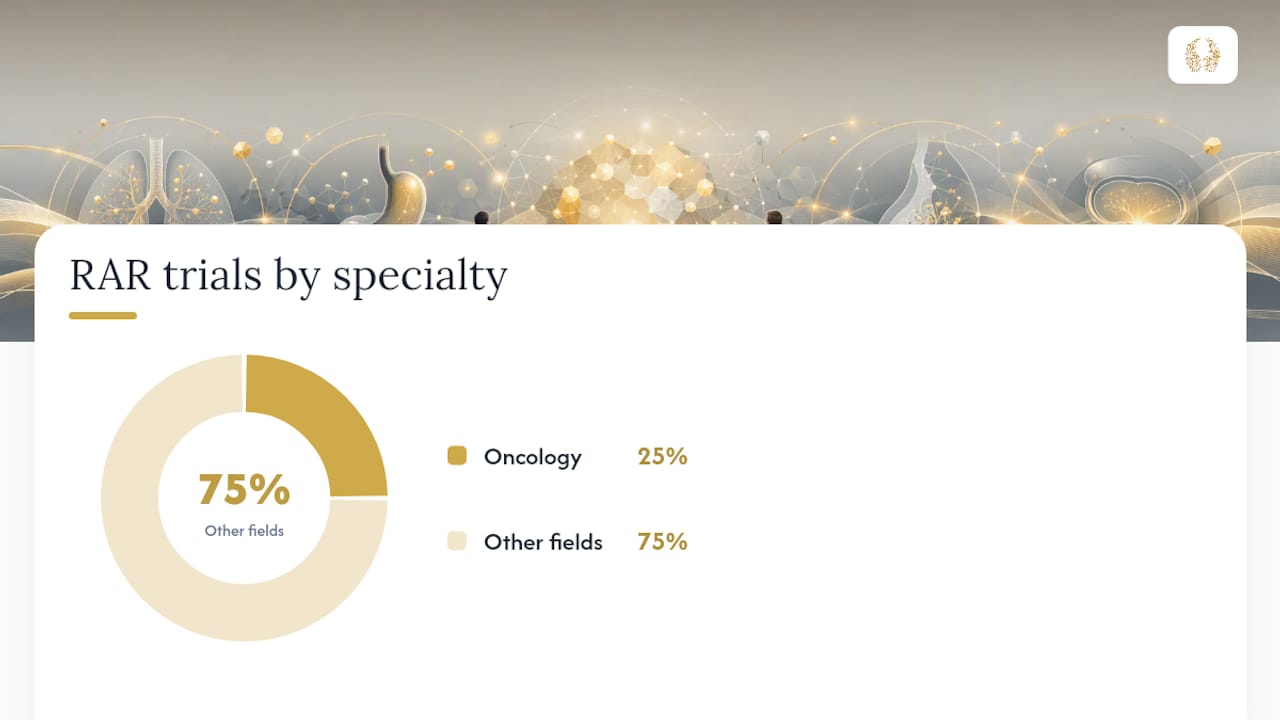
The efficiency case for adaptive designs is strong, but it isn’t unconditional. The clearest quantified benefit comes from response-adaptive randomization: the 2025 review of RAR practice found a mean sample-size reduction of about 22% across the trials it examined, out of 65 planned RAR studies identified between 1985 and 2023, a quarter of them in oncology. Smaller sample sizes mean faster answers and fewer patients exposed to an inferior arm.
It comes bundled with a documented reporting gap. The same body of trials that delivered smaller sample sizes also showed inconsistent transparency about how the adaptive machinery actually ran, which makes it harder for outside reviewers, including regulators and future trial designers, to learn from what worked and what didn’t.
The ethical case for adaptive allocation is genuinely compelling: why randomize a fixed 50% of patients to an arm the accumulating data increasingly suggests is inferior? Response-adaptive randomization directly answers that concern, and the “bandit problem” framing described by biostatistician Donald Berry captures it well: a well-designed adaptive trial both learns which treatment works and treats more patients with it as the evidence builds, instead of treating those two goals as separate.
But that same allocation shift introduces trade-offs that deserve equal weight:
- Statistical complexity rises sharply, requiring specialized biostatistics expertise most sites don’t have in-house.
- Cost and timeline for design work increase, since a defensible adaptive protocol demands extensive simulation before a single patient enrolls.
- Time-trend bias can masquerade as a treatment effect if the trial runs long enough for practice patterns to shift underneath it.
- Transparency gaps in reporting make it harder for the field to build cumulative knowledge about what adaptation strategies actually work.
Mitigation isn’t complicated, even if it’s demanding. Constrained allocation rules that cap how far the randomization ratio can swing in any single update prevent runaway imbalance. Pre-specified stopping rules, agreed before the trial starts and locked into the protocol, take the guesswork out of when to halt an arm. And transparent reporting, publishing the actual algorithm parameters and update schedule, not just the high-level design, turns each trial into something the next trial team can actually learn from.
Which Real Oncology Trials Show Adaptive Designs in Action?
Four platform trials illustrate how these methods play out once you take them off paper and into actual patients.
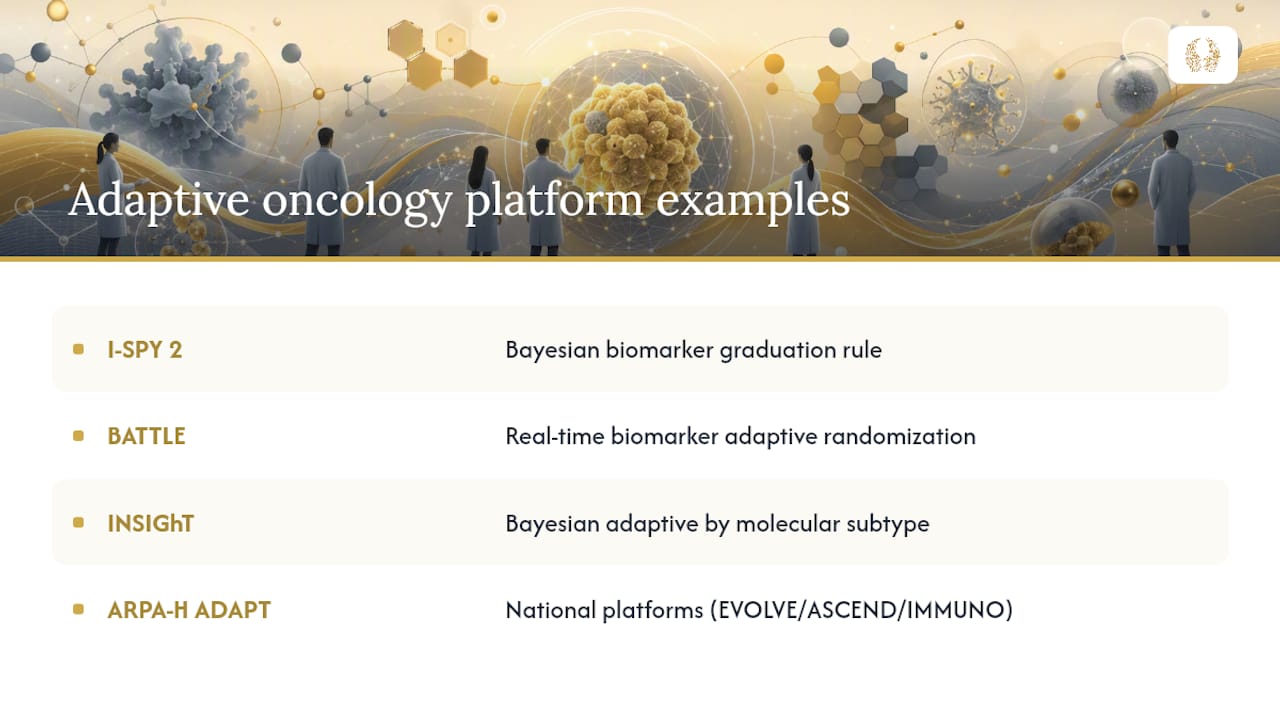
I-SPY 2 remains the reference case for Bayesian adaptive platform design in oncology. Running in the neoadjuvant breast cancer setting, it uses adaptive randomization by biomarker signature and a predictive-probability “graduation” rule: an investigational drug graduates to phase III testing once the Bayesian model determines it has crossed a pre-specified probability threshold of success in a matched biomarker subgroup. Several agents have graduated through this exact mechanism, and the trial’s design has demonstrably shortened the path from early signal to phase III decision, a result documented in detail in published analyses of the I-SPY 2 platform.
BATTLE (Biomarker-integrated Approaches of Targeted Therapy for Lung cancer Elimination) applied adaptive randomization to non-small cell lung cancer, using real-time biomarker profiling to steer patients toward the arm most likely to match their tumor’s molecular characteristics as the trial progressed. It was among the first oncology trials to prove that biomarker-adaptive allocation could run prospectively, not just retrospectively, in a lung cancer population, a design detailed in the PMC review of adaptive oncology trials.
INSIGhT brought the same Bayesian adaptive platform logic to glioblastoma, one of the hardest cancers to run efficient trials in because of small patient numbers and rapid disease progression. The trial groups patients by molecular subtype and uses adaptive randomization to favor arms showing stronger early signals within each biomarker group, a structure described in the published INSIGhT trial design paper. For a disease where every month of delayed learning costs lives, that adaptive structure isn’t a statistical nicety. It’s the difference between a trial that can pivot and one locked into a design choice made years before enrollment finished.
ARPA-H’s ADAPT program represents the newest and most ambitious entry: three nationwide adaptive oncology platform trials, EVOLVE, ASCEND-CRC, and IMMUNO-BIOMAP, each designed to enroll more than 500 patients and run continuous biomarker-driven adaptations across more than 33 U.S. sites. The ARPA-H announcement describes a serial molecular and clinical data collection approach built to feed adaptive decisions in something close to real time, with registered trial identifiers (NCT07340541, NCT07318389, and NCT07288034) already in place. It’s a useful case study precisely because it shows what national-scale adaptive infrastructure looks like when a federal research agency, rather than a single academic center, builds it.
The throughline across all four: none of them treated the adaptive rule as a bolt-on feature. Each built its data infrastructure, biomarker assays, and governance structure around the adaptive logic from day one.
How Do You Decide If Your Cancer Trial Should Be Adaptive?
Not every oncology study needs an adaptive design, and forcing one onto a trial that doesn’t fit the profile just adds cost and complexity without a matching payoff. A few questions cut through the decision quickly:
- Is your primary endpoint measurable fast enough to inform mid-trial decisions? Pathologic complete response in weeks works. Overall survival in a slow-progressing cancer, measured over years, often doesn’t leave room for meaningful interim adaptation.
- Do you have validated biomarker assays ready at trial start, or a realistic plan to develop them during enrollment? Biomarker-guided allocation is only as good as the assay behind it.
- Is sample size a genuine constraint? Rare cancer subtypes and heavily pretreated populations are exactly where an adaptive design’s efficiency gains matter most.
- Is your clinical question actually singular, or does it span multiple drugs and biomarker subgroups? A master-protocol platform trial only pays off when there’s a real portfolio of arms to test.
If the answers point toward “yes,” the planning sequence looks roughly like this: specify every planned adaptation in the protocol before writing the statistical analysis plan, run scenario simulations across a realistic range of effect sizes and time trends, validate the data flow from EHR to randomization engine before enrolling a single patient, finalize the DSMB charter with explicit adaptation-approval authority, and prepare simulation and design documentation for a pre-IND or Type B meeting with the FDA well ahead of the submission deadline.
| Planning stage | Fixed design | Adaptive design |
|---|---|---|
| Protocol development time | Shorter, fewer statistical dependencies | Longer, requires extensive simulation work upfront |
| Statistical team involvement | Primarily at analysis stage | Continuous, from design through trial close |
| Data infrastructure needs | Standard EDC, periodic locks | Real-time feeds, validated central randomization |
| Regulatory interaction | Standard IND review | Early FDA engagement recommended, simulation reports expected |
| Typical advantage | Simplicity, established precedent | Faster decisions, potential sample-size savings |
Budget accordingly. An adaptive trial almost always costs more at the design stage, often substantially so, because of the simulation workload alone. That upfront cost buys speed and efficiency later, but only if the team accounts for it in the initial funding request rather than discovering the gap mid-trial.
How Can Nonprofit Research Foundations Support Adaptive Trials?
At the Hippocratic Cancer Research Foundation, we’ve watched innovative trial design move from academic theory to real patient benefit at the Robert H. Lurie Comprehensive Cancer Center of Northwestern University, and adaptive methodology sits right at the center of that shift. Nonprofit organizations exist to fund the kind of “out of the box” research that doesn’t always fit neatly into traditional grant categories, and adaptive trial infrastructure is a textbook example of work that needs support before it can prove itself.
Nonprofit foundations have a specific role to play here that federal funding cycles and pharmaceutical sponsors often can’t fill on their own. Early biomarker assay validation, pilot simulation studies to test whether an adaptive design is even feasible for a given cancer type, and shared-data infrastructure across research sites all carry real cost before a trial produces a single result. That’s precisely the kind of derisking work philanthropic funding is built for.
Patient understanding matters just as much as the statistics. If you’re a patient or caregiver trying to figure out whether an adaptive trial fits your situation, our guide to clinical trial eligibility walks through what qualifies someone to enroll, and our breakdown of how to interpret clinical trial results helps translate statistical outcomes into what they actually mean for a real treatment decision.
What Does a Data Monitoring Committee Do in an Adaptive Cancer Trial?
A data monitoring committee, often called a DSMB in oncology settings, carries more responsibility in an adaptive trial than in a fixed one, because it isn’t just watching for safety signals. It’s actively approving or halting the adaptations the protocol allows.
The committee’s charter needs to specify, in advance, exactly which decisions fall under its authority: activating response-adaptive randomization after the burn-in period ends, approving an early stop for efficacy or futility, dropping an underperforming arm, or adding a new biomarker subgroup as assay data matures. Vague charters that leave these decisions to interpretation mid-trial invite exactly the kind of unplanned change regulators reject.
Composition matters too. An adaptive trial’s DSMB typically needs a biostatistician fluent in the specific adaptive methodology being used, not just general trial statistics experience, alongside the usual clinical oncology and bioethics expertise. Meeting cadence also has to align with the data-lock schedule: a committee that meets quarterly is useless for a trial designed to adapt monthly.
Documentation discipline separates trials that hold up under regulatory review from those that don’t. Every DSMB decision tied to an adaptation, what was reviewed, what threshold was crossed, and what action followed, needs a paper trail detailed enough that an outside auditor could reconstruct the logic months later.
How Should Adaptive Trials Handle Missing or Delayed Data?
Adaptive trials run on a promise that data flows fast enough to inform the next decision, and missing or delayed data breaks that promise in ways a fixed trial never has to confront mid-study.
The core risk is straightforward: if outcome data for the current allocation decision isn’t in yet, the adaptive algorithm has to decide what to do with an incomplete picture. Some designs handle this by building in a deliberate lag, waiting a fixed window after each patient’s treatment before that patient’s outcome counts toward the next randomization update, which trades a little speed for a lot of stability.
Other approaches use statistical imputation methods appropriate to the specific missingness pattern, but this demands caution. An adaptive algorithm that imputes aggressively risks compounding a small early data gap into a meaningfully skewed allocation decision, especially in a rare cancer subtype where every patient’s outcome carries outsized statistical weight.
Reporting delayed data transparently matters as much as handling it correctly. A trial’s statistical analysis plan should specify, before enrollment starts, exactly how much missing data at each interim look is acceptable before that look gets postponed or the adaptation rule gets suspended for that cycle. Trials that skip this step risk making consequential allocation decisions off a dataset that’s silently incomplete, then discovering the gap only after the fact during audit.
What Ethical Issues Go Beyond Patient Allocation in Adaptive Oncology Trials?
Response-adaptive randomization gets most of the ethical attention in adaptive trial design, but it isn’t the only ethical dimension that matters. Informed consent and participant communication carry weight just as heavy, and they’re easier to overlook.
An adaptive trial’s consent process has to account for a reality fixed trials don’t face: the odds of being assigned to a given arm can change meaningfully over the course of the study. A patient who enrolls early might face different allocation odds than a patient enrolling a year later, once the adaptive algorithm has shifted allocation toward a stronger-performing arm. Consent documents and conversations need to explain this dynamic clearly, not bury it in statistical language a patient can’t reasonably parse. Our resource on informed consent in clinical trials covers what participants in the United States should expect and ask about before enrolling.
Ongoing communication matters too, particularly when a trial drops or adds an arm mid-study. A patient assigned to an arm that gets dropped for futility deserves a clear explanation of what that means for their care going forward, not a vague protocol amendment notice. Platform trials running for years, like INSIGhT or the ARPA-H ADAPT studies, need a communication plan built into the protocol from the start, specifying how and when participants get updated as the trial’s structure evolves around them.
Transparency about uncertainty is its own ethical obligation. An adaptive trial’s mid-course allocation shifts reflect probability, not certainty, and participants deserve to understand that a favored arm isn’t a guaranteed better outcome. It’s a strong signal, statistically, but not a promise.
What Software Do Biostatisticians Use to Design and Analyze Adaptive Trials?
Designing an adaptive oncology trial without dedicated simulation software isn’t really possible at scale, given how many scenario-specific runs the design phase demands. Teams routinely need thousands of simulated trial replications across plausible effect sizes and enrollment patterns to demonstrate acceptable operating characteristics before a protocol is ever submitted.
R is the workhorse for most academic and cooperative-group adaptive trial design work, largely because of specialized packages built for Bayesian adaptive randomization, dose-finding simulation, and group sequential boundary calculation. Its open-source nature also makes it easier for statistical reviewers to inspect and reproduce a design’s simulation code, a transparency advantage that matters given how often reporting gaps get flagged in published RAR trials.
SAS remains common in pharmaceutical-sponsored trials and regulatory submissions, particularly where a sponsor’s existing validated analysis infrastructure already runs on it and switching platforms mid-program isn’t practical.
Specialized commercial and academic simulation platforms built specifically for adaptive and Bayesian trial design exist as well, often used to generate the operating-characteristics reports the FDA guidance expects sponsors to submit. Whatever platform a team chooses, the non-negotiable requirement is validation: the simulation code itself needs testing against known analytical results before anyone trusts its output to justify a multimillion-dollar trial design, and it needs version control so that any mid-trial code change to the live randomization algorithm is logged and auditable.
HCRF’s View: Innovation Has to Move at the Speed of Patient Need
Adaptive trial design solves a problem that has haunted oncology research for decades: the gap between how fast we can learn and how fast patients need answers. Getting the balance right, moving quickly enough to matter while keeping every statistical safeguard intact, is the real work, and it’s harder than either the enthusiasts or the skeptics of adaptive design tend to admit.
What the field needs most right now isn’t a new adaptive algorithm. It’s investment in the boring infrastructure that makes existing methods trustworthy: validated simulation tooling, trained biostatisticians who understand both the Bayesian and frequentist toolkits, and cross-site data platforms that don’t buckle under the demands of real-time analysis. Foundations willing to fund that unglamorous groundwork do as much for cancer patients as any single breakthrough drug.
If you want to understand how this kind of research gets funded, or you’re looking for a way to support the infrastructure that makes faster, smarter cancer trials possible, explore HCRF’s work and see where a contribution fits.
— HCRF
This article is general information, not a substitute for advice from a qualified doctor. Consult a qualified healthcare professional about your own circumstances before acting on anything here.
Sources
- Response adaptive randomisation in clinical trials: Current practice, gaps and future directions
- ARPA-H opens first interventional clinical trials to outpace cancer in real time
Recommended


Four checks patients and caregivers can use to read clinical trial results, find absolute benefit and NNT, spot bias, and know what to ask.
Read More →