


Pool or Split? How Clinicians Should Design Basket Trials in Cancer
September 8, 2026
Pool or Split? How Clinicians Should Design Basket Trials in Cancer

A basket trial tests one targeted therapy across multiple cancer types that share a common biomarker, rather than restricting enrollment to a single organ of origin. The design exists because a mutation like an NTRK fusion behaves similarly enough across tumors that pooling patients can find a signal faster than running a dozen separate single-histology studies. The catch: tumor biology still varies by tissue of origin, so a drug that works well in one basket can underperform in another even when the biomarker looks identical on paper.
TL;DR:
- Pooling data across tumor types can increase statistical power when response effects are consistent but may mask tissue-specific differences if heterogeneity exists.
- Bayesian hierarchical models provide a flexible approach for borrowing information across baskets while accounting for actual outcome heterogeneity.
- Effective enrollment relies on rapid genomic screening, standardized biospecimen collection, and pre-screening registries to minimize delays and screen failures.
- Regulatory approvals are more likely when basket responses are durable, consistent across tumor types, and biologically plausible, with pre-specified pooling criteria.
- The typical objective response rate across 75 basket trials is around 18%, with a serious toxicity rate of about 30%, highlighting the importance of weighing benefits against risks.
Table of Contents
- What Is a Basket Trial in Cancer Research?
- How Should Pooling, Multiplicity, and Bayesian Borrowing Be Handled?
- What Operational Steps Keep Enrollment on Track?
- What Regulatory Precedent Supports Tissue-Agnostic Approvals?
- What Do Pooled Outcomes Across Basket Trials Actually Show?
- What Do Real Basket Trials Reveal About Design Choices in Practice?
- How Do You Decide When to Pool, Expand, or Confirm a Basket Trial?
- What Makes HCRF a Credible Resource on Basket Trial Research?
- How Should Consent and Incidental Findings Be Handled in Basket Trials?
- How Do You Interpret Heterogeneous Results Across Tumor Types?
- How Does Real-World Evidence Complement Basket Trial Findings?
- What Comes Next for Basket Trial Design?
- How HCRF Helps Patients and Researchers Find the Right Trial
- Sources
What Is a Basket Trial in Cancer Research?
A basket trial belongs to a family of designs called master protocols, an umbrella term for trials built to test multiple hypotheses under one overarching infrastructure. The other two members of that family are umbrella trials, which test multiple drugs against a single tumor type stratified by biomarker, and platform trials, which allow arms to be added or dropped over time within an ongoing, adaptive structure. A basket trial flips the umbrella trial’s logic: one drug, many tumor types, one shared biomarker.
Most basket trials launch as Phase I or Phase II exploratory studies. According to a review of current basket trial practice, these studies typically enroll a median of 17 unique cancer types, with a range of 10 to 40 tumor types and an average of roughly 7.6 patients contributing to each individual basket. That per-basket sample size is small by design. It’s meant to detect a strong signal quickly, not to generate the statistical power a confirmatory trial would need.
Endpoints reflect that exploratory intent. Objective response rate (ORR) and duration of response (DoR) dominate early basket trials because they can be measured quickly in a single-arm setting without a control group. Progression-free survival (PFS) and overall survival (OS) appear more often once a basket trial matures toward a confirmatory role or feeds into a larger evidentiary package.
Key structural features that distinguish basket trials from conventional single-histology studies:
- Biomarker-first enrollment: patients qualify based on a molecular alteration, not the organ where their cancer originated.
- Modular basket structure: each tumor type functions as its own semi-independent cohort within the shared protocol.
- Shared infrastructure: one screening, consent, and data platform serves every basket, cutting duplicated startup costs.
- Adaptive potential: baskets can be expanded, paused, or closed based on interim results without halting the entire trial.
Master protocol reviews point out that this shared infrastructure is exactly what makes basket designs valuable for rare molecular subtypes, where a traditional single-tumor trial would never accrue enough patients. Review data also note that basket trials are commonly open-label, single-arm Phase II studies, though a growing number now build in randomized or confirmatory elements once early signals justify the added complexity.
How Should Pooling, Multiplicity, and Bayesian Borrowing Be Handled?
The central statistical question in any basket trial comes down to this: should you treat every basket as one combined population, or analyze each tumor type on its own? Neither answer is universally correct, and the choice shapes everything downstream, from sample size to how regulators will read the results.
Pooling versus histology-specific analysis rests on an assumption that is easy to state and hard to verify: that the biomarker’s effect on drug response is consistent across tissue types. When that assumption holds, pooling all baskets into one analysis multiplies statistical power and can turn a set of underpowered subgroups into one convincing result. When it doesn’t hold, pooling can mask a basket where the drug does nothing, or worse, inflate an average response rate that hides real harm in a specific tumor type. Histology-specific analysis avoids that risk but sacrifices power, since a basket with only 7 or 8 patients rarely reaches statistical significance on its own.
Trialists rarely commit to a pure version of either approach anymore. Instead, most protocols specify decision rules upfront: baskets are analyzed independently during an exploratory stage, then pooled only if pre-specified similarity criteria on response pattern and toxicity are met at an interim look.
Multiplicity control becomes a serious concern the moment a trial has confirmatory ambitions. Testing a drug across 10, 20, or even 40 tumor types multiplies the chance of a false positive in at least one basket, purely by chance. Family-wise error rate control methods, borrowed from multi-arm trial design, adjust significance thresholds to account for the number of independent hypothesis tests running in parallel. Skipping this step is one of the more common design flaws in early basket trials that later struggle to convince regulators the finding wasn’t a statistical fluke.
Bayesian hierarchical models offer a middle path between full pooling and full independence. Rather than treating each basket as either completely separate or completely combined, these models let information “borrow strength” across baskets in proportion to how similar their observed outcomes actually are. A basket showing a strong, consistent response pulls other baskets’ estimates toward it; a basket behaving like an outlier gets left alone. Multisource exchangeability models extend this logic further, allowing the degree of borrowing to be estimated from the data rather than fixed in advance.
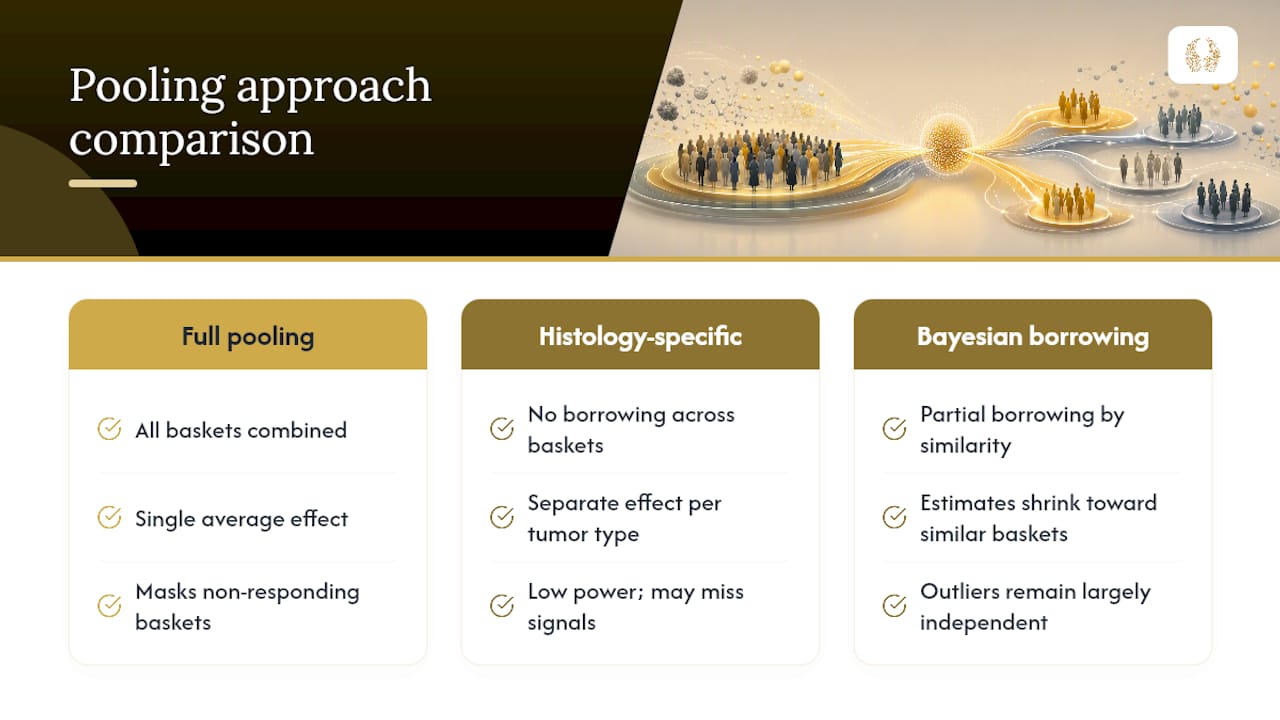
Simulation-based methodological work backs this approach specifically because naive pooling and rigid independence both carry real error risks. Calibrated hierarchical models can meaningfully reduce family-wise error compared with pooling everything by default, while preserving more statistical power than analyzing every basket in total isolation.
Interim analysis and stopping rules need calibration specific to the basket structure, not a copy-pasted rule from a conventional two-arm trial. A basket showing zero responses after its first 8 to 10 patients is usually closed for futility. A basket showing an unusually strong early signal might trigger an expansion cohort rather than an automatic move to confirmatory testing, since early response rates in small samples are notoriously unstable.
Pro Tip: Run simulation studies before the protocol is finalized, not after enrollment starts. Simulating type I error under a range of plausible heterogeneity scenarios is the only reliable way to know whether your borrowing rule will protect you or quietly inflate false positives once real data starts arriving.
What Operational Steps Keep Enrollment on Track?
Basket trials live or die on how fast patients can be matched to the right basket, and that speed depends almost entirely on genomic screening infrastructure built before the first patient is consented.
- Build the next-generation sequencing (NGS) pipeline first. Turnaround time between biopsy and actionable result directly determines how many eligible patients are lost to disease progression while waiting for a report. Protocols that rely on send-out testing with two to three week turnaround routinely see higher screen-failure rates than those using an in-house or centralized rapid-turnaround panel.
- Standardize biospecimen collection across every site. Fixation time, tissue quality, and shipping conditions vary widely between community and academic sites, and that variation directly affects sequencing success rates. Operational reviews of master protocols point to biospecimen standardization and centralized testing as one of the most persistent bottlenecks in basket trial accrual.
- Use a hub-and-spoke site model. A small number of central hub sites handle complex biomarker confirmation and rare-basket enrollment, while a wider network of spoke sites handles screening and referral. This spreads the geographic reach needed to find rare molecular subtypes without requiring every site to build full genomic testing capability.
- Run pre-screening registries alongside the trial. A registry that captures biomarker status from routine clinical testing, independent of trial enrollment, lets sponsors identify eligible patients faster once a basket opens or expands, rather than starting biomarker screening from zero at activation.
- Train every site on basket-specific data capture. Because each basket may have different eligibility nuances, staging conventions, or response criteria depending on tumor type, site staff need training specific to the tumor types they’re actually enrolling, not a generic protocol overview.
Practical experience with biopsy and sequencing logistics shows why amendment cycles are so common in basket trials: unresolved delays in NGS turnaround frequently force sponsors to widen acceptable testing windows or add central re-biopsy workflows mid-trial, rather than accepting the enrollment losses that come with a rigid original timeline. Clinicians evaluating a patient for a biomarker-driven trial can find background on how eligibility criteria interact with test results in HCRF’s clinical trial eligibility guide, and a primer on the underlying assay science in the foundation’s early detection biomarkers resource.
What Regulatory Precedent Supports Tissue-Agnostic Approvals?
The FDA has granted tissue-agnostic approvals based on basket-style evidence, and the pattern behind those approvals is worth understanding before assuming any strong basket result will translate into a label claim. Approvals supporting NTRK fusion-targeted therapies and expansions of BRAF V600E-directed treatment followed from basket trial evidence meeting specific evidentiary standards rather than a blanket allowance for any drug tested across multiple tumor types.
What those successful cases had in common:
- A consistent response pattern across baskets. Regulators looked for response rates that held up across most or all tumor types tested, not a single standout basket carrying an otherwise unimpressive average.
- A durable, clinically meaningful response. Response duration mattered as much as response rate; a high ORR with responses lasting weeks rather than months carries far less regulatory weight.
- A biologically plausible mechanism. The biomarker needed a clear, established link to the drug’s mechanism of action, not just a statistical association observed in the trial data.
- Pre-specified pooling rationale. Sponsors that pre-specified how and when baskets would be pooled, rather than deciding after seeing results, presented a cleaner case for interpretation.
Regulatory expectations shift once a sponsor moves from accelerated approval toward full approval or a broader label. Accelerated approval pathways have historically accepted single-arm basket data supported by a strong, consistent ORR signal. Confirmatory evidence, though, typically requires either a randomized comparison in a major basket or real-world outcome data that corroborates the trial’s surrogate endpoint with actual survival benefit.
Randomization becomes necessary, not optional, when the disease in question already has an established standard of care with a track record. A basket trial testing a targeted therapy against, say, treatment-naive rare sarcomas with no existing options can lean more heavily on single-arm response data. The same drug tested in a basket where an active comparator already extends survival needs a randomized element to convince regulators the response is attributable to the drug and not to more favorable baseline disease characteristics in the enrolled population.
Master protocol literature is explicit that master protocols improve operational efficiency and hold particular value for rare populations, but design choices still need to account for enrollment imbalances, multiplicity, and the analysis plan well before a regulatory submission is drafted, not as an afterthought once results look promising.
What Do Pooled Outcomes Across Basket Trials Actually Show?
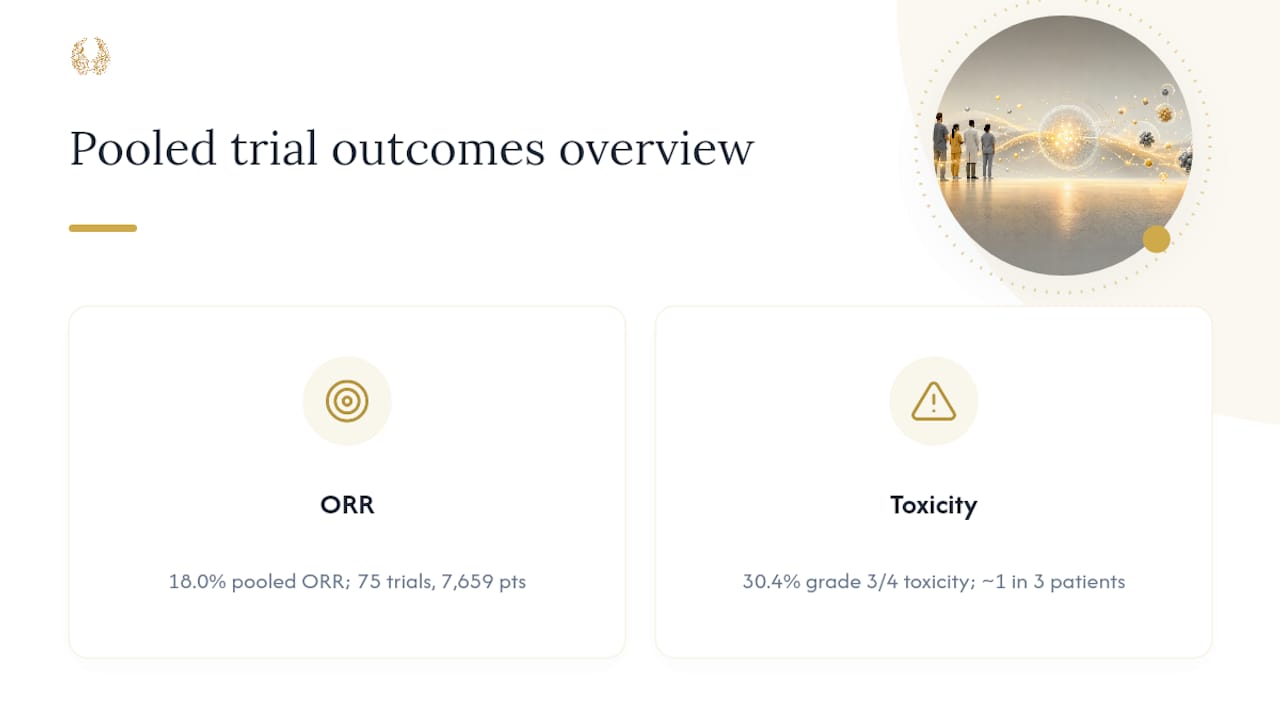
The most comprehensive answer to that question comes from a 2024 meta-analysis pooling results from 75 basket trials covering 7,659 patients. The aggregate numbers give a realistic baseline against which any single new basket trial’s results should be judged, rather than comparing against a best-case outlier.
An 18% pooled ORR sounds modest next to the response rates reported for some individual, highly selected basket trials, and that gap is the point. Individual trials that make headlines tend to be the ones with response rates well above this pooled average; the full meta-analysis across 75 trials shows what the typical basket trial actually delivers once outlier successes are averaged against the many baskets that show weak or no response.
That 18.0% ORR sits against a grade 3/4 toxicity rate of 30.4%, meaning roughly one in three patients experience serious drug-related toxicity for a roughly one-in-five chance of an objective response. That risk-benefit ratio is not unusual for targeted therapies in heavily pretreated populations, but it’s a number worth holding in mind before treating any single trial’s headline ORR as representative of the whole basket trial category.
A few interpretation caveats matter more than the topline numbers themselves. First, this is a pooled analysis across trials of varying phase, biomarker, and drug class, so the confidence intervals reflect genuine biological and design heterogeneity, not just sampling noise. Second, most contributing trials were single-arm, meaning the PFS and OS figures lack a concurrent control group and can’t isolate the drug’s specific contribution from the natural history of each disease. Third, a pooled median obscures the basket-to-basket variation that matters most clinically. A basket trial with an 18% average ORR could contain one tumor type responding at 45% and three others responding at close to zero, and the pooled number alone won’t tell you which is which.
What Do Real Basket Trials Reveal About Design Choices in Practice?
Five trials show how the theory above plays out once patients are actually enrolled, and each illustrates a different lesson about pooling, expansion, or regulatory strategy.
- NCI-MATCH (NCT02465060) matched patients to one of dozens of targeted therapy arms based on tumor genomic profiling, regardless of cancer type. It demonstrated at scale how genomic screening infrastructure, run through a national cooperative group network, can feed multiple parallel basket substudies from one shared screening platform rather than building separate infrastructure per drug.
- KEYNOTE-158 (NCT02628067) evaluated pembrolizumab across multiple advanced solid tumor types and became one of the trials underpinning tissue-agnostic approval discussions for biomarker-defined populations. It showed how a single basket trial, run with disciplined per-cohort reporting, can generate evidence regulators are willing to consider for label expansion.
- NAVIGATE (NCT02576431) tested larotrectinib in TRK fusion-positive cancers spanning dozens of histologies. Its consistent response pattern across a wide range of rare tumor types became a template for what a convincing tissue-agnostic response profile looks like to regulators.
- LIBRETTO-001 (NCT03157128) evaluated selpercatinib in RET-altered cancers using an expansion cohort strategy, growing specific baskets once early signals justified the added enrollment. It illustrates the two-wave enrollment approach directly: start small for proof of concept, expand only where the data support it.
- VE-BASKET (NCT01524978) tested vemurafenib in BRAF V600E-mutant cancers outside melanoma and became a foundational example of how a drug approved for one tumor type can be re-evaluated across others sharing its target mutation, exposing both the promise and the histology-dependent limits of that approach.
All five trials are documented with full design and enrollment details on Clinicaltrials, which remains the most reliable public record for verifying a basket trial’s actual protocol against how it gets described in secondary literature.
How Do You Decide When to Pool, Expand, or Confirm a Basket Trial?
A basket trial design succeeds or fails based on decisions made months before the first patient enrolls. This checklist reflects the sequence sponsors and trialists actually need to work through.
- Decide the trial’s core intent first. Is this an exploratory proof-of-concept study meant to find a signal, or does it carry confirmatory ambitions from day one? That single decision drives every downstream choice about sample size, randomization, and multiplicity correction.
- Set minimal per-basket sample targets before writing the statistical section. A basket needs enough patients to distinguish a real signal from noise. Reviews of current practice suggest most exploratory baskets fall in the range of a handful to roughly a dozen patients each before an expansion decision, though rare tumor types may need a lower bar simply because no larger population exists to enroll.
- Define pooling triggers in the protocol, not after seeing results. Specify exactly what similarity criteria on response and toxicity a set of baskets must meet before their data can be combined for analysis.
- Build interim rules with basket-specific futility and expansion thresholds. A rule calibrated for a common tumor type basket will misfire when applied to a rare-histology basket with a fraction of the enrollment.
- Confirm operational readiness before activation. Central lab capacity, NGS turnaround benchmarks, and pre-screening registry access all need to be in place, not aspirational, when the first site opens.
- Decide upfront where randomization becomes necessary. Any basket targeting a disease with an established, effective standard of care needs a randomized comparison built into the design, not added retroactively when regulators ask for it.
Most trialists now favor a two-wave enrollment strategy for exploratory basket trials, opening with three to five tumor types for initial proof of concept, then expanding only the baskets that clear pre-specified interim thresholds. This keeps early costs and statistical risk contained without abandoning the trial’s core promise of testing broadly.
Pro Tip: Write your basket’s stopping rule in terms of the number of responses observed, not a percentage. A rule stated as “close if zero responses occur in the first 10 patients” is far easier for a data safety monitoring board to apply consistently than a rule stated as a rate, which behaves unpredictably at small sample sizes.
What Makes HCRF a Credible Resource on Basket Trial Research?
The Hippocratic Cancer Research Foundation is a 501©(3) nonprofit organization built to support out of the box cancer research at the Robert H. Lurie Comprehensive Cancer Center of Northwestern University, one of the academic institutions actively running biomarker-driven trials of the kind described throughout this article. That institutional footing matters when a foundation is asking readers to trust its explanation of how genomic screening, biomarker eligibility, and trial design actually intersect for real patients.
HCRF maintains a set of resources built specifically to help patients and clinicians navigate that intersection, including a guide to clinical trial eligibility that walks through how biomarker results shape which trials a patient qualifies for, and a companion resource on early detection biomarkers explaining the molecular profiling that underlies basket trial screening. Disease-specific guides, including one on pancreatic cancer clinical trials and immunotherapy, show how these same biomarker-driven principles apply in specific, high-need cancer types where basket-style thinking has already changed what’s available to patients.
How Should Consent and Incidental Findings Be Handled in Basket Trials?
Informed consent gets genuinely complicated in a basket trial in a way that a conventional single-tumor study never has to face. A patient enrolling isn’t just consenting to a specific drug and its known side effects; they’re consenting to participate in a screening and matching process where the biomarker test itself might return information they didn’t ask for.
Genomic panels run for trial eligibility routinely detect incidental findings: germline mutations linked to hereditary cancer syndromes, variants of uncertain significance, or findings unrelated to the cancer being treated entirely. A basket trial’s consent process needs to address, upfront, whether incidental findings will be disclosed, who explains them, and what happens next if a patient learns they carry a hereditary risk they weren’t screened for intentionally.
There’s also a genuine tension in basket trial consent between how much a patient needs to understand about the biomarker-matching logic itself, since that logic is often more abstract than “this drug treats this cancer.” A patient needs to grasp, in plain language, why a drug developed for one cancer type is being offered to them for a different one, and why the response rate for their specific tumor type might differ from an overall trial average they may have read about.
Broader legal context around genetic information adds another layer worth flagging to patients: results from trial-related genomic testing intersect with protections and gaps addressed in ongoing legislative efforts around genetic discrimination, a consideration that deserves a place in any consent conversation involving hereditary findings.
How Do You Interpret Heterogeneous Results Across Tumor Types?
A basket trial’s biggest interpretive trap is treating a pooled result as if it describes every tumor type equally well. It rarely does. Response rates commonly diverge sharply from one basket to another even when every patient shares the identical qualifying biomarker, because the same mutation operates within a different network of co-occurring alterations, tissue microenvironment, and treatment history depending on where the cancer originated.
Reporting heterogeneity transparently means presenting basket-level results alongside any pooled estimate, not burying tumor-type variation in a supplementary table. A trial report that leads with an aggregate ORR while relegating the basket-by-basket breakdown to an appendix makes it easy for readers to mistake a heterogeneous result for a uniform one.
Statistically, Bayesian hierarchical approaches offer one honest way to represent that heterogeneity rather than hide it: instead of forcing every basket toward one shared estimate, these models can report a credible interval for how much baskets actually differ from each other, alongside the pooled number. Sponsors and journals reporting basket trial results carry real responsibility here, since a pooled response rate presented without its basket-level spread invites exactly the kind of “tissue-agnostic means universal” misreading that experienced trialists have learned to guard against, expecting that heterogeneity is the norm rather than the exception when the same biomarker crosses several distinct organ systems.
How Does Real-World Evidence Complement Basket Trial Findings?
Basket trials, especially early single-arm ones, generate response and toxicity data from a relatively small, often heavily monitored patient population. Real-world evidence, drawn from electronic health records, insurance claims databases, and post-approval registries, fills gaps that a basket trial’s limited sample size and short follow-up simply can’t cover on its own.
Real-world data proves particularly valuable for confirming whether a basket trial’s promising early response rate translates into meaningful survival benefit once the drug reaches a broader, less rigorously screened patient population, including patients with comorbidities or prior treatment histories that would have excluded them from the original trial. It also helps regulators and clinicians assess long-term and rare toxicity signals that a trial enrolling a few dozen patients per basket is statistically unlikely to catch during its active follow-up period.
The limitation runs the other direction too: real-world data lacks the standardized biomarker testing and controlled dosing that make basket trial results interpretable in the first place, so it works best as a complement rather than a substitute. A basket trial establishes that a biomarker matters and estimates the likely effect size under controlled conditions; real-world evidence then tests whether that effect holds up once the drug moves into everyday oncology practice, across a patient population the original trial’s eligibility criteria never captured.
What Comes Next for Basket Trial Design?
We keep coming back to one truth in this work: the biology does not care that a biomarker looks identical on a genomic report across ten different organs. The next generation of basket trials has to be built around that honesty, not around it.
Scaling genomic screening into routine care, not just trial-adjacent testing, is the single change that would move the field fastest. Adaptive designs that borrow strength across baskets while actively monitoring for heterogeneity, paired with liquid biopsy technology that can identify eligible patients without an invasive procedure, are where we see the most promise for shortening the gap between a promising signal and a patient actually receiving that drug.
None of that happens through better statistics alone. It takes trialists, regulators, and funders working from the same evidence base, willing to fund the unglamorous infrastructure, screening registries, central labs, biospecimen standards, that makes any of this possible at scale.
— HCRF
How HCRF Helps Patients and Researchers Find the Right Trial
The organization aims to support translational research that advances promising basket trial findings toward accessible therapies, and to assist patients and clinicians in identifying clinical trials matched to biological markers rather than location.

If you’re a clinician trying to determine whether a patient’s biomarker result opens the door to a basket trial, HCRF’s clinical trial eligibility guide walks through how molecular profiling connects to enrollment criteria. If you’re a researcher exploring collaboration on translational work connected to the Robert H. Lurie Comprehensive Cancer Center, HCRF funds exactly this kind of out of the box science and welcomes partnership conversations. Visit the HCRF website to learn about current funding priorities, sign up for research updates, or make a donation that directly supports the next basket trial working to turn a rare mutation into a treatable one.
This article is general information, not a substitute for advice from a qualified doctor. Consult a qualified healthcare professional about your own circumstances before acting on anything here.
Sources
- PubMed record for meta-analysis of basket trials (2024)
- Basket Trials: Review of Current Practice and Innovations for Future Trials (PMC10476732)
Recommended


A clinician-forward explainer of three proven AI applications in cancer imaging, the evidence that matters, operational risks, and the validation funders...
Read More →