


What Clinical Trial Costs Really Look Like by Phase
August 18, 2026
What Clinical Trial Costs Really Look Like by Phase

Clinical trial costs vary enormously by phase, but the numbers tell a clear story. A median pivotal trial supporting FDA approval costs roughly $19 million, with a range between $12 million and $33 million, and the median cost per approved drug reaches $48 million. Government analysis pegs cross-area averages at about $3.8 million for Phase I, $13.35 million for Phase II, and $19.89 million for Phase III trials, though therapeutic area shifts these figures dramatically.
Here’s who actually pays: the trial sponsor generally covers research costs and the investigational drug itself, while routine patient care costs are often billed to a participant’s insurance, just as they would be outside a trial. Travel, parking, and lodging fall into a gray zone. Sometimes the study reimburses these, sometimes the patient absorbs them.
If you’re weighing whether to join a trial, the fastest path to clarity is your informed consent form. It should spell out exactly what’s covered and what isn’t. Ask the study coordinator directly if anything is ambiguous, and call your insurer before you enroll.
Key Takeaways
Clinical trial costs depend heavily on phase, patient count, and visit frequency, with sponsors covering research costs while insurance and patients typically share routine care expenses.
| Point | Details |
|---|---|
| Median pivotal trial cost | Costs roughly $19 million (IQR $12M–$33M), with per-patient costs near $41,413. |
| Sponsors cover research costs | Insurance typically covers routine care costs, though standard copays and deductibles may still apply. |
| Patients often owe travel costs | Parking, lodging, and travel expenses may require separate reimbursement requests from the study team. |
| Enrollment size drives budgets | Patient count and visit frequency explain most of the variation in total trial cost. |
| HCRF funds access, not just science | HCRF supports patients navigating trial costs alongside the research itself at Northwestern’s Lurie Cancer Center. |
Table of Contents
- Understanding Clinical Trial Costs: Why the Numbers Vary So Much
- Clinical Trial Cost Ranges by Phase, Explained
- What Actually Drives Clinical Trial Costs Higher
- Who Pays for Clinical Trial Costs: Sponsors, Insurers, and Patients
- Per-Patient and Per-Visit Cost Estimates
- How Researchers Actually Estimate Clinical Trial Costs
- Practical Ways to Manage Clinical Trial Costs
- Why Timelines and Delays Drive Up Clinical Trial Costs
- Real-World Cost Scenarios: Low, Mid, and High Budgets
- The Hidden Overhead Behind Every Clinical Trial Budget
- Regulatory and Compliance Costs in Clinical Trials
- How Location Affects the Cost of a Clinical Trial
- What Patient Recruitment and Retention Really Cost
- Insurance and Liability Costs Sponsors Must Carry
- Why We at HCRF Care About Clinical Trial Costs
- How HCRF Helps You Move Forward
- Sources
Understanding Clinical Trial Costs: Why the Numbers Vary So Much
“Clinical trial costs” is really three different categories stacked together, and confusing them is why so many people leave a Google search more confused than when they started.
Research costs cover everything the sponsor needs to run the science: the investigational drug or device, data collection systems, statistical analysis, monitoring visits, and the extra lab work or imaging that wouldn’t happen in standard care. Routine patient care costs are the costs a patient would incur anyway, even without the trial. Think office visits, standard bloodwork, and imaging tied to your underlying diagnosis. Indirect and overhead costs sit underneath both categories. These are the institutional expenses like facility use, administrative staff, and regulatory compliance that rarely show up in a press release but absolutely show up in a sponsor’s budget.
Published estimates diverge because trials themselves diverge. A Phase I trial testing a new compound in 20 healthy volunteers bears no resemblance, cost-wise, to a global Phase III trial enrolling 3,000 patients across 40 countries with an active comparator arm. Design choices matter just as much as scale: a trial measuring a “hard” outcome like survival typically runs longer and costs more than one measuring a surrogate marker, and a placebo-controlled design carries different costs than a head-to-head comparison against an existing drug.
A typical trial budget includes:
- Per-patient site fees paid to each investigator and clinic
- Site startup and Institutional Review Board (IRB) fees
- Contract research organization (CRO) management fees
- Electronic data capture and clinical trial management system (CTMS) costs
- Monitoring visits to verify data accuracy
- Investigational product manufacturing and supply
- Participant payments for time and travel
Pro Tip: Never assume a trial is free just because a sponsor is funding the science. Read your informed consent form line by line. It’s the only document that tells you, specifically, what your trial covers and what lands on you.
Clinical Trial Cost Ranges by Phase, Explained
Averages hide more than they reveal in clinical research, because a handful of massive outlier trials can pull a mean number far above what most sponsors actually spend. That’s why the strongest published estimates report medians and interquartile ranges (IQR) instead of a single “average” figure.
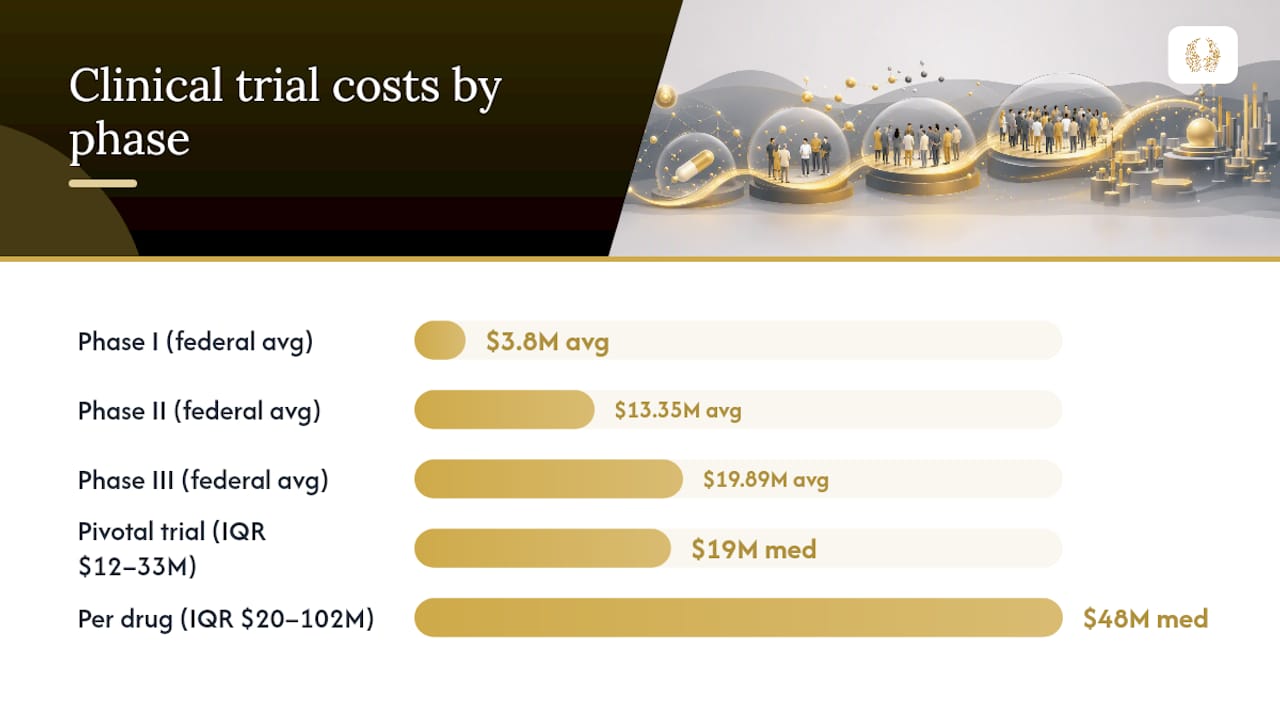
The JAMA-adjacent analysis published in JAMA Internal Medicine’s research network found a median cost of $19 million per pivotal trial, with a middle-50% range between $12 million and $33 million. Per approved drug, accounting for the fact that most drugs need more than one pivotal trial, the median climbs to $48 million (IQR $20 million to $102 million). Per patient, the median lands around $41,413, with trials averaging 11 total visits per participant.
Federal data tells a complementary story using different methodology. The Department of Health and Human Services reports cross-area averages of roughly $3.8 million for Phase I, $13.35 million for Phase II, and $19.89 million for Phase III trials. These numbers sit lower than the JAMA pivotal-trial figures partly because they average across all therapeutic areas, including smaller, faster studies that never become the large pivotal trials measured in the other analysis.
| Phase | Typical per-trial average cost | Per-patient cost factors | Primary cost drivers |
|---|---|---|---|
| Phase I | Average around $3.8 million for small, early-stage studies | Fewer patients, intensive monitoring per participant | Safety labs, dose escalation, hospital-based monitoring |
| Phase II | Average about $13.35 million, increasing in complex disease areas | Moderate enrollment, more visits compared to Phase I | Efficacy endpoints, comparator arms, expanded lab tests |
| Phase III | Average near $19.89 million; pivotal trials have median around $19 million with range $12 million–$33 million | Median per-patient cost about $41,413 in large trials | Enrollment size, number of sites, long follow-up periods |
A few patterns explain why these ranges are so wide within each phase:
- Oncology and rare-disease trials often cost more per patient due to specialized imaging and slower enrollment.
- Trials with active comparator drugs cost more than placebo-controlled designs because the comparator itself must be purchased or sourced.
- Studies measuring hard endpoints like overall survival typically run years longer than those using surrogate markers, which stretches every recurring cost.
One number worth remembering: the median cost per patient across pivotal trials sits at $41,413, and that figure rises exponentially, not linearly, as the number of patients and visits climbs. Adding patients doesn’t just add a proportional cost. It compounds it.
What Actually Drives Clinical Trial Costs Higher
Two variables explain most of the difference between a $5 million trial and a $50 million one: how many patients you enroll and how many times you see each one. Published regression analysis on pivotal trials found that patient count and visit count together explain most of the cost variation across studies, which means sponsors chasing savings should scrutinize both numbers before touching anything else in the budget.
Ranked roughly by financial impact, the drivers that move a trial budget the most are:
- Number of enrolled patients. More participants mean more site fees, more monitoring, and more investigational product.
- Number of clinic visits per patient. Every added visit multiplies across the entire enrolled population.
- Trial duration and follow-up length. Longer studies extend fixed costs like CRO management fees and data hosting.
- Endpoint type. Hard clinical outcomes (survival, hospitalization) usually require longer observation than surrogate markers (tumor shrinkage, biomarker change).
- Comparator design. Active-comparator trials cost more than placebo-controlled ones because the comparator drug must be sourced and often matched in packaging.
- Therapeutic area. Clinical procedure intensity varies by disease, and procedure costs alone can account for 15% to 22% of a trial’s total budget.
- Monitoring model. Traditional in-person, 100% source-data verification costs more than centralized, risk-based approaches.
Administrative staffing and site monitoring round out the top three direct cost drivers identified in industry-wide cost analyses, alongside clinical procedure intensity. None of these are surprising in isolation, but stacked together, they explain why two trials in the same phase and same disease area can still land a decade apart in total spend.
Who Pays for Clinical Trial Costs: Sponsors, Insurers, and Patients
The honest answer is: it depends on the cost category, and the split matters enormously if you’re the one enrolling.
Sponsors, whether that’s a pharmaceutical company, a university, or a foundation, generally cover the research-specific costs: the investigational drug, extra study visits beyond standard care, specialized lab work required only because you’re in the trial, and data collection. Health insurers, in most cases, are expected to cover routine patient care costs, meaning the portions of your care you’d receive regardless of trial participation. That said, insurers can still apply your normal deductible and copay structure to those routine costs, since trial participation doesn’t automatically waive standard cost-sharing.
Federal programs add another layer. Medicare generally covers routine costs in qualifying clinical trials, and many state Medicaid programs and TRICARE have their own trial coverage rules, so it’s worth confirming your specific plan’s policy before enrolling rather than assuming blanket coverage.
Nonmedical expenses are where most confusion happens. Common out-of-pocket costs participants report include:
- Travel to and from the study site, especially for trials requiring frequent visits
- Parking fees at hospital or research campuses
- Lodging for trials requiring overnight stays or multi-day visits
- Childcare or missed work during study visits
Some trials reimburse these costs; others don’t, and it varies site by site. The informed consent form should specify which apply to your study, including whether payments are structured as reimbursements (requiring receipts) or flat stipends.
Pro Tip: Before your first visit, ask the study coordinator for a letter outlining what the trial covers. Submit that letter to your insurer proactively rather than after a bill arrives. Preauthorization headaches are far easier to solve before a claim than after a denial.
Per-Patient and Per-Visit Cost Estimates
Translating trial-level budgets into a “cost per person” figure makes the numbers far more tangible, and it’s exactly what the strongest academic estimate does. The median cost per patient across pivotal trials sits at $41,413, with wide variability driven by therapeutic area and visit intensity. Trials in that same analysis averaged 11 total visits per patient, which puts the median cost per visit at roughly $3,685.
That per-visit figure matters because it multiplies fast. A trial that adds just three extra follow-up visits per patient, spread across 200 enrolled participants, adds over $2 million to the total budget using that same median rate, without a single new patient enrolled.
Worked example: imagine a small Phase II trial enrolling 80 patients, each attending 9 visits at a rate consistent with published medians. At roughly $3,685 per visit, that’s about $2.65 million in visit-driven costs alone, before adding site startup fees, IRB costs, drug supply, or CRO management. It’s a rough illustration, not a quote, but it shows how quickly per-visit costs compound at even a modest scale.
- Median per-patient cost: approximately $41,413
- Median number of visits per patient: around 11
- Estimated median cost per visit: about $3,685
Pro Tip: If you’re a caregiver trying to estimate what a loved one’s trial might cost your family in time and travel, ask the coordinator for the total expected number of visits up front. That single number, multiplied by your round-trip travel cost, gives you a realistic personal budget fast.
How Researchers Actually Estimate Clinical Trial Costs
Public cost figures come from a handful of methods, and knowing which one produced a number helps you judge whether it applies to your situation.
The most rigorous academic approach uses regression models built on real trial characteristics, most notably patient count and visit count, to predict total cost. That’s the method behind the JAMA-adjacent pivotal trial analysis, and it’s why that study reports medians with confidence rather than a single blended average. Industry cost-estimating software takes a different approach, applying per-patient rate cards plus fixed site startup fees, often calibrated against proprietary CRO pricing data that isn’t publicly disclosed.
Every estimate carries assumptions that shift the final number: which cost categories are included (research only, versus research plus overhead), what currency year the figures use, and whether geographic site costs are averaged globally or isolated to the U.S. Public estimates also have real limits. Most published datasets cover a fixed historical window, skew toward certain therapeutic areas with better data availability, and rely on sponsor disclosures that aren’t mandatory.
- Regression-based patient and visit counts explain most of the cost variation in the strongest published dataset
- Industry rate-card models are faster to build but harder to independently verify
- No public dataset captures every sponsor’s actual internal costs, so treat every figure as directional, not exact
Practical Ways to Manage Clinical Trial Costs
Sponsors and study teams have real levers to pull, and some of them meaningfully change a trial’s total price tag without compromising scientific integrity.
On the design side, choosing a surrogate endpoint (a biomarker change, for example) over a hard outcome (survival) can shorten follow-up dramatically, cutting years off a trial’s duration and the recurring costs that come with it. The trade-off is regulatory: surrogate endpoints sometimes require additional confirmatory studies before approval, so the savings aren’t always permanent. Adaptive trial designs, which allow protocol adjustments based on interim data, can also reduce wasted enrollment in arms that clearly aren’t working.
On the operational side, risk-based monitoring has become one of the most widely adopted cost levers in the industry. That shift, endorsed under ICH E6(R2) guidance, meaningfully cuts monitoring visit costs while maintaining data integrity. Decentralized elements like telehealth check-ins reduce both site burden and patient travel costs, and smarter site selection, choosing sites with proven enrollment track records, avoids the sunk costs of underperforming locations.
Pro Tip: If you’re evaluating a sponsor’s budget assumptions, ask specifically whether they’re using risk-based or traditional monitoring. That single choice can swing monitoring costs substantially across a multi-year trial.
Why Timelines and Delays Drive Up Clinical Trial Costs
Enrollment delays are one of the most underestimated cost multipliers in clinical research. Every month a trial spends recruiting instead of dosing patients still accrues fixed costs: CRO management fees, CTMS hosting, and core staff salaries keep running whether or not enrollment targets are on pace.
It helps to separate two timelines that budgets often blur together. Treatment duration is how long each individual patient stays on the study drug or in follow-up. Overall study duration is the total calendar time from first patient enrolled to final data lock, which includes recruitment delays and staggered enrollment across sites. A trial can have a short treatment period but a long overall duration simply because enrollment took twice as long as planned.
- Slow enrollment extends fixed CRO and staffing costs even when treatment protocols stay short
- Extended follow-up periods multiply per-visit costs across the full patient population
- Site underperformance often forces sponsors to open additional sites mid-trial, adding startup costs late in the process
Real-World Cost Scenarios: Low, Mid, and High Budgets
Numbers land better with a concrete picture attached. Here’s how three realistic trial types might shape up, drawing on the published medians above.
A small academic Phase I trial enrolling 30 healthy volunteers at a single U.S. site, with heavy safety monitoring but a short duration, might land in the $2 million to $4 million range, consistent with the roughly $3.8 million cross-area Phase I average.
A typical Phase II efficacy trial enrolling 150 patients across 10 sites, with an active comparator arm and 8 to 10 visits per patient, tracks closer to the $13.35 million Phase II average, with per-patient costs pushed higher by the comparator drug and expanded lab panels.
A large global Phase III trial enrolling 2,000 patients across 40 international sites, measuring a hard survival endpoint over several years, sits well within the $19 million to $33 million pivotal-trial range, and can climb higher when procedure-intensive therapeutic areas like oncology are involved.
| Scenario | Approx. per-trial cost | Approx. per-patient cost | Main cost driver |
|---|---|---|---|
| Small Phase I | $2M–$4M | Higher per-patient (small N, intensive monitoring) | Safety labs, dose escalation |
| Typical Phase II | ~$13M | Moderate, comparator-driven | Active comparator, expanded visits |
| Large Phase III | $19M–$33M+ | ~$41,413 median | Global sites, long follow-up, patient volume |
Pro Tip: When comparing a trial’s scope to these scenarios, ask how many sites and countries are involved. Global, multi-site trials almost always cost more per patient than single-country studies, even at similar enrollment sizes.
The Hidden Overhead Behind Every Clinical Trial Budget
Every headline cost figure hides a layer of indirect and overhead expenses that rarely make it into public summaries but consistently show up in sponsor budgets. These are the institutional costs tied to running a trial rather than the direct patient-facing costs.
Facility overhead is the biggest chunk: research institutions charge indirect cost rates on top of direct trial expenses to cover lab space, utilities, and administrative infrastructure. Academic medical centers often negotiate these rates with federal or sponsor funding separately from the trial’s direct budget, and they can add a substantial percentage on top of direct costs. Administrative staffing, including regulatory affairs coordinators, contract negotiators, and billing compliance staff, adds further overhead that scales with trial complexity rather than patient count alone.
Data management overhead deserves its own mention. Electronic data capture systems, cybersecurity compliance, and long-term data archiving all carry recurring costs that continue well after the last patient visit, since regulatory agencies typically require years of post-trial data retention. Insurance and indemnification overhead, covered in more detail later, also falls into this category.
None of these costs disappear just because they’re less visible than a per-patient site fee. They’re baked into every published average, which is one more reason a $19 million median pivotal-trial cost includes far more than lab tests and doctor visits. Understanding this layer helps explain why smaller institutions sometimes struggle to compete for trial hosting against larger academic centers with more efficient overhead structures already in place.
Regulatory and Compliance Costs in Clinical Trials
Every clinical trial has to clear a regulatory gate before it can enroll a single patient, and that gate isn’t free. Institutional Review Board (IRB) fees cover the ethics review process that evaluates whether a trial protects participant safety and rights, and sponsors pay these fees at every site involved, not just once for the overall study.
FDA interactions carry their own cost structure. Investigational New Drug (IND) application preparation requires substantial regulatory and medical writing expertise, and sponsors often need multiple rounds of FDA correspondence before a trial can proceed. Trials seeking approval in multiple regions face compounding compliance costs, since European trials must separately satisfy European Medicines Agency (EMA) requirements, which don’t automatically align with FDA standards even when studying the same drug.
Ongoing compliance doesn’t stop once a trial launches. Sponsors must maintain Good Clinical Practice (GCP) documentation, submit periodic safety reports, and respond to any regulatory inquiries throughout the study’s life. Protocol amendments, which happen in the majority of trials at some point, often require a fresh round of IRB and sometimes FDA review, adding both time and cost mid-study.
This regulatory layer is one of the more underappreciated line items in trial budgets, largely because it’s spread across the entire study rather than concentrated in one visible bill. But it’s also one of the least optional. Skipping or shortcutting ethics review isn’t a cost-saving option available to any legitimate sponsor, which is part of why building compliance costs into the budget from day one matters more than trying to trim them later.
How Location Affects the Cost of a Clinical Trial
Where a trial runs shapes its budget almost as much as what it’s studying. Site costs vary significantly by region, driven by differences in labor costs, healthcare infrastructure pricing, and local regulatory requirements.
Within the United States, costs vary too, though less dramatically than across countries. Academic medical centers in major metropolitan areas often carry higher per-patient site fees than community-based research sites, reflecting higher overhead rates and staff compensation. Multi-site U.S. trials frequently blend a mix of academic and community sites specifically to manage this cost variation while still reaching enrollment targets.
Global trials introduce a different calculation entirely. Sponsors running trials across multiple countries must navigate separate regulatory approval processes, translation and localization of consent documents, and in some cases, different standard-of-care baselines that affect what “routine care” even means in a given country. These factors explain why large Phase III trials, which frequently enroll across dozens of international sites, carry cost structures that don’t scale in a simple linear way with patient count alone.
For patients evaluating a specific trial, geography matters practically too. A trial site further from home means more travel costs, and multi-country trials sometimes mean local sites offer different levels of reimbursement support depending on regional norms and sponsor policy. If you’re considering a trial that isn’t local, ask specifically how the site handles travel support before assuming national or international policy applies uniformly.

What Patient Recruitment and Retention Really Cost
Finding and keeping patients enrolled is one of the most expensive, and most frequently underestimated, parts of running a clinical trial. Slow enrollment doesn’t just delay results. It extends every fixed cost in the budget, from CRO management fees to staff salaries, for as long as recruitment drags on.
Recruitment costs include advertising campaigns, patient registry outreach, community engagement efforts, and increasingly, digital screening tools that help identify eligible candidates faster. Rare-disease and oncology trials often carry the highest recruitment costs per patient, since the eligible population is smaller and harder to locate, sometimes requiring outreach across dozens of sites just to fill a modest enrollment target.
Retention costs are a separate but related expense. Every participant who drops out mid-trial represents sunk enrollment and screening costs, plus the added expense of recruiting a replacement to maintain statistical power. Sponsors increasingly invest in retention-focused strategies, including transportation assistance, flexible scheduling, and dedicated patient navigators, precisely because losing an enrolled patient late in a trial is far more expensive than the retention effort that could have kept them enrolled.

For patients, this is worth understanding because it explains why many trials offer more support services, transportation, scheduling flexibility, check-in calls, than public discussion of trial costs usually acknowledges. Sponsors have a direct financial incentive to help you stay enrolled, which sometimes translates into genuinely useful support if you ask about it directly.
Insurance and Liability Costs Sponsors Must Carry
Behind every clinical trial sits an insurance and liability structure that protects both participants and the institutions running the study, and it carries a real budget line.
Sponsors typically carry clinical trial liability insurance, which covers claims related to injury or harm potentially caused by the investigational treatment or study procedures. This is distinct from standard medical malpractice insurance carried by the treating institution, and sponsors often need to secure it specifically for each trial, particularly for higher-risk interventions like gene therapies or invasive procedures. Premium costs scale with perceived risk: a trial testing a well-understood drug class carries lower liability costs than one testing a novel biologic with limited safety data.
Sites themselves also carry institutional liability coverage, and larger academic medical centers typically negotiate this as part of their broader institutional insurance rather than purchasing it per trial. Smaller or independent research sites sometimes face higher relative insurance costs precisely because they lack that broader institutional buffer, which can factor into a sponsor’s site selection decisions.
Indemnification agreements, the contracts specifying who bears financial responsibility if something goes wrong, add legal review costs on top of the insurance premiums themselves. These agreements require negotiation between sponsors and sites before a trial can launch, and disputes over indemnification terms are a common source of delay in finalizing site contracts. None of this touches the patient directly in most cases, but it’s baked into the overall cost structure that ultimately shapes which trials get funded and where they run.
Why We at HCRF Care About Clinical Trial Costs
We started asking hard questions about clinical trial costs because we kept meeting patients who wanted to enroll in a trial and simply couldn’t afford the travel to get there. That’s not a hypothetical for us. It’s the exact gap the Hippocratic Cancer Research Foundation was built to close.
Our mission funds “out of the box” cancer research at the Robert H. Lurie Comprehensive Cancer Center of Northwestern University, and we believe access to that research shouldn’t depend on someone’s zip code or bank account. When donor dollars fund a trial, we want every eligible patient, not just the ones who can absorb the travel and lodging costs, to have a real shot at participating.
If you or someone you love is weighing a trial and cost is part of what’s holding you back, we’d rather you ask us than walk away. Our work on breast cancer research funding and patient support programs exists precisely for that conversation.
How HCRF Helps You Move Forward
You don’t have to navigate clinical trial costs alone, and you shouldn’t have to choose between groundbreaking research and your family’s budget. HCRF exists to close that exact gap. Every dollar donated funds not just the science happening at the Robert H. Lurie Comprehensive Cancer Center, but the patient support systems that help real people actually reach that research.

Unlike a hospital billing office or an insurance hotline, HCRF’s role is specifically to fund research and remove the access barriers around it, which means we can point you toward support programs built for exactly this situation rather than a generic customer service script. If you’re a patient wondering whether a trial’s travel or lodging costs are something you can manage, our donor’s guide to cancer research funding explains how contributions translate into patient assistance. If you’re a caregiver trying to understand what a specific trial covers, start with the study coordinator and your informed consent form, then reach out to us if cost is still standing between you and enrollment.
Visit the Hippocratic Cancer Research Foundation today to learn how your contribution funds research and to find the patient support resources available right now.
Sources
Every figure in this article traces back to a specific, checkable source, and your own trial’s informed consent form remains the single best document for cost details unique to your situation.
- Variation in the estimated costs of pivotal clinical benefit trials supporting the US approval of new therapeutic agents
- Who Pays for Clinical Trials? - NCI
- A guide to costs and payments in clinical trials — CISCRP
- Cost of Running a Clinical Trial: Budgeting — CASRAI
- Key cost drivers of pharmaceutical clinical trials in the United States
- Drug Development | ASPE
Pro Tip: Bookmark your trial’s informed consent form and reread it before every major visit. Costs and reimbursement policies occasionally get amended mid-study, and you want to catch those changes early.
This article is general information, not a substitute for advice from a qualified doctor. Consult a qualified healthcare professional about your own circumstances before acting on anything here.
Recommended
- Hippocratic Cancer Research Foundation: Innovative Therapies | Immunotherapy Clinical Trials for Lung Cancer: Your Guide
- Hippocratic Cancer Research Foundation: Innovative Therapies | Immunotherapy Clinical Trials for Prostate Cancer: 2026 Guide
- Hippocratic Cancer Research Foundation: Innovative Therapies | Pancreatic Cancer Clinical Trials: Immunotherapy Guide
- Hippocratic Cancer Research Foundation: Innovative Therapies | Breast Cancer Research Funding: A Researcher’s Guide

Dimitris has created a special series of acrylic watercolor paintings, each meticulously crafted to embody the spirit of our event. His unique artwork showcases stunning angel wings—a powerful symbol of hope, protection, and upliftment.
Read More →
Understand the critical differences between restricted and unrestricted funds for nonprofits, ensuring compliance and informed budgeting decisions.
Read More →