


Five Beat Donor Impact Stories Template Fundraisers Can Use Now
August 30, 2026
Five Beat Donor Impact Stories Template Fundraisers Can Use Now

The best donor impact stories follow one rule: name one real person, describe one measurable result, and show the donor exactly what role their gift played in creating it. Every other element, from the interview questions you ask to the channel you publish on, exists to support that single structure. The templates and measurement guidance below turn this principle into something you can use before your next appeal goes out.
TL;DR:
- Donor impact stories should name one person, specify measurable results, and clarify exactly how the gift contributed to the outcome.
- Personal stories emphasizing specific outcomes and including concrete data boost donation size and frequency through the identifiable victim effect.
- Gather stories from program staff or partners, confirming consent, privacy preferences, and verifying details before publishing.
- Tailor stories to each platform, using full narratives with a clear ask in emails, succinct captions on social media, and detailed metrics on websites.
- Reporting outcomes, not activity, and linking donations to specific research milestones or results build credibility and donor retention.
Table of Contents
- Why donor impact stories matter for giving and retention
- How do you find and prepare donor impact stories?
- A step-by-step donor impact story template
- Which channels and formats work best for sharing stories?
- How do you measure and report donor impact?
- Four ready-to-publish impact story examples
- How HCRF turns donor gifts into reported research milestones
- What one story taught us about testing small changes
- Sources
Why donor impact stories matter for giving and retention
The mechanism behind a good impact story isn’t mysterious. A meta-review of 1,339 primary studies covering more than 2.1 million participants found that emphasizing individual beneficiaries and describing concrete outcomes rank among the most reliable ways to increase both the size and frequency of donations. Psychologists call part of this the identifiable victim effect: people give more to one named person in need than to a faceless statistic, even when the statistic represents thousands of people.
By the numbers: A related meta-meta-analysis of 21 systematic reviews found the identifiable victim effect reached an effect size of r = 0.13 in some studies, alongside donation visibility and tax-deductibility as consistent (if individually modest) levers.
Separate research on actual impact information and perceived donation efficacy found that donors who see evidence their previous gift worked are more likely to give again. That’s the acquisition-to-retention bridge every stewardship program needs: a good story doesn’t just open wallets once, it convinces people their giving actually functions.
How do you find and prepare donor impact stories?
Strong stories rarely walk into your inbox. You have to go looking, and the best candidates usually surface through program staff, clinical partners, or patient navigators rather than through a general call for testimonials.

Start with people who can speak specifically about what changed, not just how they feel. A patient who can say “the trial gave me six more months with my kids” is more useful than one who says only “I’m grateful.” Look inside case files, clinical trial enrollment records, and grantee progress reports for individuals whose story ties directly to a funded program.
Before you write a word, work through this checklist:
- Confirm the person is willing and emotionally ready to share their story publicly.
- Get a signed consent and media release form that specifies where the story will appear (email, web, social, print).
- Ask about medical or personal details they want kept private, and honor that boundary in every draft.
- Collect the evidence that will anchor the narrative: dates, treatment names, dollar figures, and any data your program team can verify.
- Request photos or video with separate, explicit permission, since image consent is not the same as story consent.
Pro Tip: Interview beyond the highlight moment. Ask “what was the hardest part before this happened?” That contrast is what makes the eventual outcome land emotionally instead of reading like a press release.
Once you have consent and a rough narrative, corroborate it. If a patient credits a clinical trial for a remission, confirm the trial name and timeline with your program office before publishing. Donors trust specificity, and specificity has to be accurate.
A step-by-step donor impact story template
Use this structure as your default, then adapt the wording to fit the channel:
- Hook. Open with the person, not the problem. “Maria was 34 when her second round of chemotherapy stopped working.”
- Problem. State the stakes plainly, in one or two sentences. “Standard treatment had run out of options.”
- Solution funded. Name the specific program, trial, or research effort donors made possible. “A donor-funded clinical trial at the Robert H. Lurie Comprehensive Cancer Center gave her access to an experimental therapy.”
- Measurable outcome. Give a number, a date, or a clear before-and-after. “Fourteen months later, Maria’s scans show no active disease.”
- Donor role and ask. Close the loop by telling the reader exactly what their gift does next. “Gifts like yours fund the next phase of that trial. $150 covers one week of lab analysis for a patient like Maria.”
That five-beat structure flexes across three formats without losing its shape.
Short social post (under 280 characters): “Maria was told there were no more options. A donor-funded trial changed that. Fourteen months later, she’s cancer-free. Your gift funds the next Maria. [link]”
Donor email (150 to 250 words): Lead with the hook paragraph, expand the problem and solution into two short paragraphs, include one data point in bold, and close with a specific ask tied to a dollar figure. Subject lines that name the person (“How Maria’s story ends”) tend to outperform generic appeals.
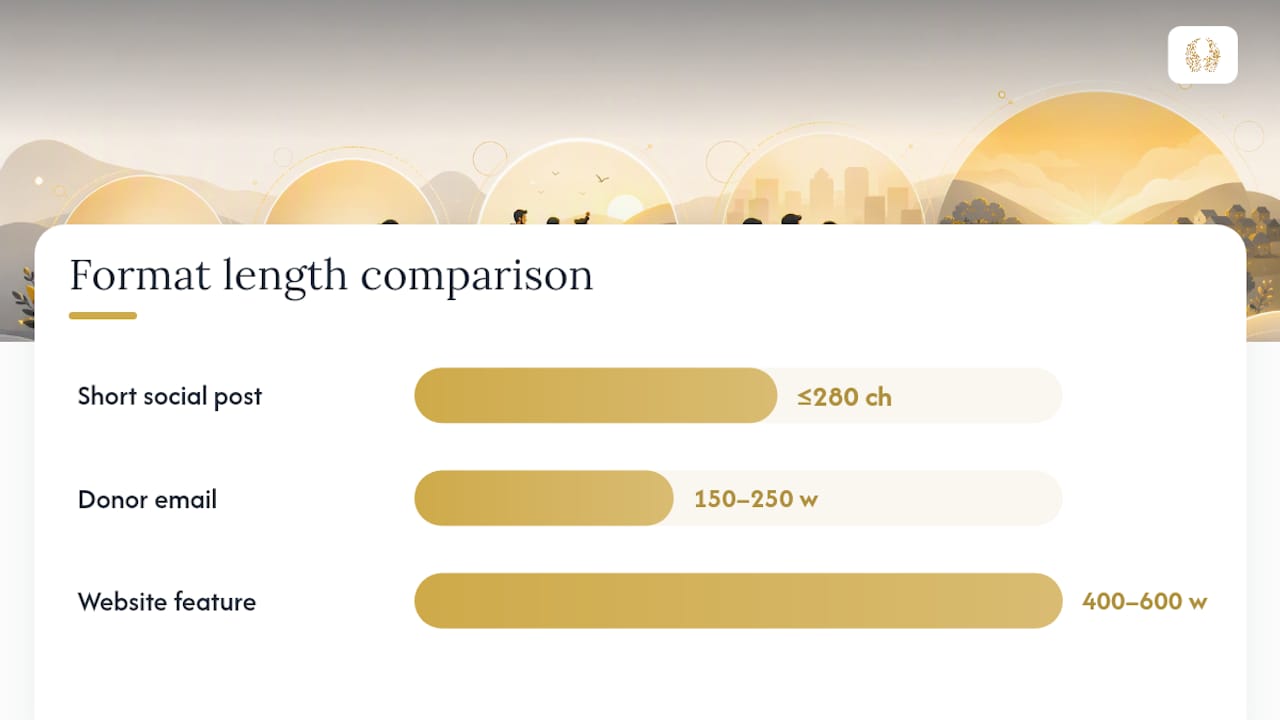
Website feature (400 to 600 words): Add a pull quote from the patient, a sidebar with program metrics, and a photo (with consent). This format has room for the corroborating data your interview checklist collected, which builds credibility for donors doing their own research before a major gift.
Across all three, avoid vague asks like “support our mission.” Tie the dollar figure to the outcome: “$500 funds one month of follow-up scans for patients in Maria’s trial cohort” does more persuasive work than any adjective could.
Which channels and formats work best for sharing stories?
The same story should look different depending on where it lands. Trying to force one version across every channel wastes the format’s strengths.
- Email: Use the full narrative arc, pair it with a specific ask, and send during stewardship windows, not just at year-end appeal time.
- Social media: Lead with the hook line and a single strong image, keep captions under three sentences, and link out to the fuller story.
- Website features: Go deeper with metrics, program background, and multimedia. This is where skeptical or high-capacity donors do their research.
- Events and galas: Live testimony works best when the speaker tells the story in their own words rather than reading a script; keep it under four minutes.
For video, 60 to 90 seconds is the sweet spot for social distribution, while a website feature can support a three to five minute piece. Always secure separate written permission for photo and video use, even if you already have narrative consent. Time story releases to align with campaign milestones, such as a trial reaching enrollment targets, so the ask feels tied to real progress rather than a calendar date.
How do you measure and report donor impact?
Measurement separates a heartwarming anecdote from a credible impact story. Donors respond to outcomes, not activity counts, so track both and report the difference clearly.
- Outputs are what you did (patients enrolled, dollars raised). Outcomes are what changed as a result (remission rates, trial milestones reached). Lead with outcomes whenever you have them.
- Calculate cost-per-result where possible: “$2,400 funded one full round of genomic sequencing for a trial participant.”
- Track percent of target achieved for specific campaigns, since partial progress reported honestly builds more trust than silence.
Field research on actual impact information and perceived donation efficacy, based on a survey of 1,062 donors and three controlled experiments involving 881 participants, found that donors who received concrete impact updates were more likely to give again and to increase their gift size.
A simple dollar-to-outcome line, something like “$250 supports one week of lab analysis,” does more to build perceived efficacy than a paragraph of mission language. Report on a predictable cadence, whether quarterly impact snapshots or donor-specific updates tied to major gifts, and keep the donation impact reporting format consistent so returning donors know what to expect.
Four ready-to-publish impact story examples
Adapt these micro-templates directly, filling in your own beneficiary name, metric, and ask.
- Email version: “[Name] faced [specific challenge]. Thanks to donor support, [program] provided [specific intervention]. Today, [measurable outcome]. Your gift of $[amount] funds [specific next step].”
- Web feature version: Open with a full narrative paragraph, add a pull quote from the beneficiary, include a metrics sidebar, and close with a donation call to action linking to your giving page.
- Social post version: “[Name] didn’t think [outcome] was possible. One year later, [specific result]. Read her story: [link].”
- Event intro version: “Tonight you’ll hear from [Name], who [one-sentence context]. What you’re about to hear is only possible because of gifts made in this room.”
Frame patient stories with care. Focus on agency and outcome rather than suffering for its own sake, and never imply a single donation “saved” someone without noting the full team and research effort behind the result. If anonymity is requested, use a first name only or a pseudonym, and say so explicitly rather than letting readers assume otherwise.
How HCRF turns donor gifts into reported research milestones
HCRF’s own donor communications follow the same discipline this article recommends, because it’s the discipline that keeps donors giving. Every campaign report ties a gift range to a specific research activity at the Robert H. Lurie Comprehensive Cancer Center, whether that’s funding a pilot study phase or supporting a specific researcher’s “out of the box” project.
Patient advocates play a particular role in this; practical guidance on using patient voices to translate complex clinical outcomes into accessible stories is essential for this role, as detailed in this guide for clinicians. Someone who has lived through a transformative treatment, the kind of outcome CRISPR-based therapy has delivered for sickle cell patients, can translate dense research into something a donor immediately understands and trusts. HCRF also draws on longitudinal findings, including research on the transformative effect of large unrestricted gifts, to reassure major donors that flexible funding gets used strategically, not carelessly.
If you’re building this into your own program, a short checklist helps:
- Tie every reported gift range to a named research activity or milestone.
- Include at least one patient or researcher voice per reporting cycle.
- Publish a plain-language summary alongside any technical research update.
Pro Tip: Keep a running “impact log” of quotable outcomes as they happen. Waiting until appeal season to hunt for a good story is how weak, generic copy ends up in a donor’s inbox.
What one story taught us about testing small changes
We once watched a single email subject line change everything: swapping “Support Cancer Research” for a patient’s first name and one outcome nearly doubled the open rate for that send. That’s not a controlled experiment, but it tracks with what the research on identifiable beneficiaries and perceived efficacy consistently shows. Specificity beats sentiment.
Here’s the experiment worth running this week: take your next stewardship email and add one line, a dollar figure tied to one outcome, like “$150 funds one week of lab analysis.” Send it to a small segment first. Compare click-through and reply rates against your last generic send.
Then tell us what you find. Every fundraiser testing this approach adds to what the whole sector understands about what actually moves donors to act again.
If you’re ready to see this principle in practice, explore current research campaigns at HCRF and the stories behind them.
— HCRF
This article is general information, not a substitute for advice from a qualified financial advisor. Consult a qualified financial professional about your own circumstances before acting on anything here.
Sources
- What works to increase charitable donations? A meta-review with meta-meta-analysis
- After three years of study: the transformative effect of MacKenzie Scott’s big gifts
- Meta-review finding: emphasis on individual beneficiaries and concrete impact increases donations
- After 34 years of debilitating sickle cell crises, CRISPR gave her a new chance at life
Recommended

See how donor gifts fund $75,000–$200,000 seed grants, generate trial ready data backed by peer reviewed evidence, and how HCRF transparently reports...
Read More →
Discover how clinical trial costs vary by phase, revealing what they mean for sponsors and participants. Gain insights into funding and budgeting.
Read More →