


6 Questions to Avoid Wrong Donation Notices: In Honor or In Memory
September 13, 2026
6 Questions to Avoid Wrong Donation Notices: In Honor or In Memory

Use “in honor of” for someone who is living, celebrating a milestone, or being recognized for an achievement. Use “in memory of” once someone has passed away. The distinction matters most on donation forms, because charities use it to decide whether a card goes to the honoree or a condolence notice goes to the family. If you want copy-ready phrases, jump to the sample wording section below.
TL;DR:
- Honor gifts are usually directed to living individuals and should be marked with “in honor of” to avoid sending condolences to the wrong person.
- Memory gifts recognize the deceased and are almost always labeled “in memory of,” with acknowledgment typically sent to the family rather than the donor.
- Incorrectly choosing between honor and memory designations can lead to misdirected notifications, making accuracy in wording and contact details essential.
- Formal settings like plaques and programs favor “in memoriam,” while casual or family contexts may use “in loving memory” for a warmer tone.
- Donors should include the full name of the honoree or deceased, the correct designation, and a contact for acknowledgment, ensuring the right message reaches the right person.
Table of Contents
- In Honor vs in Memory: The Core Definitions
- Where the Wording Shows Up and What It Signals
- Donation Etiquette: What to Write and What Happens Next
- Sample Wording You Can Copy Right Now
- Register and Variants: Loving Memory, Memoriam, and Tone
- A Six-Question Checklist for Choosing the Right Phrase
- Why the Wording You Choose Actually Matters
- Make a Tribute Gift That Reaches the Right Person
- Sources
- FAQ
In Honor vs in Memory: The Core Definitions
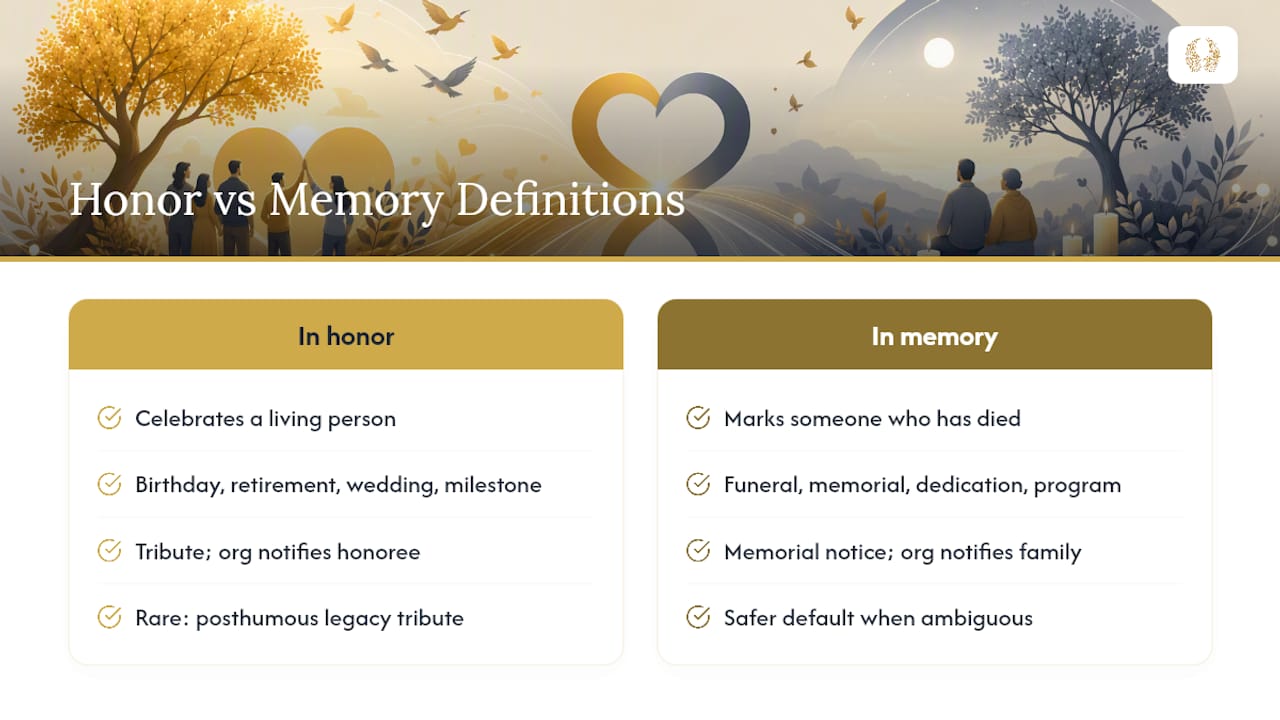
“In honor of” celebrates someone who is still with us. Birthdays, retirements, graduations, weddings, a doctor’s decades of service, a survivor’s five-year milestone. It is a phrase of tribute and admiration aimed at the living.
“In memory of” marks someone who has died. It is the standard language for memorial donations, funeral programs, and dedications made after a loss. Nonprofit donation pages typically make this exact distinction, splitting gifts into “in honor of” for living people and “in memory of” for those who have passed, because the wording tells the organization who to notify.
There are a couple of exceptions worth knowing. A posthumous award or a scholarship “dedicated to” someone’s memory can sometimes borrow honor-style language (“in honor of Dr. Smith’s legacy”) when the intent is to celebrate a body of work rather than mourn a loss. Context decides, and when it’s ambiguous, memory is the safer default.
Where the Wording Shows Up and What It Signals
The phrase you choose sends a message before anyone reads a single other word on the page.
On a donation form, most nonprofits include separate fields, often abbreviated IHO (In Honor Of) and IMO (In Memory Of). Selecting the wrong one can mean an anniversary card lands in a grieving family’s mailbox, or a sympathy notice gets mailed to someone very much alive.
On a plaque or headstone, “in memory of” is the standard, almost universal choice. Save “in loving memory” for smaller, more personal markers where a family wants intimacy over formality.
In a funeral program or obituary, “in memory of” or the more formal “In Memoriam” heading both work, depending on how traditional the service is.
On a card or social post celebrating someone living, “in honor of” fits naturally: “This gift is made in honor of Grandma’s 90th birthday” reads warmly and correctly.
A quick gut check: if the person could read the tribute themselves, it’s honor. If they can’t, it’s memory.
Donation Etiquette: What to Write and What Happens Next
When you fill out a donation form or memo line on a check, include three things: the IHO or IMO designation, the full name of the honoree or the deceased, and a contact for the family or honoree if you want them notified. Charity guidance pages consistently recommend this combination so the organization can send the right acknowledgment without guessing.
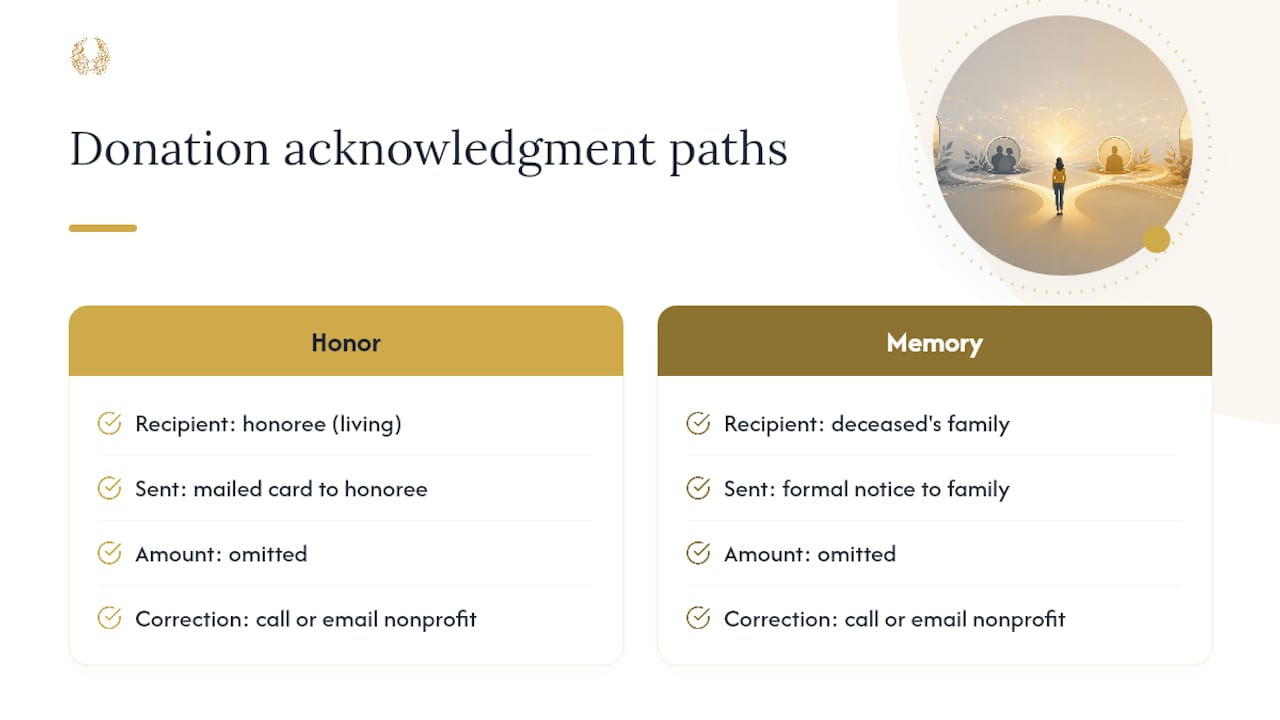
Here’s what typically happens on the nonprofit’s end. For an honor gift, the charity usually mails a card directly to the honoree, letting them know a gift was made in their name, without disclosing the amount. For a memory gift, the acknowledgment goes to the family, often as a formal notice of the donation made in the deceased’s name, again without the dollar figure attached.
If you want the gift kept quiet, most forms include an option to give anonymously. The donor still receives a tax receipt for IRS purposes; the honoree or family simply never sees your name attached to it.
Mistakes happen. Wrong spelling, wrong contact, or a memory gift accidentally marked as honor. The fix is simple: call or email the nonprofit directly. Most organizations can correct an acknowledgment before it’s mailed, especially if you catch it within a day or two of giving. A guide on making an in-memory donation walks through exactly what information to have ready when you reach out.
Sample Wording You Can Copy Right Now
Sometimes the fastest way to get this right is to borrow language that already works. Here are lines donors use across forms, cards, and programs.
For living honorees:
- “This gift is made in honor of [Name] on the occasion of [birthday/retirement/anniversary].”
- “In honor of [Name], whose courage during treatment inspired this donation.”
- “Given in honor of Dr. [Name] for outstanding dedication to patient care.”
For memorial gifts:
- “This donation is made in memory of [Name].”
- “In loving memory of [Name], a devoted mother and friend.”
- “Given in memory of [Name], with gratitude for the years we shared.”
Donation-form template line: “I would like this gift designated [IHO/IMO] [Name]. Please notify [contact name and relationship] at [email/address].”
Program or plaque heading: “In Memoriam: [Name], 1958–2025” reads as formal and dignified for printed materials.
Occasion-based versus memorial tone: a birthday gift skews cheerful (“in honor of the wonderful life Mom continues to live”), while a memorial gift skews reflective (“in memory of the life Dad lived so fully”). Choosing the right emotional register is often more important than the exact words you pick.
Register and Variants: Loving Memory, Memoriam, and Tone
“In loving memory” carries a warmer, more personal weight than the plain “in memory of.” It belongs on family keepsakes, private cards, and smaller memorial markers where intimacy matters more than formality.
“In memoriam” sits at the opposite end. It reads as literary and formal, which is exactly why programs, published obituaries, and dedication plaques favor it. Style guides for memorial writing generally agree that “in memoriam” suits public, printed contexts better than everyday conversation.
When you’re unsure which register fits, default to the plain “in memory of.” It works in almost any setting, from a donation form to a headstone, without sounding either too casual or too stiff.
A Six-Question Checklist for Choosing the Right Phrase
Run through these questions before you fill out any form or write any card:
- Is the person living or deceased? This single fact decides honor versus memory almost every time.
- Is the tribute public or private? A published program favors formal wording; a family card allows more warmth.
- Do you want warmth or neutrality? Choose “in loving memory” for intimacy, “in memory of” or “in memoriam” for anything public.
- What format is this for? Donation forms, plaques, and programs each carry slightly different conventions.
- Have you checked with the family? Some families have strong preferences about wording, especially soon after a loss.
- Still not sure? For donations, default to “in memory of.” It never accidentally sends a sympathy notice to someone who is alive, and it avoids the reverse mistake, too.
Why the Wording You Choose Actually Matters
Getting “in honor of” and “in memory of” mixed up isn’t a minor typo. Nonprofits typically receive both honor and memory gifts every year, and they follow the donor’s exact instructions when it comes to acknowledgments, because that wording is often the only signal about who should be notified and how.
We’ve seen how much a specific detail matters here too. A generic line (“in memory of a wonderful person”) carries far less weight than one grounded in something real (“in memory of the tenacity she showed through every round of treatment”). If you’re unsure how to word a gift, or need to correct an acknowledgment after the fact, it’s best to contact the organization directly to ensure accuracy.
Make a Tribute Gift That Reaches the Right Person
Nonprofits accept both honor and memory gifts and handle each one differently once received. An honor gift often results in a card sent to the honoree, while a memory gift usually prompts a notice sent to the family, without disclosing donation amounts.

When you give through our donation page, all you need to include is the IHO or IMO designation, the full name of the honoree or the person being remembered, and a contact if you’d like that person or their family notified. If you want more detail on wording before you give, our guide to making an in-memory donation covers phrasing, timing, and what to expect afterward. Every gift, honor or memory, goes directly toward funding the kind of unconventional cancer research that larger institutions often pass over. Start your tribute gift today, and know exactly who will hear about it and how.
Sources
- Donation in Honor | Children’s Medical Center Foundation
- Designate gifts In Memory Of / In Honor Of | Golden Heart Community Foundation
- Memorials
FAQ
Can you say “in honor of” a deceased person?
It’s uncommon but not unheard of, usually reserved for honoring someone’s legacy or body of work rather than mourning the loss itself. For most donations and dedications, “in memory of” is the correct and expected phrase once someone has died.
Does “in memoriam” mean someone died?
Yes. In memoriam is a formal phrase reserved for someone who has passed away, commonly seen on plaques, in programs, and in published notices rather than everyday conversation.
How do you tell someone you made a donation in their honor?
Most charities send a card or letter directly to the honoree letting them know a gift was made in their name, without stating the amount. You can also tell them yourself, or include their contact information on the donation form so the organization follows up.
How much should you donate in honor of someone for a funeral?
There is no fixed amount. What matters more is including the correct IMO designation, the deceased’s full name, and a family contact so the organization can send an appropriate acknowledgment regardless of the gift size.
Recommended


Explore the key differences in sponsorship vs donation. Understand tax implications and maximize benefits for nonprofits and sponsors.
Read More →