


Precision Medicine Trials for Researchers: Screening, FDA, Operations
September 4, 2026
Precision Medicine Trials for Researchers: Screening, FDA, Operations

Precision medicine clinical trials match patients to targeted therapies using biomarker-driven master protocols, basket, umbrella, and platform designs, layered with adaptive statistical methods that let a study change course as data accumulates. The single most important design decision is which master-protocol structure fits your scientific question, because it determines everything downstream: match rate, control-arm strategy, and how much statistical borrowing across substudies you can defend to regulators.
TL;DR:
- Most patients screened for precision trials do not match to an available treatment arm, requiring screening thousands to enroll a feasible number of participants.
- The choice of master protocol structure—basket, umbrella, or platform—determines match rates, control-arm strategies, and regulatory justifications for data pooling.
- Operational factors, especially sequencing turnaround times of under two weeks, critically influence patient match rates and overall trial timelines.
- Adaptive statistical methods, including Bayesian models and response-adaptive randomization, can shorten enrollment but increase trial complexity and workload.
- Effective trial design depends more on robust screening infrastructure and operational planning than on the theoretical elegance of the protocol.
Table of Contents
- What Are Master Protocols, and How Do Basket, Umbrella, and Platform Trials Differ?
- How Do Biomarkers and Genomic Profiling Drive Screening and Eligibility?
- Which Adaptive Statistical Methods Let Trials Change Course Mid-Study?
- How Do You Operationalize Site Networks, Sequencing Labs, and Enrollment Workflows?
- What Does FDA Guidance Say About Master Protocols and Informed Consent?
- Which Endpoints Best Measure Success in Precision Trials?
- What Do I-SPY2, NCI-MATCH, BATTLE, and IMPACT Teach Us About Trial Design?
- What Should Researchers Check Before Drafting a Precision-Medicine Protocol?
- How Do Nonprofit Sponsors Like HCRF Support Precision-Medicine Research?
- Why Practical Design Discipline Beats Theoretical Elegance
- Sources
What Are Master Protocols, and How Do Basket, Umbrella, and Platform Trials Differ?
A master protocol is one overarching framework that governs several substudies at once, sharing infrastructure like screening logs, data systems, and often a control arm. The FDA’s guidance on master protocols treats this shared-infrastructure approach as the regulatory backbone for modern oncology drug development, and for good reason: running five separate trials costs far more than running one platform with five arms.
The three designs solve different problems.
- Basket trials test a single targeted therapy across multiple tumor types that share a biomarker. If a drug targets a specific mutation, a basket trial asks whether it works regardless of whether the tumor started in the lung, colon, or thyroid.
- Umbrella trials flip that logic. They test multiple targeted therapies within a single tumor type, matching each patient’s specific mutation to the drug designed for it.
- Platform trials go further still. They are built to run indefinitely, adding and dropping treatment arms over time as new therapies emerge or existing ones prove ineffective, all under one perpetual governance structure.
Each design carries operational consequences. Basket and umbrella trials usually run for a fixed duration with a defined set of arms. Platform trials require governance charters that pre-specify exactly how and when arms get added or dropped, because reusing one infrastructure for multiple substudies only works if the rules for change are locked in before the data starts arriving. A 2024 review in Signal Transduction and Targeted Therapy notes that platform trials are increasingly favored for dynamic, ongoing evaluation precisely because oncology’s drug pipeline moves faster than fixed-arm trials can accommodate.
How Do Biomarkers and Genomic Profiling Drive Screening and Eligibility?
Every precision trial runs on a screening pipeline long before a patient gets randomized to treatment. Getting that pipeline right is often the difference between a trial that enrolls on schedule and one that stalls for a year waiting on tissue.
- Consent for screening. Patients sign a separate screening consent, distinct from treatment consent, since many will not match to any available arm.
- Biopsy or blood draw. Fresh tissue biopsy remains the gold standard for actionable genomic data, though liquid biopsy is closing the gap for patients who cannot tolerate an invasive procedure.
- Assay selection. Panel-based next-generation sequencing (NGS) covers dozens to hundreds of genes quickly; whole-exome sequencing casts a wider net but takes longer and costs more; liquid biopsy trades some sensitivity for speed and safety.
- Interpretation and variant calling. Raw sequencing output becomes a list of variants that a bioinformatics team must annotate for actionability.
- Molecular tumor board review. A standing committee of oncologists, pathologists, geneticists, and pharmacists reviews each case and decides which arm, if any, a patient’s mutation profile supports.
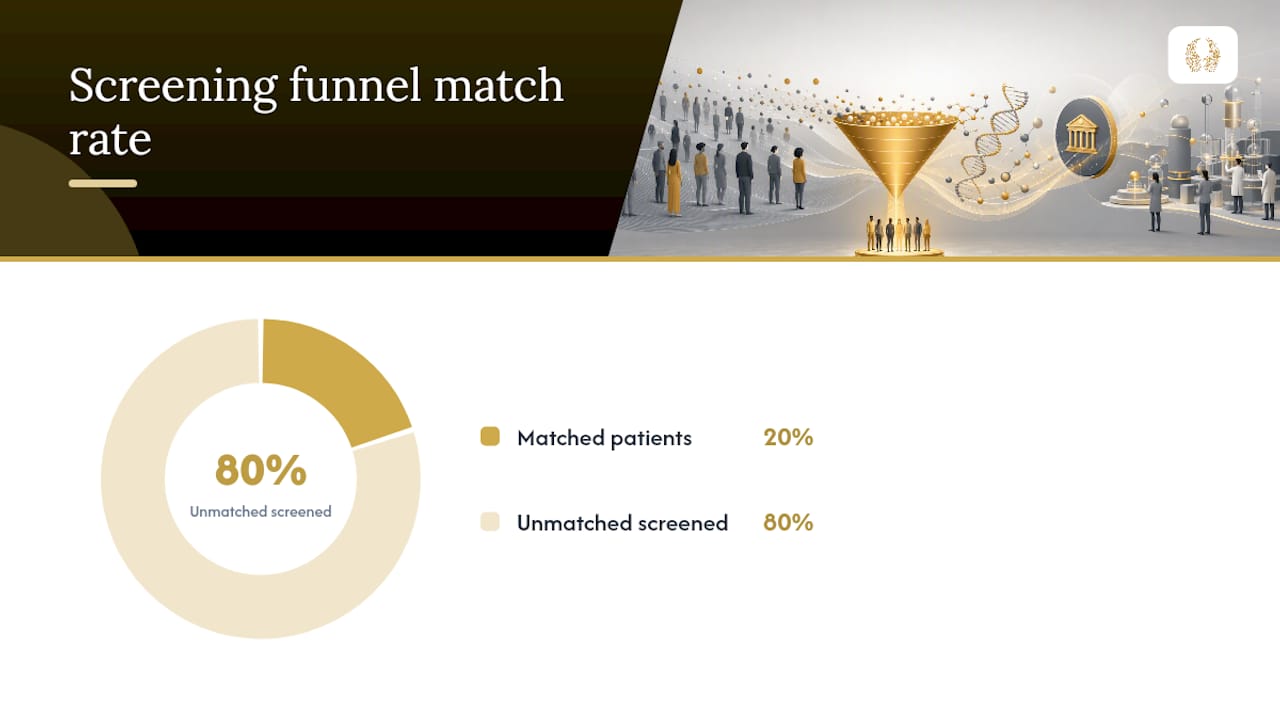
NCI-MATCH built its entire structure around this funnel, screening thousands of patients through centralized sequencing to route them into targeted subtrials. That scale exposed a hard truth about precision trials: most patients screened do not match to an open arm. Match rates in a modest range are common across large screening programs, which is exactly why enrollment timelines need padding and why screening funnels matter as much as the treatment arms themselves.
Pro Tip: Model your enrollment timeline off the screening funnel, not the treatment arms. A trial that needs 200 matched patients might need to screen 1,000 or more, and that math should shape your site network and budget from day one.
Which Adaptive Statistical Methods Let Trials Change Course Mid-Study?
Adaptive designs let a trial modify its own course based on accumulating data, without inflating the false-positive risk regulators care about. Two families dominate precision-medicine trials.
Bayesian adaptive methods update the probability that a treatment works as new patient outcomes arrive, allowing the trial to allocate more patients to arms showing promise. Response-adaptive randomization does something similar at the assignment level: instead of a fixed 50/50 split, the randomization ratio shifts toward the arm performing better in real time, which raises ethical appeal but complicates the statistics.
Interim analyses built into these designs allow the trial to stop an arm early for futility (it clearly is not working) or efficacy (it clearly is), saving patients from ineffective treatment and saving sponsors from wasted enrollment.
- Bayesian hierarchical models allow “borrowing” of information across substudies or biomarker subgroups, useful when any single subgroup is too small to power alone.
- Pre-specified stopping boundaries prevent post-hoc decisions from creeping into what should be an objective interim look.
- Multiplicity control (adjusting for testing multiple arms or endpoints) has to be baked into the statistical analysis plan before the trial starts, not retrofitted afterward.
A practical framework for master protocols stresses that adaptive designs can meaningfully shorten enrollment timelines compared to running separate phase-by-phase trials, because arms can open, close, and reallocate resources without restarting the entire study. The tradeoff is complexity: a trial statistician on an adaptive platform trial does far more real-time work than one on a traditional fixed design, and that workload needs to be budgeted for, not treated as a rounding error.
How Do You Operationalize Site Networks, Sequencing Labs, and Enrollment Workflows?
Design decisions on paper mean little if the operational plumbing cannot keep pace. Precision trials live or die on how fast a biopsy becomes an actionable result.
- Choose site networks with standardized biospecimen handling protocols, since inconsistent fixation or shipping delays degrade sample quality before it ever reaches sequencing.
- Validate sequencing partners against a firm turnaround-time target before the first patient enrolls, not after delays start piling up.
- Centralize data management so results from multiple sites and multiple assay platforms land in one system the molecular tumor board can actually use.
- Assign a Data Safety Monitoring Board (DSMB) independent of the sponsor to review interim safety and efficacy data, especially critical when arms are opening and closing on a rolling basis.
- Build consent logistics that account for the fact that a patient screened today might not know which arm they will join for weeks.
Pro Tip: Sequencing turnaround time is the hidden lever most protocol teams underestimate. Getting molecular results back inside a two-week window materially improves both match rates and patient willingness to stay enrolled while waiting on results that could determine their treatment path.
What Does FDA Guidance Say About Master Protocols and Informed Consent?
Regulators have caught up to the pace of precision-trial innovation, but they expect specific safeguards in return for the flexibility master protocols offer.
The FDA’s master-protocol guidance recommends that sponsors pre-specify randomization procedures, justify shared control-arm use across substudies, and lock in the rules for adding or removing arms before the trial begins, not as the data comes in. That last point matters enormously for platform trials designed to run for years: standard of care in oncology shifts constantly, and a control arm that was appropriate in year one can become obsolete by year three.
- Shared control arms reduce the number of patients assigned to a control condition across multiple substudies, but only work when substudy populations are similar enough to justify the pooling.
- Protocols need a documented process for updating the control arm when standard of care changes mid-trial, rather than freezing an outdated comparator for the sake of continuity.
- Informed consent for multi-arm adaptive trials has to explain, in plain language, that a patient’s specific arm assignment may depend on real-time biomarker results and randomization ratios that shift over the trial’s life.
That last requirement is harder than it sounds. Explaining response-adaptive randomization to a patient facing a cancer diagnosis, in terms they can genuinely understand before they sign, takes more care than a standard fixed-randomization consent form.
Which Endpoints Best Measure Success in Precision Trials?
Endpoint choice shapes how fast a trial can produce a usable answer and how much confidence that answer deserves.
- Objective response rate (ORR) measures tumor shrinkage and delivers a fast readout, useful for early-phase signal-finding.
- Progression-free survival (PFS) tracks how long a patient goes without disease worsening, a middle-ground endpoint balancing speed and clinical meaning.
- Overall survival (OS) remains the most persuasive endpoint but takes the longest to mature, sometimes years, which can delay access to a drug that is working.
- Pathologic complete response (pCR), used heavily in neoadjuvant breast cancer trials, measures whether treatment eliminated detectable tumor at the time of surgery.
Treatment matched to a higher proportion of a tumor’s molecular alterations is strongly associated with longer PFS and higher ORR across multiple platform trials, which is why match-rate quality and endpoint selection are inseparable design questions. Surrogate endpoints like pCR can support faster regulatory decisions when the biological link to long-term outcome is well established, but leaning on a surrogate always trades some certainty for speed.
What Do I-SPY2, NCI-MATCH, BATTLE, and IMPACT Teach Us About Trial Design?
Four trials shaped how the field thinks about precision-medicine design, and each one taught a distinct lesson.
- I-SPY2 built an adaptive platform for neoadjuvant breast cancer that uses Bayesian methods to route patients toward the drug arm most likely to work for their tumor subtype, using imaging and biomarker data to predict pathologic complete response faster than a traditional fixed trial could.
- NCI-MATCH demonstrated what large-scale genomic screening actually looks like at population scale, screening thousands of patients through centralized tumor sequencing to fill dozens of targeted subtrials, and in doing so exposed just how low real-world match rates can run.
- BATTLE pioneered umbrella-style, biomarker-driven treatment assignment using adaptive Bayesian algorithms in lung cancer, proving that real-time assignment based on biomarker status was operationally feasible years before it became standard practice.
- IMPACT provided some of the clearest evidence that degree of molecular matching correlates with outcome. Patients whose treatment matched more of their tumor’s molecular alterations showed measurably better results than those with partial or no matching.
The throughline across all four: infrastructure investment upfront (sequencing capacity, molecular tumor boards, adaptive statistics) pays off in faster, more informative trials later. None of them got there by accident.
What Should Researchers Check Before Drafting a Precision-Medicine Protocol?
Before a single protocol page gets written, a handful of decisions need to be locked in.
- Define the primary scientific question precisely enough to know whether basket, umbrella, or platform design fits.
- Choose and validate the assay (panel NGS, whole-exome, or liquid biopsy) against your target patient population’s biology.
- Estimate a realistic projected match rate and build enrollment timelines around the screening funnel, not the treatment arms alone.
- Finalize the statistical analysis plan, including borrowing rules, stopping boundaries, and multiplicity control, before the first patient is screened.
- Confirm molecular tumor board composition and establish a DSMB independent of the sponsor.
- Document control-arm justification and the process for updating it if standard of care shifts mid-trial.
Pro Tip: Write your documentation package assuming a regulator will ask “what happens if this arm underperforms at the first interim look?” If your protocol cannot answer that in one paragraph, the statistical analysis plan is not finished yet.
How Do Nonprofit Sponsors Like HCRF Support Precision-Medicine Research?
The Hippocratic Cancer Research Foundation (HCRF) is a 501©(3) nonprofit supporting unconventional cancer research at the Robert H. Lurie Comprehensive Cancer Center of Northwestern University. For researchers and patients navigating this field, HCRF offers:
- Eligibility guidance to help patients understand whether a precision trial might be a fit.
- Educational resources explaining how adaptive platforms and targeted therapies work.
- Pilot funding that helps investigators generate the early data needed before larger sponsors commit.
Nonprofits like HCRF fill gaps that federal funding cycles often miss, backing the “out of the box” science that master-protocol infrastructure depends on.
Why Practical Design Discipline Beats Theoretical Elegance
The conventional advice on precision-medicine trial design spends too much time on which master-protocol taxonomy is most elegant and not enough on whether a team can actually screen, sequence, and enroll patients fast enough to make that elegance matter. A platform trial with a beautiful Bayesian borrowing scheme is worthless if sequencing turnaround time runs three weeks and half your eligible patients progress before results come back.

What the evidence actually supports is boring but true: match rate and operational turnaround time predict trial success more reliably than which design family you chose. I-SPY2 and NCI-MATCH did not succeed because their statistics were clever, they succeeded because someone built the screening infrastructure to support the statistics.
If you are designing a precision trial in 2026, prioritize the screening funnel and the molecular tumor board before you finalize the adaptive algorithm. Get the plumbing right first. The elegant design only matters once patients can actually reach it.
— HCRF
This article is general information, not a substitute for advice from a qualified doctor. Consult a qualified healthcare professional about your own circumstances before acting on anything here.
Sources
- Master Protocols: Efficient Clinical Trial Design Strategies to Expedite Development of Oncology Drugs and Biologics — Guidance for Industry
- Precision Medicine Clinical Trials: Defining New Treatment Strategies
- Targeted Therapy Directed by Genetic Testing in Treating Patients With Advanced Refractory Solid Tumors, Lymphomas, or Multiple Myeloma (The MATCH Screening Trial)
- Master protocols: New directions in drug discovery
- New clinical trial design in precision medicine
Recommended

Discover how corporate matching gifts can double your donations to nonprofits like the Hippocratic Cancer Research Foundation. Check your eligibility today!
Read More →
Stop judging charities by a single ratio. Learn the sector's 80.6% program median and five donor steps to verify overhead, with HCRF's view.
Read More →