


42% More From Recurring Donations: Data Backed Steps for Fundraisers
August 29, 2026
42% More From Recurring Donations: Data Backed Steps for Fundraisers

Recurring donations deliver steadier budgets, higher donor lifetime value, and lower fundraising costs than one-time gifts. Monthly donors contribute roughly 42% more annually and retain at 74 to 82%, compared with about 44% for one-time givers. What follows breaks down the evidence, the operational shifts, and the steps that turn this into working revenue for your organization.
TL;DR:
- Recurring donors contribute 42% more annually and have retention rates of 74 to 82%, compared to 44% for one-time givers.
- They generate two to four times more annual revenue and have a lifetime value 600 to 800% higher than single gifts.
- Retaining existing sustainers costs about 20 cents per dollar, significantly less than the $1.50 needed to acquire a new donor.
- Implementing a well-designed onboarding and stewardship process can boost long-term retention and increased giving beyond the initial monthly contribution.
- Most nonprofits underutilize recurring giving as a strategic program, risking lost growth potential by focusing predominantly on one-time appeals.
Table of Contents
- What Are the Benefits of Recurring Donations for Nonprofits?
- What the Data Says About Recurring Donor Value
- How Recurring Gifts Change Your Cost Structure and Forecasting
- Why Sustainers Stay (and How to Get Them to Give More)
- Building a Recurring Giving Program That Actually Works
- HCRF’s Approach to Sustained Giving
- The Bottom Line on Monthly Giving
- What Fundraisers Consistently Get Wrong About Monthly Giving
- Turn What You’ve Learned Into a Real Giving Program
- Sources
What Are the Benefits of Recurring Donations for Nonprofits?
A monthly giving program does five things a one-time gift never can. It smooths your cash flow, it stretches donor relationships across years instead of moments, and it quietly does the fundraising math in your favor every single month.
Here’s the full list fundraisers cite most often:
- Predictable revenue you can build a real budget around, not a hopeful estimate.
- Higher annual value per donor, since sustainers give more over time than single-gift donors.
- Stronger retention, which compounds every year a sustainer stays active.
- Lower cost per dollar raised, because retaining a donor costs far less than acquiring one.
- Built-in stewardship runway, giving your team a natural cadence for upgrade asks and deeper engagement.
These aren’t abstractions. The Chronicle of Philanthropy has documented organizations where sustainers make up 20 to 30% of total revenue while holding retention rates well above the sector average. That’s the kind of foundation a development office can actually plan around.
What the Data Says About Recurring Donor Value
The headline number is 42%. That’s how much more a recurring donor contributes annually compared with a one-time giver, according to Blackbaud’s research.
By the Numbers: Recurring donors provide 2 to 4 times more annual revenue than one-time givers, retain at 74 to 82% versus roughly 44% for general donors, and generate lifetime value that runs 600 to 800% higher.
What does this mean for your planning cycle?
- Revenue forecasting gets easier when a known percentage of your file renews monthly instead of guessing at annual appeal response rates.
- Staffing and program investment decisions can lean on recurring revenue as a floor, not a hope.
- Board conversations shift from “did the gala hit its number” to “how is monthly revenue trending year over year.”
These ranges come from aggregated nonprofit data, not a guarantee for every organization. Your file size, cause area, and donor demographics will shift where you land inside these bands. Treat them as planning benchmarks, not promises.
How Recurring Gifts Change Your Cost Structure and Forecasting
Acquisition is expensive. Retention is cheap. Blackbaud’s figures put acquiring a new donor at roughly $1.50 versus about $0.20 to retain one you already have. Run that math across a file of a few thousand sustainers and the savings show up fast, freeing budget that would otherwise go toward acquisition mailers or paid ad spend.
Predictable monthly revenue also changes what your finance team can commit to. A hospital-based research program, for instance, can greenlight a grant match or a new outreach hire against known recurring income instead of waiting on year-end appeal results.
Recurring programs cut down on solicitation frequency too. Sustainers who trust your cadence don’t need four urgent asks a year. That frees your marketing team’s capacity for:
- Deeper storytelling and impact content instead of constant ask emails.
- Testing new acquisition channels without cannibalizing appeal revenue.
- Building donation impact reports that keep existing sustainers engaged rather than chasing new names.
Pro Tip: Take the dollars you save on reduced acquisition spend and reinvest a portion directly into stewardship, better welcome emails, a faster thank-you call, a sharper annual impact report. Retention money spent on retention compounds.
Why Sustainers Stay (and How to Get Them to Give More)
Convenience drives most of this behavior. Donors join monthly programs because a set amount fits their household budget the same way a streaming subscription does, quiet, automatic, and easy to forget about in a good way. Over time, that habit becomes identity. People start thinking of themselves as “a monthly donor to this cause,” and that self-concept is stickier than any single gift.

A strong onboarding sequence in the first 90 days does more for long-term retention than almost anything else you’ll build, according to the Chronicle of Philanthropy. Sustainers who feel welcomed and see early proof of impact stay active years longer than those who get a receipt and silence.
Sustainers also tend to give beyond their monthly gift once trust is established, an end-of-year appeal, a memorial gift, a response to a matching campaign. Test these engagement tactics first:
- Build a five-touch welcome series covering thanks, impact, and what to expect next.
- Send a mid-year impact update tied to a specific outcome their gift supported.
- Deliver annual receipts early, paired with a short summary of cumulative giving.
- Introduce a small, optional upgrade ask after the first year of consistent giving.
- Invite long-tenured sustainers to a low-pressure event or briefing as recognition.
Building a Recurring Giving Program That Actually Works
Start with the tech stack. You need recurring payment processing that supports multiple methods, credit card, EFT, and PayPal, a donor CRM that flags sustainers separately from one-time givers, and a self-service portal so donors can update their card without calling your office. Add a dunning workflow for failed payments; gentle multi-touch reminders and a short grace period recover a meaningful share of lapses before you lose the gift entirely, per the Chronicle of Philanthropy’s operational guidance.
Your acquisition playbook should prioritize donors who’ve already given multiple times, they convert to sustainers at a far higher rate than cold prospects. Layer in targeted digital appeals, event-based asks, and matching gift campaigns that frame the monthly commitment as doubled impact.
For onboarding and retention, follow this sequence:
- Confirm the gift immediately with a warm, specific thank-you.
- Launch the 90-day welcome series with real impact stories.
- Send quarterly or biannual progress updates tied to funded work.
- Deliver annual receipts with a giving summary.
- Introduce planned upgrade asks tied to milestones, not random timing.
Track churn rate, average revenue per donor, monthly recurring revenue, and retention by acquisition cohort. These four numbers tell you more about program health than total dollars raised in any single month.
Pro Tip: Test a small upgrade ask, even $5 more per month, on sustainers who’ve given consistently for a year. Small, well-timed increases raise average revenue per donor without triggering meaningful churn.
HCRF’s Approach to Sustained Giving
At the Hippocratic Cancer Research Foundation, recurring gifts fund the kind of “out of the box” cancer research that doesn’t fit neatly into a single grant cycle. Sustained monthly support gives our research partners at the Robert H. Lurie Comprehensive Cancer Center of Northwestern University something rare in science funding: continuity.
We’ve built our own donor resources around exactly these principles:
- How sponsorship differs from donation revenue and why it matters for your giving strategy.
- How corporate matching gifts can double a sustainer’s monthly impact.
- How we approach donation impact reporting to keep every donor connected to the science their gift funds.
The Bottom Line on Monthly Giving
Recurring donations turn unpredictable fundraising into a stable, growing revenue base with lower acquisition costs and deeper donor loyalty. Your next 90 days: audit your donor file for repeat one-time givers who are prime sustainer candidates, confirm your payment platform handles recurring billing and dunning cleanly, and design a welcome journey before you launch a single new ask.
What Fundraisers Consistently Get Wrong About Monthly Giving
Most nonprofits treat recurring giving as a payment option buried on a donation form instead of a program with its own strategy, budget, and staffing. That’s the real gap. The data is clear that sustainers outperform one-time donors on nearly every financial metric, yet many organizations still funnel the bulk of their marketing spend toward one-time appeal campaigns and treat monthly conversion as an afterthought.
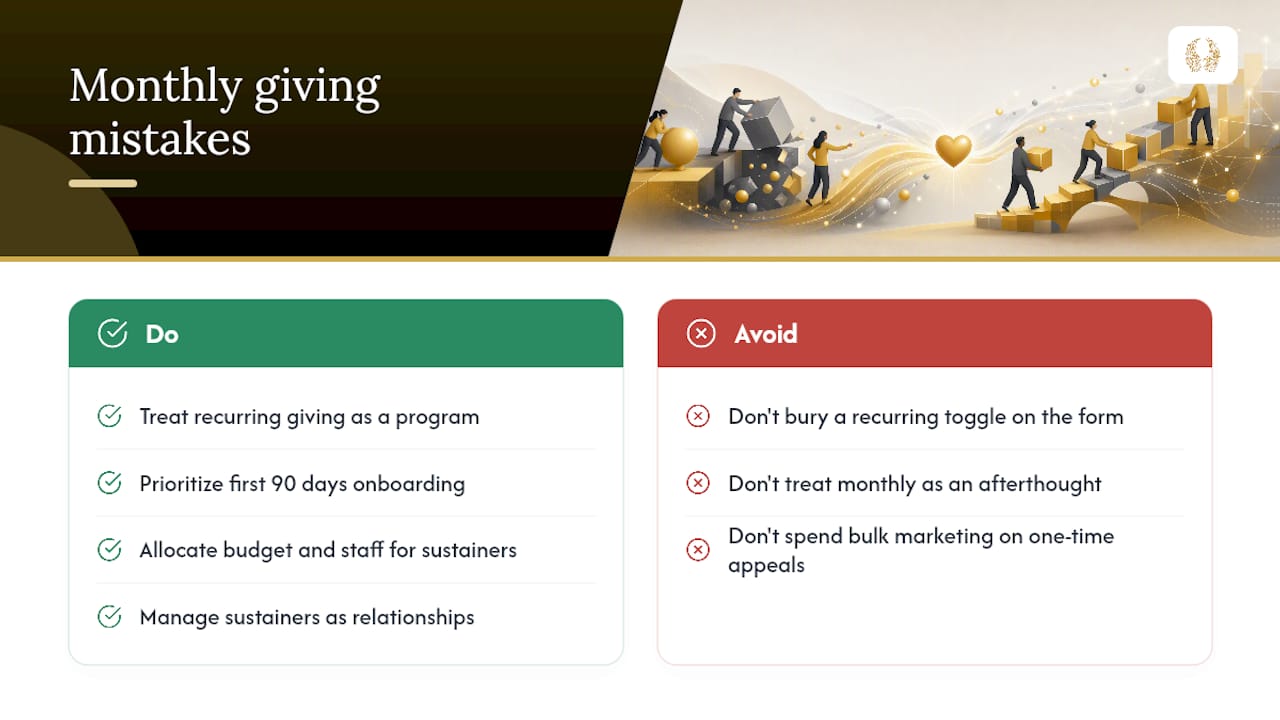
The conventional advice tells you to “just add a recurring toggle” to your donation page. That’s necessary but nowhere near sufficient. They treated monthly donors as a relationship to manage, not a transaction to process.
If you take one thing from this, prioritize the first 90 days of a new sustainer relationship over everything else. Acquisition brings someone in. Onboarding is what decides whether they stay for three months or ten years. A nonprofit’s long-term sustainability rests more on that early relationship-building than on any single acquisition campaign.
— HCRF
Turn What You’ve Learned Into a Real Giving Program
HCRF exists to fund the cancer research that doesn’t fit a conventional grant cycle, the kind of “out of the box” science happening at the Robert H. Lurie Comprehensive Cancer Center that needs sustained, not sporadic, support. If you’re a donor weighing where a monthly gift makes the biggest difference, this is precisely the case recurring giving was built for: research programs that need multi-year commitment, not one-time infusions.

Setting up a nonprofit or giving program that lasts also means getting the legal structure right from day one, a step worth understanding through resources like this guide to building a nonprofit that stands the test of time. For donors ready to act, you can start a monthly gift directly through the Hippocratic Cancer Research Foundation and see exactly where that recurring support goes, funded research, patient access to clinical trials, and progress reports you’ll actually receive.
Sources
- A Guide to Recurring Donations: From One-Time Gifts to Lifelong Supporters - Blackbaud
- Why Monthly Giving Is the Secret Weapon for Sustainable Fundraising - Chronicle of Philanthropy
Recommended

Stop judging charities by a single ratio. Learn the sector's 80.6% program median and five donor steps to verify overhead, with HCRF's view.
Read More →
Discover the 2026 cancer awareness month calendar. Plan impactful events and campaigns with key dates for every major cancer type. Join the fight!
Read More →