


Sponsorship vs Donation: What Nonprofits and Sponsors Must Know
August 4, 2026
Sponsorship vs Donation: What Nonprofits and Sponsors Must Know

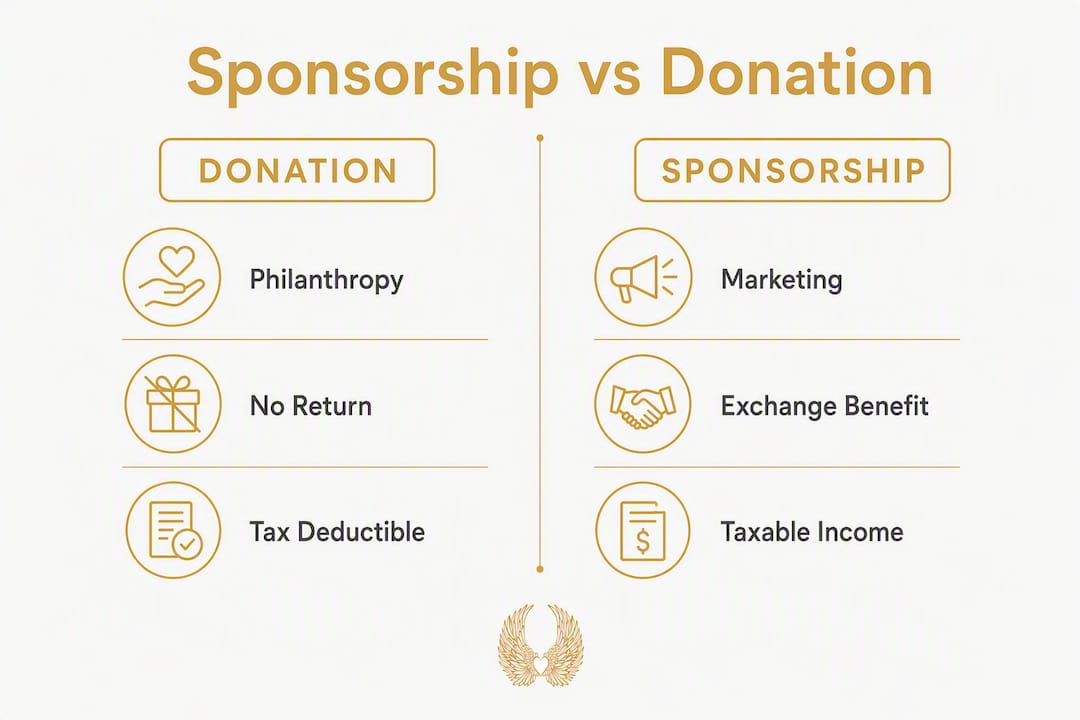
A sponsorship is a commercial exchange that buys measurable marketing value. A donation is a charitable gift with no substantial return benefit. That single distinction drives every tax, accounting, and legal consequence that follows — for both the payer and the nonprofit receiving the money.
Here is the immediate tax takeaway:
- For payers: Sponsorships are generally deducted as ordinary and necessary business expenses under IRC §162. Pure donations to a qualifying 501©(3) are deducted as charitable contributions under IRC §170.
- For nonprofits: A payment that meets the IRS definition of a qualified sponsorship payment (QSP) under IRC §513(i) avoids unrelated business income tax (UBIT). A payment that crosses into advertising territory can trigger UBIT and must be reported on Form 990-T.
The line between the two is not always obvious. A company writing a check to have its logo on a banner is probably making a sponsorship. A company writing a check with no strings attached is probably making a donation. But the moment that banner includes a price claim, an endorsement, or a call to action, the IRS may reclassify the entire payment as advertising — and the nonprofit’s tax exposure changes completely.
Table of Contents
- What is a donation, and how does it work for donors?
- What is a sponsorship, and why do businesses choose it?
- How does the IRS decide if a payment is a sponsorship or advertising?
- How should nonprofits record and report donations vs. sponsorship income?
- When should you pursue donations vs. sponsorships?
- What are the most common compliance pitfalls to avoid?
- How does HCRF approach donations and sponsorships in practice?
- Key Takeaways
- Why HCRF separates sponsorships and donations — and why it matters to you
- Support HCRF: donate to the mission or become a sponsor
- Authoritative sources and further reading
What is a donation, and how does it work for donors?
A donation is a voluntary transfer of cash, property, or services to a nonprofit with no expectation of a substantial return benefit. The donor gives because they believe in the mission. Full stop. No logo placement, no naming rights, no guaranteed visibility.
Donations come in several forms, and the tax rules vary by type.
Cash gifts are the simplest. An individual donor writes a check or gives online; the nonprofit issues a written acknowledgement. For gifts of $250 or more, that written acknowledgement is required by the IRS before the donor can claim a deduction — a verbal “thank you” does not satisfy the rule.
In-kind donations are more complex. When a business donates inventory, the deduction is generally limited to the donor’s cost basis, not the retail price. Donated property valued over $500 requires Form 8283; property valued over $5,000 typically requires a qualified appraisal. Donated services, however, are generally not deductible for the donor at all — a fact that surprises many first-time volunteers and pro bono providers. For health nonprofits that receive medical supplies, understanding how medical supply donations work is especially useful before accepting in-kind gifts.
Recurring gifts, donor-advised funds, and employee gift matching all follow the same core rule: the donor must receive a written acknowledgement from the 501©(3) for any single gift of $250 or more. The acknowledgement must describe what was given, state whether any goods or services were provided in return, and if so, provide a good-faith estimate of their fair market value.
Individuals can generally deduct cash donations up to a substantial portion of adjusted gross income (AGI) in a given tax year; corporations face a more limited percentage of taxable income. Gifts that exceed those limits can often be carried forward for up to five years.
Pro Tip: Request your written acknowledgement from the nonprofit before you file your taxes — not after. For in-kind property over $5,000, confirm the nonprofit has signed Part IV of Form 8283 before you submit it to the IRS.
What is a sponsorship, and why do businesses choose it?
A sponsorship is a commercial arrangement. A business pays a nonprofit in exchange for something of marketing value: logo placement, naming rights, booth space, hospitality, or product placement. The business is not giving out of pure generosity. It is buying audience exposure, brand association, or competitive positioning.

Under IRC §513(i), a qualified sponsorship payment is defined as any payment where the payer receives no substantial return benefit other than the use or acknowledgement of their name, logo, or product lines. That acknowledgement can include the sponsor’s name, logo, slogan, and a value-neutral description of products or services. What it cannot include is qualitative or comparative language, price information, endorsements, or calls to action — any of those elements push the payment from acknowledgement into advertising.
Common sponsorship deliverables include:
- Title or presenting sponsorship for an event (e.g., “The [Company] Annual Gala”)
- Logo placement on event signage, programs, and digital materials
- Branded merchandise or product sampling at events
- Exclusive pouring rights or hospitality suites
- Named recognition in press releases and social media
From the sponsor’s tax perspective, these payments are typically deducted as ordinary and necessary business expenses under IRC §162 — not as charitable contributions. That means the sponsor does not need the nonprofit to be a 501©(3) to claim the deduction, but it also means the deduction is subject to the ordinary business expense rules, not the more favorable charitable contribution limits.
A sponsorship that includes a call to action — “Visit our website,” “Use code GALA20,” or “Now available at participating retailers” — is no longer a qualified sponsorship payment under IRS rules. The entire payment, or the portion attributable to that benefit, becomes advertising income for the nonprofit and an advertising expense for the sponsor.
The marketing benefits of sponsorship are real and often underestimated by nonprofits. A well-structured sponsorship connects a brand to a cause its customers care about, generates earned media, and creates hospitality opportunities that pure advertising cannot replicate. For the nonprofit, a single title sponsorship for a gala can generate more revenue per transaction than dozens of individual donations — but it comes with delivery obligations, contract terms, and accounting complexity that donations do not.
How does the IRS decide if a payment is a sponsorship or advertising?
The governing rule is IRC §513(i), implemented through Treasury Regulation 1.513-4. The test is straightforward in principle and genuinely tricky in practice.
A payment is a qualified sponsorship payment when the nonprofit provides nothing more than an acknowledgement. The moment the nonprofit provides a “substantial return benefit” — something with real, measurable fair market value beyond simple acknowledgement — the payment (or the portion attributable to that benefit) becomes advertising or an exchange transaction.
Under Treas. Reg. 1.513-4©(2), a “substantial return benefit” includes advertising, exclusive provider arrangements that give the sponsor a competitive marketplace advantage, and any benefit with a fair market value exceeding 2% of the total payment. Benefits below that 2% threshold are “disregarded” and do not convert the payment to advertising.
The 2% disregarded-benefit rule is the most practical tool for mixed arrangements. If a $10,000 sponsorship includes a $150 benefit (a dinner ticket, say), that benefit is below 2% of the total and can be disregarded. If the benefit is worth $300, it exceeds the threshold, and the nonprofit must allocate: the $300 portion is advertising or exchange revenue, and the remaining $9,700 may still qualify as a QSP or charitable contribution depending on documentation.
Examples that typically remain QSPs: a logo on a banner, a name in a program, a value-neutral product description in event materials.
Examples that typically flip to advertising: “Best coffee in Chicago — now at three downtown locations,” a coupon code in the event program, an exclusive provider arrangement where the sponsor’s competitor is barred from the venue.
Consequences of misclassification are serious. For nonprofits, advertising income is unrelated business income (UBI) and triggers UBIT. The nonprofit must report it on Form 990-T and pay tax at corporate rates. For sponsors, a payment reclassified as advertising is still deductible — but under different rules, and the documentation requirements differ. The IRS has audited nonprofits specifically for this issue, particularly when sponsorship agreements contain promotional language that was never reviewed by legal or finance.
A practical classification checklist, phrased as questions to ask before signing any agreement:
- Does the sponsor receive anything beyond name, logo, or value-neutral product description?
- Does any sponsor message include qualitative or comparative language, price information, or a call to action?
- Does any benefit have a measurable fair market value? If yes, does it exceed 2% of the total payment?
- Does the arrangement give the sponsor an exclusive marketplace advantage (e.g., no competing brands at the event)?
If the answer to any of these is yes, the payment needs to be allocated — or the agreement language needs to be revised before signing.
How should nonprofits record and report donations vs. sponsorship income?
Revenue classification is where the difference between sponsorship and donation becomes a financial statement and tax filing issue. Getting it wrong does not just create audit risk — it misrepresents the organization’s financial health to donors, board members, and grantors.

Under GAAP, a contribution (donation) is a nonreciprocal transfer. It is recorded as contribution revenue and may carry donor restrictions (restricted net assets) or be unrestricted. A sponsorship that involves a genuine exchange of value is recorded as exchange revenue — typically as sponsorship income or, if it includes advertising, as advertising income.
Form 990 reporting: Contribution revenue appears on Part VIII, Line 1. Sponsorship income that is an exchange transaction typically appears on Part VIII, Line 2 (program service revenue) or Line 11 (other revenue), depending on how the nonprofit classifies it. Advertising income that generates UBIT goes on Form 990-T.
Form 990-T is required when a nonprofit has gross unrelated business income of $1,000 or more in a tax year. Advertising revenue from sponsorship arrangements that cross the IRS line is the most common trigger for health and event-focused nonprofits.
Form 8283 is the donor’s form, not the nonprofit’s — but the nonprofit must sign Part IV when a donor claims a noncash charitable contribution over $5,000. Failing to sign it when asked creates a compliance gap for the donor and a relationship problem for the nonprofit.
Pro Tip: Build a single “sponsorship packet” for every named sponsor: the signed agreement, a line-item FMV breakout for every benefit delivered, proof of delivery (photos, program copies, impression reports), and the final acknowledgement letter. Store it for at least seven years. If the IRS asks, you want to hand over one folder, not reconstruct a paper trail.
A compact reference for the most common forms and rules:
| Form / Rule | When It Applies | Who Files / Issues It |
|---|---|---|
| Written acknowledgement | Any single donation of $250 or more | Nonprofit issues to donor |
| Form 8283 | Noncash donation over $500 (donor); appraisal required over $5,000 | Donor files; nonprofit signs Part IV over $5,000 |
| Form 990, Part VIII | Annual reporting of all revenue, including contributions and sponsorship income | Nonprofit |
| Form 990-T | Gross UBI of $1,000 or more (advertising income, certain sponsorships) | Nonprofit |
| Treas. Reg. 1.513-4 | Classifying QSPs vs. advertising for any sponsorship arrangement | Governs nonprofit and sponsor |
For chart-of-accounts purposes, most nonprofits benefit from three distinct revenue codes: Contribution Revenue (unrestricted and restricted donations), Sponsorship Income (QSPs and exchange-transaction sponsorships), and Advertising Income (any payment that generates UBIT). Keeping these separate from the first transaction makes Form 990 preparation and audit defense dramatically cleaner.
When should you pursue donations vs. sponsorships?
The right choice depends on what the organization can deliver, what the payer wants, and how much compliance capacity the finance team has.
Choose donations when:
- The priority is unrestricted support for ongoing research or operations
- The donor wants a charitable deduction under IRC §170 and has no marketing objective
- The gift is for an endowment, a restricted research fund, or a capital campaign
- The organization cannot reliably deliver and document marketing benefits
Choose sponsorships when:
- The event or program has a defined, measurable audience a business wants to reach
- The sponsor has a marketing budget (not a philanthropy budget) and needs a business expense deduction
- The organization can deliver and document specific benefits: signage, hospitality, digital impressions, naming rights
- The revenue-per-transaction justifies the delivery and accounting overhead
The fundraising tradeoffs are real. Donations tend to be more flexible and predictable over time, especially from recurring donors. Sponsorships can generate significantly higher revenue per engagement for a single event, but they require reliable fulfillment, clear contracts, and finance team bandwidth to track and report correctly.
Sample sponsor agreement clauses that protect the nonprofit:
Every sponsorship agreement should include a deliverables schedule with specific, measurable commitments (logo size, placement, number of impressions, hospitality tickets). It should explicitly state that the sponsor’s messaging will not include qualitative or comparative language, price information, or calls to action — and that any such language requires written approval and may be treated as advertising. The agreement should include a FMV breakout for every benefit, a clause limiting the nonprofit’s liability if delivery is impossible due to event cancellation, and a record-retention acknowledgement.
| Dimension | Donation | Sponsorship |
|---|---|---|
| Primary benefit to payer | Philanthropy, community goodwill | Marketing visibility, audience reach |
| Tax treatment for payer | Charitable deduction (IRC §170) | Ordinary business expense (IRC §162) |
| Revenue classification for nonprofit | Contribution revenue (GAAP) | Sponsorship income or advertising income |
| Typical deliverables | None required | Logo, naming rights, hospitality, signage |
| Required documentation | Written acknowledgement ($250+), Form 8283 for in-kind | Signed agreement, FMV breakout, proof of delivery |
What are the most common compliance pitfalls to avoid?
Misclassification is the most expensive mistake — and the most preventable. These are the patterns that show up repeatedly in audits and disputes.
Common pitfalls:
- Treating a payment as a donation when the sponsor receives logo placement, hospitality, or any benefit with measurable FMV
- Failing to calculate and document FMV for sponsor benefits before issuing receipts or recognizing revenue
- Using inconsistent acknowledgement language across donors and sponsors (some letters mention benefits, others do not)
- Missing the written agreement requirement for any named sponsorship benefit
- Undervaluing in-kind donations or accepting donated services and attempting to record them as contribution revenue (services are generally not deductible and should not be recorded as contribution revenue under GAAP)
- “Double-dipping”: a sponsor claiming both a charitable deduction and a business expense deduction for the same payment
Red flags that draw IRS scrutiny:
- Sponsor messages that include endorsements, price claims, or calls to action in nonprofit materials
- Large payments disproportionate to the exposure provided (a $50,000 “donation” for a logo on a small event banner)
- Exclusive provider arrangements where a competitor is barred from the event or venue
- Sponsorship agreements with no FMV breakout and no description of benefits
Compliance checklist before issuing any receipt or recognizing revenue:
- Review the agreement: does it describe specific benefits? If yes, calculate FMV for each.
- Apply the 2% disregarded-benefit rule. If any benefit exceeds 2% of the total payment, allocate.
- Confirm acknowledgement language matches the actual benefit provided — no overstatement, no understatement.
- Assign the correct accounting code (contribution revenue, sponsorship income, or advertising income).
- Retain all supporting documents for a minimum of seven years.
Pro Tip: When a payment is genuinely mixed — part charitable gift, part advertising — break it out on the invoice itself. Line 1: “Advertising services, FMV $X.” Line 2: “Charitable contribution, $Y.” Both parties can then substantiate their respective deductions on audit without reconstructing intent after the fact.
For ambiguous cases — large payments, exclusive arrangements, or any agreement with promotional language — consult a CPA or tax counsel before signing. The cost of a one-hour review is a fraction of the cost of a UBIT assessment or a disallowed deduction.
How does HCRF approach donations and sponsorships in practice?
The Hippocratic Cancer Research Foundation (HCRF) is a 501©(3) that funds cancer research at Northwestern University’s Robert H. Lurie Comprehensive Cancer Center. The foundation accepts both major-gift donations and event sponsorships — and treats them as fundamentally different financial instruments, because they are.
For donations, HCRF issues written acknowledgements for every gift of $250 or more, stating the amount received, the date, and confirming that no goods or services were provided in exchange (or describing and valuing any benefit if one was). Restricted gifts — those directed to a specific research program or clinical trial — are tracked separately in the chart of accounts and reported as restricted net assets on the financial statements. Unrestricted gifts flow into the general operating fund and are allocated by the board. Every major donor who gives to high-impact research programs receives a detailed acknowledgement that describes how their gift will be used.
For event sponsorships, HCRF requires a signed sponsor agreement before any benefit is delivered or any revenue is recognized. The agreement includes a line-item FMV breakout for every deliverable: logo placement, event signage, hospitality tickets, digital impressions. The charitable portion — the amount above FMV — is identified separately and acknowledged as a contribution. The advertising or exchange portion is recorded as sponsorship income or advertising income, depending on the nature of the benefit.
Sample acknowledgement language HCRF uses for a sponsorship with a charitable component:
Internal signoffs at HCRF require both the development team and the finance team to review any sponsorship agreement before execution. No receipt is issued and no revenue is recognized until the FMV breakout is approved and the agreement is signed. This keeps fundraising and compliance in lockstep — a discipline that protects both the organization and its sponsors.
Pro Tip: Never let the development team issue a sponsorship receipt without finance sign-off on the FMV breakout. The two functions have different incentives — development wants to close the gift, finance wants to classify it correctly. Both are right. Build the process so neither can act alone.
Key Takeaways
Sponsorships and donations are legally and financially distinct: misclassifying one as the other creates UBIT exposure for nonprofits, disallowed deductions for sponsors, and audit risk for both.
| Point | Details |
|---|---|
| Sponsorship vs donation distinction | Sponsorships are commercial exchanges deducted under IRC §162; donations are charitable gifts deducted under IRC §170. |
| IRS qualified sponsorship payment test | Under IRC §513(i), a QSP provides acknowledgement only — any substantial return benefit above 2% of the payment triggers advertising treatment and potential UBIT. |
| Nonprofit reporting requirements | Contribution revenue goes on Form 990 Part VIII; advertising income that generates UBIT requires a separate Form 990-T filing. |
| Documentation is non-negotiable | Every sponsorship needs a signed agreement with FMV breakouts; every donation of $250+ needs a written acknowledgement before the donor files taxes. |
| HCRF’s approach | HCRF requires finance and development sign-off on all sponsorship agreements before issuing receipts, keeping compliance and donor relations aligned. |
Why HCRF separates sponsorships and donations — and why it matters to you
There is a temptation in nonprofit fundraising to treat every incoming dollar the same way: money in, mission forward. We understand that impulse. Every gift, whether it comes from a corporate sponsor or an individual donor who has been touched by cancer, carries real meaning and real hope.
But the distinction between a sponsorship and a donation is not bureaucratic fine print. It is a promise to our donors and sponsors that their money will be handled with the same care and precision that our researchers bring to the lab. When we classify a gift correctly, we protect the donor’s deduction. When we document a sponsorship properly, we protect the sponsor’s business expense claim. When we keep those two revenue streams separate on our books, we give our board, our auditors, and the IRS a clear picture of how HCRF operates.
We have seen what happens when nonprofits blur this line — not out of bad intent, but out of urgency or understaffing. UBIT assessments arrive years later. Donors lose deductions they counted on. Sponsors face disallowed expenses. The trust that took years to build erodes in a single audit cycle.
At HCRF, we believe that transparent stewardship is itself a form of hope. Every dollar that funds research at the Lurie Cancer Center was given in trust. Honoring that trust means getting the accounting right, every time, without exception.
Support HCRF: donate to the mission or become a sponsor
Cancer does not wait. Neither do we.
If you believe in funding the kind of bold, unconventional research that changes outcomes for patients, there are two clear ways to act. A direct donation to HCRF goes straight to work funding research at Northwestern University’s Lurie Cancer Center — unrestricted gifts give our scientists the freedom to pursue the most promising leads, while restricted gifts let you direct your support to a specific program or initiative. Every donation of $250 or more receives a written acknowledgement for your tax records.

If your organization is looking for meaningful event sponsorship opportunities, HCRF offers structured sponsorship packages for our gala and fundraising events, complete with signed agreements, FMV breakouts, and full documentation for your tax and accounting teams. We make the compliance side easy so you can focus on the partnership.
Your CPA can confirm the deductibility of your specific contribution. HCRF provides written acknowledgements for all qualifying donations and detailed sponsorship agreements for all named sponsors.
Give to HCRF today — or reach out to learn about sponsorship opportunities for our upcoming events. Together, we carry hope forward.
Authoritative sources and further reading
| Resource | What It Covers |
|---|---|
| IRS: Advertising or Qualified Sponsorship Payments? | Primary IRS guidance on IRC §513(i), Treas. Reg. 1.513-4, the QSP definition, and the acknowledgement vs. advertising distinction |
| 26 CFR § 1.162-15 — LII / Legal Information Institute | Federal regulation governing business expense deductions for payments to 501©(3) organizations, including sponsorship payments |
| LegalClarity: When Is a Sponsorship Tax Deductible? | Practitioner-level guidance on IRC §162 vs. §170 treatment for sponsors, with examples |
| Accounting Insights: Is Sponsorship Considered a Donation? | GAAP revenue classification guidance for nonprofits: contribution vs. exchange transaction accounting |
| Accounting Ketchup: Are Sponsorships Tax Deductible? | Practical compliance guidance, common errors, and documentation requirements for sponsors and nonprofits |
| Charity Law Group: Donation vs. Sponsorship | Non-U.S. perspective (Canada) on split-receipting and nominal-benefit thresholds — consult local counsel for cross-border situations |
| HCRF: Cancer Research Funding — A Donor’s Guide | HCRF’s own guidance on how donations fund research and how donors can give with impact |
This article provides general information about U.S. tax rules and nonprofit accounting. It is not legal or tax advice. Confirm current rules with the IRS, your CPA, or qualified tax counsel before classifying or deducting any payment.
Recommended
- Hippocratic Cancer Research Foundation: Innovative Therapies | How to Donate to Cancer Research and Drive Real Impact
- Hippocratic Cancer Research Foundation: Innovative Therapies | Cancer Research Funding: A 2026 Donor’s Guide
- Hippocratic Cancer Research Foundation: Innovative Therapies | Breast Cancer Research Funding: A Researcher’s Guide
- Hippocratic Cancer Research Foundation: Innovative Therapies | Moles Versus Melanoma: How to Tell the Difference

On Thursday, February 9th, founder of HCRF, Eleni Bousis, proudly presented a donation check to Dr. Platanias and his incredible team at the Robert H. Lurie Cancer Center of Northwestern University.
Read More →
Discover how many stages of cancer are there and what each stage means. Understand your diagnosis better for informed treatment choices.
Read More →