


Survivorship Research: A Guide for Clinicians and Investigators
August 19, 2026
Survivorship Research: A Guide for Clinicians and Investigators

Survivorship research is the study of health, function, and quality of life in people from the moment of a cancer diagnosis through the rest of their lives, spanning clinical, epidemiological, and supportive-care investigation. It matters because the population it studies is enormous and growing: roughly 18.6 million people in the United States are living with a history of cancer, about 5.4% of the population. Four things orient anyone entering this field: the scale of the survivor population, the primary outcomes researchers track (late effects, second cancers, quality of life, functional status), the major programmatic anchors (the NCI Cancer Survivorship Research Unit and the SEER Program among them), and the fact that gaps remain wide open for new investigators.
The people who use this research fall into a few clear groups:
- Researchers and epidemiologists designing cohort studies, registry analyses, or interventional trials
- Oncologists and primary care clinicians managing long-term follow-up
- Survivors and caregivers whose outcomes and preferences shape study design
- Funders and policy makers deciding where scarce research dollars go
Key Takeaways
Survivorship research succeeds when it combines rigorous methods, standardized measurement, and sustained funding aimed squarely at the gaps that current studies leave open.
| Point | Details |
|---|---|
| Scale demands attention | About 18.6 million cancer survivors live in the U.S., representing 5.4% of the population. |
| Methods vary by question | Cohorts, registries, trials, and qualitative methods each fit different survivorship research questions. |
| Gaps cluster by age and stage | Younger, older, long-term, and metastatic survivors remain the most underrepresented in interventional studies. |
| Programs anchor collaboration | NCI CSRU, SEER, ACS, and NCI-designated centers provide the infrastructure most research builds on. |
| HCRF fills the early-stage gap | HCRF provides seed funding for unconventional survivorship research at Northwestern’s Lurie Cancer Center before it qualifies for federal grants. |
Table of Contents
- What Does Survivorship Research Actually Study?
- What Study Designs Do Survivorship Researchers Use?
- Which Survivor Populations Do Studies Focus On?
- Where Do Researchers Find Survivorship Data?
- Which Programs and Funders Shape the Field?
- What Are the Biggest Gaps in Survivorship Research Today?
- How Can Researchers and Clinicians Get Involved?
- Where Can You Find Survivorship Research Tools and Templates?
- What Ethical and Regulatory Issues Apply to Survivorship Studies?
- How Does Survivorship Research Inform Clinical Care?
- What Global Efforts Support Survivorship Research?
- Which Measures Do Survivorship Studies Use Most Often?
- Author Perspective: Why Prioritize Survivorship Research Now
- How the Hippocratic Cancer Research Foundation Supports Survivorship Research
- Sources
What Does Survivorship Research Actually Study?
Survivorship research covers five overlapping focus areas, and understanding where they intersect helps you place your own work within the field.
- Late and long-term effects of treatment, including cardiotoxicity, neuropathy, and cognitive decline
- Second primary cancers, which occur at elevated rates in certain treated populations
- Psychosocial outcomes, from anxiety and depression to fear of recurrence
- Care delivery models, including who should manage follow-up (oncology versus primary care)
- Financial toxicity, the economic fallout of treatment that persists years after therapy ends
The scale here is not abstract. With survivors making up 5.4% of the U.S. population](https://cancercontrol.cancer.gov/ocs), even modest improvements in late-effect detection or care coordination translate into outcomes for millions of people.
This field sits at a crossroads. Survivorship research draws from oncology for treatment history, geriatrics for age-related risk stratification, rehabilitation medicine for functional recovery, palliative care for symptom management in advanced disease, and primary care for the actual delivery of long-term follow-up. Few other research domains require this many disciplines to talk to each other productively.
What Study Designs Do Survivorship Researchers Use?
Most survivorship research falls into a handful of recognizable designs, each suited to different questions.
- Prospective cohorts that follow survivors from diagnosis or treatment completion forward, tracking outcomes over years or decades
- Retrospective registry analyses, often built on SEER or institutional tumor registries, useful for population-level trends
- Randomized controlled trials testing interventions such as exercise programs, symptom management protocols, or care coordination models
- Pragmatic trials embedded in real-world clinical workflows rather than controlled research settings
- Qualitative and mixed-methods studies capturing survivor experience that numbers alone miss
- Implementation studies testing whether an evidence-based intervention actually gets adopted in practice
Standard measurement tools include patient-reported outcomes (PROs) covering fatigue, distress, and function; clinician-graded toxicity scales; objective functional measures like grip strength or six-minute walk tests; biomarker and genetic assays for late-effect risk; and administrative data on health-care utilization and return-to-work status.
Two methodological headaches show up constantly. Loss to follow-up erodes long-term cohorts, since survivors move, change insurance, or simply stop responding to surveys after year five. And identifying metastatic or advanced survivors within electronic health records is notoriously difficult, since billing codes and structured fields rarely capture disease trajectory with precision.
Pro Tip: Build your outcome measures around existing common data elements before designing new instruments. A custom fatigue scale might fit your study perfectly, but it will be uncitable against the rest of the literature, and reviewers notice.
Which Survivor Populations Do Studies Focus On?
Different survivor groups raise fundamentally different research questions, which is why cohort selection often matters more than method choice.
- Childhood and pediatric survivors, who face decades of potential late effects and require lifelong surveillance frameworks
- Adolescent and young adult (AYA) survivors, a group with distinct fertility, career, and psychosocial concerns
- Older adults (65 and up), where comorbidity and frailty complicate outcome attribution
- Cancer-type-specific cohorts, such as breast cancer or hematologic malignancy survivors, each with characteristic late-effect profiles
- People living with advanced or metastatic disease, whose survivorship goals center on stabilization and quality of life rather than cure surveillance
Long-term survivors, generally defined as five years or more past diagnosis, deserve separate attention because most funded studies still skew toward the first two years post-treatment. ASCO and NIH portfolio analyses point to persistent gaps in interventional research for survivors under 21, survivors past the five-year mark, and adults over 65, alongside a broader need for more diverse study samples.
Where Do Researchers Find Survivorship Data?
Picking the right data source shapes everything downstream, from sample size to what you can actually claim.
- SEER and SEER-linked resources, which combine population-based cancer incidence with claims and survey data
- Cancer center cohorts, often prospective and richly phenotyped but limited to a single institution’s catchment
- Clinical trial follow-up data, valuable for treatment-linked outcomes but rarely representative of the general survivor population
- Electronic health records and claims data, useful at scale but inconsistent in capturing disease stage and recurrence
- Disease-specific registries, which offer depth on a single cancer type at the cost of breadth
The metrics pulled from these sources tend to cluster around PROs (distress, fatigue, physical function), late-effect surveillance (cardiotoxicity, peripheral neuropathy), second-primary cancer incidence, and health-care utilization including return-to-work rates.
Registry data wins on scale and population representativeness but loses on granularity. Prospective cohorts capture rich, longitudinal detail but cost more and shrink over time to loss-to-follow-up. EHR and claims data are cheap and current but were never designed with research questions in mind, so expect to spend real effort on case definition before you trust a single outcome variable.
Which Programs and Funders Shape the Field?
A handful of institutions anchor nearly every conversation in this space, and knowing them saves time when you’re looking for collaborators, data, or funding signals.
- NCI Cancer Survivorship Research Unit (CSRU), which organizes trans-disciplinary epidemiologic and genetics research into treatment-related late effects across pediatric, breast, hematologic, and other survivor populations
- SEER Program, the backbone population-based registry most U.S. survivorship epidemiology relies on
- American Cancer Society, which runs survivorship programs and clinics that model comprehensive post-treatment care
- NCI-designated Comprehensive Cancer Centers, which combine clinical volume with research infrastructure
- Commission on Cancer (CoC) accreditation, a quality signal indicating a program meets standards for coordinated cancer care
- Academic center programs such as Memorial Sloan Kettering’s survivorship research initiatives and Penn Medicine’s Survivorship Program, which models coordinated transition from active treatment to long-term follow-up
Watch for targeted funding opportunity announcements (RFAs), NCI-led portfolio analyses, and convening meetings. NCI designation and CoC accreditation are useful proxies for infrastructure quality when you’re scouting collaborators, not marketing labels to take at face value.
What Are the Biggest Gaps in Survivorship Research Today?
The gaps are well documented and surprisingly consistent across independent analyses. Priority areas include:
- Interventional trials for survivors diagnosed before age 21
- Research on survivors five or more years past diagnosis
- Studies focused on adults over 65, who are underrepresented relative to their share of the survivor population
- Advanced and metastatic survivorship, where quality-of-life and symptom-management research still trails cure-focused work
- Care-delivery models that clarify who should manage follow-up long term
- Mechanistic research into why late effects occur, not just how often
- Financial toxicity and employment outcomes, which remain thinly studied relative to their reported burden
There is real momentum here. NIH and NCI portfolio analyses show recent expansion in survivorship research for people living with advanced and metastatic cancer, with multiple newly funded grants between fiscal years 2021 and 2024 driven largely by targeted RFAs. That growth proves the model works: focused funding calls move the needle on underrepresented topics faster than waiting for investigator-initiated proposals to catch up on their own. The open question these gaps point toward is straightforward. Randomized pragmatic trials testing care-delivery models, and longitudinal cohorts built specifically to capture late-effect biomarkers over decades, would each address a documented shortfall directly.
How Can Researchers and Clinicians Get Involved?
Getting a foothold in survivorship research does not require reinventing your career. It requires a sequence of deliberate steps.
- Audit local data and care programs. Most institutions already collect survivorship-relevant data that no one has mined for research questions.
- Review current RFAs and portfolio analyses from NCI, NIH, and ASCO to see where funders are actively steering money.
- Identify collaborators outside your specialty. Rehabilitation medicine, primary care, and biostatistics colleagues often see angles oncology alone misses.
- Bring survivors and caregivers into study design early, not as an afterthought during recruitment. Their input reliably surfaces real-world concerns like financial toxicity that clinician-driven protocols overlook.
- Register your protocol and plan your consent model for long-term follow-up from the outset, since retrofitting IRB approval for a multi-year extension is far harder than designing it in.
Funding pathways worth knowing include targeted RFAs, standard investigator-initiated grants, and philanthropic seed funding. Foundations built around early-stage, high-risk research, such as HCRF’s model of funding cancer research, often bridge exactly the gap between a promising pilot idea and the preliminary data a federal grant application demands.
Pro Tip: When building a multidisciplinary team, recruit a long-term survivor advisory voice before you finalize your aims page, not after. Protocols designed with survivor input up front need far fewer amendments later.
Where Can You Find Survivorship Research Tools and Templates?
A short set of resources covers most methodological and program-level needs:
- PRO instrument libraries and common data elements, best for standardizing measurement across studies
- Survivorship care plan templates, useful for translating research findings into clinical documentation
- NCI and ASCO RFA and portfolio pages, the fastest way to see where funding is currently directed
- SEER and DCEG publication portals, which offer epidemiologic study examples and methods worth reviewing before designing a new cohort
Measurement libraries help with methodology; CoC and NCI program pages help with institutional benchmarking. Knowing which type of resource you need saves a lot of wasted searching.
What Ethical and Regulatory Issues Apply to Survivorship Studies?
Survivorship research raises regulatory questions that differ meaningfully from acute treatment trials, mostly because of the timeframes involved. A study following childhood cancer survivors into their fifties requires a consent model built for decades, not months, and institutional review boards increasingly expect a plan for re-consent, data retention, and participant reengagement built into the original protocol.
Long-term follow-up studies also raise genuine questions about incidental findings. A genetic or biomarker assay conducted for late-effect surveillance can turn up information unrelated to the original cancer diagnosis, and researchers need a pre-specified plan for whether and how to return that information to participants.
Privacy protection matters more here than in many other research domains, since survivorship cohorts often link clinical records, genetic data, employment status, and financial information over long periods. That combination creates re-identification risk that a single cross-sectional dataset would not. Data use agreements, de-identification standards, and secure linkage protocols deserve attention at the design stage, not as an afterthought before publication.
Equity considerations run throughout this work as well. Populations historically underrepresented in cancer research, including racial and ethnic minorities and rural residents, are frequently the same populations underrepresented in long-term follow-up data. A protocol that does not actively plan for equitable recruitment tends to reproduce the same representational gaps ASCO’s portfolio analyses have already flagged as a field-wide problem.
How Does Survivorship Research Inform Clinical Care?
Research findings only matter if they change what happens in an exam room, and the primary mechanism for that translation is the survivorship care plan (SCP). An SCP summarizes a patient’s treatment history and lays out a follow-up schedule for surveillance, screening, and management of anticipated late effects, functioning as the connective tissue between research evidence and day-to-day care.

The clinical value here is proactive, not reactive. Instead of waiting for a survivor to report neuropathy, cognitive changes, or cardiac symptoms, an SCP built on population-level late-effect research flags who is at elevated risk and when to start screening. That shift, from reactive symptom management to anticipatory surveillance, is arguably the single biggest practical payoff of decades of survivorship research.
Survivorship programs and clinics increasingly serve as the institutional vehicle for this translation, coordinating prevention counseling, late-effect monitoring, psychosocial referrals, and communication with primary care physicians who often take over long-term management. Programs modeled on this structure, including Penn Medicine’s coordinated survivorship care approach, demonstrate how research-derived risk stratification gets operationalized into actual follow-up schedules rather than staying in a journal article.
The gap that remains is speed. Findings from cohort studies and clinical trials can take years to work their way into standard SCP templates, and smaller community oncology practices often lack the infrastructure that academic cancer centers use to update their protocols quickly. Closing that lag is itself an active area of implementation science within the field.
What Global Efforts Support Survivorship Research?
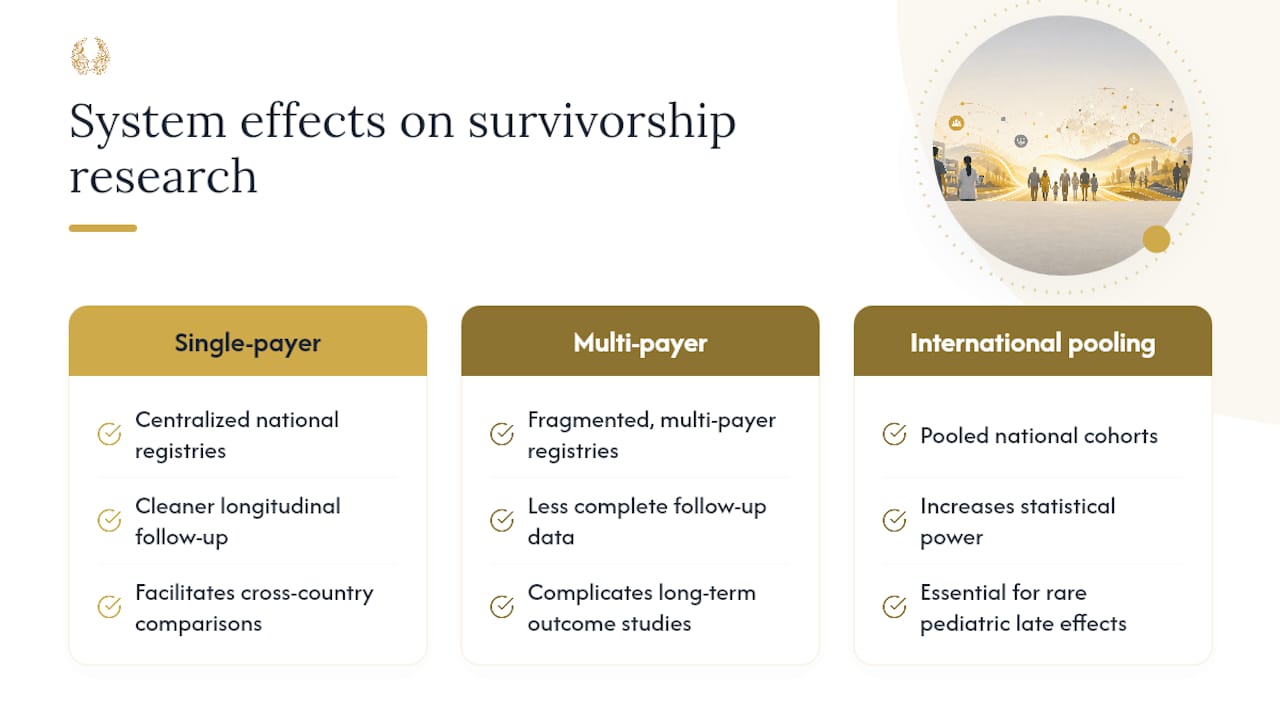
Cancer survivorship is not a uniquely American research question, though the United States has built some of the most developed infrastructure for it. Other health systems are building comparable registries and cohort studies, often organized around national cancer registries similar in structure to SEER, and international collaboration is increasingly common for questions that require larger sample sizes than any single country can generate alone, particularly for rare late effects in pediatric and AYA survivors.
Cross-border collaboration matters most for childhood cancer survivorship, where any individual country’s pediatric cancer incidence is too low to power studies on rare, delayed effects like secondary malignancies decades after treatment. Pooling data across national cohorts is often the only realistic way to detect these signals with adequate statistical power.
Differences in health-system structure shape what these international comparisons can actually show. Countries with single-payer systems and centralized cancer registries often have cleaner longitudinal follow-up data than fragmented, multi-payer systems, which makes cross-national comparison valuable for identifying which care-delivery structures produce better long-term outcomes. American researchers designing care-delivery studies increasingly look at how other systems structure survivorship transition, not to import a model wholesale, but to see which components of coordinated follow-up translate across different systems and which do not.
The practical takeaway for U.S.-based investigators is that international literature searches and registry comparisons belong in the early design phase of any large survivorship cohort, particularly for rare cancer types or pediatric populations where domestic sample sizes alone will rarely suffice.
Which Measures Do Survivorship Studies Use Most Often?
Consistency in measurement is what lets separate studies actually talk to each other, and the field has converged on a recognizable set of instruments and data elements.
Patient-reported outcomes dominate the toolkit: validated instruments capturing fatigue, distress, physical function, and fear of recurrence show up across the large majority of interventional and observational survivorship studies. Clinician-graded toxicity scales complement these self-reports, tracking objective measures like cardiac ejection fraction or peripheral neuropathy grade over time.
Common data elements, standardized variables that multiple studies collect the same way, matter more in this field than most people realize. A treatment summary field, a recurrence status field, and a comorbidity index that mean the same thing across three different cohort studies let researchers pool data or at least compare findings meaningfully. Without that standardization, cross-study synthesis becomes guesswork.
Functional status measures round out the picture, from objective performance tests to self-reported activities-of-daily-living scales, particularly important in older adult and advanced-cancer survivor populations where physical function often matters as much to quality of life as disease-specific outcomes. The NCI CSRU’s genetics and epidemiology work increasingly incorporates biomarker and genetic assay data alongside these traditional measures, aiming to identify who is biologically predisposed to specific late effects before symptoms appear, which could eventually let follow-up schedules become personalized rather than one-size-fits-all by cancer type.
Author Perspective: Why Prioritize Survivorship Research Now
At HCRF, our mission is funding early-stage, unconventional cancer research at Northwestern’s Lurie Comprehensive Cancer Center. As the survivor population continues to grow, the scientific opportunity to fund the work that turns survival into genuine long-term health has never been larger.
How the Hippocratic Cancer Research Foundation Supports Survivorship Research
Federal grants move slowly and rarely fund the earliest, riskiest stage of a new survivorship research idea. That’s the gap HCRF exists to fill: seed funding for exactly the kind of unconventional, early-stage work that needs preliminary data before it can compete for an NIH award.
HCRF supports investigators at the Robert H. Lurie Comprehensive Cancer Center of Northwestern University through several channels: seed grants for pilot survivorship studies, convening opportunities that connect investigators across disciplines, and educational resources that help donors understand where their contributions go. If you’re a researcher exploring a novel angle on late effects, care-delivery models, or supportive care, or a donor looking to put philanthropic dollars behind research too early-stage for traditional funding, HCRF’s foundation page is the place to start. Every dollar donated funds research that federal grants often can’t reach until someone else proves it’s worth the risk. Visit the foundation page to explore current funding priorities or reach out about supporting a specific research direction.
Sources
Keep these close for citation, methods reference, or program-level guidance:
- Cancercontrol
- Survivorship Research — ASCO
- Cancer Survivorship Research Unit (CSRU) — NCI DCEG
- Cancer survivorship programs and clinics — American Cancer Society
This article is general information, not a substitute for advice from a qualified doctor. Consult a qualified healthcare professional about your own circumstances before acting on anything here.
Recommended
- Hippocratic Cancer Research Foundation: Innovative Therapies | Breast Cancer Research Funding: A Researcher’s Guide
- Hippocratic Cancer Research Foundation: Innovative Therapies | Immunotherapy Clinical Trials for Lung Cancer: Your Guide
- Hippocratic Cancer Research Foundation: Innovative Therapies | Immunotherapy Clinical Trials for Prostate Cancer: 2026 Guide
- Hippocratic Cancer Research Foundation: Innovative Therapies | Why Cancer Screening Matters: Your 2026 Guide

Unlock the potential of corporate philanthropy programs with key steps to align your CSR efforts with community needs. Start making an impact today!
Read More →
Tumor profiling and molecular tumor boards guide precision oncology, but cost and equity limit access. HCRF funded research supports progress in treatment.
Read More →