


Corporate Philanthropy Programs: A Practical Guide for CSR Teams
August 6, 2026
Corporate Philanthropy Programs: A Practical Guide for CSR Teams

Corporate philanthropy programs are structured company initiatives that invest money, time, product, or expertise in community causes aligned with business values to create measurable social impact and business value. If you’re a CSR coordinator or business leader ready to move forward this week, here are your three immediate next actions:
- Map one organizational objective to one community need. Pick a business priority (talent retention, brand trust, community license to operate) and identify a local or national cause that mirrors it.
- Pick a pilot vehicle. Matching gifts, volunteer grants, or a donor-advised fund (DAF) are the lowest-friction starting points. A DAF through a sponsoring community foundation lets you make an immediate tax-deductible contribution and recommend grants over time, with far less administrative overhead than a private foundation.
- Assign an internal owner and a 3-month reporting cadence. Without a named owner and a calendar date for the first review, most pilots stall before they generate data.
Table of Contents
- What do corporate philanthropy programs actually cover?
- What are the most common corporate giving models?
- Why does corporate philanthropy make business sense?
- How do you design and implement a giving program?
- How do you measure and report program impact?
- What are the U.S. legal and tax rules for corporate giving?
- What do real corporate philanthropy programs look like?
- How does HCRF partner with companies to fund cancer research?
- Key Takeaways
- Why corporate philanthropy deserves more than a budget line
- Partner with HCRF to put your giving program to work
- Useful sources and references
What do corporate philanthropy programs actually cover?
Corporate philanthropy is one layer inside a broader framework that also includes corporate social responsibility (CSR) and environmental, social, and governance (ESG) reporting. Understanding where each begins and ends saves you from designing a program that tries to do everything and measures nothing.
Philanthropy is the direct transfer of company resources (cash, product, employee time, expertise) to community causes. It primarily addresses community partners and nonprofit organizations. Matching gifts, volunteer grants, in-kind product donations, corporate foundations, and DAFs are all squarely philanthropic activities.
CSR is broader. It covers how a company manages its relationships with employees, suppliers, customers, and communities, including labor practices, supply-chain ethics, and community investment. Philanthropy is one visible expression of CSR, but CSR also includes things like fair-wage policies and supplier diversity programs.
ESG is the reporting and investment framework that translates both CSR and philanthropy into metrics that matter to investors and capital markets. Community-impact disclosures from your philanthropy program can feed directly into the “S” pillar of your ESG report.
“Strategic philanthropy — giving that is aligned with business objectives — produces measurable benefits in employee retention and external reputation, not just goodwill.” — Greater Houston Community Foundation
The practical implication: use ESG frameworks (GRI, SASB) for investor-facing reporting, and use your philanthropy program’s output data (dollars granted, volunteer hours, beneficiaries reached) to populate the community-impact disclosures within those frameworks. They are complementary, not competing.
What are the most common corporate giving models?
Matching gifts and volunteer grants are consistently the most scalable program elements for employers of all sizes, but they are far from the only options. Here is a practical catalog of the principal models, with the organizational fit for each.
-
Matching gift programs. The company matches employee donations to eligible nonprofits, typically at a 1:1 ratio (though some go higher). Pros: high employee visibility, low administrative cost once automated. Cons: participation depends entirely on employee initiative. Best fit: mid-to-large employers with a CSR platform to handle verification.
-
Volunteer grants (dollars for doers). The company donates a fixed dollar amount to a nonprofit where an employee volunteers a set number of hours. Pros: rewards employee time, not just dollars. Cons: requires hour-tracking infrastructure. Best fit: companies with strong volunteer culture and a CSR platform.
-
Corporate foundations and direct grantmaking. A separately incorporated 501©(3) entity funded by the company makes grants to nonprofits. Pros: maximum strategic control, strong brand identity. Cons: significant legal and administrative overhead, IRS compliance requirements. Best fit: large companies with dedicated philanthropy staff.
-
Donor-advised funds (DAFs). The company contributes to a DAF held at a sponsoring community foundation, takes the immediate tax deduction, and recommends grants over time. Pros: lower administrative burden than a private foundation, flexible grant timing. Cons: the company loses legal control of the funds once contributed. Best fit: smaller firms or companies with variable revenue that want to separate contribution timing from grant distributions.
-
In-kind and product donations. The company donates goods, services, or expertise rather than cash. Pros: leverages existing assets, high visibility. Cons: harder to value and report. Best fit: product companies or professional-services firms.
-
Sponsorships and cause marketing. The company funds an event or campaign in exchange for brand visibility. Pros: dual marketing and community benefit. Cons: can blur the line between philanthropy and advertising. Best fit: consumer-facing brands.
-
Payroll giving. Employees authorize recurring paycheck deductions to designated nonprofits, often with a company match. Pros: frictionless for employees, predictable revenue for nonprofits. Cons: requires payroll integration. Best fit: large employers with established HR infrastructure.
-
Employee relief funds and scholarships. Internal funds that support employees or community members facing hardship or educational barriers. Pros: strong internal morale signal. Cons: governance and eligibility rules require legal review. Best fit: companies with a strong employee-first culture.
Companies that combine multiple vehicles address different strategic goals simultaneously: matching gifts serve employee-driven requests, direct grants address long-term community investment, and sponsorships build brand visibility. A blended approach is almost always more durable than a single vehicle.
Why does corporate philanthropy make business sense?
The internal pitch for a philanthropy program does not need to be long. Here is a template you can adapt for an executive deck or email:
“A structured giving program aligned to [business objective] will reduce voluntary turnover by reinforcing our employee value proposition, strengthen brand favorability in [target market], and deepen our operating relationships in the communities where we hire and sell. We propose a 12-month pilot with a matching gift and volunteer grant component, a $[X] matching pool, and quarterly reporting to the executive team.”
The business case rests on three pillars. First, employee engagement: well-structured workplace giving and volunteering programs are linked to measurable increases in employee engagement and reductions in turnover. Second, brand reputation: community investment builds the kind of trust that advertising cannot buy, particularly in markets where the company depends on a local license to operate. Third, talent attraction: purpose-driven work is a documented factor in candidate decisions, especially among younger professionals.
Statistic callout: Strategic alignment between giving and business objectives produces measurable benefits in employee retention and external reputation, according to practitioners at community foundations who track program outcomes across corporate partners.
Pro Tip: Get one executive sponsor on record before you launch. A program with a named C-suite champion generates significantly higher employee participation than one that lives only in the CSR team’s inbox. Present the business case in the language of the CFO (cost per retained employee, brand favorability index) and the CHRO (engagement scores, voluntary turnover rate), not just the language of impact.

How do you design and implement a giving program?
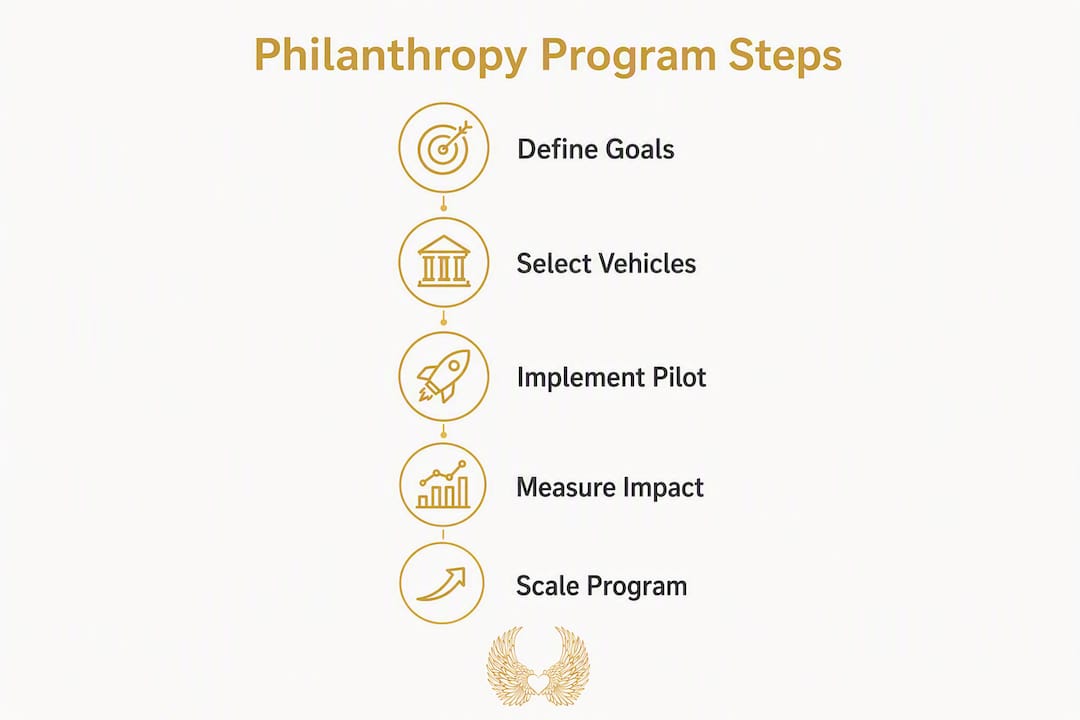
Building a program from strategy to pilot takes 6–12 months when done deliberately. Here is the sequence that works.
The 12-month implementation sequence
- Months 1–2: Strategy alignment. Define the one or two business objectives the program will serve. Map them to community needs. Get executive sponsor sign-off.
- Month 2–3: Governance structure. Assign an internal owner (CSR manager or HR lead). Define approval authority for grants, matching caps, and partner selection. Draft a conflict-of-interest policy.
- Month 3–4: Vehicle and partner selection. Choose your primary vehicle (matching gifts, volunteer grants, DAF, or a combination). Identify two or three nonprofit partners whose missions align with your business objectives. Verify their 501©(3) status via the IRS Tax Exempt Organization Search.
- Month 4–5: Budget and funding cadence. Set a matching pool cap, volunteer grant rate (e.g., $10 per volunteer hour), and administrative budget. Decide whether contributions are annual lump sums or quarterly.
- Month 5–6: Technology and process. Select a CSR platform (or a manual process for pilots under 50 employees) to handle matching verification, volunteer hour logging, and reporting. Overly complex submission portals are one of the primary reasons participation rates stay low; centralized platforms materially improve both participation and reporting accuracy.
- Month 6–7: Employee engagement plan. Draft internal communications (launch email, intranet page, manager talking points). Set a participation target (10% employee participation is a reasonable scale trigger for a first pilot).
- Month 7–8: Soft launch. Open the program to a pilot group (one department or one office). Collect feedback on process friction.
- Month 8–10: Measure and adjust. Run the first quarterly review. Check participation rate, matching dollars deployed, volunteer hours logged, and employee satisfaction with the process.
- Month 10–12: Scale decision. If the pilot hits its triggers (10% participation, positive employee feedback, at least two nonprofit partners reporting on outcomes), prepare a full-company rollout plan.
Sample budget categories
These are illustrative allocations for a mid-size employer pilot, not sourced mandates:
- Matching pool: 50–60% of total philanthropy budget
- Volunteer grants: 15–20%
- Program administration and staffing: 10–15%
- Communications and employee engagement: 5–10%
- Measurement, reporting, and platform costs: 5–8%
Technology considerations
CSR platforms automate the three most labor-intensive tasks: nonprofit eligibility verification, matching gift processing, and volunteer hour tracking. For companies under 100 employees, a spreadsheet-based manual process can work for a 6-month pilot. Above that threshold, the administrative burden of manual processing typically exceeds the cost of a platform subscription. When evaluating platforms, prioritize matching automation, a clean employee-facing submission interface, and a reporting dashboard that exports to your ESG reporting format.

Pro Tip: Set two explicit scale triggers before you launch the pilot: a participation rate threshold (e.g., 10% of employees) and a qualitative signal (e.g., at least one nonprofit partner submitting an outcome report). If neither trigger is met by month 9, diagnose the friction point before committing to a full rollout. Most programs that fail do so because they scale before they understand why participation is low.
How do you measure and report program impact?
The most common mistake in philanthropy reporting is tracking only outputs (dollars granted, hours volunteered) and calling that “impact.” Outputs tell you what you spent. Outcomes tell you what changed.
- Outputs are what your program produces directly: total dollars granted, volunteer hours logged, number of nonprofit partners, number of employees participating.
- Outcomes are what changes as a result: beneficiary outcomes (students served, patients reached, meals provided), employee engagement scores, voluntary turnover rate, brand favorability in target communities.
KPI reference table
| Metric | What it measures | Why it matters | How to collect | Frequency |
|---|---|---|---|---|
| Employee participation rate | % of employees who gave or volunteered | Signals program health and culture fit | CSR platform or HR data | Monthly |
| Matching dollars deployed | Total company match paid out | Tracks budget utilization | Finance / CSR platform | Quarterly |
| Volunteer hours logged | Total hours employees volunteered | Measures time investment | CSR platform | Quarterly |
| Nonprofit partner outcomes | Beneficiaries reached, services delivered | Connects dollars to real-world change | Partner reports / MOUs | Annually |
| Employee engagement delta | Change in engagement survey scores | Links program to HR KPIs | Annual engagement survey | Annually |
| Voluntary turnover rate | % of employees who left voluntarily | Tests retention hypothesis | HR data | Annually |
| Community reach | People served by funded programs | Demonstrates external impact | Partner reports | Annually |
Reporting cadence
- Monthly: Operational dashboard for the internal CSR owner (participation rate, matching pool utilization, volunteer hours). Audience: CSR manager and HR lead.
- Quarterly: Program review for the executive sponsor (budget vs. actuals, partner updates, participation trend, any compliance flags). Audience: executive sponsor, CFO.
- Annually: Public impact summary (total giving, volunteer hours, partner outcomes, employee participation rate). Audience: employees, board, community partners, ESG/sustainability report.
What are the U.S. legal and tax rules for corporate giving?
Corporate giving in the United States operates under a clear but nuanced tax framework, and the 2026 updates make timing and structure more consequential than they were before.
The 2026 deduction framework
Beginning in 2026, U.S. corporate tax guidance introduced a minimum floor and maintained a ceiling on deductible corporate charitable contributions. Specifically, companies may only deduct contributions that exceed 1% of taxable income (the floor), and total deductions remain capped at 10% of taxable income (the ceiling). This makes contribution timing and planning more important. Companies should work with their corporate tax advisor to model the optimal contribution amount and timing before the fiscal year closes.
Corporate foundation vs. direct giving vs. DAF
- Corporate foundation — is a separately incorporated 501©(3) controlled by the company. Offers maximum strategic control but carries significant IRS compliance requirements (Form 990-PF, excise tax on investment income, mandatory annual distribution of at least 5% of assets, self-dealing rules).
Compliance checklist
- Verify every grantee’s 501©(3) status using the IRS Tax Exempt Organization Search before making any contribution.
- Obtain written acknowledgment for every gift over $250 (required for deductibility).
- Execute a memorandum of understanding (MOU) or grant agreement for any multi-year commitment or restricted grant.
- Document the business purpose of each contribution in your contribution registry.
- Run conflict-of-interest checks for any grant to an organization where a company officer or director has a relationship.
- Retain all records for at least three years (seven years is the safer standard for audit purposes).
- Engage a corporate tax advisor to model the floor/ceiling impact on your annual giving budget.
Pro Tip: Keep a centralized contribution and grant registry, updated in real time, that logs recipient name, EIN, amount, date, business purpose, and acknowledgment receipt. For multi-year commitments, require a signed MOU before the first payment. This single habit protects both the company and the nonprofit partner if the relationship or the tax rules change.
This article provides general information about U.S. tax and legal frameworks for corporate giving. Confirm current rules and their application to your specific situation with a qualified tax advisor or legal counsel.
What do real corporate philanthropy programs look like?
The most instructive examples are not the largest ones. They are the ones with a clear model, a defined business objective, and a replicable operational structure.
Salesforce: the 1-1-1 pledge model
Salesforce commits 1% of equity, 1% of product, and 1% of employee time to philanthropy. The model’s power is structural: by tying giving to percentages rather than fixed dollar amounts, the program scales automatically as the company grows. Employee volunteer time is tracked and reported, and product donations go to nonprofits as software licenses. The lesson: embedding philanthropy into corporate governance (not just a budget line) makes it durable through leadership changes and economic cycles.
Google and Microsoft: large-scale matching programs
Both Google and Microsoft run matching gift programs that amplify employee giving at scale. Microsoft’s program matches employee donations to eligible nonprofits and also provides volunteer grants, converting employee time into additional dollars for nonprofits. The operational lesson: at large employers, matching programs work best when the submission process is frictionless. A complex portal kills participation faster than a low match ratio.
“The most effective matching programs are the ones employees actually use. Simplicity of submission is not a nice feature — it is the program’s most important design decision.” — Microsoft Corporate Responsibility
Apple and Dell: in-kind and product giving
Apple and Dell both direct significant resources toward in-kind and product donations, channeling technology to schools, nonprofits, and underserved communities. The business objective is dual: community impact and brand alignment with education and access. The operational lesson: in-kind programs require a clear valuation methodology for tax reporting and a distribution partner who can absorb and deploy the product.
PepsiCo: community listening and long-term partnerships
PepsiCo’s approach emphasizes working alongside community partners to fund solutions that communities themselves define, rather than imposing a top-down grantmaking agenda. This “listen-first” model, also championed by the Hilton Global Foundation, produces longer-term impact than episodic sponsorships because the nonprofit partners are co-designers, not just recipients. The lesson: the most durable partnerships begin with a listening phase, not a grant announcement.
Hilton: the Hilton Global Foundation and community co-design
The Hilton Global Foundation structures its giving around long-term community partnerships in the markets where Hilton operates, with a focus on economic opportunity and environmental stewardship. The foundation’s model demonstrates that hospitality companies can align philanthropy directly with their operating footprint, making the business case to local stakeholders visible and concrete.
How does HCRF partner with companies to fund cancer research?
The Hippocratic Cancer Research Foundation (HCRF) is a 501©(3) nonprofit that funds “out of the box” cancer research at the Robert H. Lurie Comprehensive Cancer Center of Northwestern University. For corporate partners, HCRF offers a direct, meaningful way to connect a workplace giving program to life-saving science.
Corporate partners have structured their support through several vehicles. Workplace matching gift programs direct employee donations to HCRF, with the company match doubling the impact of every contribution. Named research grants allow companies to fund a specific research initiative or clinical trial, with stewardship reporting that connects employees to the science their dollars are supporting. Sponsorships of HCRF’s gala events provide brand visibility alongside a compelling community narrative. Employee fundraising campaigns, organized around HCRF’s donor-driven initiatives, build internal community and purpose.
Structured gifts to cancer research can support clinical trials, translational research, and patient access programs at the Lurie Cancer Center. HCRF provides corporate partners with stewardship reporting: progress updates on funded research, researcher communications, and impact summaries that companies can share with employees and include in their annual philanthropy reports.
Pro Tip: If your company is considering a named research fund or a multi-year sponsorship with HCRF, request a stewardship plan before you commit. A good stewardship plan specifies what reporting you will receive, at what frequency, and in what format — so you can translate research progress into employee communications and ESG disclosures without extra work on your end.
CSR teams interested in building a cancer-research funding program with HCRF are welcome to reach out directly through the HCRF partnership page.
Key Takeaways
A well-designed corporate philanthropy program aligns giving vehicles to business objectives, runs a measured pilot before scaling, and connects outputs to outcomes through consistent reporting.
| Point | Details |
|---|---|
| Choose the right vehicle | Match gifts, volunteer grants, and DAFs each suit different company sizes and administrative capacities. |
| Align to a business objective | Programs tied to retention, brand trust, or community relations generate measurable KPIs, not just goodwill. |
| Run a pilot with scale triggers | Set a 10% employee participation threshold before committing to a full rollout. |
| Track outcomes, not just outputs | Beneficiary results and employee engagement scores tell you what changed; dollars granted only tell you what you spent. |
| HCRF as a partner | Companies can direct matching gifts, named grants, or sponsorships to HCRF to fund cancer research at Northwestern’s Lurie Cancer Center. |
Why corporate philanthropy deserves more than a budget line
Most corporate philanthropy programs fail quietly. Not because the company stopped caring, but because the program was designed as a standalone line item rather than an integrated part of how the company operates. A matching gift program that no one knows about, a volunteer grant that requires six forms to claim, a foundation that announces grants but never reports outcomes — these are not philanthropy failures. They are design failures.
What we have seen, working alongside corporate partners at HCRF, is that the companies whose programs endure are the ones that treat giving as a governance question, not a marketing question. They assign real ownership. They set real reporting cadences. They ask their nonprofit partners what they actually need, rather than what looks good in a press release.
The 2026 tax framework changes make this discipline even more urgent. The new deduction floor means that small, scattered contributions may no longer be deductible at all. That is not a reason to give less. It is a reason to give more deliberately, with a structure that maximizes both community impact and business value.
We believe that every company, regardless of size, can build a program worth being proud of. And we believe that when that program is connected to something as urgent as cancer research, the pride runs deeper, and the impact lasts longer.
Partner with HCRF to put your giving program to work
When your company is ready to move from intention to impact, HCRF offers corporate partners something rare: a direct line between your workplace giving program and breakthrough cancer research at one of the nation’s leading cancer centers.
HCRF works with companies to set up workplace giving programs that are straightforward to administer and meaningful to employees. Whether your company wants to launch a matching gift campaign, sponsor a named research fund, or organize an employee fundraising drive around HCRF’s annual gala, we provide the program setup support, compliance documentation, stewardship reporting, and employee communications you need to make it work.
Your employees want to give to something that matters. Cancer research at Northwestern’s Lurie Cancer Center is exactly that. To start the conversation, visit the Hippocratic Cancer Research Foundation and reach out to our partnerships team. We will respond with a tailored proposal within five business days.
Useful sources and references
These primary sources support the guidance in this article. Use them to verify tax and legal rules, explore program design frameworks, and review corporate giving examples.
Tax and legal guidance:
- Greater Houston Community Foundation: How Do Corporate Philanthropy Programs Work? — authoritative on the 2026 deduction floor/ceiling rules and DAF mechanics.
- Council on Foundations: Corporate Giving Programs and Foundations — primary reference for corporate foundation governance and compliance.
Program design and employee engagement:
- Candid Learning: Corporate Giving — research on what motivates companies and how to structure blended programs.
- YourCause: Corporate Philanthropy Guide — practical guidance on employee engagement and program design.
Corporate program examples:
- Microsoft Corporate Responsibility Reports — authoritative source for Microsoft’s matching and volunteer grant program details.
- Hilton Global Foundation — community partnership and listen-first grantmaking model.
- Salesforce Philanthropy (1-1-1 model) — structural reference for the pledge-based giving model.
HCRF partnership resources:
- Hippocratic Cancer Research Foundation — partnership options, donation routes, and stewardship information for corporate partners.
- Cancer Research Funding: A 2026 Donor’s Guide — guidance on donor incentives, timing, and compliance for research funding.
Recommended
- Hippocratic Cancer Research Foundation: Innovative Therapies | Workplace Giving Programs for Cancer Research Donors
- Hippocratic Cancer Research Foundation: Innovative Therapies | How to Donate to Cancer Research and Drive Real Impact
- Hippocratic Cancer Research Foundation: Innovative Therapies | Breast Cancer Research Funding: A Researcher’s Guide
- Hippocratic Cancer Research Foundation: Innovative Therapies | Cancer Research Funding: A 2026 Donor’s Guide

Discover essential insights on cancer research funding in 2026. Learn where donations go and how to make an impact in the fight against cancer.
Read More →
Practical rules for bidders and organizers: start bids at 30–50% FMV, use proxy bids and extended close, and follow a tax receipt checklist.
Read More →