


How Many Cures for Cancer Are There?
July 31, 2026
How Many Cures for Cancer Are There?

There is no single universal cure for cancer. What exists instead is something more nuanced and, in many ways, more hopeful: dozens of curative treatments that work for specific cancer types, at specific stages, in specific patients. Testicular cancer, early-stage Hodgkin lymphoma, and many thyroid cancers, for example, are routinely treated with curative intent and carry high survival rates. The word “cure” itself, though, is rarely used in the clinic. Stage, tumor biology, and available therapies determine everything.
The short answer:
- The National Cancer Institute (NCI) recognizes more than 200 distinct cancer types, each with its own biology and treatment response.
- The U.S. Food and Drug Administration (FDA) has approved curative-intent therapies across surgery, radiation, chemotherapy, immunotherapy, targeted therapy, and more.
- The American Cancer Society (ACS) tracks population-level outcomes through the SEER database, where 5-year relative survival rates serve as the closest proxy for curability.
- Early-stage cancers are often curable. Metastatic disease is a different challenge entirely.
Table of Contents
- What does “cure” actually mean in oncology?
- How many cancers are there, and which ones are commonly curable?
- Why a single “one-size-fits-all” cure is unlikely
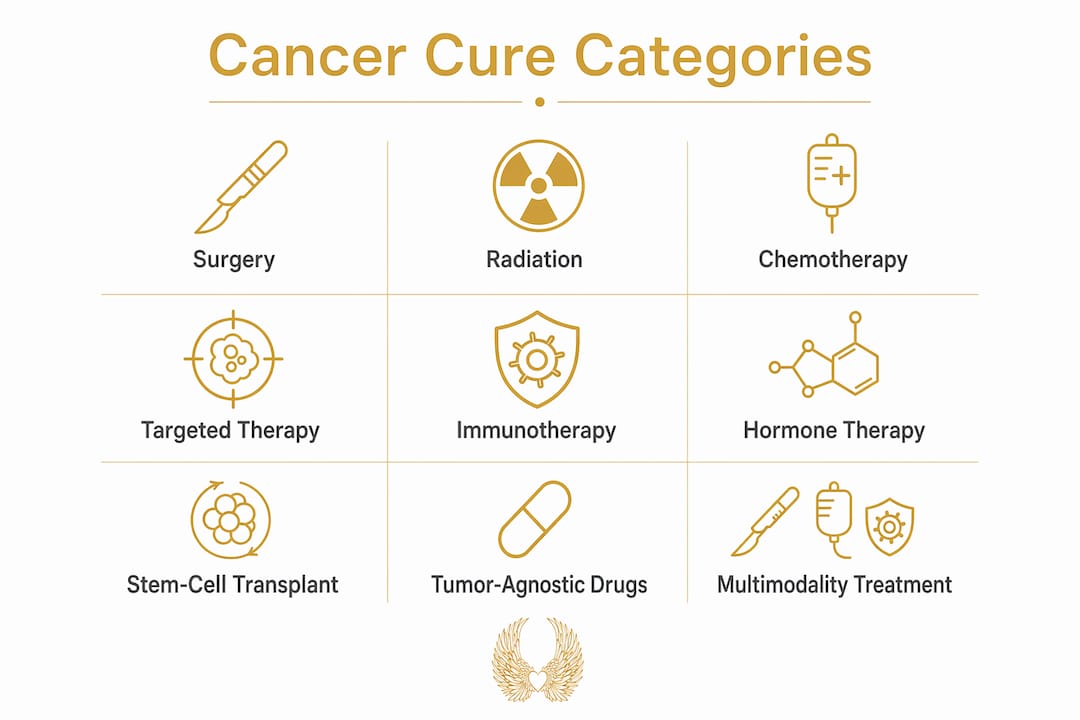
- What treatment categories can actually achieve a cure?
- What recent advances are changing the definition of “curable”?
- How do you evaluate claims that a cancer cure exists?
- Key Takeaways
- Why funding “out of the box” research is the real path forward
- The Hippocratic Cancer Research Foundation is where hope becomes research
- Authoritative sources and further reading
What does “cure” actually mean in oncology?
Clinicians rarely say the word “cured.” That is not pessimism. It is precision.
In oncology, a complete remission means no detectable cancer remains after treatment. A partial remission means the tumor has shrunk significantly but not disappeared. Durable remission describes a complete remission that holds over years, and it is the closest most oncologists come to using the word cure in practice. The reason for this caution: microscopic residual disease can persist silently and resurface years, even decades, later.
The milestones clinicians use most are 5-year and 10-year relative survival rates. These figures, drawn from the NCI’s SEER database, compare the survival of people with a given cancer to the general population. A 5-year relative survival rate of 95% means people with that cancer are nearly as likely to be alive at five years as people without it. That is a powerful signal, but not a guarantee of permanent cure.
Key distinction: “Disease-free interval” measures time without detectable cancer after treatment ends. “Overall survival” measures how long patients live regardless of recurrence. Both matter, and neither is the same as a permanent cure.
The NCI projects that 16.3 million people in the U.S. will be alive at least five years after their cancer diagnosis over the next eight years. That number reflects real progress. It also reflects how many people are living with the ongoing uncertainty that comes with a cancer history.
How many cancers are there, and which ones are commonly curable?
Cancer is an umbrella term for more than 200 distinct diseases, each driven by different genetic mutations, arising in different tissues, and responding to different treatments. When you count major histologic subtypes, the number of clinically distinct entities runs even higher. This is the core reason no single cure exists: you are not fighting one disease.
Some cancers, however, have well-established curative treatments when caught at the right stage. The table below summarizes commonly cited examples, using 5-year relative survival data as a curability indicator.
| Cancer Type | Typical 5-Year Relative Survival (Localized/Early Stage) | Common Curative Approach |
|---|---|---|
| Testicular cancer | ~95% or higher | Surgery, chemotherapy, radiation |
| Thyroid cancer (papillary) | 94% | Surgery, radioactive iodine |
| Hodgkin lymphoma | 89% | Chemotherapy, radiation |
| Early-stage breast cancer | 94% (localized) | Surgery, radiation, adjuvant therapy |
| Pediatric ALL (leukemia) | ~90%+ | Chemotherapy, sometimes stem-cell transplant |
| Early-stage prostate cancer | 94% (localized) | Surgery, radiation, active surveillance |
Sources: NCI SEER data, Medical News Today, ACS.
A few things stand out in that table. First, “early stage” is doing enormous work. The same cancer that is routinely cured at Stage I can become extraordinarily difficult to treat at Stage IV. Second, why certain cancers are more common than others often tracks with the same biological factors that determine how curable they are. Third, pediatric leukemias represent one of oncology’s genuine triumphs: survival rates that have climbed from below 10% in the 1960s to above 90% today, driven entirely by research.
Pro Tip: When you see a survival statistic, always check whether it refers to all stages combined or to localized disease specifically. The difference can be enormous, and combined figures often understate how curable early-stage cancers truly are.
Why a single “one-size-fits-all” cure is unlikely
The honest answer is biological complexity. Cancer is not one thing that behaves one way. Even within a single tumor, cells can carry different mutations, respond differently to the same drug, and evolve under treatment pressure. Here is what that looks like in practice:
- Inter-tumor heterogeneity: Lung cancer and breast cancer share almost no meaningful biology. A drug that targets one rarely touches the other.
- Intra-tumor heterogeneity: Within a single tumor, subpopulations of cells can carry distinct genetic profiles. Treat the dominant clone, and a resistant minority survives and repopulates.
- Acquired resistance: Cancer cells evolve. A targeted therapy that produces a dramatic initial response can lose effectiveness as resistant mutations emerge, sometimes within months.
- The tumor microenvironment: Tumors recruit surrounding cells, blood vessels, and immune cells to protect themselves. Immunotherapy works partly by disrupting this shield, but tumors can rebuild it.
- Metastasis: Once cancer spreads to distant organs, the disease becomes systemic. Surgery and radiation, which are highly effective for localized tumors, cannot reach every metastatic site.
Stage-dependent curability is perhaps the clearest illustration of these obstacles. A localized tumor can often be removed entirely. A metastatic tumor has already demonstrated the ability to survive, travel, and colonize new tissue. Those are fundamentally different biological problems, and they require fundamentally different solutions.
Pro Tip: If you read about a “breakthrough” cancer treatment, check whether the results come from a localized or metastatic setting. A therapy that cures early-stage disease and one that extends life in metastatic disease are both meaningful, but they are not the same achievement.
What treatment categories can actually achieve a cure?
The NCI recognizes more than 10 categories of cancer treatment, and the most effective curative strategies almost always combine several of them. No single modality is universally curative, but each has settings where it can be.
Surgery remains the most direct curative tool for solid tumors caught before they spread. Removing a localized tumor entirely, with clear margins, is the foundation of curative intent for cancers of the colon, breast, lung, and many others.

Radiation therapy uses high-dose energy to destroy cancer cells. In early-stage Hodgkin lymphoma and some head and neck cancers, radiation alone can be curative. More often, it works alongside surgery or chemotherapy.
Chemotherapy kills fast-dividing cells throughout the body. It is the backbone of curative treatment for many blood cancers and pediatric leukemias, and it serves as adjuvant therapy after surgery to eliminate microscopic residual disease.
Targeted therapy attacks specific molecular drivers of cancer growth. When a tumor carries a targetable mutation, these drugs can produce dramatic, durable responses. Their limitation is that not every tumor has a targetable driver, and resistance often develops.
Immunotherapy, including checkpoint inhibitors and CAR-T cell therapy, works by enabling the immune system to recognize and destroy cancer cells. CAR-T has produced durable remissions in some patients with blood cancers who had no other options.
Hormone therapy is curative or disease-controlling in hormone-sensitive cancers, particularly certain breast and prostate cancers, by cutting off the hormonal signals that fuel tumor growth.
Stem-cell transplant replaces a diseased immune system with a healthy one, and it remains one of the few potentially curative options for certain leukemias and lymphomas.
Tumor-agnostic drugs are a newer category approved based on a biomarker present across cancer types, not the tumor’s location. They represent a genuine shift in how oncology thinks about treatment.
Multimodality treatment, combining surgery with adjuvant chemotherapy and radiation, or targeted therapy with immunotherapy, is often what tips the balance toward cure. Treating the primary tumor alone is rarely enough; eliminating microscopic systemic disease is the other half of the equation.
What recent advances are changing the definition of “curable”?
This is where the story gets genuinely exciting. Oncology is shifting from organ-based treatment to precision, biomarker-selected therapy, and that shift is producing curative outcomes in patients who previously had none.
The clearest example is selpercatinib (Retevmo), which received FDA traditional approval for RET fusion-positive cancers across tumor sites. Nearly half of patients saw their tumors shrink substantially across more than a dozen different cancer types, with responses lasting a notable duration on average. The drug targets a genetic defect, a RET gene fusion, that can drive cancer growth anywhere in the body. A patient’s tumor location becomes secondary to its molecular fingerprint.
| Therapy | Approval Basis | Approximate Response Rate | Significance |
|---|---|---|---|
| Selpercatinib (Retevmo) | RET fusion-positive (any site) | Notable tumor shrinkage across multiple cancer types | First tumor-agnostic approval for RET fusions |
| CAR-T cell therapies | CD19/BCMA targets (blood cancers); expanding to solid tumors | Up to ~44% objective response in selected solid tumor cohorts | Expanding beyond blood cancers |
Source: FDA approval data; MSK clinical reporting.
A 2006–2025 analysis published in the Journal of Clinical Oncology identified 44 curative-intent approvals for adult solid cancers over that period, with 60% granted in the last five years. Immunotherapy and targeted therapy were the dominant modalities. That acceleration is not a coincidence. It reflects decades of investment in basic science finally reaching patients.
At the Hippocratic Cancer Research Foundation, we believe the most important discoveries often come from researchers willing to ask questions no one else is asking. The “out of the box” research we fund at the Robert H. Lurie Comprehensive Cancer Center of Northwestern University is precisely the kind of work that produces the next generation of curative therapies. We are proud to stand behind it.
How do you evaluate claims that a cancer cure exists?
Every year, headlines announce a “cancer cure.” Most do not survive contact with the peer-reviewed literature. Here is how to tell the difference between real progress and misinformation.
Red flags to watch for:
- A single anecdote presented as proof, with no clinical trial data
- Claims that a cure is being “suppressed” by pharmaceutical companies or governments
- Treatments offered only behind a paywall or through unverifiable sources
- No peer-reviewed publication, no FDA approval, no ClinicalTrials.gov registration
- Testimonials substituting for evidence
Trusted sources to verify any claim:
- NCI treatment pages for approved therapies and clinical context
- FDA drug approval announcements for what has actually cleared regulatory review
- ClinicalTrials.gov for registered, ongoing trials with real oversight
- Peer-reviewed journals (PubMed, NEJM, JCO) for the underlying evidence
- Major NCI-designated cancer centers for expert interpretation
“Could somebody be hiding the cure for cancer? The short answer is no. Cancer is not one disease — it is hundreds. There is no single cure to hide.” — Worldwide Cancer Research
A common false-claim pattern: a natural compound is described as “proven to kill cancer cells in a lab.” Lab studies are a starting point, not a finish line. Thousands of compounds kill cancer cells in a dish. Very few survive animal studies, fewer still reach human trials, and only a fraction prove safe and effective in people. The gap between a lab result and an approved therapy is measured in years and billions of dollars of research.
Cancer screening is one of the most evidence-backed tools we have for improving curability, precisely because it catches disease before it reaches the stages where treatment becomes most difficult.
Key Takeaways
No single cure for cancer exists, but many cancer types are routinely treated with curative intent when caught early, and the pace of new curative-intent approvals has accelerated sharply over the past five years.
| Point | Details |
|---|---|
| No universal cure | Cancer is 200+ distinct diseases; no single therapy cures all of them. |
| Stage determines curability | Early, localized cancers are often curable; metastatic disease remains the central challenge. |
| Curative approvals are accelerating | An analysis from 2006 to 2025 found dozens of curative-intent approvals for adult solid cancers, with a majority occurring in recent years. |
| Precision medicine is reshaping outcomes | Tumor-agnostic drugs like selpercatinib show substantial response rates across diverse cancer types based on genetics, not tumor location. |
| HCRF funds the research that matters | The Hippocratic Cancer Research Foundation supports high-risk, high-reward research at Northwestern’s Lurie Cancer Center to advance the next generation of curative therapies. |
Why funding “out of the box” research is the real path forward
Here is the part that does not get said enough: the curative therapies we celebrate today, the CAR-T approvals, the tumor-agnostic drugs, the precision oncology breakthroughs, did not emerge from safe, incremental science. They came from researchers who asked questions that seemed impractical at the time, funded by people who believed the answer was worth finding.
The conventional wisdom in cancer research has always been to follow the most established pathways. That produces steady progress. But the leaps, the moments when a 10% survival rate becomes 90%, or when a drug works across a dozen cancer types because of a single genetic marker, come from willingness to fund the unconventional. Donor-supported foundations are often the only entities with the freedom to back that kind of work, because they answer to patients and families, not quarterly earnings reports.
We also tend to underestimate how much stage-dependence shapes the public’s understanding of cancer curability. When someone says “cancer is not curable,” they are often thinking of the metastatic cases they have witnessed personally. When a clinician says “this is highly curable,” they are thinking of the localized cases they treat every week. Both are telling the truth. The gap between those two realities is where research lives, and where every dollar of funding matters most.
The Hippocratic Cancer Research Foundation is where hope becomes research
The Hippocratic Cancer Research Foundation (HCRF) is a 501©(3) nonprofit that funds precisely the kind of research this article describes: high-risk, high-reward science at the Robert H. Lurie Comprehensive Cancer Center of Northwestern University. We support work that established funding channels often pass over because it is too early, too unconventional, or too ambitious. That is exactly why we fund it.
Every donation to HCRF goes directly toward translational research with curative intent. When you support our mission, you are not writing a check into a void. You are backing a specific researcher, at a specific institution, working on a specific question that could change what “curable” means for thousands of patients. Learn more about how donations drive real research impact and take that next step today. We need you. THEY need our support.
Authoritative sources and further reading
- National Cancer Institute (NCI) — Comprehensive treatment type descriptions, clinical trial information, and SEER survival statistics. The primary U.S. government source for cancer information.
- FDA Drug Approvals — Official approval announcements, including tumor-agnostic therapies like selpercatinib. Use to verify any claim about an approved treatment.
- American Cancer Society (ACS) — Patient-facing survival statistics, treatment guides, and advocacy resources grounded in SEER data.
- ClinicalTrials.gov — The U.S. registry for all federally and privately supported clinical trials. Search by cancer type, stage, or location to find active studies.
- NCI Prognosis Page — Explains how clinicians use remission terminology and milestone-based survival statistics.
- Journal of Clinical Oncology: Curative-Intent Approvals Analysis (2006–2025) — Peer-reviewed analysis of 44 curative-intent FDA approvals for adult solid cancers, with trend data showing acceleration in recent years.
- PMC: Stage-Dependent Curability — Academic review of how tumor stage shapes curative potential across cancer types.
- Hippocratic Cancer Research Foundation (HCRF) — Learn about funded research at Northwestern’s Lurie Cancer Center and how to support innovative, curative-intent science.
This article is general educational information, not medical advice. For guidance specific to your situation, consult your care team and verify current treatment options through NCI, FDA, or a qualified oncologist.
Recommended
- Hippocratic Cancer Research Foundation: Innovative Therapies | How Many Stages of Cancer Are There? A Clear Guide
- Hippocratic Cancer Research Foundation: Innovative Therapies | What Causes Cancer: Key Factors and Prevention
- Hippocratic Cancer Research Foundation: Innovative Therapies | Why Are Some Cancers More Common Than Others?
- Hippocratic Cancer Research Foundation

Compare CharityWatch, Charity Navigator, BBB WGA and GiveWell. Learn what each rating measures, which documents to verify, and a five-step donor checklist.
Read More →
Join us for a spectacular lineup of events where fashion, philanthropy, and community come together to fuel groundbreaking cancer research. From an inspiring Cancer Survivors’ Walk & 5K to a glamorous Fashion Show, an exclusive evening with Anne Fontaine, and our signature Wings to Cure Gala, each event is an opportunity to celebrate, connect, and make a difference.
Check out our lineup of events here! You won't want to miss!