


T2 N0 Cancer Staging: What It Means for You
July 22, 2026
T2 N0 Cancer Staging: What It Means for You

If you or someone you love has received a T2 N0 classification, here is what that notation tells you right away: the primary tumor has grown beyond its earliest stage but has not reached any nearby lymph nodes. According to the TNM staging system, T2 means a tumor larger or more locally grown than T1 according to cancer-specific criteria, N0 confirms no regional lymph node involvement, and M0 indicates no distant spread.
Together, T2 N0 M0 is an early to mid-stage cancer profile. For breast cancer specifically, T2 N0 M0 corresponds to Stage IIA per AJCC guidelines, though in other cancer types this combination may map to Stage I or Stage II.
What does T2 tell you about tumor size and extent?
The “T” in TNM measures the primary tumor’s size and how far it has grown into surrounding tissue. The National Cancer Institute explains that higher T numbers reflect either a larger tumor or deeper invasion into nearby structures. T2 sits in the middle of that scale, above T1 but below T3 and T4.

What T2 actually means depends heavily on the cancer type. For breast cancer, T2 means the tumor is more than 2 cm but not more than 5 cm across. In colon cancer, T2 means the tumor has grown into the muscularis propria layer of the colon wall, not simply that it has reached a certain size. That distinction matters for treatment planning.
Key T2 size and invasion thresholds across common cancer types include tumor size or depth of invasion, depending on cancer type
Pro Tip: Always ask your oncologist which cancer-specific T2 definition applies to your diagnosis. A T2 in lung cancer is defined differently than a T2 in bladder or thyroid cancer. Site-specific staging criteria from the American Joint Committee on Cancer (AJCC) are the authoritative reference.
Staging also carries important prefixes. A “cT2” means the tumor was measured clinically before surgery, while “pT2” reflects pathologic confirmation after a surgical specimen was examined. A “yT2” indicates staging after neoadjuvant therapy. These prefix distinctions matter because pathologic staging is generally considered more accurate than clinical staging alone.
How N0 lymph node status shapes your prognosis
The “N” in TNM reflects whether cancer has reached the regional lymph nodes closest to the primary tumor. N0 is one of the most hopeful designations a staging report can carry. It means no cancer cells were found in those nearby nodes.
Lymph node involvement is one of the strongest predictors of cancer spread. When nodes are clear, the cancer is far less likely to have traveled through the lymphatic system to other parts of the body. That absence of nodal involvement is a key reason why T2 N0 cancers often respond well to surgery with curative intent.
Doctors determine N0 status through a combination of imaging and tissue analysis:
- Sentinel lymph node biopsy: The first lymph node(s) that drain the tumor are removed and examined under a microscope
- Axillary lymph node dissection: A broader removal of lymph nodes for more thorough analysis in some cases
- Imaging: CT scans, PET scans, and ultrasound can detect enlarged or suspicious nodes before surgery
There is one important nuance. Detailed pathologic tests can sometimes detect isolated tumor cells (ITCs) in a lymph node using immunohistochemistry. A finding labeled N0(i+) means isolated tumor cells were detected but the node is still classified as N0 for staging purposes. These cells may carry clinical implications for therapy planning even when they do not change the formal stage.
- N0: No cancer in nearby lymph nodes
- N0(i+): Isolated tumor cells detected by special tests, still classified N0
- N1, N2, N3: Increasing numbers and locations of affected nodes, each indicating more advanced disease
How T, N, and M combine into an overall stage
The M category completes the TNM picture. M0 means no distant metastasis has been detected. No spread to the lungs, liver, bones, or brain. When you combine T2, N0, and M0, you get a staging profile that reflects a cancer still largely contained.
T2 N0 M0 does not map to a single universal stage. The AJCC guidelines assign stage groups based on cancer type, and for breast cancer specifically, T2 N0 M0 can correspond to Stage IIA or other early stages depending on hormone receptor, HER2 status, and cancer type. For other cancers, the same TNM combination might fall into Stage I or Stage II.
How T, N, and M combine in staging:
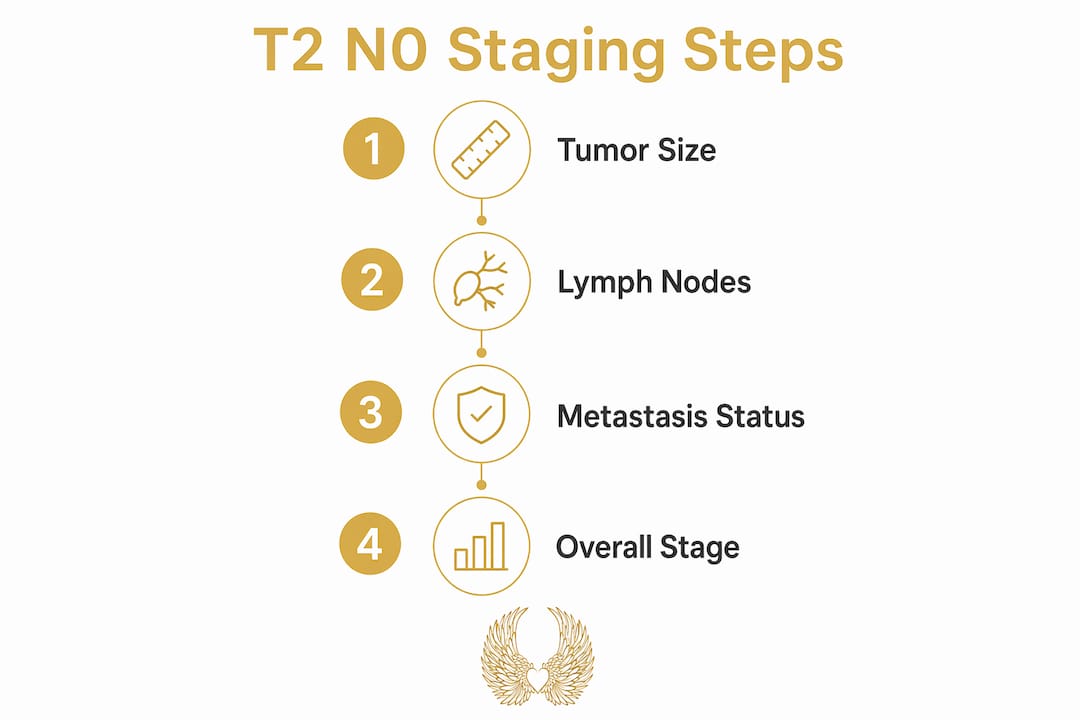
- T (tumor): Size and local extent of the primary tumor
- N (nodes): Presence or absence of cancer in regional lymph nodes
- M (metastasis): Whether cancer has spread to distant organs
- Stage group: Assigned by combining all three, plus cancer-specific biological factors in modern staging systems
The TNM system, maintained by the AJCC and used worldwide, standardizes communication among oncologists and guides both treatment decisions and clinical trial eligibility. A patient in Chicago and a patient in Houston with the same T2 N0 M0 classification are speaking the same clinical language.
What a T2 N0 diagnosis means for treatment and prognosis
T2 N0 M0 cancers are often candidates for surgery with curative intent, depending on detailed staging and cancer type. Because the tumor has not spread to lymph nodes or distant sites, accurate staging identifies patients who may not need systemic neoadjuvant treatment before surgery. That is a meaningful distinction. It can mean fewer treatment steps and a clearer path toward remission.
Prognosis at this stage is generally more favorable than at Stage III or IV. No lymph node involvement reduces significant risk factors for recurrence and metastasis.
Common treatment and prognosis considerations for T2 N0 cancers:
- Surgery: Often the primary treatment, with the goal of complete tumor removal
- Radiation therapy: Frequently recommended after surgery to reduce local recurrence risk
- Adjuvant chemotherapy or hormone therapy: Depends on cancer type, grade, and biological markers such as hormone receptor or HER2 status
- Prognosis: Generally more favorable than node-positive or metastatic stages, though outcomes vary by cancer site and tumor biology
- Staging updates: Initial clinical staging may be revised after pathologic review of surgical specimens, which can affect subsequent treatment decisions
Every treatment plan is individualized. Two patients with identical T2 N0 M0 designations may receive different therapies based on tumor grade, molecular subtype, and overall health. That is why the staging notation is a starting point, not a complete answer.
How the Hippocratic Cancer Research Foundation supports T2 N0 patients and research
The Hippocratic Cancer Research Foundation (HCRF) stands at the intersection of hope and science. As a 501©(3) nonprofit, HCRF funds “out of the box” cancer research at the Robert H. Lurie Comprehensive Cancer Center of Northwestern University, one of the nation’s leading cancer institutions. For patients navigating a T2 N0 diagnosis, that research connection carries real weight.
Accurate staging like T2 N0 M0 is not just a label. It is the foundation on which researchers build better therapies. When staging criteria become more precise, clinical trials can target the right patients, and treatments can be matched to the specific biology of a tumor rather than its size alone. HCRF’s mission is to accelerate exactly that kind of progress.
Key research and patient impact insights from HCRF and the Robert H. Lurie Comprehensive Cancer Center:
- Refining staging criteria: Ongoing research explores how molecular markers can sharpen the accuracy of TNM classifications
- Stage-specific therapies: Studies focus on identifying which T2 N0 patients benefit most from surgery alone versus combined modality treatment
- Clinical trial access: Patients at the Robert H. Lurie Comprehensive Cancer Center gain access to trials designed around precise staging profiles
- Community and education: HCRF provides educational resources to help patients and families understand diagnoses like T2 N0 M0 with clarity and confidence
We believe that knowledge is one of the most powerful tools a patient can carry. Understanding your staging notation is the first step. Supporting the research that refines it is how we all move forward together.

The work happening at the Robert H. Lurie Comprehensive Cancer Center gives us reason for real hope. If you want to be part of that mission, to help fund the research that turns a T2 N0 diagnosis into a story of survival, we invite you to join our mission today. Every contribution brings us closer to the answers patients deserve.
Key Takeaways
T2 N0 M0 is an early to mid-stage cancer classification indicating a moderately sized tumor with no lymph node involvement and no distant spread, which typically supports curative treatment options.
| Point | Details |
|---|---|
| T2 tumor definition | T2 reflects a tumor larger than T1; in breast cancer, this means greater than 2 cm and up to 5 cm. |
| N0 lymph node status | N0 confirms no cancer in nearby regional lymph nodes, a favorable prognostic indicator. |
| Stage group varies | T2 N0 M0 corresponds to Stage IIA in breast cancer per AJCC guidelines, though may differ by cancer type. |
| Treatment implications | T2 N0 M0 patients are often candidates for surgery with curative intent, sometimes without neoadjuvant therapy. |
| Staging can be updated | Clinical staging may be revised after surgical pathology, which can influence subsequent treatment decisions. |
Recommended
- Hippocratic Cancer Research Foundation: Innovative Therapies | How Many Stages of Cancer Are There? A Clear Guide
- Hippocratic Cancer Research Foundation: Innovative Therapies | Signs of Appendix Cancer: What You Need to Know
- Hippocratic Cancer Research Foundation: Innovative Therapies | What Causes Cancer: Key Factors and Prevention
- Hippocratic Cancer Research Foundation: Innovative Therapies | Cancer Awareness Month Calendar: 2026 Complete Guide

For clinicians & researchers: PDOs show 93% histology and ~80% genomic concordance. Practical protocol steps to boost reproducibility.
Read More →
Discover how qualified charitable distributions can benefit retirees and enhance your tax strategy in 2026. Maximize your charitable giving today!
Read More →