


Nanomedicine Cancer Treatment: What Works and What Stalls
August 25, 2026
Nanomedicine Cancer Treatment: What Works and What Stalls

Targeted delivery already changes cancer care. Nanoparticle carriers shuttle chemotherapy directly toward tumor tissue while sparing healthy organs, and that single mechanical advantage has produced real, approved treatments rather than laboratory promises alone.
Three drugs prove the point. Doxil, liposomal doxorubicin, treats ovarian cancer and Kaposi sarcoma while dramatically cutting the cardiotoxicity that plagues conventional doxorubicin. Abraxane, an albumin-bound (protein-bound) form of paclitaxel, treats breast, lung, and pancreatic cancers without the toxic solvents that standard paclitaxel formulations require. Onivyde, liposomal irinotecan, extends survival in metastatic pancreatic cancer after first-line treatment fails, giving patients an option where few existed.
None of this means the technology has matured evenly. The enhanced permeability and retention (EPR) effect that lets nanoparticles slip through leaky tumor blood vessels behaves inconsistently between patients, and the immune system clears a large share of injected particles before they ever reach a tumor. A 2023 Nature review makes clear that EPR heterogeneity in humans is a central reason so few actively targeted nanoparticles have reached approval, despite decades of engineering effort.
Where nanomedicine cancer treatment stands right now:
- Liposomal and protein-bound platforms dominate the approved drug list, not newer inorganic or polymeric designs.
- Most experimental nanomedicines remain in early-phase human trials rather than late-stage confirmatory studies.
- The clinical bottleneck is rarely the chemistry itself. It is manufacturing consistency, immune clearance, and inconsistent tumor biology across patients.
A comprehensive 2024 review of bench-to-bedside translation notes that nanomedicines already support chemotherapy delivery, phototherapy, nucleic acid therapy, and immunotherapy, but that nano-bio interactions and regulatory bottlenecks limit how many of these approaches survive the leap into humans.
Table of Contents
- What Is Nanomedicine and How Does It Treat Cancer?
- How Nanoparticles Enable New Cancer Therapies and Imaging
- FDA-Approved Nanomedicines and the Clinical Trial Pipeline
- Why Nanomedicines Stall Between the Lab and the Clinic
- Manufacturing and Regulatory Realities for Nanomedicines
- What Should Nanomedicine Research Prioritize Next?
- How the Hippocratic Cancer Research Foundation Supports This Work
- Are Nanomedicines Safe? How Toxicity Gets Assessed
- Pharmacokinetics: How Nanoparticles Move Through the Body
- How the FDA Regulates Nanomedicine for Cancer
- Does Nanomedicine Cost More? Weighing the Economics
- Ethical Questions Nanomedicine Research Has to Answer
- Where to Read More on Nanomedicine Cancer Research
- An Honest Look at Where Nanomedicine Cancer Research Stands
- Help Close the Gap Between Nanomedicine Research and Patients
- Sources
What Is Nanomedicine and How Does It Treat Cancer?
Nanomedicine cancer treatment relies on engineered particles, typically between 1 and 200 nanometers, that carry a drug payload, imaging agent, or gene therapy directly into or near tumor tissue. The particle itself is the therapeutic strategy: its size, surface charge, and coating determine whether it reaches a tumor at all, and whether the immune system tags it for destruction along the way.
Six particle classes make up the field, and each solves a different problem:
- Liposomes. Spherical lipid bilayers that encapsulate drugs like doxorubicin. They dominate the approved-drug landscape because their manufacturing is well understood and their biocompatibility is high.
- Polymeric nanoparticles. Built from biodegradable polymers such as PLGA, these allow tunable, sustained drug release and are common in oncology and vaccine research.
- Protein-bound particles. Abraxane’s albumin-paclitaxel complex is the flagship example, using a naturally occurring transport protein to avoid the toxic surfactants older formulations needed.
- Micelles. Self-assembling structures from amphiphilic block copolymers, useful for poorly soluble drugs.
- Inorganic nanoparticles. Gold, iron oxide, and silica particles offer imaging contrast and heat-generating properties useful for photothermal therapy.
- Biomimetic vesicles. Particles cloaked in cell membranes, exosomes, or platelet fragments to reduce immune detection and improve targeting specificity.
Targeting happens in layers. Passive targeting exploits the EPR effect: tumor vasculature is often leaky and poorly drained, so appropriately sized particles accumulate there simply by circulating long enough. That mechanism built the field’s first successes, but it is unreliable across tumor types and even across patients with the same cancer. Active targeting adds a second layer, attaching ligands, antibodies, or aptamers to the particle surface so it binds selectively to receptors overexpressed on cancer cells, such as HER2 or folate receptors. The Nature review frames this as hierarchical targeting: a particle first has to reach the tumor as tissue, then the specific cancer cell, and increasingly, researchers are trying to direct it to a specific organelle inside that cell, such as the mitochondria or nucleus, where a drug does the most damage.
Stimuli-responsive designs push further. Particles engineered to release their payload only when they sense a tumor-specific trigger, acidic pH, elevated reactive oxygen species, specific enzymes, heat, ultrasound, or an external magnetic field, keep the drug locked away during circulation and dump it only where it is needed. This reduces off-target toxicity, which is precisely what makes Doxil gentler on the heart than free doxorubicin.
Every one of these design choices involves a trade-off. Larger, neutrally charged, PEG-shielded particles circulate longer and evade immune clearance, but that same shielding blocks deep tumor penetration once the particle arrives. Smaller, positively charged particles with exposed targeting ligands penetrate tumor tissue more effectively but get cleared from the bloodstream faster and trigger more immune response. No single particle geometry optimizes both stages of the journey, which is why “transforming” or size-switchable particles, designed to circulate large and shrink once inside tumor tissue, have become one of the more promising engineering answers to this conflict.
Pro Tip: When evaluating a new nanoparticle platform in early research, ask which stage of the delivery journey it was optimized for, circulation, tumor accumulation, cellular uptake, or intracellular release, because a design that excels at one stage often underperforms at another.
How Nanoparticles Enable New Cancer Therapies and Imaging
Chemotherapy delivery remains the best-proven use of nanomedicine cancer treatment, but it is no longer the only one. Liposomal doxorubicin changes the drug’s pharmacokinetics outright: instead of a sharp peak concentration that batters the heart muscle, the drug circulates encapsulated and releases gradually, lowering the cumulative cardiotoxicity that limits how much conventional doxorubicin a patient can safely receive over a lifetime.
The therapeutic and diagnostic map now includes:
- Nucleic acid delivery. Lipid nanoparticles (LNPs), the same platform that carried mRNA in COVID-19 vaccines, are now being adapted to deliver siRNA and mRNA cancer therapeutics, silencing oncogenes or coding for tumor antigens directly inside cells.
- Photothermal therapy (PTT). Gold or carbon-based nanoparticles absorb near-infrared light and convert it to localized heat, destroying tumor cells while sparing surrounding tissue. Early-phase trials, including intratumoral carbon nanoparticle studies, are testing this in solid tumors.
- Photodynamic therapy (PDT). Nanoparticles carrying photosensitizing agents generate reactive oxygen species when activated by light, damaging tumor cells and vasculature from within.
- Sonodynamic therapy (SDT). A newer variant using ultrasound instead of light to activate the nanoparticle payload, useful for tumors located too deep for light-based activation.
- Nano-immunotherapy. Nanoparticles deliver tumor antigens and adjuvants together, training the immune system to recognize cancer cells, or they reprogram the tumor microenvironment to make existing checkpoint inhibitors work better.
- Imaging and diagnostics. Iron oxide and gold nanoparticles serve as contrast agents for MRI and CT, improve sentinel lymph node mapping during surgery, and increase detection sensitivity for small metastatic lesions that conventional contrast agents miss.
The lessons from mRNA vaccine LNPs matter more than most oncology discussions acknowledge. Those vaccines proved, at a population scale, that lipid nanoparticles could be manufactured reproducibly, stored at defined temperatures, and delivered safely to hundreds of millions of people. Cancer researchers are now borrowing that manufacturing playbook directly, adapting the same core lipid chemistry toward tumor-targeted mRNA and siRNA payloads instead of viral antigens.
Phototherapy and sonodynamic approaches remain earlier in development than chemotherapy delivery platforms, largely confined to preclinical models and small first-in-human trials. A Phase I dose-escalation trial of carbon nanoparticle-loaded iron for advanced solid tumors illustrates where this modality actually sits today: promising mechanism, early safety data, and years away from the kind of confirmatory evidence Doxil and Abraxane already have.
Nano-immunotherapy is arguably the most active research frontier. Combining antigen delivery with adjuvants inside a single nanoparticle lets researchers control the ratio and timing of immune signals in ways a simple injected vaccine cannot, and several groups are testing nanoparticles designed to convert “cold” tumors that don’t respond to checkpoint inhibitors into “hot” ones that do.

FDA-Approved Nanomedicines and the Clinical Trial Pipeline
A handful of nanomedicines have cleared the FDA and entered routine oncology practice, while a much larger number sit in early-phase trials testing everything from nucleic acid delivery to sonodynamic activation.
FDA-approved oncology nanomedicines currently in clinical use:
- Doxil (liposomal doxorubicin) treats ovarian cancer, multiple myeloma, and AIDS-related Kaposi sarcoma, with its liposomal shell reducing cardiotoxicity compared to conventional doxorubicin.
- Abraxane (albumin-bound paclitaxel) treats breast cancer, non-small cell lung cancer, and pancreatic cancer, eliminating the need for the toxic solvent Cremophor EL used in standard paclitaxel.
- Onivyde (liposomal irinotecan) treats metastatic pancreatic cancer following gemcitabine-based therapy, extending median survival in a disease with historically limited second-line options.
These three anchor a field where, according to an analysis of nanoparticle clinical trials and FDA approvals, liposomal and protein-bound platforms account for the clear majority of approved nanomedicines, while inorganic and polymeric platforms remain concentrated in earlier trial phases.
| Platform Type | Representative Drug/Trial | Phase or Status | Clinical Focus |
|---|---|---|---|
| Liposomal | Doxil | FDA approved | Ovarian cancer, Kaposi sarcoma; reduced cardiotoxicity |
| Protein-bound | Abraxane | FDA approved | Breast, lung, pancreatic cancer; solvent-free delivery |
| Liposomal | Onivyde | FDA approved | Metastatic pancreatic cancer, extended survival |
| Inorganic (carbon/iron) | NCT06048367 | Phase I | Intratumoral injection, advanced solid tumors |
Trials registered on ClinicalTrials.gov reveal how much of the field’s activity is still exploratory. Dose-escalation studies like the carbon nanoparticle-loaded iron trial referenced above are designed primarily to establish safety and a maximum tolerated dose, not efficacy. That is a normal and necessary step, but it also means most nanomedicine cancer treatment innovations covered in scientific press releases are years away from reaching a pharmacy shelf.
The interpretive pattern holds across the literature: most nanomedicine clinical programs remain phase 1 or phase 2. The reasons are consistent across reviews. Tumor biology varies enormously between patients and even within a single tumor, animal models don’t reliably predict how a nanoparticle will behave in human vasculature, and manufacturing a nanoparticle reproducibly at clinical trial scale is a materially different challenge than making a small molecule drug. If you are a clinician guiding a patient toward a trial, or a patient considering enrollment yourself, understanding what a clinical trial phase actually means for the strength of the evidence is worth doing before signing a consent form.
Why Nanomedicines Stall Between the Lab and the Clinic
The protein corona is the single most underappreciated barrier in nanomedicine cancer treatment. Within seconds of entering the bloodstream, a nanoparticle gets coated in blood proteins, a process called protein fouling, that changes its effective size, charge, and targeting behavior before it ever reaches a tumor. That corona often masks the very targeting ligands researchers engineered onto the surface, which is a major reason lab results rarely translate cleanly into human outcomes.
Four barriers explain most translational failures, and each has a partial fix:
- Protein corona formation. PEGylation (coating particles in polyethylene glycol) reduces but doesn’t eliminate immune recognition, and repeated PEGylated-drug exposure can trigger anti-PEG antibodies that accelerate clearance on subsequent doses. Biomimetic coatings, cloaking particles in the patient’s own cell membranes, are a newer answer that reduces this immune signature more durably.
- EPR heterogeneity. Because passive accumulation varies so widely between tumors and patients, the Nature review argues researchers should stop assuming uniform EPR and instead stratify patients, using imaging biomarkers to predict who will actually benefit from a passively targeted nanomedicine, or shift toward locoregional delivery (direct intratumoral or intraperitoneal injection) when systemic EPR is unreliable.
- Tumor penetration barriers. Dense stroma, high interstitial pressure, and abnormal vasculature stop nanoparticles from penetrating past the tumor rim. Size-convertible particles that shrink after arrival, and cell-mediated delivery using immune cells or platelets as biological Trojan horses, are both active engineering responses to this problem.
- Safety and biodistribution. Nanoparticles that resist degradation can accumulate in the liver, spleen, and kidneys over repeated dosing, raising long-term biocompatibility questions that require dedicated preclinical assays, biodistribution imaging, histopathology of clearance organs, and genotoxicity panels, well before a first-in-human trial begins.
Pro Tip: If you’re assessing a new nanomedicine’s preclinical package, look specifically for biodistribution data in a tumor model that matches the human disease’s vascular biology, not just a subcutaneous xenograft. Subcutaneous tumors chronically overstate EPR-driven accumulation compared to orthotopic or metastatic models.
None of these barriers are new discoveries. What has changed is the growing consensus, reflected across recent reviews, that biology, not chemistry, is now the rate-limiting step. Researchers have gotten remarkably good at building nanoparticles that do exactly what they were designed to do in a dish. Getting a human immune system and a heterogeneous tumor to cooperate with that design remains the harder problem.
Manufacturing and Regulatory Realities for Nanomedicines
Even a nanoparticle with airtight preclinical data can fail for reasons that have nothing to do with biology. Batch-to-batch variability, where one manufacturing run produces particles with a slightly different size distribution or surface density than the last, is one of the most common reasons a promising nanomedicine stalls before a pivotal trial. Surface functionalization, attaching targeting ligands evenly across thousands of individual particles, is notoriously difficult to reproduce at scale, and storage stability can degrade a formulation long before it reaches a patient.
Quality attributes that any nanomedicine development program needs to monitor:
- Size distribution, typically measured by dynamic light scattering (DLS) or electron microscopy
- Surface charge, or zeta potential, which predicts circulation behavior and immune uptake
- Endotoxin levels and sterility, critical given how nanoparticles can trigger immune activation independent of their drug payload
- Drug release profile under physiologic conditions, confirming the payload releases on the intended timeline rather than prematurely
Regulatory review for nanomedicines is handled case by case rather than through a single standardized nanoparticle pathway, since a liposome, a polymeric particle, and an inorganic nanoparticle raise distinct safety questions. The NCI’s Nanotechnology Characterization Laboratory exists specifically to help close this gap, offering standardized preclinical characterization services that give the FDA consistent, comparable data across different nanoparticle platforms. Early engagement with regulators, well before a pivotal trial design is locked in, consistently shortens the overall path to approval.
Key Takeaways
| Point | Details |
|---|---|
| Standardize characterization early | Use NCL-style DLS, zeta potential, and endotoxin testing before finalizing a trial-ready formulation. |
| Plan GMP scale-up from day one | Batch reproducibility failures, not toxicity, are a leading cause of stalled nanomedicine programs. |
| Engage FDA case by case | Nanomedicines lack a single standardized pathway, so early regulatory consultation reduces late-stage surprises. |
What Should Nanomedicine Research Prioritize Next?
Immune-savvy materials deserve the top spot on any translational research agenda. Biomimetic coatings and corona-resistant surface chemistries directly address the biggest measured gap between lab performance and human outcomes, and they are more tractable near-term than trying to solve EPR variability through targeting ligands alone.
Practical priorities for translational teams right now:
- Adopt hierarchical targeting designs that address tissue, cell, and organelle-level delivery as separate engineering problems, rather than expecting one surface modification to solve all three.
- Integrate AI-assisted patient selection, using imaging or biomarker data to predict which patients will show meaningful EPR-driven accumulation before enrolling them in a nanomedicine trial.
- Choose orthotopic or metastatic animal models over subcutaneous xenografts whenever feasible, since vascular architecture drives most of the translational mismatch between mice and humans.
- Run manufacturing feasibility and GMP consultation in parallel with efficacy studies, not after a lead candidate is chosen.
For clinicians guiding patients toward trial enrollment, the bench-to-bedside translation checklist is a useful lens: reproducible synthesis, a real scale-up plan, a completed biodistribution and immunogenicity panel, a clinically relevant animal model, and early regulatory consultation. A trial missing several of these markers is a reasonable one to view with caution regardless of how compelling its preclinical data looks.
Pro Tip: When discussing a nanomedicine trial with a patient, focus the conversation on the trial’s phase and its primary endpoint, safety versus efficacy, rather than the novelty of the nanoparticle technology itself. Novel mechanisms attract headlines; phase and endpoint determine what the data can actually tell you.
How the Hippocratic Cancer Research Foundation Supports This Work
The Hippocratic Cancer Research Foundation, HCRF, is a 501©(3) nonprofit built around a simple idea: cancer research needs a home for out-of-the-box thinking, not just incremental studies. HCRF funds that kind of work at the Robert H. Lurie Comprehensive Cancer Center of Northwestern University, where researchers pursue exactly the translational questions this article covers, closing the gap between a promising nanoparticle and a treatment that actually reaches patients.
Resources HCRF offers researchers, clinicians, and patients:
- Donor-driven campaigns that fund early-stage, high-risk research too speculative for conventional grant cycles
- Educational newsletters and progress reports that track funded research from bench to clinical relevance
- Guides on interpreting clinical trial funding and what donor dollars actually enable
- Patient-facing resources on immunotherapy trials and what enrollment involves
Support for this kind of translational research, the unglamorous work of solving manufacturing reproducibility and immune clearance, rarely comes from traditional funding sources looking for guaranteed near-term results. That is precisely the gap HCRF exists to fill.
Are Nanomedicines Safe? How Toxicity Gets Assessed
Safety assessment for a nanomedicine covers more ground than a conventional drug because the particle itself, not just its payload, can trigger biological responses. Standard toxicity testing checks organ-specific damage from the drug, but nanoparticle-specific assessment adds immunogenicity panels, complement activation testing, and long-term biodistribution tracking in clearance organs like the liver, spleen, and kidneys.
Doxil’s clinical history illustrates why this matters. Its liposomal shell reduces the free-drug cardiotoxicity that limits conventional doxorubicin, but that same shell introduces its own distinct side effect, palmar-plantar erythrodysesthesia (hand-foot syndrome), that clinicians had to characterize and manage separately. Reformulating a drug into a nanoparticle doesn’t just dilute toxicity. It can trade one toxicity profile for another, which is why regulatory review treats each nanomedicine’s safety data as its own case rather than assuming the underlying drug’s known safety record carries over.
Preclinical toxicity testing for nanomedicines typically includes acute and repeat-dose studies, histopathology of major clearance organs, hemolysis and complement activation assays specific to the nanoparticle surface, and genotoxicity screening for particles that resist degradation and might accumulate over repeated dosing cycles. Persistent, non-biodegradable inorganic particles carry the most scrutiny here, since accumulation risk grows with each additional dose a patient receives over a treatment course.
Pharmacokinetics: How Nanoparticles Move Through the Body
A nanoparticle’s pharmacokinetic profile looks fundamentally different from a small-molecule drug’s, and that difference is the entire point of using one. Free doxorubicin clears from circulation within hours; liposomal doxorubicin circulates for days, because the lipid shell shields it from rapid kidney filtration and enzymatic breakdown. That extended circulation time is what gives EPR-based accumulation a chance to work at all.
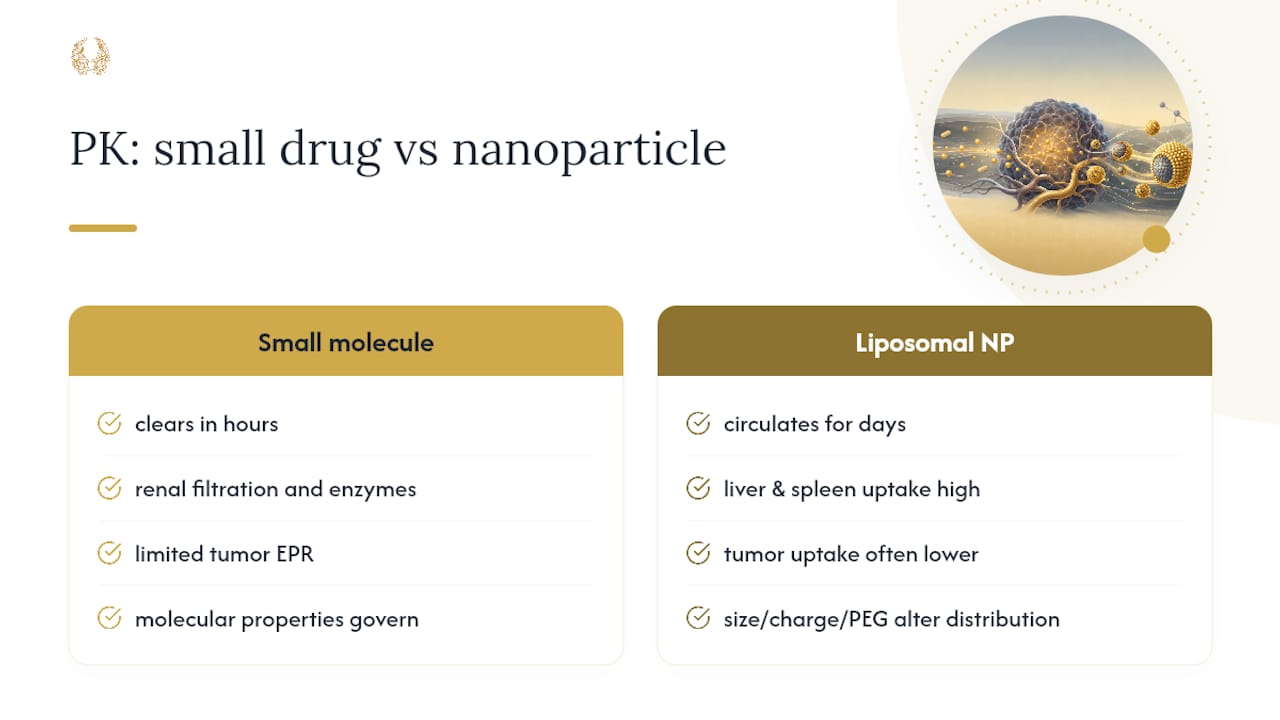
Biodistribution studies track where a particle ends up over time, and the pattern is remarkably consistent across platforms: the liver and spleen, organs rich in the phagocytic cells that clear foreign particles from blood, absorb the largest share of an injected dose, often far more than the tumor itself receives. This is a core reason so much nanomedicine research now focuses on evading or exploiting that clearance system rather than ignoring it.
Particle size, surface charge, and PEGylation density all shift this distribution pattern measurably. Smaller particles with denser PEG coatings tend to circulate longer and accumulate less in the liver, while larger or more positively charged particles get swept into clearance organs faster. Understanding a specific formulation’s pharmacokinetic and biodistribution profile, not assuming it behaves like the drug class in general, is a prerequisite for interpreting whether a trial’s dosing schedule and safety findings will hold up in a broader patient population.
How the FDA Regulates Nanomedicine for Cancer
No dedicated regulatory pathway exists specifically for nanomedicines. Instead, the FDA evaluates each nanoparticle-based therapy through its existing drug or biologic approval framework, applying nanoparticle-specific scrutiny to chemistry, manufacturing, and controls (CMC) sections of the submission based on the particle’s actual risk profile.
That case-by-case approach exists because a liposome, a protein-bound particle, and an inorganic nanoparticle raise genuinely different safety questions, and forcing them through an identical checklist would either under-scrutinize novel risks or over-burden well-understood platforms. The NCI’s Nanotechnology Characterization Laboratory plays a practical bridging role here, offering standardized preclinical characterization services that give sponsors and regulators a shared, comparable dataset before a formal submission, which shortens the back-and-forth that often stalls early nanomedicine reviews.
Researchers who engage the FDA early, before finalizing a pivotal trial design, consistently report fewer late-stage protocol changes. That is not a formal requirement, but it reflects how much nanoparticle-specific manufacturing and characterization questions benefit from being resolved before a large trial is underway rather than during it. For patients or family members researching a nanomedicine trial, understanding informed consent in this regulatory context, including what the sponsor is and isn’t required to have already proven, is worth reviewing before enrolling.
Does Nanomedicine Cost More? Weighing the Economics
Nanomedicine formulations generally cost more to manufacture than their conventional drug counterparts, and that manufacturing premium shows up in list price. Liposomal and protein-bound production requires specialized equipment and tighter quality control than standard small-molecule synthesis, and that cost gets passed through the healthcare system.
The cost-effectiveness argument for nanomedicines rests less on the drug price itself and more on what it prevents. Abraxane’s solvent-free paclitaxel formulation avoids the premedication regimens and infusion-reaction management that Cremophor-based paclitaxel requires, offsetting some of its higher acquisition cost through reduced supportive-care spending. Doxil’s reduced cardiotoxicity can mean fewer cardiac monitoring visits and less need for cardioprotective co-therapy over a treatment course.
Market-wide, the field’s economic footprint is still concentrated in a small number of approved products rather than spread across many, which mirrors the clinical trial pipeline: heavy early-stage investment, a narrow band of drugs that have actually reached commercial scale, and a long tail of platforms still working through the manufacturing and regulatory hurdles this article has covered. That concentration is itself informative for anyone evaluating where donor and grant dollars produce the most translational leverage right now, which tends to be exactly the unglamorous scale-up and characterization work that rarely attracts headline funding.
Ethical Questions Nanomedicine Research Has to Answer
Equitable access sits at the top of the ethical agenda for nanomedicine cancer treatment. When a nanoparticle formulation costs meaningfully more to manufacture than its conventional equivalent, and insurance coverage or geography determines who can actually receive it, the technology risks widening existing gaps in cancer outcomes rather than closing them.
Informed consent carries particular weight in early-phase nanomedicine trials, where novel particle behavior means safety data is thinner than it would be for a conventional drug at the same trial phase. Patients weighing enrollment deserve a clear, honest picture of what is and isn’t yet known about how a specific nanoparticle behaves in humans, not just its mechanism’s theoretical promise.
Long-term biocompatibility raises a separate ethical question that current trial timelines don’t fully answer: some inorganic and non-biodegradable particles may persist in clearance organs for years, and most trials aren’t designed or funded to follow patients that long. Building that follow-up into research funding models, rather than treating five-year survival as the natural endpoint of nanomedicine study, is a conversation the field is still having.
Where to Read More on Nanomedicine Cancer Research
The reviews and databases behind this article remain the strongest starting points for anyone going deeper.
- Recent advances in the bench-to-bedside translation of cancer nanomedicines, a 2024 review covering translational barriers across modalities
- Nanomedicine in cancer therapy, the 2023 Nature review on hierarchical targeting and EPR heterogeneity
- Nanoparticles in Clinical Trials: Analysis of Clinical Trials, FDA Approvals and Use for COVID-19 Vaccines, for trial pipeline and approval trends
- Cancer nanomedicine: a review of nano-therapeutics and challenges ahead, for historical context on Doxil and Abraxane
- NCI’s Nanotechnology Characterization Laboratory, for preclinical characterization standards
- Clinicaltrials, for searching active nanomedicine trials by phase and modality
- Precision-medicine context from Cancer Genomics in 2026, useful for readers exploring how genomic biomarkers might guide patient selection for nanomedicine trials
An Honest Look at Where Nanomedicine Cancer Research Stands
The evidence supports a specific, unglamorous conclusion: nanomedicine’s clinical wins so far have come from reducing toxicity, not from precision targeting. Doxil, Abraxane, and Onivyde succeed because they make existing chemotherapy tolerable, not because they hunt down cancer cells with the surgical precision the field’s marketing language often implies.
That gap between promise and delivery is where conventional coverage of this topic goes wrong. Coverage built around “smart nanoparticles” and active targeting breakthroughs skips past the inconvenient fact that no actively targeted nanoparticle has FDA approval yet, and that EPR, the passive mechanism actually driving current successes, works inconsistently in real tumors.
Researchers and clinicians reading this should prioritize one thing above novel materials chemistry: patient stratification. Knowing which patients will actually benefit from EPR-dependent delivery, before a nanomedicine is chosen, will likely move the field further in the next five years than another generation of exotic particle designs.
— HCRF
Key Takeaways
Nanomedicine reduces chemotherapy toxicity today through approved liposomal and protein-bound drugs, while active targeting and most novel modalities remain in early clinical trials awaiting proof in humans.
| Point | Details |
|---|---|
| Approved successes are toxicity-driven | Doxil, Abraxane, and Onivyde succeed by reducing side effects, not by proving precision targeting. |
| EPR is inconsistent in humans | Patient stratification, not universal passive targeting, should guide who receives EPR-dependent nanomedicines. |
| Manufacturing is a translation bottleneck | Batch variability and reproducible surface functionalization stall programs as often as biology does. |
| Immune clearance limits every platform | Protein corona formation reduces targeting precision regardless of how well a particle performs in a dish. |
| Regulatory engagement should start early | Working with FDA and NCI characterization resources before a pivotal trial shortens the path to approval. |
Help Close the Gap Between Nanomedicine Research and Patients
Every barrier covered here, immune clearance, manufacturing scale-up, patient stratification, gets solved by researchers willing to test the approaches that don’t fit a conventional grant proposal. That is the exact kind of work HCRF funds at the Robert H. Lurie Comprehensive Cancer Center, and it depends entirely on donors who believe unconventional research deserves a chance to reach patients.
If this article changed how you think about what nanomedicine can and can’t yet do, consider supporting the researchers working to close that gap. Visit the Hippocratic Cancer Research Foundation to give, partner, or follow the progress of the studies your support makes possible. Every dollar moves a promising nanoparticle one step closer to a patient who is waiting for it.
This article is general information, not a substitute for advice from a qualified doctor. Consult a qualified healthcare professional about your own circumstances before acting on anything here.
Sources
- Recent advances in the bench-to-bedside translation of cancer nanomedicines
- Nanomedicine in cancer therapy
- Nanoparticles in Clinical Trials: Analysis of Clinical Trials, FDA Approvals and Use for COVID-19 Vaccines
- Nanotechnology - NCI
Recommended
- Hippocratic Cancer Research Foundation: Innovative Therapies | How Many Cures for Cancer Are There?
- Hippocratic Cancer Research Foundation: Innovative Therapies | The Tumor Microenvironment: What Researchers and Clinicians Need to Know
- Hippocratic Cancer Research Foundation: Innovative Therapies | Does Tumor Size Determine Cancer Stage? What You Need to Know
- Hippocratic Cancer Research Foundation: Innovative Therapies | Supplements to Avoid During Immunotherapy: A Patient Guide

Unlock funding for your nonprofit with volunteer grant programs. Learn how to maximize support from corporate and capacity-building grants.
Read More →
Discover how using a donor-advised fund can maximize your contributions to cancer research, ensuring your grants make an impact.
Read More →