


Start Bids 40–50% on Experience Charity Auction Items for Nonprofits
September 16, 2026
Start Bids 40–50% on Experience Charity Auction Items for Nonprofits

The charity auction items that reliably raise the most money aren’t merchandise. They’re experiences, mission-linked packages, and curated themed baskets, sold with a specific story, a professional photo, and a starting bid tied to fair market value. Source them through donor asks, local business partnerships, and zero-risk consignment programs, and pair every listing with clear stewardship so donors trust where their generosity lands.
TL;DR:
- Experience-based packages such as private dinners and behind-the-scenes tours generate higher bids because they create memorable moments rather than physical objects.
- Items with specificity, like named seats or exact travel dates, tend to sell for more and receive better bids than vague or generic offerings.
- Placing rare or emotionally compelling items in live auctions can maximize their selling price, while broad-appeal, practical items perform better in silent auctions.
- Donors should provide written fair market value estimates at the time of contribution, and items should be well-presented with professional photos and clear descriptions to boost bidding.
- A well-curated selection of 12 to 15 live auction items and 30 to 80 silent auction items, segmented by price, optimizes energy and bidding across the event.
Table of Contents
- What Are the Best Charity Auction Items to Sell?
- Live Auction or Silent Auction: Where Should Each Item Go?
- How Do You Get Items Donated for a Charity Auction?
- What Makes a Charity Auction Item Sell for More?
- How Many Items Should a Charity Auction Have?
- What HCRF Wants Donors and Organizers to Know About Auction Receipts
- The Item That Outbid Everyone’s Expectations
- Sources
- FAQ
What Are the Best Charity Auction Items to Sell?
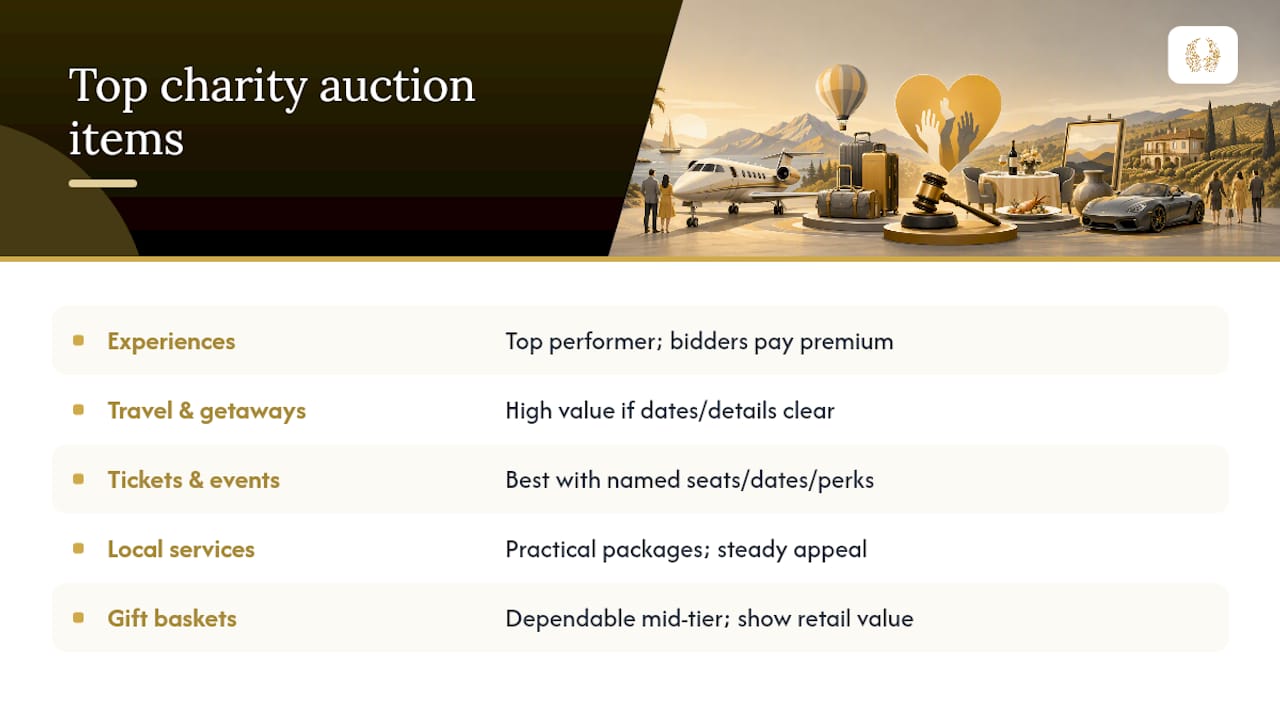
Experiences beat objects almost every time. A GiveSmart analysis of 25,000-plus campaigns found item performance shifts by category, region, and season, which is exactly why a rigid item list fails and a flexible framework works better. Here’s how to prioritize what you gather.
Experiences top the list because they can’t be bought off a shelf. Private chef dinners, wine pairings, cooking classes, and behind-the-scenes studio tours create a memory instead of a box to unwrap. Bidders pay a premium for access money can’t easily buy elsewhere.
Travel and getaways pull big numbers when they’re packaged with precision. A weekend cabin stays or a condo week works only if you nail down usage dates, blackout periods, and what’s included, like cleaning fees or airfare credits. Vague travel offers stall at low bids because nobody wants to guess what they’re actually winning.
Tickets and events perform best with specificity: named seats, named dates, named perks. “Front row seats to a Saturday concert, includes backstage meet and greet” out-earns “concert tickets” by a wide margin, according to CharityAuctions’ breakdown of items that sell well.
Local services round out a strong silent auction table. Home cleaning packages, a year of lawn care, private tutoring sessions, or a personal training package appeal to bidders who want practical value they’d pay for anyway.
Gift baskets remain a dependable mid-tier category. Build them around a theme, a backyard barbecue kit, a spa night, a coffee lover’s bundle, and keep the retail value visible on the card. Teen Lifeline’s compiled list of top-performing silent auction items leans heavily on themed baskets for exactly this reason.
Memorabilia and unique collectibles work in smaller doses, reserved for donor bases with a known passion, like sports fans or art collectors, rather than a general audience.
Mission-linked items, like symbolic gift-catalog donations (a share of medical equipment, a research grant match), can outsell ordinary goods because bidders feel their money doing double duty. Heifer International’s gift catalog model shows how a donation amount mapped directly to an impact statement turns a simple transaction into something worth bidding on.
Live Auction or Silent Auction: Where Should Each Item Go?
Item placement decides how much of its value you actually capture. Get it wrong and a rare experience gets buried on a silent bid sheet where nobody notices it.
- Send exclusivity to the live auction. Items with genuine rarity or emotional pull, a founder’s dinner, an owner’s box, a one-of-a-kind experience, belong on the stage where a live bidding war can push the price well past fair market value. Industry guidance from Bloomerang recommends capping this list at 12 to 15 premium items so momentum never stalls.
- Send broad appeal to the silent auction. Gift baskets, local services, mid-priced experiences, and travel packages do better spread across a larger catalog where guests can browse and bid at their own pace over the course of the evening.
- Watch return on FMV, not just final price. Experience packages often return a higher percentage of fair market value than physical goods because there’s no resale comparison point pulling the bid down. A silent auction basket priced against a retail tag caps out fast; a private dinner with a notable local chef doesn’t have that ceiling.
How Do You Get Items Donated for a Charity Auction?
Sourcing charity auction items comes down to three channels, and most successful events use all three at once rather than relying on a single well of generosity.
Start with direct donor asks. Approach major donors and board members first, since they already have skin in the game, then move to a written ask that names a specific item category rather than a vague request for “anything you can give.” A one-page ask letter with a suggested value range tends to perform better than an open-ended email.
Next, build local business partnerships. Restaurants, salons, boutique gyms, and specialty shops often donate gift certificates or service packages in exchange for event-night recognition and a mention in your printed program. Treat this as a relationship, not a transaction: businesses that donate once tend to donate again if you follow up with a thank-you and a photo from the event.
Finally, consider zero-risk consignment programs for high-value travel and experience inventory. Providers like GalaBid supply no-cost consigned auction items, and you pay only if the item actually sells, which removes the financial exposure smaller nonprofits can’t absorb on unproven inventory.
Whichever channel lands the donation, collect the same information every time:
- Donor’s full name and contact information for the receipt
- Fair market value as stated by the donor
- Blackout dates, expiration windows, and geographic restrictions
- Any usage limits (party size, transferability, appointment requirements)
Pro Tip: Ask every donor for a fair market value estimate in writing at the time of the pledge. Chasing that number down two weeks before the event, when the donor has moved on, wastes staff time you don’t have.
What Makes a Charity Auction Item Sell for More?
Presentation decides whether an item sells near its floor price or well above it. Items listed with clear, professional photos and specific descriptions draw roughly 30% more bidder engagement than items with generic stock images or vague copy.
Three levers do most of the work:
- Photography. A single photo session for your top ten items pays for itself many times over; staged, well-lit images signal that the item is worth a serious look.
- Storytelling. A one or two sentence story connecting the item to your mission converts a hesitant browser into an active bidder, since specific emotional detail raises perceived value far more than a plain product description.
- Pricing. Set starting bids at roughly 40 to 50% of fair market value to invite early action, then use bid increments that keep momentum without discouraging new bidders from jumping in.
Display matters just as much as the listing itself. Clear signage, a QR code linking to mobile bidding, and a printed fair market value on every card remove friction at the exact moment a guest is deciding whether to bid. For guidance on documenting what a donor should receive once an item changes hands, an overview of noncash charitable contributions walks through the paperwork side of the process.
How Many Items Should a Charity Auction Have?
Curate, don’t hoard. A catalog stuffed with low-value donations dilutes attention away from the items that could actually move the needle.
- Live auction: 12 to 15 items. This range keeps energy high and gives your auctioneer room to build momentum on each item without losing the room’s attention.
- Silent auction: 30 to 80 items, segmented by price band. A workable mix runs roughly 40% low-price items ($25 to $75), 40% mid-price items ($75 to $250), and 20% high-price items ($250 and up), so bidders across every budget find something worth pursuing.
- Pace your closes. Stagger silent auction closing times by table or category rather than closing everything at once, and sequence your live items so the strongest piece lands roughly two-thirds through the segment, when the room’s energy peaks.
What HCRF Wants Donors and Organizers to Know About Auction Receipts
Every organizer running a charity auction inherits a documentation responsibility the moment a business or individual donates an item. Guidance on noncash charitable contributions outlines what belongs in a donor’s file: the donor’s name, a written description of the item, and its stated fair market value at the time of the gift.
Before the event, confirm four things for every donated item: a signed donor acknowledgment, an FMV notation the donor agrees with, current contact information, and any restrictions the winning bidder needs to know before they bid. For questions about how a donation might affect a donor’s own return, point them toward an explainer on charitable donation tax deductions rather than guessing at IRS rules yourself.
Mission-linked items deserve extra care in how they’re presented. If you’re auctioning a symbolic gift tied to research funding, state plainly what the dollar amount supports so bidders know exactly what their winning bid accomplishes. After the event closes, move fast: notify every donor whether their item sold, publish a short recap of what the event funded, and get receipts out within a few weeks, not months.
— HCRF
The Item That Outbid Everyone’s Expectations
The pattern HCRF sees again and again is simple: the items that overperform aren’t the most expensive ones on the sheet. They’re the ones with the clearest story. A modest weekend cabin donation with a warm, specific write-up and a good photo has outbid flashier items with vague descriptions more than once.

Three moves worth making this week: write a one-sentence story for every item tying it back to why the donation matters, invest an afternoon in decent photos for your top ten pieces, and send donor thank-yous within 48 hours of the event closing. Stewardship isn’t an afterthought bolted onto the end of a fundraiser. It’s the reason the same donors show up next year.
Every dollar raised through auction items like these goes directly toward funding unconventional cancer research at the Hippocratic Cancer Research Foundation, supporting work at the Robert H. Lurie Comprehensive Cancer Center that depends on exactly this kind of community generosity.
Sources
For deeper data on item performance, see GiveSmart’s nationwide auction study, CharityAuctions’ breakdown of top-selling items, Bloomerang’s live auction item guide, and HCRF’s own donor impact stories for storytelling templates.
- Silent Auction Items That Sell Well | CharityAuctions
- 40+ unforgettable live auction items that sell well | Bloomerang
- Auction Items for Charity Events. No Risk Prizes | GalaBid
FAQ
How Do You Get Items for a Charity Auction?
Combine three sourcing channels: direct asks to major donors and board members, partnerships with local businesses for gift certificates and services, and zero-risk consignment programs for high-value travel or experience packages that cost nothing upfront.
Can You Write Off Donated Charity Auction Items?
Donors who contribute an item can typically deduct its fair market value as a noncash charitable contribution, while a bidder who pays more than an item’s stated FMV may deduct only that excess amount. Rules vary by situation, so donors should review HCRF’s charitable donation tax deduction guidance or consult a tax professional.
What Items Sell Best at Charity Auctions?
Experience-based packages, like private dinners, travel getaways, and VIP event tickets, consistently outsell physical merchandise, especially when paired with a specific story and a professional photo.
What Are the Easiest Items to Sell for Fundraising?
Themed gift baskets and local service packages tend to move quickly because they’re broadly appealing, easy to price against retail value, and simple for local businesses to donate without much lead time.
Recommended


Dimitris has created a special series of acrylic watercolor paintings, each meticulously crafted to embody the spirit of our event. His unique artwork showcases stunning angel wings—a powerful symbol of hope, protection, and upliftment.
Read More →