


Clinicians: Why 83% Sensitivity in Liquid Biopsy Research Misleads
September 24, 2026
Clinicians: Why 83% Sensitivity in Liquid Biopsy Research Misleads

Liquid biopsy research uses tumor-derived material circulating in blood and other body fluids, including circulating tumor DNA (ctDNA), circulating tumor cells (CTCs), exosomes, and ctRNA, to profile, monitor, and screen for cancer without a surgical sample. Some applications, like advanced-disease genotyping in non-small cell lung cancer, are clinically established today. Others, including minimal residual disease (MRD) tracking and multi-cancer early detection (MCED), remain active research priorities with real promise but incomplete outcome data. The evidence strength behind any liquid biopsy claim depends entirely on which use case you’re asking about.
TL;DR:
- Liquid biopsy accuracy varies significantly with cancer type, disease stage, and assay chemistry, making a single sensitivity or specificity figure unreliable.
- False positives often result from clonal hematopoiesis mimicking tumor mutations, while false negatives are common in low-shedding tumors and certain anatomical sites.
- Most clinically established applications, such as advanced disease genotyping, are supported by regulatory clearance and payer coverage, unlike MRD and MCED, which require further validation.
- Combining methylation, fragmentomics, and protein data in multimodal assays shows promise but needs rigorous validation across different labs and populations.
- Proper study reporting should include specimen processing details and matched white-blood-cell controls to ensure reproducibility and accuracy in liquid biopsy research.
Table of Contents
- What Does Liquid Biopsy Research Actually Measure?
- Which Liquid Biopsy Applications Are Clinically Ready?
- What Lab Methods Power Modern Liquid Biopsy Assays?
- Why Doesn’t Liquid Biopsy Have One Accuracy Number?
- What Should a Reproducible Liquid Biopsy Study Report?
- How Do FDA Clearance and Insurance Coverage Actually Work?
- Where Should Liquid Biopsy Research Focus Next?
- Reading Liquid Biopsy Claims: A Practical Filter
- Sources
- FAQ
What Does Liquid Biopsy Research Actually Measure?
Every liquid biopsy analyte tells a slightly different story about a tumor, and choosing the wrong one for your research question is a common early mistake. Circulating tumor DNA fragments are short, typically under 180 base pairs, and clear from the bloodstream within roughly two hours. That short half-life is actually an advantage for monitoring: a fresh ctDNA draw reflects the tumor’s current mutational and methylation state rather than a snapshot from months earlier. Hybrid-capture and amplicon-based sequencing of ctDNA now support both single-gene mutation calling and genome-wide methylation profiling, which is why ctDNA dominates most companion-diagnostic and MRD research programs.
Other analytes fill narrower but valuable niches:
- Circulating tumor cells (CTCs) carry whole-cell biology, letting researchers study protein expression and even culture live cells, though their low abundance in blood limits throughput.
- Exosomes and extracellular vesicles (EVs) shuttle RNA and protein cargo that can reveal tumor signaling even when ctDNA shedding is low.
- ctRNA captures gene-expression activity, useful for transcriptomic subtyping that DNA alone cannot provide.
- Circulating proteins remain the backbone of many screening panels, often combined with genomic markers for higher sensitivity.
- Tumor-educated platelets absorb RNA from the tumor microenvironment and are an emerging, less-validated signal source.
Non-blood fluids matter too. Cerebrospinal fluid captures ctDNA shed by central nervous system tumors that rarely reaches peripheral blood. Urine and pleural or peritoneal effusions offer tumor-proximity advantages for bladder, lung, and gynecologic cancers respectively. The NCI Liquid Biopsy Consortium is actively developing and validating assays across nearly all of these analytes and fluid types, aiming specifically to distinguish cancer from benign or indolent disease rather than just detect a signal.
Which Liquid Biopsy Applications Are Clinically Ready?
Evidence readiness varies sharply by application, and conflating a research-stage use with an established one is the most common misreading of this field. Recent review literature frames the landscape across three distinct tiers, and understanding which tier a given claim belongs to changes how much weight it should carry.
- Advanced-disease genotyping is the most mature application. Plasma-based companion diagnostics for identifying actionable mutations in metastatic non-small cell lung cancer and other solid tumors are supported by regulatory clearance and routine payer coverage, particularly when tissue biopsy is unavailable or unsafe.
- Minimal residual disease (MRD) detection after curative-intent surgery or chemotherapy is a fast-moving research area. Tumor-informed assays, which design a patient-specific mutation panel from the resected tumor, generally show stronger analytical performance than tumor-naïve assays that scan for generic cancer signals. Prospective trials linking MRD-guided treatment decisions to survival outcomes are still ongoing rather than complete.
- Multi-cancer early detection (MCED) carries genuinely promising pooled accuracy metrics, but no MCED test has yet demonstrated a mortality benefit in a completed randomized trial. Between-study heterogeneity in MCED performance data is substantial, a point worth holding onto before citing any single accuracy figure as definitive.
- Monitoring and resistance profiling during active treatment is where liquid biopsy often adds the most immediate clinical value, since serial blood draws can flag emerging resistance mutations weeks before imaging shows progression.
A recent Frontiers review of liquid biopsy biomarkers frames this same tiered structure, emphasizing that MRD and MCED both need randomized outcome trials before they can graduate from “promising” to “practice-changing.” Researchers designing new studies should state explicitly which tier they’re targeting, since reviewers and readers judge advanced-disease genotyping claims and MCED claims by very different evidentiary standards.
What Lab Methods Power Modern Liquid Biopsy Assays?
The method you choose determines the tradeoff between sensitivity and breadth, and no single platform wins on both axes. Digital droplet PCR (ddPCR) and digital PCR (dPCR) offer the highest sensitivity for detecting a small number of known variants, making them ideal for tracking a single hotspot mutation across serial samples. Their weakness is breadth: ddPCR can’t scan for unknown or novel variants outside its designed targets.
Next-generation sequencing (NGS) approaches trade some of that per-variant sensitivity for much wider coverage. Amplicon-based NGS panels are faster and cheaper but can miss structural variants; hybrid-capture NGS panels sequence broader genomic regions at higher depth, which matters because unique fragment depth (how many independent DNA molecules are actually sequenced at a given position, not just total reads) directly determines the assay’s limit of detection for low-frequency variants.
Two newer signal-amplification strategies are reshaping what’s detectable in low-shedding tumors:
- Methylation profiling captures epigenetic changes that appear earlier and more broadly across cancer types than point mutations, which is why most MCED panels lean heavily on methylation signal.
- Fragmentomics analyzes the size and end-motif patterns of cell-free DNA fragments, exploiting the fact that tumor-derived DNA fragments differently than normal cell-free DNA.
- Machine-learning pipelines integrate methylation, fragmentomics, and mutation data into a single composite score, often outperforming any single modality alone.
The catch with machine-learning integration is validation. A review of multimodal cfDNA approaches notes that combining methylation, fragmentomics, and protein markers shows real promise for low-shedding cancers, but many models are trained and tested on the same population without external validation, which inflates apparent performance. Any ML-based liquid biopsy claim deserves a follow-up question: was this validated on an independent cohort collected at a different site?
Why Doesn’t Liquid Biopsy Have One Accuracy Number?
There is no single sensitivity or specificity figure that applies across liquid biopsy research, and any source that quotes one flat number is oversimplifying. Performance shifts with cancer type, disease stage, the specific assay chemistry, and where the positivity threshold is set. A ctDNA assay tuned for high sensitivity in stage IV disease will underperform badly in stage I, where tumors simply shed less DNA into circulation.
A 2025 meta-analysis pooling 13 studies and nearly 14,900 participants found ML-based cfDNA assays for multi-cancer early detection achieved pooled sensitivity of 0.78 and specificity of 0.96, with an AUC of 0.94. But between-study heterogeneity exceeded 90% (I²), meaning individual studies varied so much that the pooled average masks real inconsistency in how these assays perform across different populations and cancer types.
That heterogeneity problem isn’t isolated to one meta-analysis. A broader umbrella review of 42 systematic reviews covering liquid biopsy outcomes found that 75 of 211 reported outcomes had excellent accuracy, an AUC above 0.90, yet 197 of those same 211 outcomes carried a very serious risk of bias. High reported accuracy and low certainty routinely coexist in this literature, which is exactly the kind of nuance that gets lost when a press release quotes only the accuracy number.
Two failure modes account for most misclassifications:
- False positives frequently trace back to clonal hematopoiesis of indeterminate potential (CHIP), where age-related blood-cell mutations in genes like DNMT3A, TET2, and ASXL1 mimic tumor-derived variants in plasma.
- False negatives occur in low-shedding tumors and certain anatomical sites where the tumor simply doesn’t release enough DNA into peripheral blood to clear the assay’s limit of detection.
The practical fix is procedural: serial sampling instead of a single draw, matched white-blood-cell controls to filter CHIP variants, and confirmatory tissue biopsy or imaging before any consequential clinical decision. A negative liquid biopsy result does not rule out cancer, particularly for tumors known to shed poorly, according to MedlinePlus’s overview of circulating tumor DNA testing.
What Should a Reproducible Liquid Biopsy Study Report?
Cross-study comparison in this field is often undermined by inconsistent methods reporting, not flawed biology. A clinical practice guideline for blood-based ctDNA assays lays out the pre-analytic and analytic variables that materially change ctDNA yield and must be reported for a study to be interpretable:
- Specimen type, collection tube (EDTA vs. cell-stabilizing tubes), and time-to-spin from draw to plasma separation.
- Storage temperature and centrifugation parameters, since hemolysis and delayed processing both degrade signal quality.
- Analyte type, assay chemistry, sequencing depth, limit of detection (LOD and LOD95), and the specific bioinformatic variant-calling thresholds used.
- Matched white-blood-cell sequencing alongside every plasma sample to exclude CHIP-driven variants before calling them tumor-derived.
- Confidence intervals and heterogeneity metrics (I², for example) whenever pooling results across sites or cohorts.
Validation frameworks like BloodPAC exist specifically to standardize these reporting elements across labs, and referencing them in a methods section signals that a study can actually be compared against others in the field.
Pro Tip: Run a matched white-blood-cell control on every single plasma sample, not just a subset. Skipping this step on “obviously clean” samples is exactly how CHIP-driven false positives slip through peer review.
How Do FDA Clearance and Insurance Coverage Actually Work?
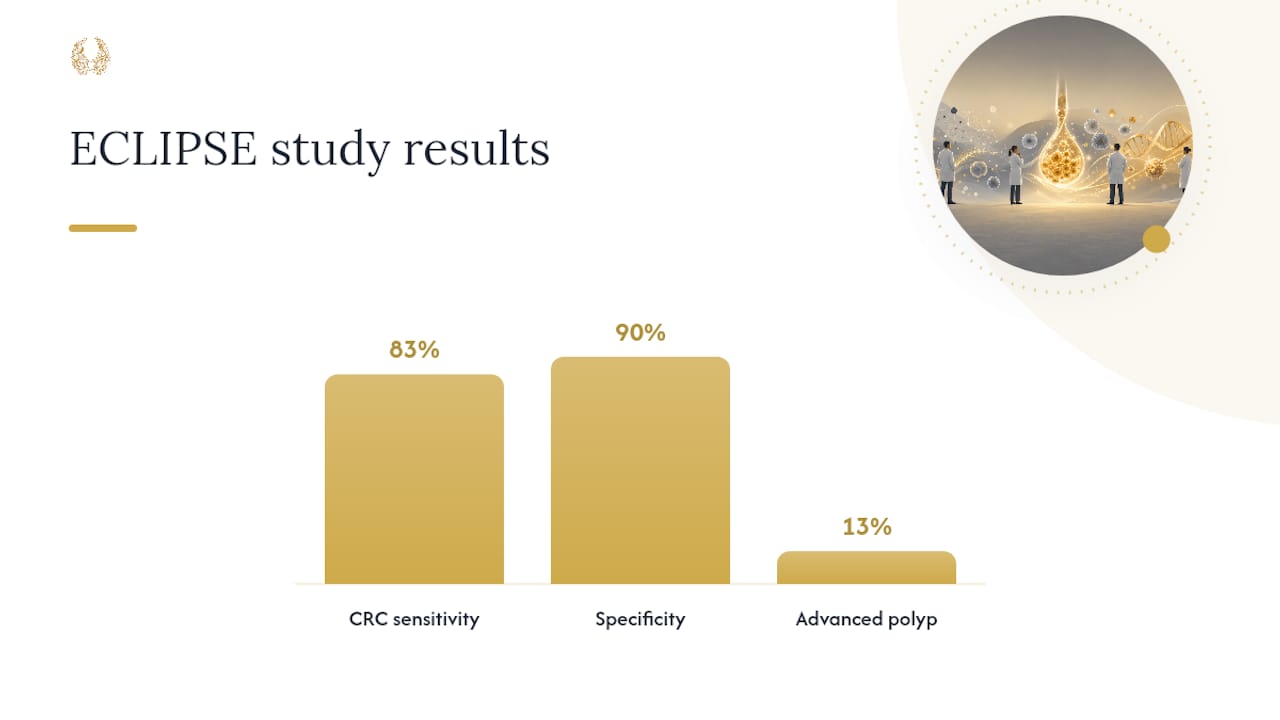
Regulatory clearance for one liquid biopsy test doesn’t transfer to another, and mixing up “FDA-cleared” with “covered by my payer” causes real confusion for ordering clinicians. Shield received FDA clearance in 2024 as a primary colorectal cancer screening blood test, backed by the ECLIPSE study of roughly 23,000 participants, which showed 83% sensitivity and 90% specificity for colorectal cancer, plus detection of 13% of advanced precancerous polyps. A positive Shield result still requires a diagnostic colonoscopy, since the test screens rather than diagnoses.
Companion diagnostics operate under a different clearance logic entirely. Guardant360® CDx and FoundationOne® Liquid CDx are plasma-based tests cleared to identify specific actionable mutations that guide targeted therapy selection, most notably in non-small cell lung cancer. The cobas EGFR Mutation Test v2 similarly serves as a plasma companion diagnostic tied to a specific EGFR inhibitor decision. Each clearance covers a defined indication, not liquid biopsy broadly.
Payer behavior follows indication, not technology. Payer coverage analyses show routine coverage for FDA-cleared companion-diagnostic uses in NSCLC and select cancers, while MCED and other investigational applications frequently require prior authorization or go uncovered. Before ordering, clinicians should confirm the specific test code, document medical necessity in the chart, and check the payer’s current criteria rather than assuming coverage follows the FDA clearance automatically.
Where Should Liquid Biopsy Research Focus Next?
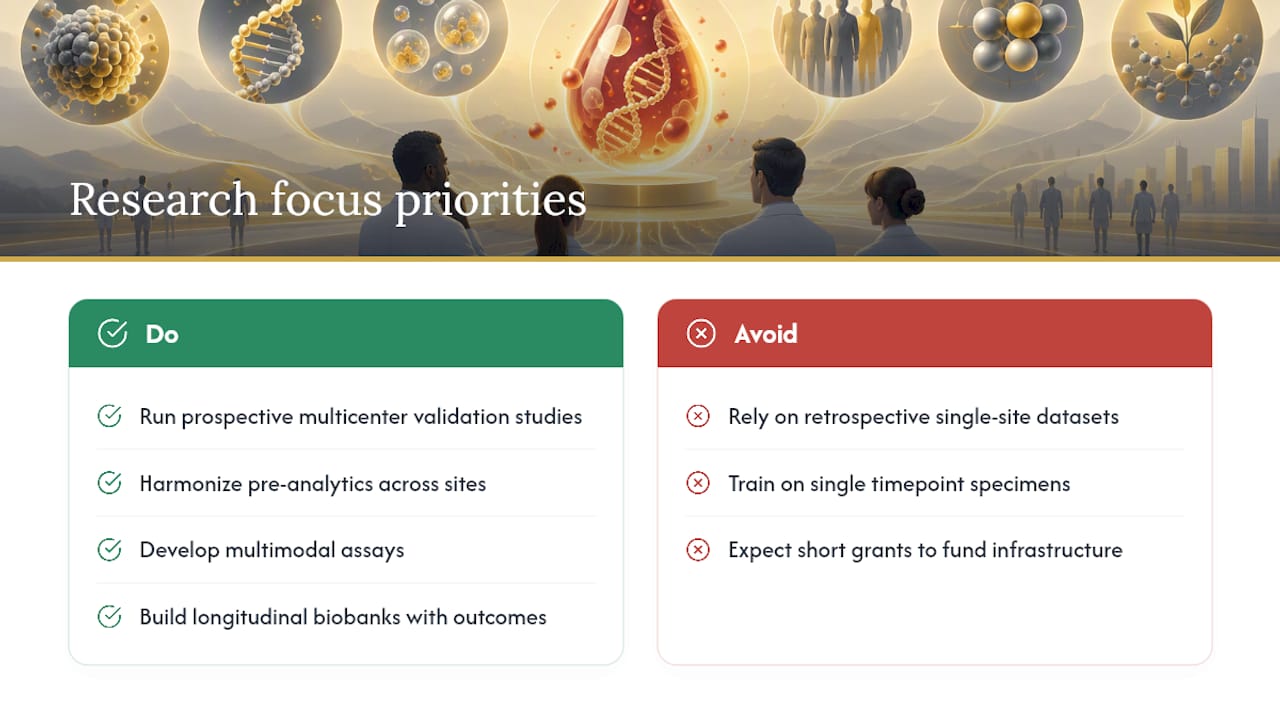
The next real gains in this field will come from prospective, multicenter validation, not from a better algorithm run on the same retrospective dataset. Multimodal assays that layer methylation, fragmentomics, and protein signal are the most technically promising direction for catching low-shedding cancers, but the field needs harmonized pre-analytics across sites before those results can be trusted outside the lab that generated them. The NCI Liquid Biopsy Consortium is one of the clearest examples of this priority in action, funding multi-site development specifically designed to test whether an assay validated at one center holds up at another.
Biobank-linked studies matter here too. A liquid biopsy assay is only as good as the annotated specimens it’s trained and tested against, and that requires longitudinal collection paired with confirmed clinical outcomes, not just a diagnosis at a single time point. This is exactly the kind of infrastructure-heavy, unglamorous research that traditional grant cycles tend to underfund, because it rarely produces a flashy result within a two-year review window.
That gap is where nonprofit and academic-industry consortium funding earns its keep. HCRF exists to support the “out of the box” studies at the Robert H. Lurie Comprehensive Cancer Center of Northwestern University that don’t fit neatly into conventional grant categories, including the kind of multi-year biobank and validation infrastructure liquid biopsy research depends on. Clinicians interested in this work can explore current early detection biomarker research or review clinical trial eligibility criteria for studies actively enrolling patients. Peer nonprofit efforts, like Beat Stupid Cancer, reflect the same broader pattern of philanthropy filling gaps that federal funding cycles leave open.
Reading Liquid Biopsy Claims: A Practical Filter
Before trusting a new liquid biopsy study or commercial claim, separate analytical validity (does it detect the target reliably) from clinical validity (does the result correlate with disease) and clinical utility (does acting on it improve outcomes). Most marketing skips straight to utility language without utility data behind it. Order a liquid biopsy when tissue is unavailable, unsafe to obtain, or when serial monitoring is the goal; lean on tissue biopsy or imaging when the liquid result is negative but clinical suspicion remains high. Patients deserve a plain explanation that a negative result doesn’t rule out cancer, and that incidental findings, an unexpected mutation unrelated to the cancer being tracked, are a real possibility worth discussing before the draw, not after.
— HCRF
This article is general information, not a substitute for advice from a qualified doctor. Consult a qualified healthcare professional about your own circumstances before acting on anything here.
Sources
- Liquid Biopsy Consortium - Division of Cancer Prevention
- Meta-analysis of ML-based cfDNA assays for multi-cancer early detection (2025)
- Shield blood test colorectal cancer screening (NCI blog, 2024)
FAQ
What Is the Success Rate of a Liquid Biopsy?
There’s no single success rate; performance depends on cancer type, stage, and assay. Shield’s ECLIPSE trial reported 83% sensitivity and 90% specificity for colorectal cancer screening specifically, while pooled MCED assays showed 78% sensitivity and 96% specificity with substantial variability between studies.
What Are the Downsides of Using a Liquid Biopsy?
The main downsides are false negatives from low-shedding tumors and false positives from clonal hematopoiesis mimicking tumor mutations. A negative result never fully rules out cancer, according to MedlinePlus, and confirmatory tissue or imaging is usually still needed when clinical suspicion persists.
How Accurate Are Liquid Biopsies?
Accuracy varies widely by application and assay design rather than following one fixed number. A 2025 umbrella review found many outcomes reached AUC above 0.90, but most of those same outcomes carried very low certainty due to high risk of bias, so high reported accuracy doesn’t automatically mean high confidence.
Does Insurance Pay for a Liquid Biopsy?
Coverage depends heavily on the specific indication rather than the technology itself. Payer analyses show routine coverage for FDA-cleared companion diagnostics like Guardant360® CDx in eligible cancers, while investigational uses and MCED testing often require prior authorization or go uncovered.
Recommended

For U.S. high net worth families: compare DAFs and private foundations: tax limits, the 5% payout, privacy vs control, and when to use both.
Read More →
Discover how to make anonymous charitable donations while staying IRS-compliant. Utilize donor-advised funds and other options for total privacy.
Read More →