


Clinician Update: Degraders, KRAS, AI Drive 2026 Targeted Therapy
September 20, 2026
Clinician Update: Degraders, KRAS, AI Drive 2026 Targeted Therapy

The most consequential targeted therapy advances of the past year center on mutation-defined approvals that finally reach patients who had no good options: sevabertinib for HER2-mutant lung cancer, daraxonrasib for RAS-driven pancreatic cancer, and the first phase III positive result for an individualized neoantigen mRNA therapy in melanoma. Each expands a treatable, biomarker-selected population rather than offering marginal benefit across an unselected group. Together with early KRAS G12D inhibitor data and label updates for existing agents, these developments mark a real shift in how precisely oncology can now match drug to tumor.
TL;DR:
- The approval of sevabertinib shows it has a 75% response rate in HER2-mutant lung cancer, with 73% of responders benefiting beyond six months.
- Daraxonrasib demonstrated substantial effectiveness in pancreatic cancer, with a median overall survival of 13.2 months versus 6.7 months for standard therapy in a randomized trial.
- New mechanisms like degraders and bispecific antibodies are expanding druggable targets, including previously considered undruggable proteins like KRAS G12D.
- Resistance to targeted therapy mainly arises from on-target mutations, bypass signaling, or lineage plasticity, prompting combination and sequential treatment strategies.
- Personalized neoantigen mRNA vaccines show promise in shortening development timelines but still depend on early tissue sampling and manufacturing speed.
Table of Contents
- Recent Advances in Targeted Therapy: What’s New in Approvals and Trial Readouts
- How New Targeted Cancer Drugs Work: Degraders, Bispecifics, and RAS Inhibitors
- Reading the Clinical Trial Data on Targeted Cancer Treatments
- Why Targeted Cancer Treatments Stop Working, and How Oncologists Respond
- How AI Is Speeding Up Personalized Medicine Breakthroughs
- Who Benefits: Biomarker Testing and Patient Selection for Targeted Therapy
- HCRF’s Role in Advancing Targeted Cancer Treatments
- Where Targeted Therapy Research Goes From Here
- Support the Research Behind the Next Approval
- Sources
- FAQ
Recent Advances in Targeted Therapy: What’s New in Approvals and Trial Readouts
The last cycle of approvals and late-stage readouts has been unusually dense for a field that often moves in small increments.
- Sevabertinib received FDA accelerated approval for locally advanced or metastatic non-squamous NSCLC carrying HER2 tyrosine kinase domain activating mutations.
- Daraxonrasib (RASONQUE) won full FDA approval for metastatic pancreatic adenocarcinoma with RAS G12 mutations after prior therapy.
- Intismeran autogene plus pembrolizumab met its primary endpoint in INTerpath-001, improving recurrence-free survival in resected melanoma at interim analysis.
- RYBREVANT (amivantamab)-based regimens, IBTROZI (taletrectinib) with an updated duration-of-response label, GFH375, and tinengotinib each added mutation-specific or biomarker-correlated efficacy signals this cycle.
The number that matters most right now: sevabertinib produced a 75% objective response rate in Skin-dive HER2-mutant NSCLC patients, with 73% of responders maintaining benefit past six months.
How New Targeted Cancer Drugs Work: Degraders, Bispecifics, and RAS Inhibitors
Targeted therapy traditionally meant three tools: small-molecule kinase inhibitors, monoclonal antibodies, and antibody-drug conjugates (ADCs) that deliver cytotoxic payloads directly to antigen-positive cells. The newest wave adds mechanisms built for targets that used to be considered undruggable.
- Molecular glues and targeted protein degraders recruit the cell’s own disposal machinery to destroy a disease-driving protein rather than merely block its activity, opening access to fusion proteins and scaffolding targets that resist conventional inhibition.
- Bispecific antibodies engage two targets simultaneously, such as EGFR and MET together, which can delay the bypass signaling that lets tumors escape single-target drugs.
- ADCs still rely on antibody specificity plus a toxic payload, but newer linker chemistry improves the therapeutic window compared with earlier-generation conjugates.
- KRAS ON/OFF inhibitors like GFH375 selectively lock the G12D-mutant protein in its inactive state, and several programs in this class are being engineered for brain penetration to address central nervous system metastases, per mechanistic reviews on molecular glues and degraders.
Pro Tip: When reviewing a new agent’s mechanism, check whether it inhibits a protein’s activity or degrades the protein entirely. Degraders can remain effective against resistance mutations that render inhibitors useless, because there’s no active site left to mutate.
Reading the Clinical Trial Data on Targeted Cancer Treatments
Numbers only mean something in context, and this crop of trials offers a useful contrast between mature randomized evidence and early single-arm signals.
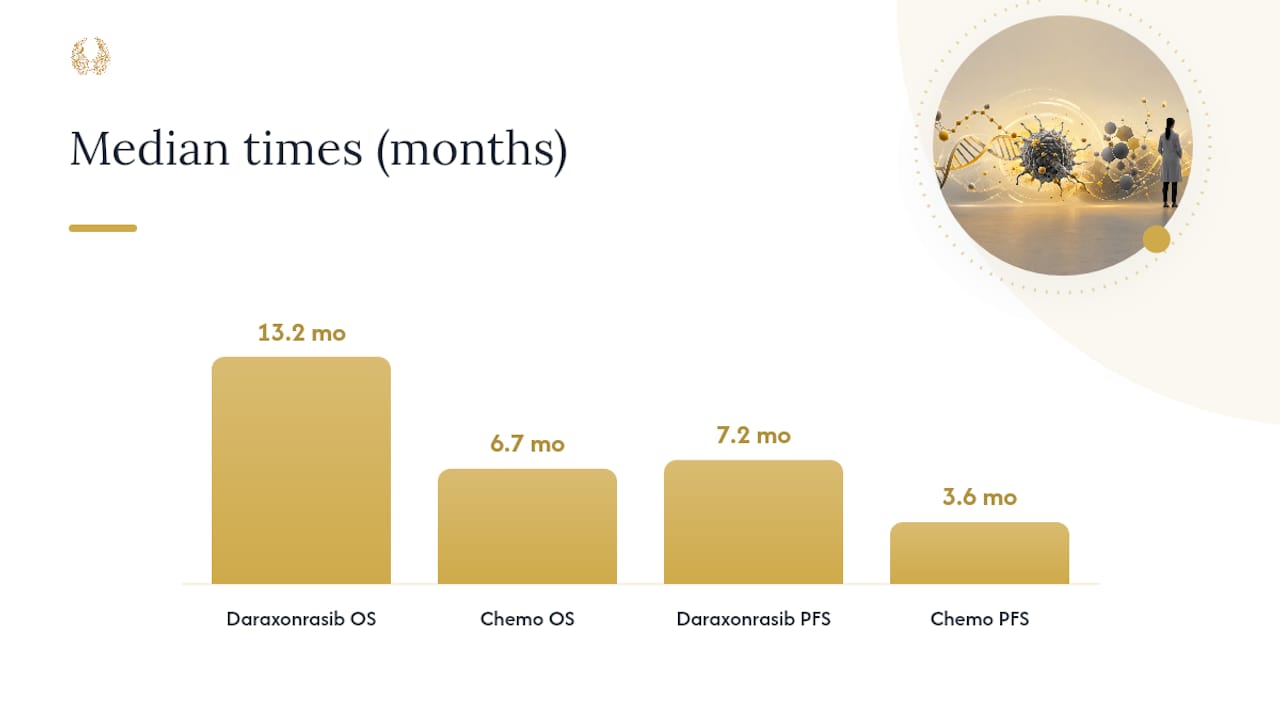
Daraxonrasib’s RASolute 302 trial is the standout for rigor: a randomized comparison against standard chemotherapy showing median overall survival of 13.2 months versus 6.7 months (hazard ratio 0.40), median progression-free survival of 7.2 versus 3.6 months, and an ORR of 30% versus 11%. That is a randomized, controlled dataset in a cancer where survival gains have been measured in weeks for decades.
GFH375, by contrast, is still in phase 1. It posted an ORR of 35.1% in pancreatic cancer and 35.7% in NSCLC, with manageable safety at the recommended phase 2 dose of 600 mg once daily. Promising, but single-arm data in a small cohort always overstates durability compared with what randomized phase 3 trials later confirm.
- IBTROZI’s updated label now reflects a median duration of response near 49.7 months in TKI-naive ROS1-positive NSCLC, among the longest DOR figures reported for any targeted lung cancer regimen.
- Tinengotinib showed clinical benefit in 27% of evaluable patients across a mixed solid tumor population, with responses correlating to FGFR2 fusion status.
- INTerpath-001’s interim analysis reached statistical significance on recurrence-free survival, but interim results in immunotherapy combinations have occasionally narrowed at final analysis, so mature follow-up still matters.
Why Targeted Cancer Treatments Stop Working, and How Oncologists Respond
Every targeted agent eventually meets resistance, and the mechanisms tend to fall into recognizable categories.
- On-target mutations alter the drug-binding site itself, the classic escape route for kinase inhibitors and a known challenge even for newer KRAS inhibitors.
- Bypass signaling reroutes the tumor through a parallel pathway, which is part of why dual-targeting bispecifics against EGFR and MET are being tested to close that escape hatch before it opens.
- Lineage plasticity lets tumor cells shift identity entirely, sometimes converting an adenocarcinoma into a more treatment-resistant histology.
Clinicians increasingly counter these patterns with sequential or combination strategies, pairing a targeted agent with a checkpoint inhibitor, layering bispecifics onto first-line inhibitors, or switching regimens based on serial biomarker monitoring rather than fixed schedules. Adaptive trial designs that adjust cohorts based on real-time biomarker data, as described in research on acquired resistance, are becoming the standard framework for testing these sequences rather than a novelty.
How AI Is Speeding Up Personalized Medicine Breakthroughs
The individualized neoantigen mRNA program behind intismeran illustrates how much translational timelines have compressed. A deterministic machine learning pipeline scans a patient’s tumor sequencing data, predicts which mutated proteins are most likely to trigger an immune response, and designs an mRNA vaccine encoding those specific neoantigens.
- The approach depends on paired clinical and immunogenicity data to train and validate its predictions, and algorithm bias remains a real limitation when training sets underrepresent certain tumor types.
- Manufacturing timelines for a fully individualized vaccine still run longer than off-the-shelf therapy, which matters for patients who cannot wait.
Pro Tip: If you’re considering a referral to an individualized neoantigen trial, confirm the tissue sample requirements and expected manufacturing turnaround with the trial site early. A delayed tumor sample can push vaccine readiness back by weeks.
Who Benefits: Biomarker Testing and Patient Selection for Targeted Therapy
Matching a patient to the right targeted cancer treatment starts with tissue, not intuition.
- Order a tumor NGS panel and, when tissue is limited or unavailable, a liquid biopsy to identify actionable mutations such as HER2 TKD, KRAS G12D/G12, or ROS1 fusions.
- Match the mutation to the approved or trial-eligible setting. Some agents, like daraxonrasib, are approved after prior systemic therapy in metastatic disease; others are being tested earlier, in adjuvant or first-line contexts.
- Confirm the result with an FDA-authorized companion diagnostic before initiating a mutation-matched agent, and bring the case to multidisciplinary tumor board for trial-eligible patients whose mutation doesn’t yet have an approved match.
The National Cancer Institute’s overview of targeted therapy types remains a reliable primer on which drug classes apply to which settings and their typical side-effect profiles.
HCRF’s Role in Advancing Targeted Cancer Treatments
The Hippocratic Cancer Research Foundation funds “out of the box” translational projects at the Robert H. Lurie Comprehensive Cancer Center of Northwestern University, the kind of early, high-risk work that traditional grant cycles often pass over before it reaches the stage these approvals represent.
- HCRF-supported research spans multiple translational fronts, including oncolytic virus therapy and nanomedicine approaches to drug delivery.
- Donor funding is directed at projects too early-stage or unconventional for standard federal grant mechanisms, the exact gap where degrader platforms and individualized neoantigen pipelines once sat, before this year’s data matured.
- Readers evaluating diagnostic infrastructure behind mutation testing can also review how genomic diagnostics programs operationalize the NGS panels referenced above.
Where Targeted Therapy Research Goes From Here
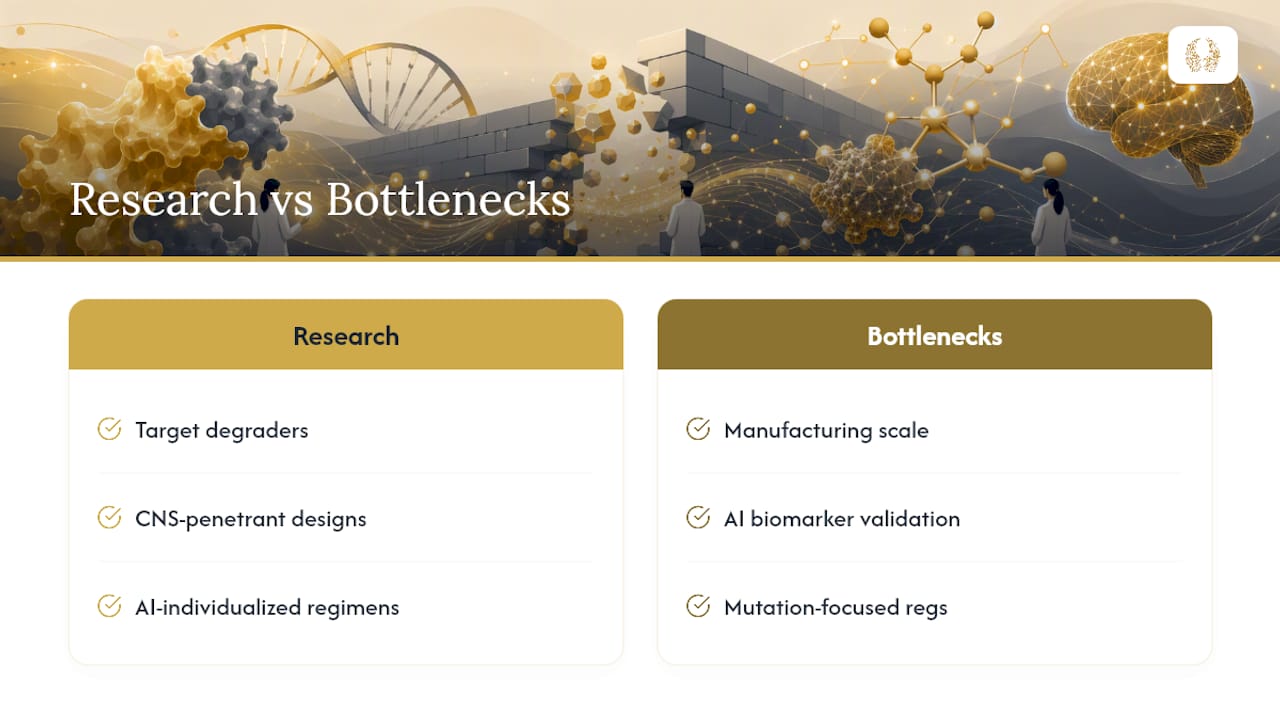
Expect the next three to five years to concentrate on degraders reaching targets inhibitors can’t touch, CNS-penetrant designs for brain metastases, and AI-enabled individualized regimens moving from single trials to broader access. The bottleneck won’t be discovery. It will be manufacturing scale for personalized therapies, independent validation of AI-driven biomarker algorithms, and regulatory pathways built for mutation-defined cohorts smaller than traditional trial populations. Funders and clinicians who focus there will shape the next approval cycle.
Support the Research Behind the Next Approval
Every advance described above, from RAS inhibitors to AI-designed neoantigen vaccines, started as an early-stage project that needed funding before it had data to prove itself. HCRF exists to close that gap for scientists at the Robert H. Lurie Comprehensive Cancer Center, funding the unconventional, high-risk work that traditional grants tend to overlook.

You can support that work directly. Cocktails for a Cure is a $150 per person event that channels ticket proceeds straight into funded research projects, and HCRF’s 13th Annual Wings To Cure Gala offers a larger annual gathering for donors and corporate sponsors who want to back the foundation’s translational pipeline. If you’re ready to help fund the research that produces the next sevabertinib or intismeran, reserve your seat at Cocktails for a Cure today or reach out through the HCRF donation page to learn about sponsorship options for the Wings To Cure Gala.
This article is general information, not a substitute for advice from a qualified doctor. Consult a qualified healthcare professional about your own circumstances before acting on anything here.
Sources
- FDA grants accelerated approval to sevabertinib for locally advanced or metastatic non-squamous non-small cell lung cancer
- Oral KRAS G12D inhibitor GFH375 for previously treated advanced solid tumors with KRASG12D mutations: a phase 1 trial | Nature Medicine
- Machine-learning-designed individualized neoantigen therapy improves recurrence-free survival in resected melanoma — ASCO AI article
- FDA approves daraxonrasib for metastatic pancreatic adenocarcinoma | FDA
FAQ
What Is the Success Rate of Targeted Therapy?
Success rates vary enormously by drug and mutation. Sevabertinib produced a 75% objective response rate in TKI-naive HER2-mutant NSCLC, while GFH375 showed a 35.1% response rate in pancreatic cancer in early-phase testing. There is no single success rate for “targeted therapy” as a category since outcomes depend entirely on the specific mutation and drug match.
What Stage of Cancer Is Targeted Therapy Used For?
Targeted agents are used across disease stages, from adjuvant settings after surgery to first-line and later-line metastatic disease, depending on the drug and mutation. Daraxonrasib is approved for metastatic pancreatic adenocarcinoma after prior systemic therapy, while intismeran is being tested in the adjuvant setting for resected melanoma.
What Are the Newest Therapies for Cancer Treatment?
The most recent additions include sevabertinib for HER2-mutant lung cancer, daraxonrasib for RAS-mutant pancreatic cancer, intismeran autogene for melanoma, and early-phase agents like GFH375 and tinengotinib targeting KRAS and multikinase pathways. Each targets a specific mutation rather than treating cancer broadly.
Does Targeted Therapy Improve Life Expectancy?
Yes, in mutation-matched patients, targeted therapy can extend survival substantially compared with standard chemotherapy. Daraxonrasib nearly doubled median overall survival in RASolute 302, from 6.7 months to 13.2 months, though benefit depends on having the specific biomarker the drug targets.
How Much Does HCRF’s Cocktails for a Cure Event Cost?
Details and registration for Cocktails for a Cure, an event supporting cancer research, are available on the organization’s event page. Details and registration are available on the event page.
Recommended

Practical steps to build peer-to-peer cancer campaigns, protect donors from deceptive charities, and use HCRF resources for clear stewardship and...
Read More →
Practical guidance for researchers on precision medicine trials: prioritize the screening funnel, FDA master protocol rules, sequencing speed, and...
Read More →