


Vitamins to Avoid During Chemotherapy: What Patients Need to Know
July 29, 2026
Vitamins to Avoid During Chemotherapy: What Patients Need to Know

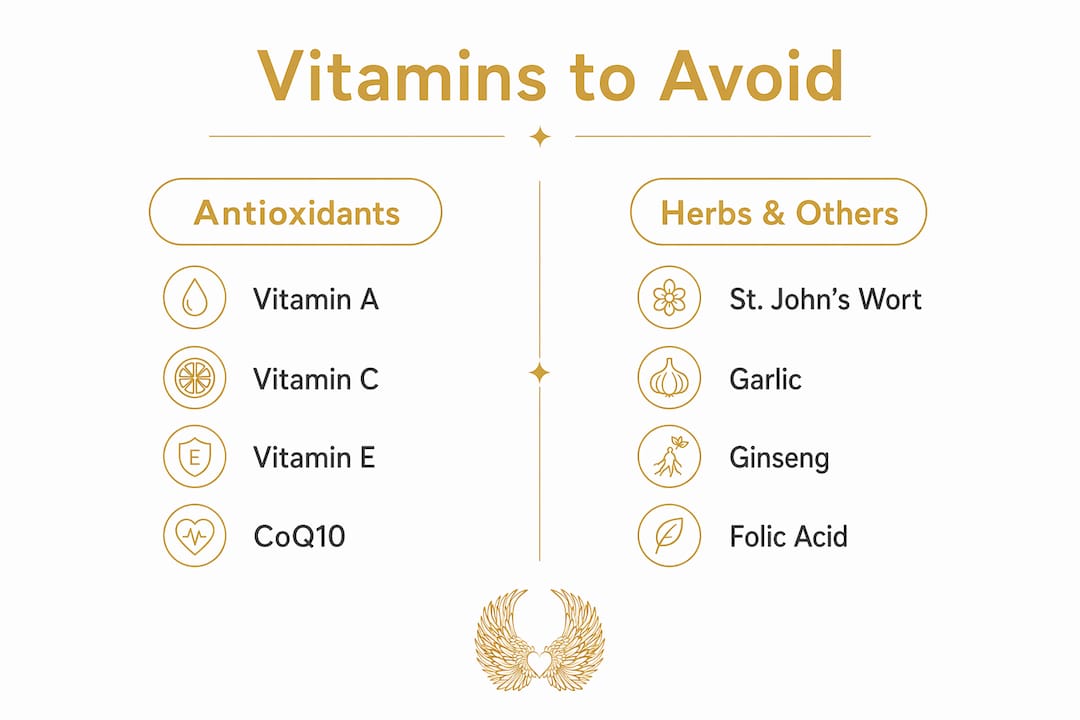
If you are currently receiving chemotherapy, stop taking high-dose antioxidant supplements right now and bring every bottle you own to your next oncology appointment. The vitamins and supplements most likely to interfere with treatment include high-dose antioxidant vitamins including vitamin A, C, vitamin E, carotenoids such as beta-carotene, and Coenzyme Q10 (CoQ10), St. John’s wort and other CYP-modulating herbs, vitamin K (if you are on anticoagulants), high-dose folic acid with certain chemotherapy regimens, and any IV vitamin infusions from nonmedical clinics. Garlic, ginkgo, and ginseng supplements also raise bleeding risk and should be discussed with your care team before you continue them.
Take these three steps today:
- Stop all high-dose antioxidant vitamins, herbal supplements, and IV vitamin therapies until your oncologist clears them.
- Bring every supplement bottle, including brand name, dose, and how often you take it, to your next visit.
- Ask for a formal supplement and medication interaction review from your oncologist or oncology pharmacist.
Pro Tip: Photograph the label of every supplement bottle with your phone before your appointment. One clear image captures the brand, dose, and frequency in seconds. Share the photos with your care team or email them ahead of time so the pharmacist can flag interactions before you even sit down.
Table of Contents
- How do supplements change chemotherapy’s effectiveness or safety?
- Which specific vitamins and supplements should you avoid?
- When should you stop supplements before and during treatment?
- What supplements and nutrition approaches are generally safer?
- What should you bring to your oncology appointment about supplements?
- What do the major cancer authorities say about this?
- Key Takeaways
- HCRF’s perspective on supplements and cancer treatment
- Authoritative sources and further reading
How do supplements change chemotherapy’s effectiveness or safety?
Supplements are bioactive chemicals. They do not sit passively in your body while chemotherapy does its work. They interact with it, sometimes in ways that genuinely matter for your survival.
The most studied mechanism involves oxidative stress. Many chemotherapy agents work precisely by generating reactive oxygen species (ROS) that damage and kill cancer cells. Antioxidant supplements can neutralize those ROS, which is exactly what they are designed to do. The problem is they cannot distinguish between a healthy cell and a tumor cell. When you take concentrated antioxidant supplements during treatment, you may be shielding the very cells your chemotherapy is trying to destroy.
A second mechanism is enzyme-based. Your liver uses a family of enzymes called CYP450 to process drugs, including chemotherapy agents and supportive medications. Certain herbs and supplements either speed up or slow down those enzymes, which changes how much of a drug actually reaches your bloodstream. St. John’s wort, for example, strongly induces CYP3A4 and P-glycoprotein, which can lower drug plasma levels significantly. Grapefruit and Seville oranges work in the opposite direction, inhibiting CYP3A4 and potentially pushing drug concentrations into toxic territory.
Bleeding risk is a third concern. Garlic, ginkgo, and ginseng all have antiplatelet or anticoagulant properties. If you are on warfarin or another blood thinner, or if you are approaching surgery or a central line placement, these supplements can complicate clotting in ways your care team needs to know about. Vitamin K interacts directly with warfarin by affecting clotting factor synthesis, so even small changes in your vitamin K intake can destabilize anticoagulation control.
A note on how common this is: Studies show that a substantial proportion of cancer patients use dietary supplements during treatment, yet many do not report this to their oncologists. Supplements are bioactive chemicals, and clinicians cannot catch interactions they do not know about. Always bring your full supplement list for review.
Which specific vitamins and supplements should you avoid?
The table below maps each major supplement category to its mechanism, the drug types most affected, the risk it creates, and what to do.
| Supplement | Mechanism | Drugs/Regimens Affected | Risk Type | Recommended Action |
|---|---|---|---|---|
| Vitamins A, C, E, carotenoids, CoQ10 | Antioxidant protection of tumor cells | Alkylating agents, anthracyclines, platinum compounds | May reduce efficacy; linked to higher recurrence risk | Stop during treatment; discuss restart timing with oncologist |
| St. John’s wort, goldenseal, black cohosh | CYP enzyme induction/inhibition | Oral targeted therapies, supportive meds | Lowers or raises drug blood levels | Stop at least 2 weeks before chemo; do not restart without clearance |
| Garlic, ginkgo, ginseng | Antiplatelet/anticoagulant effects | Anticoagulants, perioperative care | Increased bleeding risk | Stop before surgery or central line; discuss with oncologist |
| Vitamin K | Clotting factor modulation | Warfarin and other anticoagulants | Destabilizes anticoagulation control | Maintain consistent dietary intake; avoid high-dose supplements |
| High-dose folic acid | Alters folate pathway | Fluoropyrimidines, antifolate agents | May amplify systemic toxicity | Avoid high-dose supplementation; treat only confirmed deficiency |
| IV vitamin megadoses | Bypasses digestive absorption controls | All systemic therapies | Toxicity, electrolyte imbalance, infection risk | Avoid nonmedical IV clinics entirely during treatment |
| Echinacea | Immune modulation | Immunosuppressive regimens | May counteract intended immune effects | Discuss with oncologist before use |
Antioxidants: vitamins A, C, E, carotenoids, and CoQ10
Antioxidant supplements including vitamins A, C, E, carotenoids, and CoQ10 should be avoided during chemotherapy because they may protect cancer cells from the oxidative damage that treatment depends on. Observational studies in breast cancer patients found that using these supplements before and during chemotherapy was associated with a higher risk of death and reduced chance of staying cancer-free. Some randomized controlled trials of vitamin E in head and neck cancer patients have reported an association with a higher risk of tumor relapse and decreased cancer-free survival. These are not theoretical concerns.

Herbs that affect CYP enzymes: St. John’s wort, goldenseal, black cohosh
St. John’s wort is the most clinically significant herbal CYP inducer. It accelerates the breakdown of many oral targeted therapies and supportive medications, which means less drug reaches the tumor. Because CYP induction can persist for weeks after stopping, your oncology team may ask you to discontinue it well before your first cycle. Goldenseal and black cohosh also alter CYP activity, though with different profiles. For a broader look at herbal interactions during treatment, HCRF has additional patient-facing resources.
Garlic, ginkgo, and ginseng
These three are among the most widely used supplements in the U.S., and all three carry meaningful bleeding risk during cancer treatment. Garlic inhibits platelet aggregation. Ginkgo has well-documented antiplatelet effects. Ginseng has been flagged in case reports for interactions with certain targeted agents. If you are approaching surgery, a port placement, or a biopsy, these should be stopped in advance and only restarted with your oncologist’s approval.
Folic acid with fluoropyrimidine-based chemotherapy
Excess folic acid can amplify toxicity when taken alongside fluoropyrimidine-based regimens. The interaction is regimen-specific: the safe path is lab-confirmed deficiency treatment under oncology supervision, not routine high-dose supplementation. Never add a folic acid supplement to your routine during chemo without explicit guidance from your care team.
IV vitamin megadoses
IV vitamin therapy administered outside a medical setting can produce blood concentrations far exceeding what oral intake ever achieves, creating real risks of toxicity, electrolyte imbalance, kidney stress, and infection. MD Anderson experts are direct: avoid nonmedical IV vitamin clinics during chemotherapy. If your oncologist believes IV supplementation is clinically warranted, it will be administered and monitored in a medical setting.
Pro Tip: If you have a documented nutrient deficiency, your oncologist can prescribe a supervised, dose-controlled supplement. A deficiency is a medical condition that deserves treatment. The goal is clinician oversight, not blanket avoidance of every nutrient.
When should you stop supplements before and during treatment?
The timing matters as much as the decision to stop. Some supplements clear your system quickly; others, particularly herbal enzyme modulators, can affect drug metabolism for weeks after the last dose.
- Two or more weeks before starting chemotherapy: Stop St. John’s wort, goldenseal, and other CYP-modulating herbs. CYP induction persists well beyond the last dose, so an early stop date protects your first treatment cycle.
- At least one week before any surgery, port placement, or biopsy: Stop garlic, ginkgo, ginseng, and other supplements with antiplatelet or anticoagulant effects. Some supplements can cause surgical complications and increase bleeding risk in ways that are difficult to reverse quickly.
- Throughout all active chemotherapy cycles: Avoid high-dose antioxidant vitamins (A, C, E, carotenoids, CoQ10), IV vitamin infusions from nonmedical clinics, and high-dose folic acid unless your oncologist has specifically prescribed it.
- After treatment ends: Do not restart antioxidant supplements immediately. Ask your oncologist for a specific clearance date. For some regimens, a waiting period of several weeks is appropriate before reintroducing even standard-dose supplements.
- Before any new cycle or regimen change: Reassess your entire supplement list. A supplement that was acceptable during one phase of treatment may not be safe during another.
Pro Tip: Write the stop date for each supplement on a sticky note and attach it to the bottle. Photograph it. When your oncologist or pharmacist asks when you stopped, you will have a precise answer, not an estimate. That precision matters for drug-level calculations.
What supplements and nutrition approaches are generally safer?
Hope lives here too. Stopping risky supplements does not mean abandoning nutritional support. There are evidence-informed options your care team can work with.
A standard multivitamin at 100% of the daily value is generally considered acceptable by most oncology experts, provided your team has reviewed it. The key phrase is “100% DV,” not megadose. If a multivitamin contains 5,000 IU of vitamin A or 1,000 mg of vitamin C, it is not a standard multivitamin.
Commonly accepted options under oncology supervision:
- Standard multivitamin at 100% DV, reviewed and cleared by your oncologist or pharmacist
- Prescribed iron or B12 when a deficiency is confirmed by lab testing
- Clinician-supervised vitamin D and calcium when indicated, at doses your team specifies
- Food-based antioxidants from whole fruits, vegetables, and legumes, which deliver nutrients in concentrations far lower than supplements and alongside fiber and phytonutrients that modify absorption
Food-based nutrition is genuinely different from supplemental nutrition. Eating a bowl of blueberries does not produce the concentrated antioxidant load that a 1,000 mg vitamin C capsule does. A whole-foods, plant-forward diet remains the most consistently recommended nutritional approach during treatment, and it carries none of the pharmacokinetic risks of high-dose supplements.
Pro Tip: Ask your oncology team for a referral to a registered dietitian who specializes in oncology nutrition. Many cancer centers, including those affiliated with the Robert H. Lurie Comprehensive Cancer Center, have oncology dietitians on staff. An oncology pharmacist can also run a formal supplement interaction screen before you restart anything after treatment.
What should you bring to your oncology appointment about supplements?
Your oncology team cannot protect you from interactions they do not know about. Walk into every appointment prepared.
Bring these items:
- Every supplement bottle, or clear photos of the front and back labels
- The exact dose and how many times per day you take each supplement
- The timing relative to your chemotherapy cycles (do you take it on infusion days?)
- A list of any IV infusions you have received outside your cancer center
- All prescription and over-the-counter medications, since some interact with supplements
Ask your team these questions directly:
- “Will any of these supplements affect my chemotherapy or my supportive medications?”
- “Should I stop any of these right now, and if so, when?”
- “Do I need lab testing to check for any nutrient deficiencies?”
- “Can I speak with the oncology pharmacist or a registered dietitian about my supplement list?”
After the conversation, ask for the recommendations in writing or request that they be added to your patient portal notes. Verify with the pharmacy before restarting anything after treatment ends. This is your health, and you deserve a documented answer, not a verbal one you might misremember under stress.
What do the major cancer authorities say about this?
The National Cancer Institute, American Cancer Society, and MD Anderson Cancer Center are aligned on the core message: antioxidant supplements and herb-drug interactions are real clinical concerns during chemotherapy, and patients should not assume supplements are safe simply because they are “natural.”
- NCI PDQ: Chemotherapy’s intended mechanism often relies on inducing oxidative stress. Antioxidant supplements can undermine that mechanism if taken in concentrated supplemental form. NCI also flags grapefruit juice as a CYP3A4 inhibitor that can raise plasma levels of certain oral chemotherapy drugs to toxic concentrations.
- American Cancer Society: Antioxidants may make some chemotherapy less effective by protecting cancer cells from oxidative damage. ACS also notes that supplements are not regulated like medicines by the FDA, meaning product variability and contamination are genuine risks, not theoretical ones.
- MD Anderson: IV vitamin therapy administered outside a medical setting can produce blood concentrations over 100 times higher than oral intake, with attendant risks of toxicity, electrolyte imbalance, and infection.
- Peer-reviewed literature: A study examining antioxidant supplement use (vitamins A, C, E, carotenoids, and CoQ10) in breast cancer patients during treatment with cyclophosphamide, doxorubicin, and paclitaxel found trends toward increased hazards of recurrence and death. A separate study of postmenopausal breast cancer survivors found increased total mortality and worsened recurrence-free survival associated with antioxidant supplement use during chemotherapy or radiation.
On evidence strength: Much of this data comes from observational studies, and randomized controlled trial data remain limited. That does not mean the risk is hypothetical. It means the signal is strong enough that major authorities recommend caution, and the potential downside of continuing supplements outweighs the benefit of waiting for perfect evidence.
Key Takeaways
Stopping high-dose antioxidant supplements and bringing a complete supplement list to your oncology team are the two most protective actions you can take right now.
| Point | Details |
|---|---|
| Stop antioxidants immediately | Vitamins A, C, E, carotenoids, and CoQ10 may protect tumor cells from chemotherapy’s oxidative mechanism. |
| Herbs need early stoppage | CYP-modulating herbs like St. John’s wort should be stopped at least two weeks before chemotherapy begins. |
| Bring every bottle to your appointment | Your oncologist and pharmacist cannot catch interactions they do not know about; include dose, brand, and frequency. |
| Food-first nutrition is the safest path | Whole-foods nutrition delivers nutrients without the pharmacokinetic risks of high-dose supplements. |
| Documented deficiencies can be treated | Lab-confirmed deficiencies in iron, B12, or vitamin D can be managed safely under oncology supervision. |
HCRF’s perspective on supplements and cancer treatment
We believe every patient deserves clear, honest information, not false reassurance. And here is what we have come to understand deeply through our work supporting research at the Robert H. Lurie Comprehensive Cancer Center of Northwestern University: the supplement question is one of the most underestimated sources of treatment risk in oncology today.
Patients arrive at infusion centers carrying genuine hope in those supplement bottles. They want to fight back, to do something. We honor that instinct completely. But the evidence is telling us something important: during active chemotherapy, the most protective thing you can do is not add more. It is to work with your care team, bring your full supplement list, and let the treatment do what it was designed to do.
What concerns us most is the gap between how patients think about supplements and how oncologists think about them. Patients see vitamins. Oncologists see bioactive chemicals with real pharmacokinetic profiles. Closing that gap, one conversation at a time, is part of why HCRF publishes patient guides like this one.
We also want to name something that rarely gets said: the fear of nutrient deficiency during treatment is legitimate. Chemotherapy is hard on the body. The answer is not to ignore that fear, but to address it through lab testing, clinician oversight, and food-first strategies rather than self-directed high-dose supplementation. Your oncology team can treat a real deficiency safely. What they cannot undo is a supplement interaction that compromised your treatment.
The Hippocratic Cancer Research Foundation is a 501©(3) nonprofit dedicated to funding “out of the box” cancer research. We stand with every patient navigating these decisions. You are not alone in this, and we are here carrying hope alongside you.
Pro Tip: Ask your care coordinator or nurse navigator to connect you with the oncology pharmacist and a registered dietitian before your next cycle. Most comprehensive cancer centers offer both. If yours does not, ask your oncologist to make a referral. You have every right to that level of support.
Authoritative sources and further reading
The recommendations in this article draw from the highest-authority sources in U.S. oncology. Here is where to go next.
“There is insufficient information for many specific antioxidant supplements to determine if they are safe and effective as a complementary therapy to standard cancer treatment.” — NCI PDQ, Cancer Therapy Interactions With Foods and Dietary Supplements
Primary sources:
- NCI PDQ: Cancer Therapy Interactions With Foods and Dietary Supplements — The National Cancer Institute’s comprehensive review of supplement-drug interactions, including antioxidants, grapefruit, and herbal preparations. The most authoritative U.S. government source on this topic.
- American Cancer Society: Are Dietary Supplements Safe? — ACS guidance on antioxidants, herb-drug interactions, FDA regulation gaps, and practical patient recommendations.
- MD Anderson: IV Vitamin Therapy During Chemo — Expert commentary on the specific risks of high-dose IV vitamin infusions outside medical settings.
- MDPI Pharmaceuticals: Folic Acid and Chemotherapy Interactions — Peer-reviewed analysis of folic acid interactions with fluoropyrimidine-based regimens.
- NCBI Bookshelf: Dietary Supplement Use During Chemotherapy — Includes observational data linking antioxidant supplement use during treatment with adverse survival outcomes.
- HCRF Patient Resources — Patient guides, research updates, and information on clinical trials at the Robert H. Lurie Comprehensive Cancer Center.
A note on evidence gaps: Most of the data linking supplements to worse outcomes comes from observational studies. Randomized controlled trial data are limited. This does not mean the risk is absent. It means that for regimen-specific questions, your oncology team’s guidance takes precedence over any general article, including this one. Always confirm supplement decisions with your care team before acting.
This article provides general health information and is not a substitute for professional medical advice. Please consult your oncologist or a qualified healthcare provider for guidance specific to your treatment regimen.
Recommended
- Hippocratic Cancer Research Foundation: Innovative Therapies | Teas to Avoid During Chemo: A 2026 Patient Guide
- Hippocratic Cancer Research Foundation: Innovative Therapies | Supplements to Avoid During Immunotherapy: A Patient Guide
- Hippocratic Cancer Research Foundation: Innovative Therapies | Signs of Appendix Cancer: What You Need to Know
- Hippocratic Cancer Research Foundation: Innovative Therapies | What Causes Cancer: Key Factors and Prevention

Wondering if the size of a tumor determines the stage? Understand how tumor size, lymph nodes, and metastasis impact cancer staging today.
Read More →
The 2025 HCRF Board Meeting showcased significant achievements, progress, and heartfelt reflections, emphasizing the collective impact of teamwork, leadership, and philanthropy in advancing cancer research. Click to read more!
Read More →